



Build Your Custom Market Intelligence Report
Customize Your ReportAsia Rubber-Tired Gantry Crane Market Statistics & Future Outlook (2026–2034)
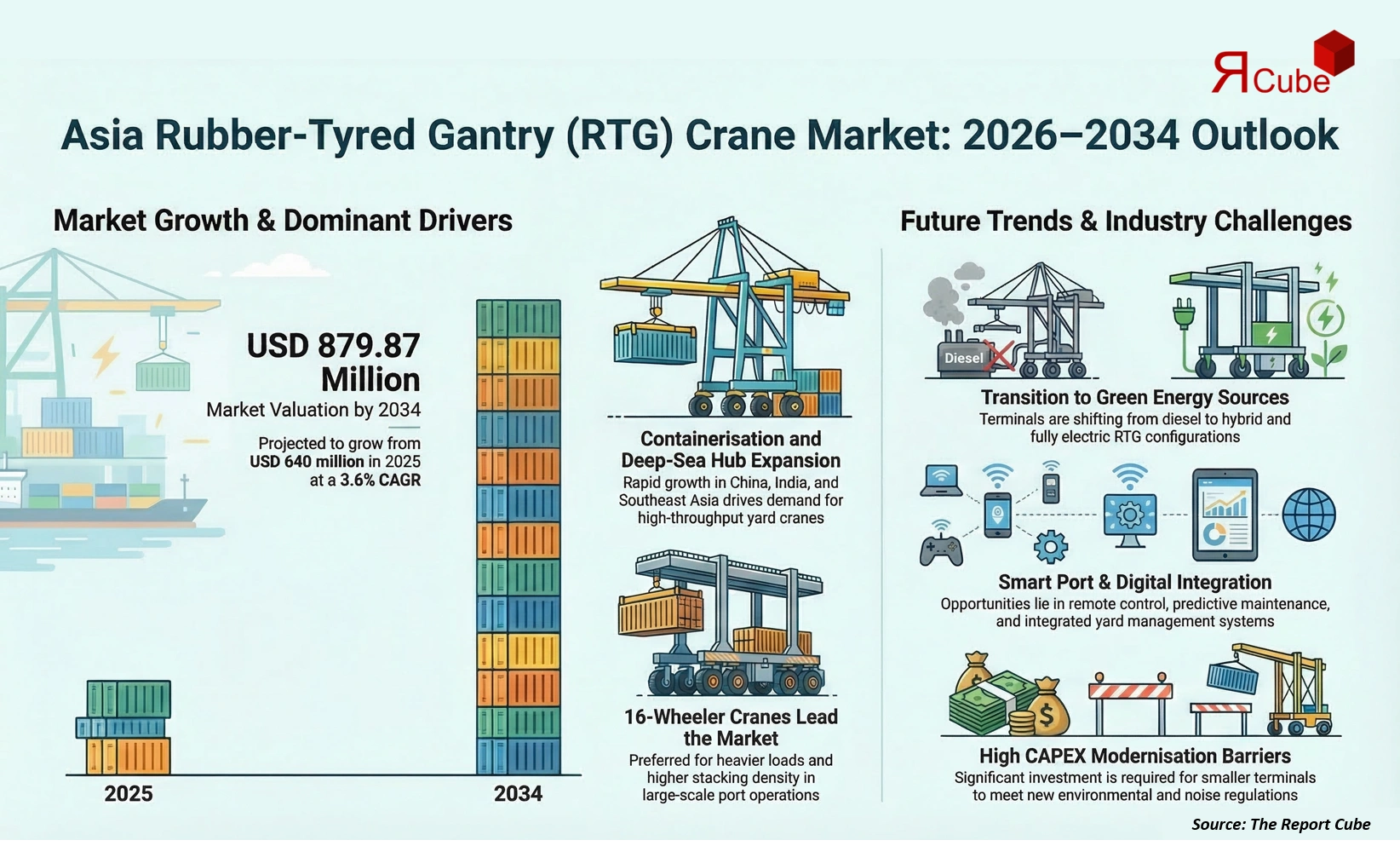
- The Asia Rubber-Tired Gantry Crane Market is expected to grow at a CAGR of around 3.6% during 2026 - 2034.
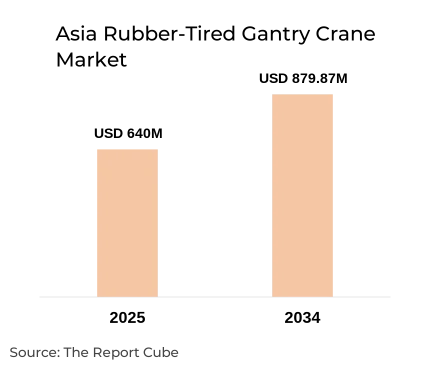
- In 2025, the market was valued at nearly USD 640 million.
- By 2034, it is projected to reach around USD 879.87 million.
- Sustained containerization growth and expansion of deep-sea hubs in China, India, and Southeast Asia drive demand for high-throughput yard cranes, particularly rubber-tired gantry (RTG) cranes, to handle larger ships and higher stacking density.
- Capex-intensive modernization under environmental and noise regulations challenges smaller and public terminals, as upgrading to hybrid or fully electric RTGs requires substantial investment and careful operational planning.
- Smart port initiatives and regional manufacturing hubs from 2026–2034 create opportunities for digitally enabled RTG fleets, integrating yard management systems, remote control, and predictive maintenance, leveraging local manufacturing expertise for domestic and export markets.
- Electrification and hybridization of yard equipment is a major industry trend, with terminals favoring energy-efficient, low-maintenance RTG configurations to meet emissions targets and manage total lifecycle costs.
Insightful Analysis
The Asia Rubber-Tired Gantry Crane Market report insights & analysis offer in-depth understanding of market trends, growth drivers, challenges, and opportunities. This comprehensive analysis includes market size, segmentation, competitive landscape, and customer behavior to guide strategic decisions. Further, it aids in providing thorough market research, industry breakdown, market forecast, competitive examination, market trends, growth factors, SWOT analysis, and market opportunities. These insights support business planning, investment decisions, and market positioning for sustainable success.
Why Choose This Report?
- Provides a comprehensive overview of the overall market analysis, encompassing key trends, consumer behavior analysis, and risk assessment to support strategic decision-making.
- Provides accurate, up-to-date insights into market size, segmentation, and emerging opportunities, helping to minimize risk & capitalizing on growth.
- Gives deep understanding of target audience preferences, investment habits, and communication channels for enhanced product development & marketing effectiveness.
- Delivers competitive analysis & benchmarking, uncovering the strengths & weaknesses of market competitors to guide strategies.
- Consolidate comprehensive market intelligence, reducing reasoning & streamlining research efforts.
- Facilitates customized market segmentation & risk mitigation strategies, fine-tuned to the business objectives.
- Aids in identifying both market challenges & untapped opportunities within the industry to drive long-term business growth.
- Provides valuable information based on actual customer data & search trends.
Asia Rubber-Tired Gantry Crane Market Dynamics (2026–2034)
Market Driver:
Containerization Surge and Deep-Sea Hub Expansion - The key positive influencer in Asia is the sustained rise in containerized trade and the expansion of deep-sea hubs in China, India, and Southeast Asia, which depend heavily on yard cranes to handle higher vessel throughputs. Rubber-tired gantry (RTG) cranes enable flexible, high-density stacking and faster turnaround, making them central to terminal productivity gains as ship sizes and call sizes grow.
Major Challenge:
Capex-Heavy Modernization Under Environmental Pressure - Ports must modernize with hybrid or fully electric RTGs to meet emission norms and noise restrictions, but capital intensity and long payback periods constrain smaller and public terminals. Balancing initial investment, grid-readiness, and operational continuity during crane upgrades poses a significant planning and financing challenge across developing Asian ports.
Opportunity Ahead:
Smart Port Initiatives and Regional Manufacturing Hubs - From 2026–34, Asia’s push for smart ports—integrating yard management systems, remote crane control, and predictive maintenance—creates an opportunity for RTG suppliers offering digitally enabled fleets. With many crane manufacturers and component suppliers already located in Asia, the region can serve both domestic port projects and export markets, leveraging scale and localized engineering.
Industry Trend:
Electrification and Hybridization of Yard Equipment - A defining trend is the move from diesel-only RTGs to hybrid and fully electric units that cut fuel consumption and emissions while improving reliability. As environmental regulations tighten and energy prices fluctuate, terminals increasingly evaluate total lifecycle cost, favoring energy-efficient, low‑maintenance RTG configurations.
How is the Asia Rubber-Tired Gantry Crane Market Defined as per Segments?
The Asia Rubber-Tired Gantry Crane Market segmentation categorizes the market into distinct segments based on behavioral, psychographic, geographic, and demographic factors. Firmographic & technographic segmentation for B2B or B2C markets is also included. Further, by concentrating on client, lifestyle, location, behavior, and company attributes, these segments assist businesses in targeting particular customer or user needs, enhancing product/services positioning, and improving marketing methods. Effective market reach and resource allocation are achieved through this segmentation. some of the segment are:
By Type:
In Asia, 16‑wheeler RTG cranes form the leading type segment because they handle heavier loads, allow higher stacking, and spread weight over more wheels, which protects terminal pavements and supports dense container yards. These cranes are widely preferred in large ports and manufacturing hubs where stability, safety, and lower lifetime maintenance costs are critical. In simple terms, 16‑wheeler RTGs are chosen when ports need to move many heavy containers quickly and safely in big yards, while 8‑wheelers are more suited for smaller, tighter spaces.
By Power Source:
Diesel-powered RTG cranes currently lead the power source segment in Asia because they offer high power, proven reliability, and can operate without depending on strong grid connections, which suits many busy ports. However, electric and hybrid RTGs are rapidly gaining share as ports try to cut fuel costs and emissions, supported by stricter regional environmental rules and port “green” initiatives. Put simply, diesel RTGs remain the workhorse for heavy everyday operations, while hybrid and electric models are the growing choice for cleaner, more energy‑efficient terminals.
Company Profile: Largest Asia Rubber-Tired Gantry Crane Companies (2034)
By 2034, the Asia Rubber-Tired Gantry Crane Market would be led by Liebherr Group, Konecranes, Mi-Jack Products, Inc., SANY Group, etc., who are forecasted to generate the highest market revenues & share owing to numerous activities like partnerships, collaborations & mergers, and innovation & launch of new products/services.
Major Queries Answered in the Report
- What is the current state of the Asia Rubber-Tired Gantry Crane Market?
- What key developments are influencing the Asia Rubber-Tired Gantry Crane industry?
- Which factors are shaping growth in the Asia Rubber-Tired Gantry Crane Market?
- What are the challenges faced by businesses in this sector?
- How are emerging technologies transforming the Asia Rubber-Tired Gantry Crane industry?
- Who are the primary competitive players in the Asia Rubber-Tired Gantry Crane domain?
- What new opportunities exist for stakeholders and investors?
- How are consumer and enterprise behaviors evolving within the market?
- Which regional and global factors impact Asia Rubber-Tired Gantry Crane adoption?
- Where can stakeholders access detailed, sector-specific insights on the Asia Rubber-Tired Gantry Crane Market?
- What innovations are defining the industry’s next phase of growth?
Table of Contents
- Introduction
- Objective of the Study
- Product and Market Definition
- Scope of the Report
- Market Segmentation
- Study Variables and Assumptions
- Limitations of the Study
- Research Methodology
- Research Approach and Design
- Data Triangulation and Validation
- Secondary Data Points
- Breakdown of Secondary Sources
- Data Extraction and Screening Criteria
- Primary Data Points
- Breakdown of Primary Interviews
- Respondent Profile (By Company Type, Role, Geography)
- Forecasting Methodology (2026–2034)
- Executive Summary
- Key Findings
- Snapshot: Market Size & Growth Outlook (2020–2034)
- Snapshot: Key Segments and Regions
- Strategic Imperatives for Stakeholders
- Market Dynamics
- Market Drivers
- Market Restraints
- Market Challenges
- Opportunity Assessment
- Recent Trends and Developments
- Policy and Regulatory Landscape
- Asia Rubber Tired Gantry Crane Market Overview (2020–2034)
- Market Size, By Value (USD Billion) and Volume (Units), 2020–2034
- Market Share, By Type
- 8-Wheeler RTG Cranes
- 16-Wheeler RTG Cranes
- Market Share, By Power Source
- Diesel
- Electric
- Hybrid
- Market Share, By Application
- Ports and Container Handling
- Industrial Manufacturing
- Others
- Market Share, By Region
- China
- India
- Japan
- South Korea
- South East Asia
- Others
- Market Share, By Company
- Revenue and Volume Shares (Leading RTG Crane Manufacturers)
- Market Positioning and Tier Analysis
- Competition Characteristics
- Key Differentiators and Value Propositions
- Segment-wise & Region-wise Market Forecast (2026–2034)
- By Type
- By Power Source
- By Application
- By Region
- Top Growth Segments and Attractive Opportunities
- Competitive Outlook & Company Profiles
- Liebherr Group
- Company Overview
- Business Segments
- Strategic Alliances/Partnerships
- Recent Developments
- Konecranes
- Company Overview
- Business Segments
- Strategic Alliances/Partnerships
- Recent Developments
- Mi-Jack Products, Inc.
- Company Overview
- Business Segments
- Strategic Alliances/Partnerships
- Recent Developments
- SANY Group
- Company Overview
- Business Segments
- Strategic Alliances/Partnerships
- Recent Developments
- Others
- Liebherr Group
- Contact Us / Disclaimer
Top Key Players & Market Share Outlook
- Liebherr Group
- Konecranes
- Mi-Jack Products, Inc.
- SANY Group
- Others
Frequently Asked Questions






