




Build Your Custom Market Intelligence Report
Customize Your ReportPhilippines Satellite Bus Market Key Takeaways
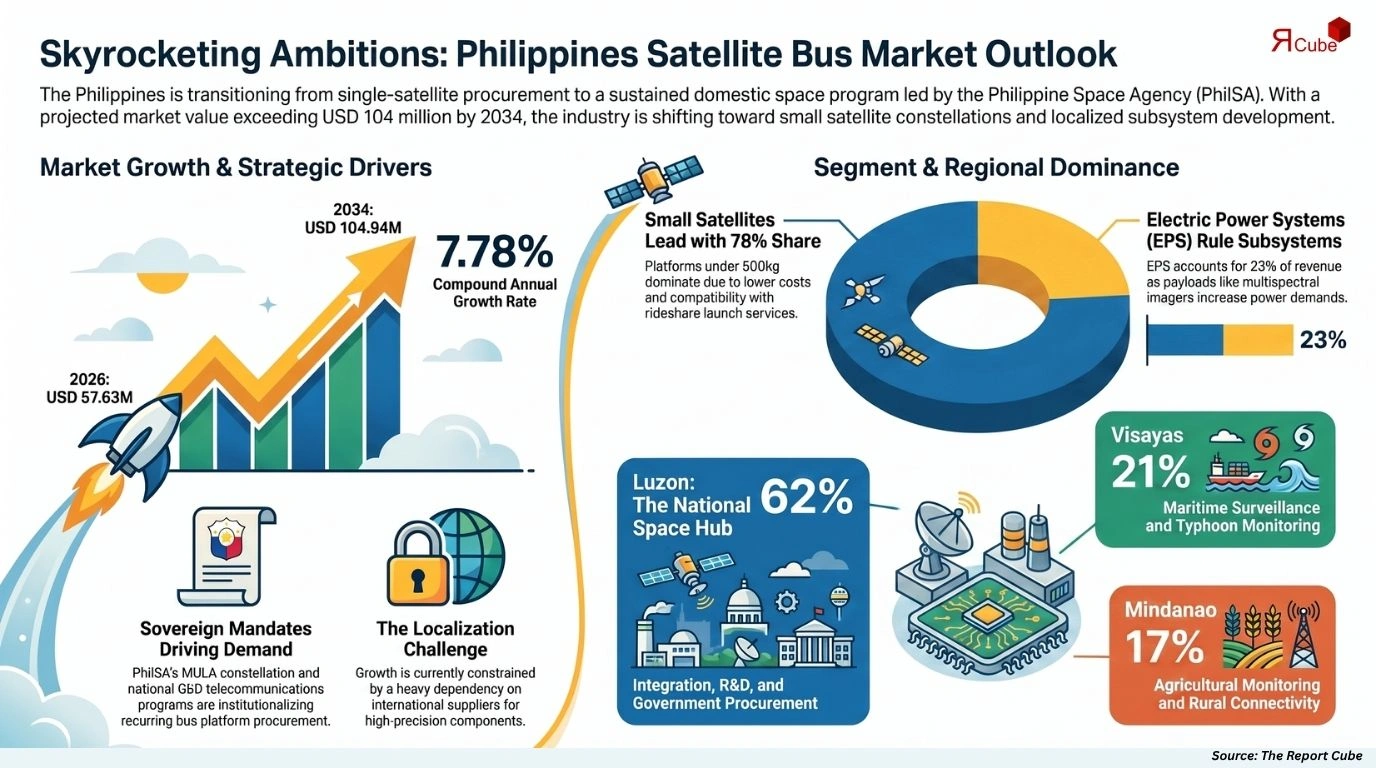
- Market valued at USD 57.63 million in 2026, reflecting growing national space investment.
- Industry projected to reach USD 104.94 million by 2034, expanding at a 7.78% CAGR.
- Electric Power System dominates the By Subsystem segment owing to rising satellite power demands.
- Small satellites (up to 500 kgs) lead the By Size segment, capturing the majority share.
- Luzon maintains regional leadership as the primary hub of government space infrastructure.
- Earth observation, maritime surveillance, and digital connectivity are the three core demand drivers.
- Key players include Airbus SE, NanoAvionics, OHB SE, Northrop Grumman, and Thales.
- PhilSA-led programs, sovereign satellite mandates, and commercial LEO growth drive long-term expansion.
Philippines Satellite Bus Market Insights & Analysis
The Philippines Satellite Bus Market is anticipated to register a 7.78% CAGR during 2026–2034. The market size was valued at USD 57.63 million in 2026 and is projected to reach USD 104.94 million by 2034. Growth is underpinned by the Philippine Space Agency's accelerating mission pipeline, sovereign satellite programs, and the government's multi-billion peso commitment to domestic space infrastructure. The MULA constellation's designation as a national priority undertaking signals a structural shift from single-satellite procurement toward sustained bus platform investment, supporting subsystem localization and international partnership activity.
The STAMINA4Space program, jointly funded by the Department of Budget and Management and the Department of Science and Technology, has institutionalized Filipino capability in satellite bus subsystem development and integration, training engineers across power, attitude control, and data handling disciplines. PhilSA's public-private partnership roadmap, including a PHP 17.5 billion commercial spaceport initiative and sovereign geostationary telecommunications satellite program, extends the market's addressable scope well beyond microsatellite buses. International collaborations with Japan, the United Kingdom, and the United States continue strengthening local engineering capacity while expanding procurement of advanced bus subsystems.
Philippines Satellite Bus Market Dynamics
The Philippines Satellite Bus Market is gaining momentum as government programs, natural disaster resilience needs, and commercial broadband demand simultaneously create multi-sector demand for satellite platforms. PhilSA's growing project pipeline, including Earth observation constellations, sovereign GEO telecommunications satellites, and spaceport development, is converting one-off satellite investments into recurring bus platform procurement. International partnerships and rising private sector participation further broaden the market's growth architecture beyond government-driven demand.
|
Factor |
Type |
Specific Impact on Market |
Magnitude |
|---|---|---|---|
|
PhilSA sovereign satellite mandates |
Driver |
Accelerates domestic bus procurement and subsystem integration |
Very High |
|
Earth observation constellation demand |
Opportunity |
Expands recurring orders for standardized small satellite bus platforms |
High |
|
Maritime surveillance requirements |
Driver |
Increases demand for attitude control and SAR-capable bus configurations |
High |
|
STAMINA4Space localization initiative |
Trend |
Builds local subsystem manufacturing for long-term supply chain independence |
High |
|
Commercial LEO connectivity deployments |
Opportunity |
Drives demand for small, mass-producible bus platforms from Philippine operators |
Very High |
Key Market Driver: Sovereign Space Policy and Government Funding
The Philippine government's allocation of over PHP 2.578 billion for the MULA satellite, combined with the Philippine Space Council's approval of a national MULA constellation program and a sovereign geostationary telecommunications satellite initiative, has made space infrastructure a formal development priority. These sovereign mandates directly stimulate demand for small satellite platforms and bus subsystems, requiring consistent procurement of structures, power systems, attitude control, and command and data handling components across successive mission generations. PhilSA's PHP 544.3 million unfunded but shovel-ready pipeline reinforces the depth of upcoming investment.
Major Industry Challenge: Limited Domestic Manufacturing Depth
Despite growing engineering capability through programs like STAMINA4Space and the MULA mission, the Philippines still depends heavily on international suppliers for high-precision satellite bus components including propulsion systems, advanced attitude determination sensors, and radiation-hardened electronics. This dependency introduces procurement lead times, foreign exchange exposure, and supply chain risks that can affect mission schedules. Developing a Philippine aerospace component manufacturing base with sufficient technical maturity to support recurring constellation missions remains the critical industrial constraint for sustained market growth.
Emerging Trend Shaping Outlook: Miniaturized Bus Platforms for LEO Constellations
Philippine mission planners are shifting from bespoke, one-off satellite designs toward standardized, miniaturized bus architectures capable of supporting multi-satellite LEO constellations. The MULA constellation approval and Maya-series CubeSat succession demonstrate a deliberate move toward scalable platform families. Modular bus designs that integrate commercial off-the-shelf subsystems with mission-specific payloads reduce per-unit costs, shorten integration timelines, and enable faster deployment of observation and communications coverage. This trend aligns the Philippines with global commercial satellite architecture practices and strengthens the case for domestic subsystem co-development with partners such as Surrey Satellite Technology and NanoAvionics.
Need Specific Data, Let’s Customize the Report for You
Request CustomizationPhilippines Satellite Bus Market Segment-wise Analysis
The Philippines satellite bus market is segmented by subsystem type, satellite size, and regional geography, reflecting the country's diverse mission requirements across Earth observation, maritime surveillance, telecommunications, and disaster management applications.
By Subsystem
- Structures
- Thermal Control
- Electric Power System
- Telemetry, Tracking and Command
- Command and Data Handling
- Attitude Determination and Control Subsystem
- Propulsion
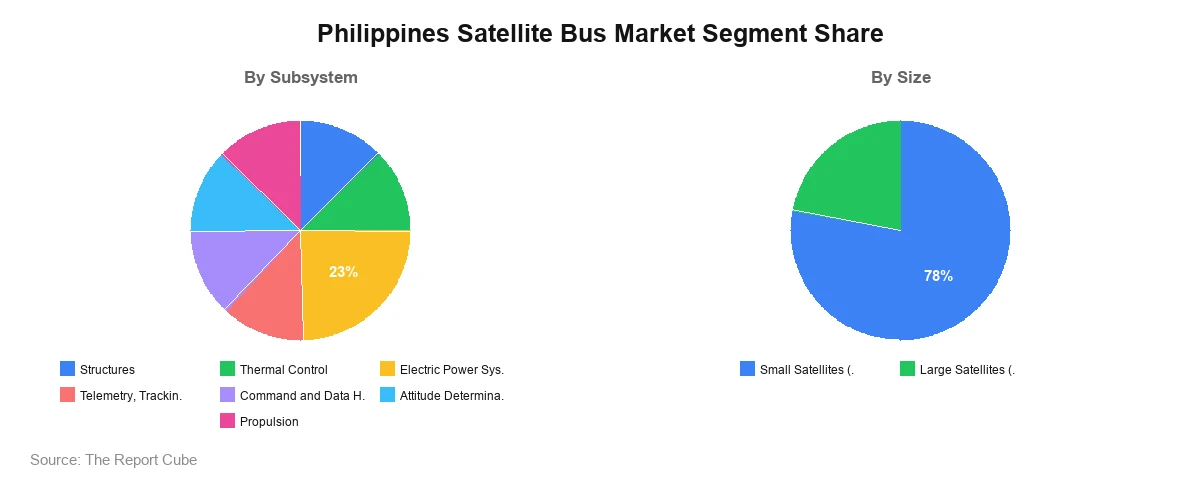
The Electric Power System (EPS) subsystem accounts for the largest share of the Philippines satellite bus market by subsystem, representing an estimated 23% of total market revenue. As satellite payloads grow in complexity and power demand - particularly multispectral imagers and SAR instruments - robust solar array configurations and battery storage architectures become central to mission viability. The MULA satellite's SSTL X-50 bus design demonstrates this priority: its EPS is engineered to sustain between 35 and 85 watts of payload power continuously across a 5–7 year mission life, reflecting the growing performance requirements for Earth observation satellite power management. Philippine engineers trained under the STAMINA4Space program have developed hands-on EPS integration competency, positioning domestic institutions to increasingly co-develop these systems.
The Attitude Determination and Control Subsystem (ADCS) is the fastest-growing segment, driven by precision pointing requirements for high-resolution imaging and the Maya CubeSat program's dedicated ADCS testing missions. Structures and thermal control collectively represent approximately 19% of market revenue, supported by localization efforts in satellite frame fabrication. The Command and Data Handling and Telemetry, Tracking and Command subsystems each hold stable market positions as essential components of every Philippine mission bus, with demand scaling proportionally with the number of active satellites in orbit. Propulsion remains a specialized, lower-volume segment, primarily relevant to larger bus platforms and future geostationary missions.
By Size
- Small Satellites (up to 500 kgs)
- Large Satellites (above 500 kgs)
Small satellites (up to 500 kgs) dominate the Philippines satellite bus market by size, accounting for an estimated 78% of total market revenue. This dominance reflects the country's mission profile: the Diwata microsatellites, Maya CubeSats, and the 130-kilogram MULA satellite all fall within the small satellite category. The Philippine government's preference for small platforms is driven by their lower per-unit cost, shorter development timelines, compatibility with rideshare launch services, and proven fit with the country's Earth observation and maritime surveillance mission objectives. The proliferation of small LEO satellite buses for remote sensing and the MULA constellation approval confirm that small satellite platforms will anchor Philippine procurement through at least 2030.
Large satellites (above 500 kgs) represent approximately 22% of market revenue but are projected to grow at 8.1% CAGR - the fastest rate among size segments - as the Philippine Space Council's newly approved sovereign geostationary telecommunications satellite program moves from planning into procurement. A sovereign GEO platform would require a substantially larger bus with high-power EPS, advanced propulsion, and extended mission life design specifications, engaging global manufacturers such as Airbus SE, Northrop Grumman, Thales, and Israel Aerospace Industries. This program represents the single largest potential order event in the Philippine satellite bus market through 2034 and will significantly recalibrate the large satellite segment's revenue contribution.
Regional Projection of Philippines Satellite Bus Market
The Philippines satellite bus market shows pronounced regional variation tied to government infrastructure concentration, disaster vulnerability, maritime activity intensity, and the geographic distribution of ground station and space data application assets.
|
Region |
Estimated Market Share |
Key Growth Factors |
Consumer Trends |
|---|---|---|---|
|
Luzon |
62% |
PhilSA headquarters, DOST-ASTI ground station, MULA program, university engineering base |
Government procurement, satellite integration, and space data application platforms |
|
Visayas |
21% |
Maritime domain awareness demand, disaster monitoring for typhoon corridor |
Growing satellite data applications for fisheries and disaster preparedness |
|
Mindanao |
17% |
Agricultural monitoring, connectivity deficit resolution, resource surveillance |
Rising demand for satellite broadband and remote sensing data services |
- Luzon: Luzon dominates the Philippines satellite bus market with approximately 62% regional share, hosting PhilSA's headquarters in Quezon City, the DOST-Advanced Science and Technology Institute ground station, and the University of the Philippines Diliman's satellite engineering program. All major Philippine satellite integration activities, including the MULA project, the STAMINA4Space program, and the Maya CubeSat series, are coordinated from Luzon. Government satellite procurement decisions, subsystem development contracts, and international partnerships are effectively centralized in this region, making it the primary demand generator for satellite bus investment.
- Visayas: Visayas accounts for approximately 21% of market activity, driven primarily by maritime domain awareness and disaster resilience requirements in one of the Philippines' most typhoon-exposed corridors. The region's dependence on satellite data for fisheries management, storm tracking, and coastal ecosystem monitoring creates sustained demand for Earth observation satellite services, which in turn supports procurement of small satellite bus platforms with capable imaging and synthetic aperture radar payloads.
- Mindanao: Mindanao represents approximately 17% of the market, with demand anchored in agricultural monitoring, connectivity solutions for underserved communities, and resource surveillance applications. As PhilSA's ACQUIRES program and broader connectivity initiatives target rural digital inclusion, Mindanao becomes an increasingly important end-user of satellite data, indirectly supporting upstream demand for satellite bus procurement aligned with multi-mission constellations.
Philippines Satellite Bus Market: Recent Development (2025)
- PhilSA finalized MULA satellite space environment testing in the United Kingdom ahead of planned launch.
- PhilSA and National Power Corporation signed a July 2025 MOA for satellite-based energy infrastructure monitoring.
- PhilSA launched the 2025 Space Business Innovation Challenge inviting private sector propulsion and data solutions.
- Maya-7 satellite reached design completion milestone, incorporating advanced amateur radio communication subsystems.
Philippines Satellite Bus Market Future Outlook (2034)
The Philippines Satellite Bus Market is projected to expand at a 7.78% CAGR, reaching approximately USD 104.94 million by 2034. The MULA constellation program's national priority status, combined with the sovereign geostationary telecommunications satellite initiative, will generate the largest sustained procurement cycle in Philippine space history. Subsystem localization - particularly in structures, thermal control, and electric power - will mature progressively as engineers trained through STAMINA4Space and the MULA mission return to the Philippines and establish institutional manufacturing capability. The end-of-life satellite servicing and bus replacement market will also emerge as a secondary revenue stream as early-generation Filipino satellites approach their operational limits.
Technology advancement will shape the market's long-term trajectory. AI-assisted on-board data processing, autonomous attitude control algorithms, and miniaturized propulsion systems will become standard features in future Philippine satellite bus specifications. Commercial LEO constellation operators entering Southeast Asian connectivity markets will seek cost-optimized, standardized bus platforms compatible with rideshare launch profiles, presenting Philippine manufacturers and integrators with opportunities to serve regional demand beyond government clients. The SpaceX-supported spaceport initiative, if advanced under PhilSA's public-private partnership model, could further position the Philippines as a regional satellite integration and launch services hub by the end of the forecast period.
Philippines Satellite Bus Market Report Coverage
|
Report Attribute |
Details |
|---|---|
|
Market Name |
Philippines Satellite Bus Market |
|
Market Size (2026) |
USD 57.63 Million |
|
Market Size (2034) |
USD 104.94 Million |
|
Forecast Period |
2026–2034 |
|
CAGR |
7.78% |
|
Base Year |
2026 |
|
Historical Years |
2021–2025 |
|
Forecast Years |
2026–2034 |
|
Segments Covered |
By Subsystem (Structures, Thermal Control, Electric Power System, Telemetry Tracking and Command, Command and Data Handling, Attitude Determination and Control Subsystem, Propulsion), By Size (Small Satellites up to 500 kgs, Large Satellites above 500 kgs) |
|
Regions Covered |
Luzon, Visayas, Mindanao |
|
Key Companies |
Orbits Corporation, Airbus SE, OHB SE, Israel Aerospace Industries Ltd., Northrop Grumman Corporation, Thales, NanoAvionics, Ball Corporation, Lockheed Martin Corporation, Others |
|
Report Format |
PDF, Excel, PPT |
|
Customization |
Available as per client requirements |
Why Choose This Report?
- Comprehensive analysis covering all seven satellite bus subsystem categories.
- Accurate market sizing with Philippines-specific forecast data through 2034.
- Detailed segmentation revealing revenue-leading and fastest-growing bus size categories.
- Regional insights across Luzon, Visayas, and Mindanao with differentiated demand drivers.
- Competitive profiling of ten major global and regional satellite bus manufacturers.
- Analysis of PhilSA's MULA constellation and sovereign GEO satellite program impacts.
- Strategic insights into subsystem localization trends shaping domestic manufacturing capacity.
- Data-driven research grounded in Philippine Space Council decisions and official program milestones.
Table of Contents
- Introduction
- Objective of the Study
- Product Definition
- Market Segmentation
- Study Variables
- Research Methodology
- Secondary Data Points
- Companies Interviewed
- Primary Data Points
- Breakdown of Primary Interviews
- Secondary Data Points
- Executive Summary
- Market Dynamics
- Drivers
- Challenges
- Opportunity Assessment
- Recent Trends and Developments
- Policy and Regulatory Landscape
- Philippines Satellite Bus Market Overview and Forecast Analysis (2021-2034)
- Market Size, By Value, By Growth Rate (CAGR/USD Billions)
- Demand – Supply Trends
- Market Share, By Subsytem
- Structures
- Thermal Control
- Electric Power System
- Telemetry, Tracking and Command
- Command and Data Handling
- Attitude Determination and Control Subsystem
- Propulsion
- Market Share, By Size
- Small Satellites (upto 500 kgs)
- Large Satellites (above 500 kgs)
- Market Share, By Region
- Luzon
- Visayas
- Mindanao
- Market Share, By Competitors
- Competition Characteristics
- Revenue Shares
- Structures Philippines Satellite Bus Market Overview, 2021-2034F
- By Value (USD Million)
- By Size – Market Size & Forecast 2021-2034, USD Million
- Small Satellites (upto 500 kgs)
- Large Satellites (above 500 kgs)
- Thermal Control Philippines Satellite Bus Market Overview, 2021-2034F
- By Value (USD Million)
- By Size – Market Size & Forecast 2021-2034, USD Million
- Small Satellites (upto 500 kgs)
- Large Satellites (above 500 kgs)
- Electric Power System Philippines Satellite Bus Market Overview, 2021-2034F
- By Value (USD Million)
- By Size – Market Size & Forecast 2021-2034, USD Million
- Small Satellites (upto 500 kgs)
- Large Satellites (above 500 kgs)
- Telemetry, Tracking and Command Philippines Satellite Bus Market Overview, 2021-2034F
- By Value (USD Million)
- By Size – Market Size & Forecast 2021-2034, USD Million
- Small Satellites (upto 500 kgs)
- Large Satellites (above 500 kgs)
- Command and Data Handling Philippines Satellite Bus Market Overview, 2021-2034F
- By Value (USD Million)
- By Size – Market Size & Forecast 2021-2034, USD Million
- Small Satellites (upto 500 kgs)
- Large Satellites (above 500 kgs)
- Attitude Determination and Control Subsystem Philippines Satellite Bus Market Overview, 2021-2034F
- By Value (USD Million)
- By Size – Market Size & Forecast 2021-2034, USD Million
- Small Satellites (upto 500 kgs)
- Large Satellites (above 500 kgs)
- Propulsion Philippines Satellite Bus Market Overview, 2021-2034F
- By Value (USD Million)
- By Size – Market Size & Forecast 2021-2034, USD Million
- Small Satellites (upto 500 kgs)
- Large Satellites (above 500 kgs)
- Competitive Outlook (Company Profile - Partial List)
- Orbits Corporation
- Company Overview
- Business Segments
- Strategic Alliances/Partnerships
- Recent Developments
- Airbus SE
- Company Overview
- Business Segments
- Strategic Alliances/Partnerships
- Recent Developments
- OHB SE
- Company Overview
- Business Segments
- Strategic Alliances/Partnerships
- Recent Developments
- Israel Aerospace Industries Ltd.
- Company Overview
- Business Segments
- Strategic Alliances/Partnerships
- Recent Developments
- Northrop Grumman Corporation
- Company Overview
- Business Segments
- Strategic Alliances/Partnerships
- Recent Developments
- Thales
- Company Overview
- Business Segments
- Strategic Alliances/Partnerships
- Recent Developments
- NanoAvionics
- Company Overview
- Business Segments
- Strategic Alliances/Partnerships
- Recent Developments
- Ball Corporation
- Company Overview
- Business Segments
- Strategic Alliances/Partnerships
- Recent Developments
- Lockheed Martin Corporation
- Company Overview
- Business Segments
- Strategic Alliances/Partnerships
- Recent Developments
- Others
- Orbits Corporation
- Contact Us & Disclaimer
Top Key Players & Market Share Outlook
- Orbits Corporation
- Airbus SE
- OHB SE
- Israel Aerospace Industries Ltd.
- Northrop Grumman Corporation
- Thales
- NanoAvionics
- Ball Corporation
- Lockheed Martin Corporation
- Others
Frequently Asked Questions