




Build Your Custom Market Intelligence Report
Customize Your ReportSingapore SME Digital Lending Market Key Highlights
By Loan Product:
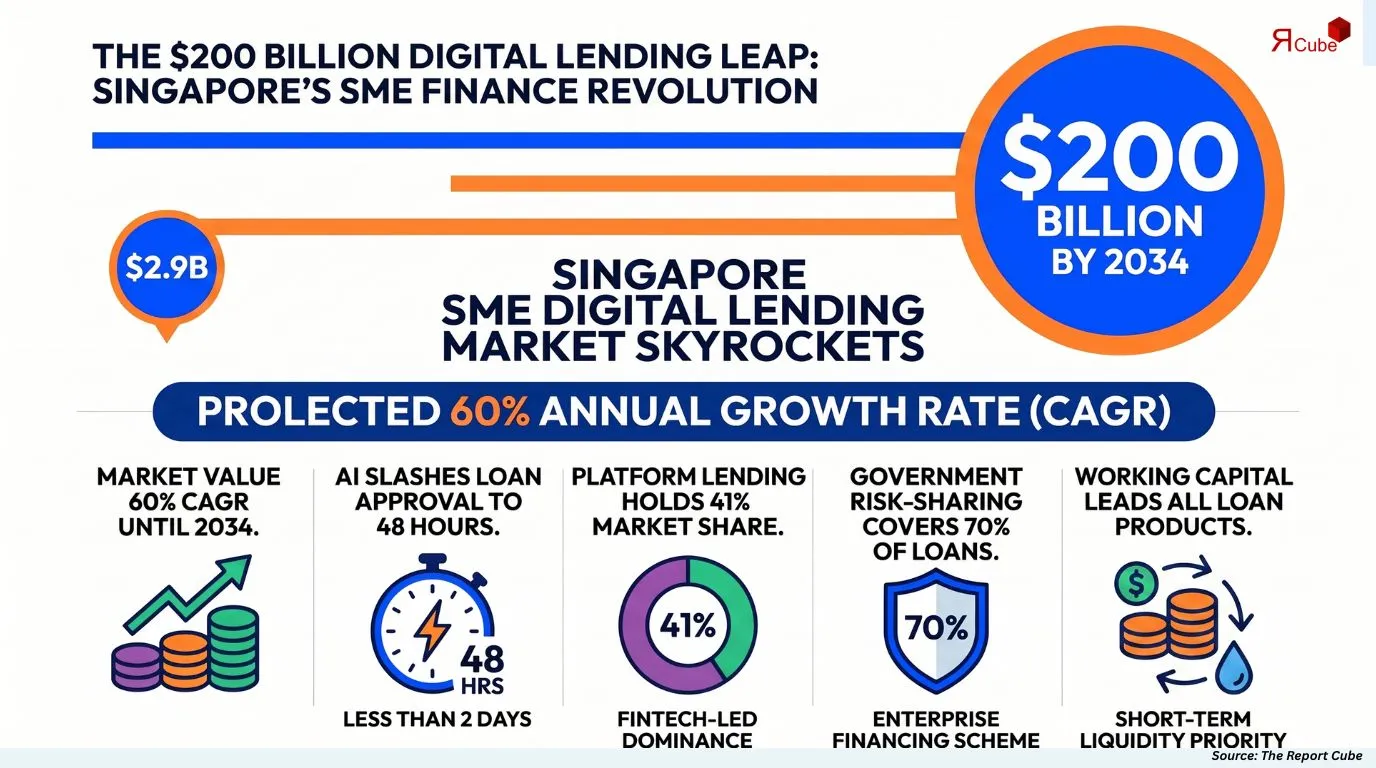
Working Capital Loans segment leads the market, with around 32% share.
By Deployment Model:
Platform-Based Lending segment dominates the market, accounting for nearly 41% of total revenue.
Regional Outlook:
Central Region dominates the singapore sme digital lending market, with around 38% share.
Government Initiatives & Policies
- Enterprise Financing Scheme (EFS) - Enhanced 2025 Framework: Administered by Enterprise Singapore, the scheme provides government risk-sharing of up to 70% for SME loans, encouraging banks and fintech lenders to expand unsecured digital credit access.
- MAS Digital Bank Regulatory Framework & Project MindForge (2025 Update): Monetary Authority of Singapore initiatives supporting AI adoption, digital risk governance, and SME-focused digital banking expansion.
Singapore SME Digital Lending Market Insights & Analysis
The Singapore SME Digital Lending Market is anticipated to register a CAGR: 60% during 2026-34. The market size was valued at USD 2.9 billion in 2025 and is projected to reach USD 199.29 billion by 2034. Singapore’s digitally mature financial ecosystem, strong regulatory oversight, and SME-dominant economic structure are collectively accelerating the transition from traditional bank lending to technology-enabled credit models.
SMEs account for over 99% of enterprises in Singapore and contribute nearly 48% of GDP, creating a structurally strong demand base for short-term working capital, trade finance, and expansion loans. Digital lending penetration has risen sharply, with more than 65% of SMEs using at least one fintech-enabled financing platform by 2025. The increasing digitization of accounting systems, e-commerce platforms, and payment gateways allows lenders to access real-time transactional data, improving underwriting speed and accuracy. Loan approval timelines have reduced from an industry average of 3-4 weeks in traditional banking to under 48 hours on digital platforms.
Singapore’s regulatory sandbox framework and digital banking licenses have further intensified competition. Digital banks such as ANEXT Bank, MariBank, GXS Bank, and Green Link Digital Bank are deploying AI-driven credit scoring engines and embedded lending models integrated into supply chain ecosystems. Meanwhile, established banks including DBS SME Banking, OCBC SME Banking, and UOB BizSmart are digitizing credit processes to retain SME customers. Strategic partnerships between fintech platforms and ecosystem players are expanding cross-border SME financing across Southeast Asia.
Capital inflows and consolidation are reshaping the competitive landscape. In 2025, major acquisitions and equity investments strengthened platform scalability and loan book growth. Marketplace and co-lending models are gaining traction as institutional investors seek exposure to SME credit as an alternative asset class. With Singapore positioning itself as a regional fintech hub, digital SME lending is evolving from transactional financing into an integrated financial services ecosystem encompassing payments, FX, insurance, and trade services.
Singapore SME Digital Lending Market Dynamics
Key Driver: Rapid Digital Adoption Among SMEs and Embedded Finance Expansion
Singapore SMEs are increasingly digital-first, with over 75% using cloud accounting software and digital payment systems. This digital footprint enables alternative data underwriting based on cash flow analytics, POS transactions, and supply chain data. Embedded finance models integrated within e-commerce marketplaces and logistics platforms allow SMEs to access credit at the point of transaction. For example, merchant cash advance and invoice financing products are now automatically triggered based on receivable cycles. Approval rates have improved by nearly 20% compared to traditional scorecard-only assessments. Government-backed guarantees under the Enterprise Financing Scheme reduce lender risk exposure, encouraging higher disbursement volumes. These factors collectively support strong lending momentum and sustained high growth through 2034.
Book your FREE 30-minute expert consultation today
Contact UsIndustry Trends: AI-Driven Risk Models and Platform Consolidation
Artificial intelligence and machine learning are central to underwriting transformation. Lenders are deploying hybrid risk models combining bureau data with alternative inputs such as GST filings, bank transaction feeds, and marketplace performance metrics. Predictive default models are reducing non-performing loan ratios to below 3% in well-managed digital portfolios. Additionally, consolidation activity is accelerating scale. Acquisitions allow digital banks to integrate fintech platforms, gain SME customer databases, and diversify funding sources. Co-lending and syndicated structures are becoming common, enabling risk distribution among banks, fintech lenders, and institutional investors. Platform-based lending now represents over 40% of total digital SME lending volume in Singapore, reflecting its scalability and cost efficiency.
Major Challenge: Rising Credit Risk Sensitivity and Regulatory Compliance Complexity
While growth is strong, credit risk management remains critical. SMEs are vulnerable to global trade volatility and interest rate fluctuations. A sudden slowdown in export demand or supply chain disruptions can affect repayment cycles. Digital lenders must comply with MAS capital adequacy and risk governance standards, which require continuous model validation and cybersecurity safeguards. Compliance costs have increased by an estimated 15% since enhanced digital risk guidelines were introduced. Smaller fintech platforms face funding constraints during tightening liquidity cycles. Balancing rapid loan book expansion with prudent underwriting discipline remains a central operational challenge.
Opportunity: Cross-Border SME Financing and ESG-Linked Lending
Singapore’s role as a regional trade hub presents significant cross-border lending opportunities. SMEs engaged in ASEAN trade increasingly require FX-linked trade finance and supply chain credit solutions. Digital platforms are integrating multi-currency settlement, real-time FX conversion, and trade documentation services. ESG-linked SME financing is also emerging, with preferential rates offered to companies meeting sustainability benchmarks. Government incentives for green financing encourage lenders to design ESG-aligned loan products. By 2034, cross-border and ESG-linked SME lending could represent over 25% of total digital SME loan disbursements in Singapore.
Singapore SME Digital Lending Market Segment-wise Analysis
By Loan Product:
- Working Capital Loans
- Invoice Financing & Factoring
- Merchant Cash Advance
- Trade Finance & Supply Chain Finance
- Equipment & Asset Financing
- Growth & Expansion Loans
- Others
Working capital loans command approximately 32% market share in 2025 due to short-term liquidity requirements of SMEs facing variable cash flow cycles. Retail and e-commerce businesses frequently rely on revolving credit lines to manage inventory turnover. Digital approval mechanisms allow funds disbursement within 24-72 hours, improving operational agility. Invoice financing follows closely, particularly among logistics and manufacturing SMEs with extended receivable periods. Merchant cash advance products are gaining traction among online sellers integrated with payment gateways. Working capital remains dominant due to its recurring demand and scalable digital underwriting compatibility.
By Deployment Model:
- Platform-Based Lending
- Bank-Owned Digital Lending
- Embedded & Platform Partnerships
Platform-based lending holds nearly 41% share, reflecting fintech-led innovation and cost-efficient digital operations. These platforms leverage API integrations, automated onboarding, and AI underwriting engines to minimize manual intervention. Bank-owned digital lending channels are expanding as incumbents modernize legacy systems. Embedded lending partnerships within marketplaces and payment ecosystems represent the fastest-growing model, driven by contextual financing embedded directly into SME workflows. Platform scalability, lower customer acquisition costs, and flexible funding structures reinforce this segment’s leadership position.
Regional Projection of Singapore SME Digital Lending Industry
- Central Region
- East Region
- West Region
- North Region
- Northeast Region
The Central Region accounts for around 38% of market share due to the concentration of commercial headquarters, fintech firms, and financial institutions. Marina Bay and CBD clusters host a majority of SME service providers and technology startups. The West Region follows, supported by industrial estates and manufacturing hubs. East and Northeast Regions show steady adoption among retail and logistics SMEs. Regional lending distribution closely mirrors SME density and commercial activity concentration across Singapore.
Singapore SME Digital Lending Market Recent Developments
- 2025: Funding Societies secured a strategic equity investment from Gobi Partners to enhance its AI-driven SME lending infrastructure, expanding regional capacity and strengthening alternative data underwriting capabilities across Southeast Asia.
- 2025: GXS Bank obtained regulatory approval to acquire Validus Capital, combining digital banking balance sheet strength with fintech platform technology to significantly scale SME lending volumes in Singapore.
- 2025: Validus Capital (rebranded as GXS Capital) reported a 54% expansion in SME loan book growth between April and August 2025, reflecting accelerated digital credit deployment and platform integration.
- 2025: DBS SME Banking launched Spark GenAI and ESG Ready programs in partnership with Enterprise Singapore and IMDA, integrating advisory support with financing solutions to drive AI adoption and sustainable SME growth.
Need insights for a specific region within this market?
Request Regional DataWhy Choose This Report?
- Provides a comprehensive overview of the overall market analysis, encompassing key trends, consumer behavior analysis, and risk assessment to support strategic decision-making.
- Provides accurate, up-to-date insights into market size, segmentation, and emerging opportunities, helping to minimize risk & capitalizing on growth.
- Gives deep understanding of target audience preferences, investment habits, and communication channels for enhanced product development & marketing effectiveness.
- Delivers competitive analysis & benchmarking, uncovering the strengths & weaknesses of market competitors to guide strategies.
- Consolidate comprehensive market intelligence, reducing reasoning & streamlining research efforts.
- Facilitates customized market segmentation & risk mitigation strategies, fine-tuned to the business objectives.
- Aids in identifying both market challenges & untapped opportunities within the industry to drive long-term business growth.
- Provides valuable information based on actual customer data & search trends.
Table of Contents
- Introduction
- Objective of the Study
- Product and Category Definition
- Market Segmentation
- Study Variables
- Research Methodology
- Secondary Data Points
- Breakdown of Secondary Sources
- Primary Data Points
- Breakdown of Primary Interviews
- Secondary Data Points
- Executive Summary
- Market Dynamics
- Drivers
- Challenges
- Opportunity Assessment
- Recent Trends and Developments
- Regulatory and Policy Landscape
- Singapore SME Digital Lending Market Overview (2021-2034)
- Market Size, By Value (USD Billion)
- Market Share, By Loan Product
- Working Capital Loans
- Invoice Financing & Factoring
- Merchant Cash Advance
- Trade Finance & Supply Chain Finance
- Equipment & Asset Financing
- Growth & Expansion Loans
- Others
- Market Share, By Deployment Model
- Platform-Based Lending
- Bank-Owned Digital Lending
- Embedded & Platform Partnerships
- Market Share, By Credit Model
- Balance Sheet Lending
- Marketplace & P2P Lending
- Co-Lending & Syndicated Lending
- Market Share, By Underwriting Approach
- Traditional Credit Scoring
- Alternative Data Underwriting
- Hybrid Risk Models
- Market Share, By SME
- Micro Enterprises
- Small Enterprises
- Medium Enterprises
- Market Share, By Industry Vertical
- Retail & E-commerce
- Manufacturing & Industrial
- Logistics & Trade
- Services & Professional Firms
- Technology & Startups
- Others
- Market Share, By Distribution Channel
- Direct Digital Platforms
- Bank & Branch Referrals
- Marketplace & Ecosystem Partners
- Agent & Broker Channels
- Others
- Market Share, By Region
- East Region
- North Region
- Northeast Region
- West Region
- Central Region
- Market Share, By Company
- Revenue Shares & Analysis
- Competitive Landscape
- East Region SME Digital Lending Market
- Market Size, By Value (USD Billion/Million)
- Market Share, By Loan Product
- Market Share, By SME
- Market Share, By Industry Vertical
- Market Share, By Distribution Channel
- North Region SME Digital Lending Market
- Market Size, By Value (USD Billion/Million)
- Market Share, By Loan Product
- Market Share, By SME
- Market Share, By Industry Vertical
- Market Share, By Distribution Channel
- Northeast Region SME Digital Lending Market
- Market Size, By Value (USD Billion/Million)
- Market Share, By Loan Product
- Market Share, By SME
- Market Share, By Industry Vertical
- Market Share, By Distribution Channel
- West Region SME Digital Lending Market
- Market Size, By Value (USD Billion/Million)
- Market Share, By Loan Product
- Market Share, By SME
- Market Share, By Industry Vertical
- Market Share, By Distribution Channel
- Central Region SME Digital Lending Market
- Market Size, By Value (USD Billion/Million)
- Market Share, By Loan Product
- Market Share, By SME
- Market Share, By Industry Vertical
- Market Share, By Distribution Channel
- Competitive Outlook and Company Profiles
- Funding Societies
- Company Overview
- Product Portfolio
- Strategic Alliances/Partnerships
- Recent Developments
- Validus Capital
- Company Overview
- Product Portfolio
- Strategic Alliances/Partnerships
- Recent Developments
- ANEXT Bank (Ant Group)
- Company Overview
- Product Portfolio
- Strategic Alliances/Partnerships
- Recent Developments
- MariBank (Sea Group)
- Company Overview
- Product Portfolio
- Strategic Alliances/Partnerships
- Recent Developments
- Aspire
- Company Overview
- Product Portfolio
- Strategic Alliances/Partnerships
- Recent Developments
- Green Link Digital Bank
- Company Overview
- Product Portfolio
- Strategic Alliances/Partnerships
- Recent Developments
- GXS Bank (Grab/Singtel)
- Company Overview
- Product Portfolio
- Strategic Alliances/Partnerships
- Recent Developments
- IFS Capital
- Company Overview
- Product Portfolio
- Strategic Alliances/Partnerships
- Recent Developments
- Lendingpot
- Company Overview
- Product Portfolio
- Strategic Alliances/Partnerships
- Recent Developments
- Capital Match
- Company Overview
- Product Portfolio
- Strategic Alliances/Partnerships
- Recent Developments
- Airwallex
- Company Overview
- Product Portfolio
- Strategic Alliances/Partnerships
- Recent Developments
- M-DAQ Global
- Company Overview
- Product Portfolio
- Strategic Alliances/Partnerships
- Recent Developments
- Incomlend
- Company Overview
- Product Portfolio
- Strategic Alliances/Partnerships
- Recent Developments
- Chere (formerly Lyte)
- Company Overview
- Product Portfolio
- Strategic Alliances/Partnerships
- Recent Developments
- DBS SME Banking
- Company Overview
- Product Portfolio
- Strategic Alliances/Partnerships
- Recent Developments
- OCBC SME Banking
- Company Overview
- Product Portfolio
- Strategic Alliances/Partnerships
- Recent Developments
- UOB BizSmart
- Company Overview
- Product Portfolio
- Strategic Alliances/Partnerships
- Recent Developments
- Others
- Funding Societies
- Contact Us and Disclaimer
Top Key Players & Market Share Outlook
- Funding Societies
- Validus Capital
- ANEXT Bank (Ant Group)
- MariBank (Sea Group)
- Aspire
- Green Link Digital Bank
- GXS Bank (Grab/Singtel)
- IFS Capital
- Lendingpot
- Capital Match
- Airwallex
- M-DAQ Global
- Incomlend
- Chere (formerly Lyte)
- DBS SME Banking
- OCBC SME Banking
- UOB BizSmart
Frequently Asked Questions






