


Build Your Custom Market Intelligence Report
Customize Your ReportKey Highlights
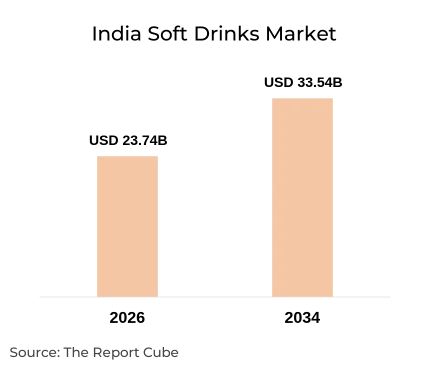
- The India Soft Drinks Market was valued at USD 23.74 billion in 2026, up from USD 21.66 billion in 2025.
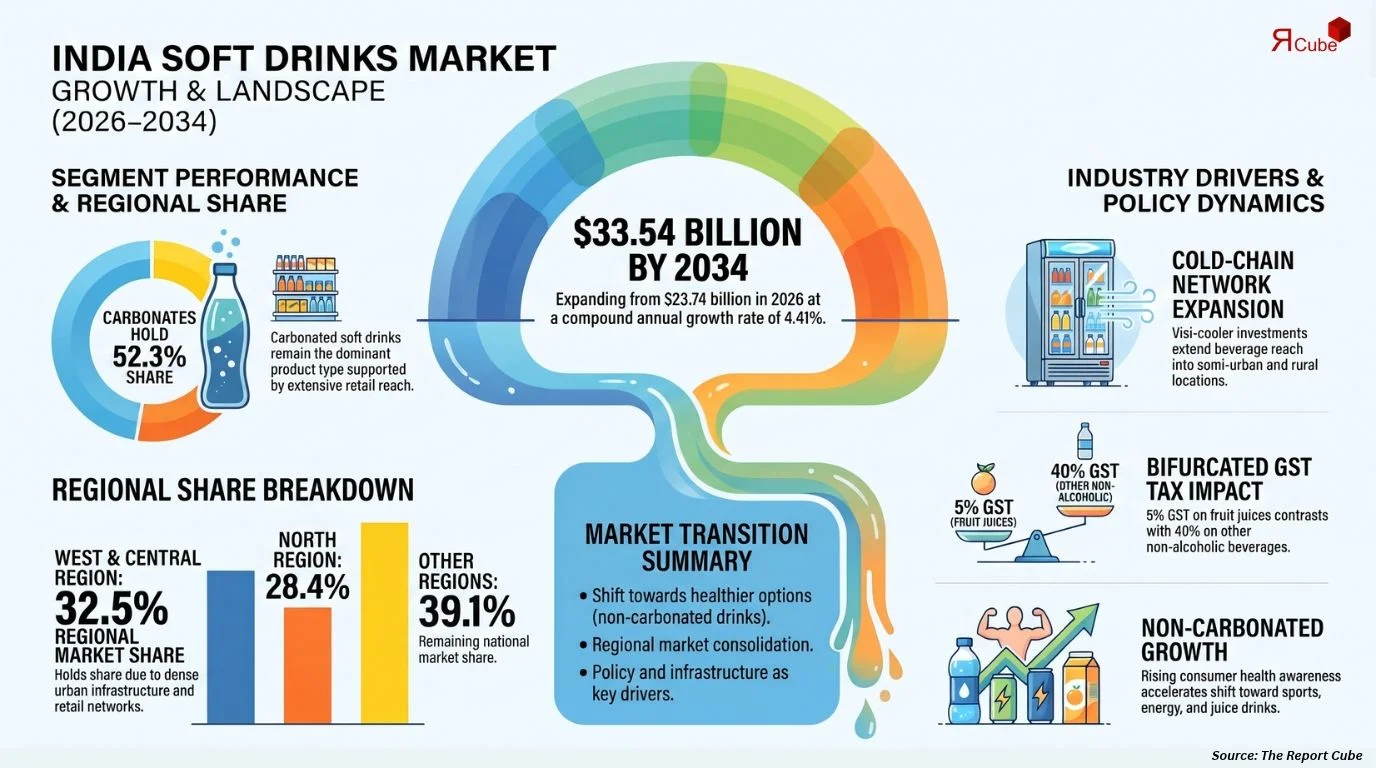
- Market size is forecast to reach USD 33.54 billion by 2034.
- The market is expected to grow at a CAGR of 4.41% during 2026-2034, compared with 4.61% over 2021-2025.
- By product type, carbonated soft drinks led with a 52.3% share in 2025.
- By region, West and Central India led in 2025 with a 32.5% share.
- Rising urbanisation, disposable incomes, and expanding cold-chain and retail distribution are the main growth drivers.
- Competition combines multinational brands, bottling franchisees and domestic players such as Reliance Consumer Products (Campa), Parle Agro and Dabur.
Market Outlook
The India Soft Drinks Market covers commercially sold, non-alcoholic ready-to-drink beverages and concentrates, including carbonated drinks, juices, RTD tea and coffee, energy and sports drinks, packaged water and squashes. Dairy-based and alcoholic beverages are excluded. The market links agriculture, packaging, bottling, distribution and retail, making it a major part of India’s packaged food and beverage economy.
Demand is shaped by hot climatic conditions, young demographics, impulse purchasing and the reach of refrigerated retail. Carbonated beverages remain the largest category, while fruit beverages, flavoured water, hydration and functional drinks broaden consumption occasions. Neighbourhood stores, supermarkets, foodservice outlets and quick-commerce platforms all contribute to availability across urban and semi-urban areas.
The India Soft Drinks Market is valued at USD 23.74 billion in 2026 and is projected to reach USD 33.54 billion by 2034 at a CAGR of 4.41%. Growth is expected to rest on affordable pack sizes, wider distribution and product diversification, although weather variability, taxation and sugar-related health concerns may moderate the pace of expansion.
Government Regulations
Food safety, labelling and product standards for the India Soft Drinks Industry are administered by the Food Safety and Standards Authority of India (FSSAI), whose Food Category 14.1 covers non-alcoholic beverages such as waters, juices, nectars, energy and sports drinks, and concentrates. Taxation is set by the GST Council. Following its 56th meeting, revised GST rates took effect on 22 September 2025: fruit and vegetable juices and several juice-based and plant-based drinks moved to 5%, while other non-alcoholic beverages under the special classification attract 40%. These rates change relative pricing across categories and favour non-carbonated products. Manufacturers must verify tariff classification for each formulation, especially carbonated fruit drinks, and maintain compliance with labelling, packaging and food-safety rules, which raises documentation and reformulation requirements.
India Soft Drinks Market Dynamics
Demand in the India Soft Drinks Market is shaped by consumption preferences, packaged-beverage distribution, product innovation and competition between multinational and domestic brands. Taxation, weather variability, health awareness and packaging economics influence manufacturers’ pricing and expansion decisions, while portfolio diversification into non-carbonated categories is changing how companies allocate capacity and marketing investment.
|
Factor |
Type |
Specific Impact on Market |
Magnitude |
|---|---|---|---|
|
Urbanisation and rising disposable incomes |
Driver |
Supports demand for convenient packaged beverages |
High |
|
Cold-chain and retail expansion |
Driver |
Improves product availability in semi-urban and rural areas |
Medium–High |
|
Rural and semi-urban penetration |
Opportunity |
Affordable packs extend consumption into underserved locations |
Medium–High |
|
Sugar-related health concerns and taxation |
Challenge |
Raises reformulation needs and may restrain sugary categories |
Medium–High |
|
Weather and packaging supply variability |
Challenge |
Affects seasonal demand and production continuity |
Medium |
|
Shift to non-carbonated and functional drinks |
Trend |
Broadens product portfolios beyond traditional carbonates |
Medium–High |
Growth Drivers: Urbanisation, Disposable Incomes and Cold-Chain Expansion
Urbanisation, a young population and higher household spending are increasing demand for convenient packaged beverages. Producers are investing in additional bottling plants and visi-coolers, which improve product availability in smaller towns and underserved markets. Varun Beverages’ FY2025 annual report cites rising disposable incomes, urbanisation and cold-chain investment as structural drivers, supporting higher consumption frequency and wider retail penetration across the India Soft Drinks Market through the forecast period.
Market Opportunities: Rural and Semi-Urban Penetration
Expanding retailer networks, refrigeration and affordable pack sizes create room to reach consumers outside metropolitan areas. Improved last-mile distribution can raise product availability and purchase frequency. Varun Beverages’ investment in new facilities in Uttar Pradesh, Bihar, Himachal Pradesh and Meghalaya illustrates the importance of geographic expansion. The Ministry of Food Processing Industries also identifies juices, mineral water, plant-based drinks and sports drinks as emerging opportunities, widening the addressable consumer base for manufacturers.
Industry Challenges: Health Awareness and Weather Dependency
Growing awareness of sugar consumption may shift demand towards reduced-sugar and sugar-free options, and the World Bank’s October 2024 India health-tax study discusses public-health concerns around sugar-sweetened beverages. Weather also affects sales: Varun Beverages reported that prolonged rainfall disrupted beverage consumption during parts of 2025. Together, health policy and seasonal volatility complicate demand planning, pricing decisions and capacity utilisation for beverage manufacturers.
Need Specific Data, Let’s Customize the Report for You
Request CustomizationMarket Trends: Diversification Towards Non-Carbonated and Functional Beverages
Manufacturers are expanding fruit beverages, sports drinks, energy drinks and flavoured water. The World Bank’s category dataset records 2013-2022 volume CAGRs of 8.3% for juice and 12.6% for sports drinks, against 2.5% for carbonated drinks, indicating momentum beyond traditional carbonates. Quick-commerce and smaller pack formats are also widening purchase occasions. These historical rates are not forecasts for 2026-2034.
India Soft Drinks Market Segment Analysis
The India Soft Drinks Market is segmented by product type, distribution channel, packaging type, price category and consumer segment. Each category reflects a different commercial lens, from product portfolios and retail access to packaging economics and pricing tiers. Segment shares below are supplied 2025 estimates.
By Product Type
- Carbonated Soft Drinks
- Non-Carbonated Soft Drinks
- Bottled Water
- Beverage Concentrates
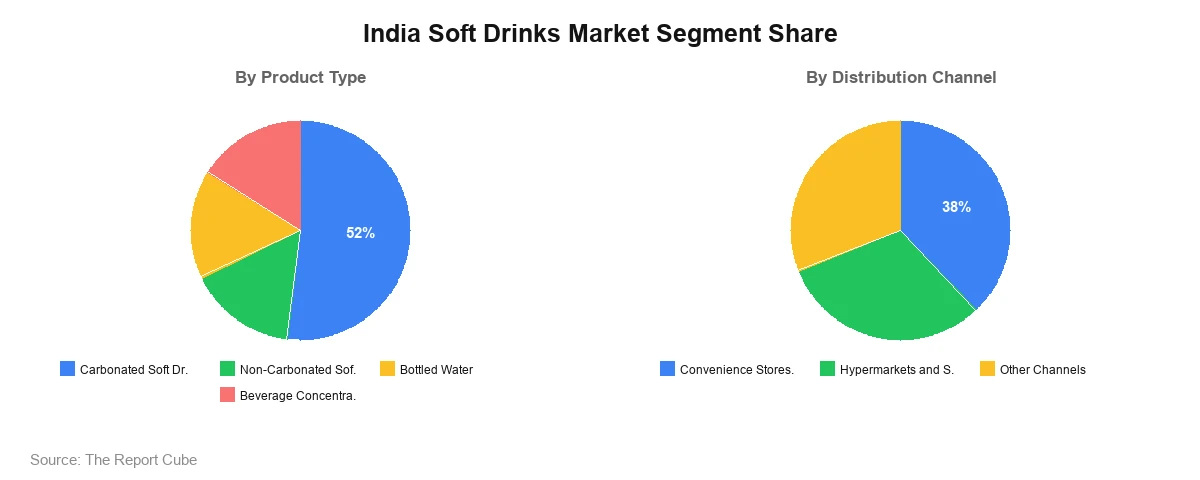
Carbonated soft drinks lead the product segment with a 52% share in 2025, supported by strong brand familiarity, extensive general-trade distribution, high summer-season consumption and established cola, lemon-lime and orange portfolios. Non-carbonated soft drinks form the second major segment, spanning juices, nectars, RTD tea and coffee, energy and sports drinks and flavoured water, with demand supported by changing preferences and category diversification. Bottled water and beverage concentrates complete the segment and serve hydration and home-preparation needs. Bottled water is included in the market definition and is not added again to the non-carbonated total.
By Distribution Channel
- Convenience Stores
- Hypermarkets and Supermarkets
- Other Channels
Convenience Stores lead the channel segment with a 38% share in 2025, benefiting from neighbourhood accessibility, frequent purchases and impulse buying. Supermarkets and hypermarkets rank next, offering multipack purchases, promotions and wider assortments, particularly in urban areas. Departmental stores, online retail and quick commerce add convenience-led and planned purchasing, while on-trade outlets serve foodservice and hospitality consumption. Comparable shares for online retail and quick commerce are not established in the available evidence, so no ranking is assigned to them.
India Soft Drinks Market Regional Analysis
The India Soft Drinks Market is analysed across four regional groupings. Regional shares below are supplied 2025 estimates based on the same market definition and reflect differences in urban retail infrastructure, income levels, climate and distribution depth across the country.
|
Region |
Estimated Market Share |
Key Growth Factors |
Industry Trends |
|---|---|---|---|
|
West and Central India |
32.5% |
Urban retail infrastructure, commercial and hospitality demand |
Established distribution, premium and modern-trade expansion |
|
North India |
28.4% |
Large consumer base, strong summer demand |
Carbonated and juice consumption, quick-commerce growth |
|
South India |
- |
Warm climate, expanding urban centres, cloud of manufacturing presence |
Packaged water and non-carbonated diversification |
|
East and Northeast India |
- |
Developing retail networks, rising incomes |
Gradual distribution expansion and pack-size affordability |
West and Central India leads with 32.5% in 2025. Its position reflects dense urban retail networks, established beverage distribution and demand from commercial and hospitality centres. Modern trade, foodservice and premium products are relatively developed, and the region hosts significant manufacturing and bottling capacity that supports supply reliability and product availability.
North India holds 28.4%, supported by a large population base, hot summers that lift seasonal demand and strong general-trade networks. Carbonated drinks and juices are widely consumed, and quick-commerce platforms in major cities add convenience-led purchasing. Manufacturers continue to expand facilities in northern states to improve supply efficiency and reach.
Competitive Landscape
The India Soft Drinks Market includes multinational beverage companies, franchise bottlers, domestic manufacturers and regional brands. Competition centres on brand portfolios, distribution reach, cold-chain capability, pricing and pack innovation. The table summarises companies by general capability and does not represent numerical market share or ranking.
|
Company |
Competitive Strength |
Primary Segment Served |
|---|---|---|
|
The Coca-Cola Company / Coca-Cola India |
Established brand portfolio and franchise bottling network |
Carbonated and non-carbonated beverages |
|
PepsiCo India |
Carbonated portfolio, flavour innovation, energy and sports offerings |
Carbonated and energy drinks |
|
Varun Beverages Limited |
Manufacturing, bottling and distribution scale |
Carbonated and non-carbonated beverages |
|
Reliance Consumer Products |
Affordable pricing and general-trade expansion (Campa) |
Carbonated beverages |
|
Parle Agro |
Fruit beverages, sparkling drinks and packaged water |
Fruit-based and sparkling beverages |
|
Dabur India Limited |
Packaged fruit juices (Real) |
Juices and fruit-based drinks |
|
Bisleri International |
Packaged water brand and distribution |
Bottled water |
|
Tata Consumer Products |
RTD and packaged beverage portfolio |
RTD beverages |
|
Hajoori & Sons |
Regional carbonated brands, including Sosyo |
Regional carbonated drinks |
|
Red Bull / Monster Beverage |
Global energy drink brands |
Energy drinks |
Varun Beverages Limited: Varun Beverages manufactures, bottles and distributes PepsiCo brands including Pepsi, Mountain Dew, Mirinda, 7UP, Slice, Tropicana and Sting. Its FY2025 annual report records consolidated sales volume of 1,213.1 million cases against 1,124.4 million in 2024, a consolidated rather than India-only figure. Its strength lies in production scale, supply-chain capability and continued investment in plants and visi-coolers.
Reliance Consumer Products: Reliance Consumer Products owns the Campa brand and uses the Reliance retail ecosystem for distribution. Its competitive positioning rests on affordable pricing and general-trade expansion. Reliance’s 2024-25 annual report states that Campa achieved over 10% share in the sparkling beverage category in select states, which is a regional result and not a national market share.
Recent Developments and Updates
- September 2025: The GST Council’s revised rates took effect on 22 September 2025, placing fruit and vegetable juices and certain juice-based and plant-based drinks at 5% and other non-alcoholic beverages at 40%, changing relative affordability across beverage categories.
- 2025: Varun Beverages reported in its FY2025 annual report that prolonged rainfall affected beverage consumption, while it continued investing in manufacturing facilities and visi-coolers to expand retail reach and availability.
India Soft Drinks Market Future Outlook
The India Soft Drinks Market is projected to expand from USD 23.74 billion in 2026 to USD 33.54 billion by 2034 at a CAGR of 4.41%. Opportunities lie in rural and semi-urban penetration, affordable packaging, reduced-sugar and functional beverages, and online and quick-commerce channels. Non-carbonated categories such as juices, hydration and flavoured water may gain share as GST changes and health awareness influence purchasing.
Competition is expected to intensify as multinational brands, bottlers and domestic players invest in capacity, cold-chain infrastructure and portfolio diversification. Challenges include sugar-related policy, tax classification, weather-driven volatility and packaging supply. The figures are projections rather than verified outcomes, and actual results will depend on consumer demand, regulation, input costs and the execution of manufacturers’ expansion plans.
India Soft Drinks Market Report Coverage
This India Soft Drinks Market Report summarises the supplied valuation, forecast assumptions, segmentation, regional framework and competitive ecosystem for 2021-2034.
|
Parameter |
Details |
|---|---|
|
Market Name |
India Soft Drinks Market |
|
Market Size (Base Year) |
USD 23.74 billion (2026) |
|
Market Size (Forecast Year) |
USD 33.54 billion (2034) |
|
CAGR |
4.41% (2026-2034) |
|
Base Year |
2026 |
|
Historical Period |
2021-2025 |
|
Forecast Period |
2026-2034 |
|
Geographic Scope |
India |
|
Segmentation |
By Product Type; By Distribution Channel; By Packaging Type; By Price Category; By Consumer Segment |
|
Regions Covered |
West and Central India, North India, South India, East and Northeast India |
|
Key Companies |
Coca-Cola India; PepsiCo India; Varun Beverages; Reliance Consumer Products; Parle Agro; Dabur India; Bisleri International; Tata Consumer Products |
|
Customization |
Available as per requirement |
Why Choose This India Soft Drinks Market Report?
- Presents the 2026 valuation, 2034 forecast and 4.41% CAGR with stated assumptions.
- Segments the market by product type, channel, packaging, price category and consumer group.
- Reviews drivers, opportunities, challenges and trends with a dynamics table.
- Provides regional context across four Indian regions with supplied 2025 shares.
- Profiles key companies by capability and primary segment served.
- Highlights non-carbonated, functional and quick-commerce opportunities.
- Summarises GST and FSSAI context to support planning, pricing and portfolio decisions.
Table of Contents
- Introduction
- Objective of the Study
- Product Definition
- Market Segmentation
- Study Variables
- Research Methodology
- Secondary Data Points
- Companies Interviewed
- Primary Data Points
- Breakdown of Primary Interviews
- Secondary Data Points
- Executive Summary
- Market Dynamics
- Drivers
- Challenges
- Opportunity Assessment
- Recent Trends and Developments
- Policy and Regulatory Landscape
- India Soft Drinks Market Overview and Forecast Analysis (2021-2034)
- Market Size, By Value, By Growth Rate (CAGR/USD Billions)
- Demand – Supply Trends
- Market Share, By Distribution Channel
- Off-Trade
- On-Trade
- Market Share, By Packaging Type
- PET Bottles
- Glass Bottles
- Aluminium Cans
- Cartons
- Pouches
- Other Packaging Formats
- Market Share, By Price Category
- Economy
- Mass Market
- Premium
- Super-Premium
- Market Share, By Consumer Segment
- Children and Teenagers
- Young Adults
- Working Professionals
- Family Consumers
- Health-Conscious Consumers
- Sports and Fitness Consumers
- Market Share, By Region
- West and Central India
- North India
- South India
- East and Northeast India
- Market Share, By Competitors
- Competition Characteristics
- Revenue Shares
- Off-Trade India Soft Drinks Market Overview, 2021-2034F
- By Value (USD Million)
- By Packaging Type – Market Size & Forecast 2021-2034, USD Million
- PET Bottles
- Glass Bottles
- Aluminium Cans
- Cartons
- Pouches
- Other Packaging Formats
- On-Trade India Soft Drinks Market Overview, 2021-2034F
- By Value (USD Million)
- By Packaging Type – Market Size & Forecast 2021-2034, USD Million
- PET Bottles
- Glass Bottles
- Aluminium Cans
- Cartons
- Pouches
- Other Packaging Formats
- Competitive Outlook (Company Profile – Partial List)
- The Coca-Cola Company / Coca-Cola India
- Company Overview
- Business Segments
- Strategic Alliances/Partnerships
- Recent Developments
- PepsiCo India
- Company Overview
- Business Segments
- Strategic Alliances/Partnerships
- Recent Developments
- Varun Beverages Limited
- Company Overview
- Business Segments
- Strategic Alliances/Partnerships
- Recent Developments
- Reliance Consumer Products
- Company Overview
- Business Segments
- Strategic Alliances/Partnerships
- Recent Developments
- Parle Agro
- Company Overview
- Business Segments
- Strategic Alliances/Partnerships
- Recent Developments
- Dabur India Limited
- Company Overview
- Business Segments
- Strategic Alliances/Partnerships
- Recent Developments
- Bisleri International
- Company Overview
- Business Segments
- Strategic Alliances/Partnerships
- Recent Developments
- The Coca-Cola Company / Coca-Cola India
- Contact Us & Disclaimer
Top Key Players & Market Share Outlook
- The Coca-Cola Company / Coca-Cola India
- PepsiCo India
- Varun Beverages Limited
- Reliance Consumer Products
- Parle Agro
- Dabur India Limited
- Bisleri International
Frequently Asked Questions