



Build Your Custom Market Intelligence Report
Customize Your ReportIndonesia Carbonated Soft Drink Market Key Highlights
By Product Type:
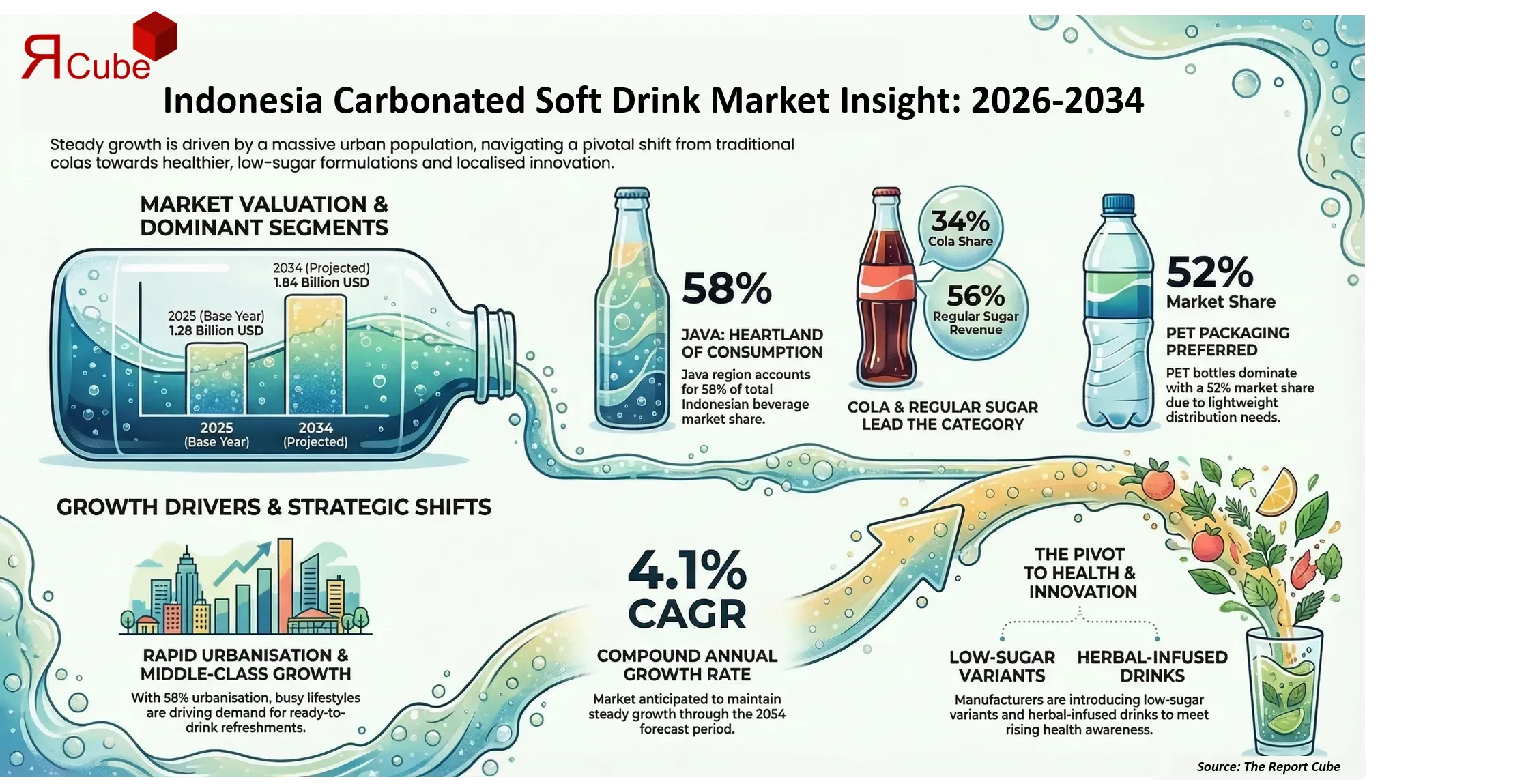
Cola Carbonates segment lead the market, with around 34% share.
By Sugar Content:
Regular Sugar Carbonates segment dominate the market, accounting for nearly 56% of total revenue.
Regional Outlook:
Java region dominates the Indonesia carbonated soft drink market, with around 58% share.
Government Initiatives & Policies
- Indonesia National Food and Beverage Industry Development Roadmap: The Indonesian government supports domestic beverage manufacturing through incentives, investment facilitation, and infrastructure upgrades to strengthen food and beverage production ecosystems.
- Indonesia Halal Product Assurance Law (BPJPH): The regulation promotes halal certification for food and beverages, encouraging beverage producers to meet quality and safety standards while expanding domestic and export markets.
Indonesia Carbonated Soft Drink Market Insights & Analysis
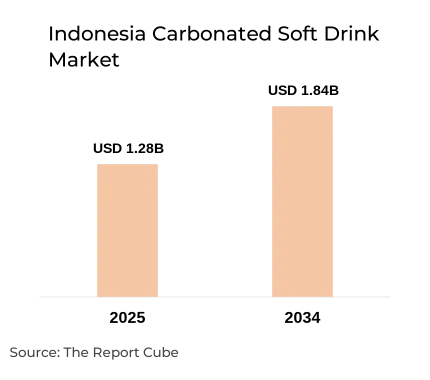
The Indonesia Carbonated Soft Drink Market is anticipated to register a 4.1% during 2026-2034. the market size was valued at USD 1.28 billion and is projected to reach USD 1.84 billion by 2034. The Indonesian beverage sector has witnessed steady growth supported by expanding urban populations, rising disposable incomes, and the increasing penetration of modern retail channels. Carbonated beverages continue to remain popular among young consumers and urban households, particularly in metropolitan regions such as Jakarta, Surabaya, and Bandung. Demand for ready-to-drink refreshment products remains strong due to busy lifestyles and changing consumption habits across Indonesia’s growing middle class.
Several multinational and domestic beverage companies are expanding production capacity and distribution networks across Indonesia to capture the country’s expanding consumer base. Investments in bottling facilities, packaging technology, and logistics infrastructure are improving product availability across islands and secondary cities. Companies are also launching localized flavors, herbal-infused carbonated drinks, and low-sugar variants to align with evolving consumer preferences.
In addition, partnerships with convenience stores, foodservice outlets, and digital commerce platforms are strengthening product visibility and accessibility. Government support for food and beverage manufacturing, combined with rising tourism and hospitality sectors, is also supporting demand for packaged beverages. As beverage companies continue to innovate with healthier formulations and sustainable packaging solutions, the Indonesian carbonated soft drink market is expected to maintain stable growth across the forecast period.
Indonesia Carbonated Soft Drink Market Dynamics
Key Driver: Expanding Urban Population and Rising Middle-Class Consumption
One of the primary drivers supporting the growth of the Indonesia carbonated soft drink market is the country’s expanding urban population and the steady growth of middle-income households. Indonesia is home to more than 275 million people, with urbanization levels exceeding 58% in 2025. Urban consumers tend to demonstrate higher demand for packaged beverages due to lifestyle changes, busy work schedules, and increased exposure to international food and beverage brands. Carbonated soft drinks remain a popular refreshment option, particularly among teenagers and young adults.
Modern retail expansion has also strengthened beverage consumption patterns. Supermarkets, hypermarkets, and convenience stores continue to grow across large cities and suburban areas, offering greater product availability and promotional activities that stimulate consumer purchases. Moreover, the rapid growth of the quick-service restaurant sector and food delivery platforms further increases carbonated beverage consumption. With growing purchasing power and stronger brand awareness among Indonesian consumers, beverage manufacturers continue to invest in product marketing, promotional campaigns, and distribution expansion to capture rising demand.
Book your FREE 30-minute expert consultation today
Contact UsIndustry Trends: Shift Toward Low-Sugar Formulations and Localized Beverage Innovation
The Indonesia carbonated soft drink market is witnessing a noticeable shift toward healthier beverage formulations and localized flavor innovation. Consumer awareness regarding sugar consumption has increased significantly in recent years, encouraging beverage manufacturers to introduce low-sugar and sugar-free variants. Many companies are reformulating existing products to reduce sugar content while maintaining taste profiles that appeal to Indonesian consumers. Functional beverage concepts are also gaining popularity, including carbonated drinks infused with vitamins, natural extracts, and herbal ingredients inspired by traditional Indonesian flavors.
In addition, manufacturers are investing in packaging innovation to improve product convenience and sustainability. PET bottles remain the most widely used packaging format due to their lightweight design and cost efficiency, while aluminum cans are gaining popularity in urban markets due to portability and recyclability. Digital marketing strategies, influencer partnerships, and social media campaigns are also reshaping how beverage brands engage with younger consumers. These evolving trends demonstrate how beverage companies are adapting their product portfolios and marketing strategies to maintain competitiveness within Indonesia’s dynamic beverage industry.
Major Challenge: Growing Health Awareness and Regulatory Pressure on Sugary Beverages
A major challenge influencing the Indonesia carbonated soft drink market is the increasing awareness regarding health concerns associated with high sugar consumption. Rising rates of obesity and diabetes have encouraged consumers to become more cautious about sugary beverages. Public health campaigns and nutrition awareness initiatives are encouraging individuals to reduce consumption of high-sugar drinks and consider healthier alternatives such as bottled water, functional beverages, and ready-to-drink teas. This shift in consumer behavior can influence sales growth of traditional high-sugar carbonated beverages.
In addition, regulatory discussions surrounding sugar taxation and labeling standards are gaining attention in Southeast Asia. Although Indonesia has not fully implemented a nationwide sugar tax similar to some neighboring countries, policymakers continue to evaluate policies that encourage healthier food and beverage consumption. Such regulatory considerations may encourage manufacturers to reformulate products or diversify beverage portfolios toward lower-sugar options. For beverage companies operating in Indonesia, maintaining flavor appeal while reducing sugar levels remains a key strategic challenge that requires continued research and product innovation.
Opportunity: Growth of Digital Commerce and Expansion into Emerging Regional Markets
The growth of digital commerce platforms and the expansion of modern retail infrastructure present strong opportunities for beverage manufacturers operating in Indonesia. E-commerce platforms and online grocery services have experienced significant growth in the country, enabling consumers to purchase packaged beverages conveniently from home. Many beverage companies are now partnering with digital marketplaces and food delivery platforms to increase product reach and improve brand visibility among younger consumers who frequently shop online.
Beyond major cities, emerging regional markets across Sumatra, Kalimantan, and Sulawesi also represent significant opportunities for beverage producers. Improvements in logistics infrastructure, retail expansion, and rising household incomes in secondary cities are increasing access to packaged beverages. Companies that invest in localized marketing strategies and regional distribution partnerships can capture untapped consumer demand in these markets. With Indonesia’s population continuing to grow and consumer lifestyles evolving, expanding into new geographic regions and digital sales channels is expected to create long-term growth opportunities for the carbonated soft drink industry.
Indonesia Carbonated Soft Drink Market Segment-wise Analysis
By Product Type:
- Cola Carbonates
- Lemon-Lime Carbonates
- Orange and Citrus Carbonates
- Other Fruit-Flavored Carbonates
- Herbal and Traditional Carbonates
Among product categories, cola carbonates hold the leading position in the Indonesia carbonated soft drink market, accounting for approximately 34% of total market revenue in 2025. The popularity of cola beverages is strongly supported by the extensive brand presence of international beverage companies and their long-standing marketing strategies in Indonesia. Cola drinks are widely consumed across various age groups and remain a staple offering in restaurants, convenience stores, and supermarkets. Global beverage brands have established extensive bottling and distribution networks across Indonesia, ensuring consistent product availability across urban and rural areas.
In addition, cola beverages are frequently promoted through bundled meal deals, restaurant partnerships, and large-scale advertising campaigns that reinforce brand loyalty among Indonesian consumers. Beverage companies are also introducing smaller pack sizes and affordable packaging formats to attract price-sensitive consumers. The strong association between cola drinks and fast-food consumption further strengthens demand across foodservice outlets. As Indonesia’s quick-service restaurant industry continues expanding across major cities, cola carbonates are expected to maintain their dominant position within the product segment.
By Packaging:
- Glass Bottle
- Plastic Bottle (PET)
- Metal Can
- Other Packaging
Plastic bottle (PET) packaging dominates the Indonesia carbonated soft drink market with an estimated market share of nearly 52%. PET bottles remain the most widely used packaging format due to their lightweight design, affordability, and ease of transportation across Indonesia’s geographically dispersed islands. Beverage manufacturers prefer PET packaging because it offers flexibility in packaging sizes, ranging from small single-serve bottles to large family-size containers. This versatility allows brands to target multiple consumer groups, including individual consumers and family households.
PET bottles also support efficient distribution across Indonesia’s complex logistics network. Since transportation between islands often involves long distances and varying infrastructure conditions, lightweight plastic packaging helps reduce transportation costs and minimize breakage risks. Beverage companies are also investing in recyclable PET packaging and sustainability initiatives to address environmental concerns. As recycling infrastructure continues to develop in Indonesia, PET packaging is expected to remain the dominant packaging format due to its cost efficiency and practical advantages for both manufacturers and retailers.
Regional Projection of Indonesia Carbonated Soft Drink Industry
- Java
Java represents the largest regional market for carbonated soft drinks in Indonesia, accounting for nearly 58% of the country’s total beverage consumption. The island is home to the majority of Indonesia’s population and includes major metropolitan centers such as Jakarta, Surabaya, and Bandung. High population density, advanced retail infrastructure, and stronger purchasing power contribute to the region’s dominant position in the beverage industry. Supermarkets, hypermarkets, convenience stores, and foodservice outlets are highly concentrated in Java, creating strong distribution channels for carbonated beverage brands.
In addition, many beverage manufacturing plants and bottling facilities are located within Java due to its well-developed transportation networks and access to major ports. This proximity enables efficient distribution across both domestic and international markets. The presence of large universities, commercial centers, and tourism destinations also increases beverage consumption among younger demographics and visitors. As economic development and urbanization continue to accelerate within Java, the region is expected to remain the central hub for Indonesia’s carbonated soft drink industry.
Indonesia Carbonated Soft Drink Market Recent Developments
- 2025: PepsiCo Indonesia Food and Beverages announced the commencement of operations at its US$200 million snack manufacturing facility in Cikarang, West Java. The facility supports Indonesia’s food and beverage industry expansion and strengthens PepsiCo’s distribution ecosystem, which also enhances beverage supply networks and retail presence.
- 2025: Kalbe Farma reported continued investments in research and development for nutrition and consumer health products. The company aims to expand innovation in healthier beverage alternatives, including functional drinks and low-sugar beverage formulations aligned with evolving consumer preferences in Indonesia.
- 2025: Coca-Cola Europacific Partners Indonesia expanded its local distribution infrastructure and strengthened partnerships with retail chains and foodservice operators to improve beverage availability across major Indonesian cities.
- 2025: Suntory Garuda Beverage introduced new fruit-flavored carbonated beverage variants targeting young consumers, supported by digital marketing campaigns and collaborations with local entertainment brands.
Need insights for a specific region within this market?
Request Regional DataWhy Choose This Report?
- Provides a comprehensive overview of the overall market analysis, encompassing key trends, consumer behavior analysis, and risk assessment to support strategic decision-making.
- Provides accurate, up-to-date insights into market size, segmentation, and emerging opportunities, helping to minimize risk & capitalizing on growth.
- Gives deep understanding of target audience preferences, investment habits, and communication channels for enhanced product development & marketing effectiveness.
- Delivers competitive analysis & benchmarking, uncovering the strengths & weaknesses of market competitors to guide strategies.
- Consolidate comprehensive market intelligence, reducing reasoning & streamlining research efforts.
- Facilitates customized market segmentation & risk mitigation strategies, fine-tuned to the business objectives.
- Aids in identifying both market challenges & untapped opportunities within the industry to drive long-term business growth.
- Provides valuable information based on actual customer data & search trends.
Table of Contents
- Introduction
- Objective of the Study
- Product and Category Definition
- Market Segmentation
- Study Variables
- Research Methodology
- Secondary Data Points
- Breakdown of Secondary Sources
- Primary Data Points
- Breakdown of Primary Interviews
- Secondary Data Points
- Executive Summary
- Market Dynamics
- Drivers
- Challenges
- Opportunity Assessment
- Recent Trends and Developments
- Regulatory and Policy Landscape
- Indonesia Carbonated Soft Drink Market Overview (2021-2034)
- Market Size, By Value (USD Billion)
- Market Share, By Product Type
- Cola Carbonates
- Lemon-Lime Carbonates
- Orange and Citrus Carbonates
- Other Fruit-Flavored Carbonates
- Herbal and Traditional Carbonates
- Market Share, By Sugar Content
- Regular Sugar Carbonates
- Low-Sugar Carbonates
- Sugar-Free Carbonates
- Market Share, By Packaging
- Glass Bottle
- Plastic Bottle (PET)
- Metal Can
- Other Packaging
- Market Share, By Distribution Channel
- Supermarkets and Hypermarkets
- Convenience Stores
- Traditional Grocery Stores
- Foodservice and On-Premise
- Online Retail
- Other
- Market Share, By Consumer
- Children and Teenagers
- Young Adults
- Family Households
- Market Share, By Region
- Sumatra
- Java
- Kalimantan
- Sulawesi
- Nusa Tenggara
- Maluku
- Papua
- Market Share, By Company
- Revenue Shares and Analysis
- Competitive Landscape
- Sumatra Carbonated Soft Drink Market
- Market Size, By Value (USD Billion/Million)
- Market Share, By Product Type
- Market Share, By Sugar Content
- Market Share, By Packaging
- Market Share, By Distribution Channel
- Market Share, By Consumer
- Java Carbonated Soft Drink Market
- Market Size, By Value (USD Billion/Million)
- Market Share, By Product Type
- Market Share, By Sugar Content
- Market Share, By Packaging
- Market Share, By Distribution Channel
- Market Share, By Consumer
- Kalimantan Carbonated Soft Drink Market
- Market Size, By Value (USD Billion/Million)
- Market Share, By Product Type
- Market Share, By Sugar Content
- Market Share, By Packaging
- Market Share, By Distribution Channel
- Market Share, By Consumer
- Sulawesi Carbonated Soft Drink Market
- Market Size, By Value (USD Billion/Million)
- Market Share, By Product Type
- Market Share, By Sugar Content
- Market Share, By Packaging
- Market Share, By Distribution Channel
- Market Share, By Consumer
- Nusa Tenggara Carbonated Soft Drink Market
- Market Size, By Value (USD Billion/Million)
- Market Share, By Product Type
- Market Share, By Sugar Content
- Market Share, By Packaging
- Market Share, By Distribution Channel
- Market Share, By Consumer
- Maluku Carbonated Soft Drink Market
- Market Size, By Value (USD Billion/Million)
- Market Share, By Product Type
- Market Share, By Sugar Content
- Market Share, By Packaging
- Market Share, By Distribution Channel
- Market Share, By Consumer
- Papua Carbonated Soft Drink Market
- Market Size, By Value (USD Billion/Million)
- Market Share, By Product Type
- Market Share, By Sugar Content
- Market Share, By Packaging
- Market Share, By Distribution Channel
- Market Share, By Consumer
- Competitive Outlook and Company Profiles
- Coca-Cola Europacific Partners Indonesia
- Company Overview
- Product Portfolio
- Strategic Alliances/Partnerships
- Recent Developments
- Sinar Sosro
- Company Overview
- Product Portfolio
- Strategic Alliances/Partnerships
- Recent Developments
- Suntory Garuda Beverage
- Company Overview
- Product Portfolio
- Strategic Alliances/Partnerships
- Recent Developments
- PepsiCo Indonesia Food and Beverages
- Company Overview
- Product Portfolio
- Strategic Alliances/Partnerships
- Recent Developments
- Indofood CBP Sukses Makmur
- Company Overview
- Product Portfolio
- Strategic Alliances/Partnerships
- Recent Developments
- Tirta Fresindo Jaya
- Company Overview
- Product Portfolio
- Strategic Alliances/Partnerships
- Recent Developments
- Sayap Mas Utama
- Company Overview
- Product Portfolio
- Strategic Alliances/Partnerships
- Recent Developments
- Amerta Indah Otsuka
- Company Overview
- Product Portfolio
- Strategic Alliances/Partnerships
- Recent Developments
- Danone-AQUA
- Company Overview
- Product Portfolio
- Strategic Alliances/Partnerships
- Recent Developments
- Singa Mas Indonesia
- Company Overview
- Product Portfolio
- Strategic Alliances/Partnerships
- Recent Developments
- Multi Bintang Indonesia
- Company Overview
- Product Portfolio
- Strategic Alliances/Partnerships
- Recent Developments
- Nutrifood Indonesia
- Company Overview
- Product Portfolio
- Strategic Alliances/Partnerships
- Recent Developments
- Kalbe Farma
- Company Overview
- Product Portfolio
- Strategic Alliances/Partnerships
- Recent Developments
- Ultra Jaya Milk Industry
- Company Overview
- Product Portfolio
- Strategic Alliances/Partnerships
- Recent Developments
- Kino Indonesia
- Company Overview
- Product Portfolio
- Strategic Alliances/Partnerships
- Recent Developments
- CS2 Pola Sehat
- Company Overview
- Product Portfolio
- Strategic Alliances/Partnerships
- Recent Developments
- Others
- Coca-Cola Europacific Partners Indonesia
- Contact Us and Disclaimer
Top Key Players & Market Share Outlook
- Coca-Cola Europacific Partners Indonesia
- Sinar Sosro
- Suntory Garuda Beverage
- PepsiCo Indonesia Food and Beverages
- Indofood CBP Sukses Makmur
- Tirta Fresindo Jaya
- Sayap Mas Utama
- Amerta Indah Otsuka
- Danone-AQUA
- Singa Mas Indonesia
- Multi Bintang Indonesia
- Nutrifood Indonesia
- Kalbe Farma
- Ultra Jaya Milk Industry
- Kino Indonesia
- CS2 Pola Sehat
Frequently Asked Questions






