



Build Your Custom Market Intelligence Report
Customize Your ReportPhilippines Solar Energy Development Market Key Highlights
By Technology:
Solar Photovoltaic segment leads the market, with around 88% share.
By Application:
Utility-Scale Solar segment dominates the market, accounting for nearly 46% of total revenue.
Regional Outlook:
Luzon region dominates the Philippines solar energy development market, with around 62% share.
Government Initiatives & Policies
- Philippines Renewable Energy Act Expansion and Green Energy Auction Program (GEAP): The Department of Energy continues expanding the Green Energy Auction Program to accelerate renewable installations, including solar projects across Luzon, Visayas, and Mindanao to meet national clean energy targets.
- Philippines National Renewable Energy Program (NREP) 2025–2040: The Department of Energy launched updated renewable targets aiming for 35% renewable power share by 2030 and 50% by 2040, encouraging large-scale solar investments and grid modernization projects nationwide.
Philippines Solar Energy Development Market Insights & Analysis
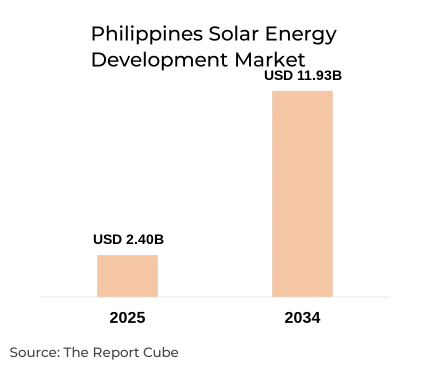
The Philippines Solar Energy Development Market is anticipated to register a 19.5% during 2026-2034. The market size was valued at USD 2.4 billion in 2025 and is projected to reach USD 11.93 billion by 2034. Rapid energy demand growth, government renewable energy targets, and strong private sector investment are accelerating solar deployment across the Philippines. Rising electricity prices and vulnerability to fossil fuel price fluctuations are also encouraging the expansion of solar power infrastructure across the country.
Investment activity in solar power has increased significantly as the Philippines aims to strengthen energy security while reducing carbon emissions. National electricity demand has grown by nearly 6% annually in recent years, driven by industrial expansion, urbanization, and increasing residential consumption. Solar energy offers a scalable and cost-effective solution to meet this rising demand. Large-scale solar farms, distributed rooftop systems, and hybrid solar-battery projects are becoming central components of the national energy strategy.
Private sector participation is also expanding rapidly. Major energy companies and renewable developers are investing in multi-gigawatt solar projects, battery storage systems, and grid integration technologies. The country’s geographic advantage—high solar irradiance averaging 4.5–5.5 kWh/m² per day—supports strong solar productivity throughout the year. Financial incentives such as feed-in tariffs, tax benefits, and foreign investment allowances are attracting international developers and capital into the Philippine solar market.
Infrastructure modernization is another critical driver. The National Grid Corporation of the Philippines has accelerated transmission upgrades to accommodate higher renewable penetration. Battery energy storage systems are increasingly deployed to stabilize intermittent solar generation. These developments strengthen the reliability of renewable power while supporting the Philippines’ long-term transition toward sustainable electricity generation.
Philippines Solar Energy Development Market Dynamics
Key Driver: Rising Electricity Demand and Renewable Energy Targets
Growing electricity demand across the Philippines is one of the primary drivers supporting solar energy development. The country’s rapidly expanding economy and population are creating increasing energy consumption across industrial, commercial, and residential sectors. Annual electricity demand is projected to increase by nearly 6–7% through the next decade. Solar energy provides a scalable solution capable of meeting this demand while reducing dependence on imported fossil fuels.
Government renewable energy targets are also accelerating solar development. National energy policy aims to increase renewable energy share to 35% by 2030 and 50% by 2040. These targets require large-scale expansion of solar power generation capacity. Utility-scale solar farms are particularly attractive because they can be deployed quickly and provide competitive electricity costs compared with coal and natural gas power plants.
Private investment is another major factor supporting growth. Domestic and international energy developers are increasingly entering the Philippine renewable energy sector. Competitive auction programs and improved regulatory transparency have encouraged project financing and infrastructure development. As solar technology costs continue to decline, solar power is becoming one of the most cost-effective electricity sources in the country.
Book your FREE 30-minute expert consultation today
Contact UsIndustry Trends: Rapid Expansion of Utility-Scale Solar and Energy Storage
One of the most notable trends shaping the Philippines solar energy development market is the expansion of large-scale solar power projects integrated with battery storage systems. Developers are building gigawatt-scale solar farms capable of delivering consistent electricity through integrated storage technology. This approach improves grid stability while enabling solar energy to provide reliable power even during evening demand peaks.
Hybrid renewable energy systems are also becoming increasingly popular. Solar plants are being combined with wind, geothermal, and energy storage infrastructure to diversify power generation and improve supply reliability. These hybrid systems allow energy developers to maximize generation efficiency while maintaining consistent electricity output.
Another key trend is the growing adoption of distributed solar installations. Commercial buildings, manufacturing facilities, and residential homes are installing rooftop solar systems to reduce electricity costs. Net metering policies enable consumers to export excess electricity to the grid, improving the financial attractiveness of rooftop solar investments.
Technology innovation is also supporting industry growth. Modern solar photovoltaic panels are achieving higher efficiency levels, while digital monitoring systems allow real-time performance optimization. These improvements increase energy output while lowering maintenance costs, making solar power even more competitive compared with conventional electricity generation sources.
Major Challenge: Grid Infrastructure Limitations and Intermittency Issues
Although the solar energy sector is expanding rapidly in the Philippines, grid infrastructure limitations remain a significant challenge. Many renewable energy projects are located in remote regions with limited transmission capacity. Upgrading transmission lines and substations is necessary to ensure efficient power distribution from solar farms to urban demand centers.
Solar energy generation is also intermittent, meaning electricity output varies depending on sunlight availability. Without adequate storage solutions or grid flexibility, sudden fluctuations in solar generation can affect grid stability. Energy storage technologies such as lithium-ion batteries are increasingly being deployed to address this issue, but large-scale storage systems still require substantial investment.
Land acquisition and permitting processes can also delay project development. Large solar farms require significant land area, and environmental approvals may take time to obtain. These regulatory and infrastructure challenges can extend project timelines and increase development costs for solar developers.
Opportunity: Expansion of Distributed Solar and Commercial Rooftop Installations
The expansion of distributed solar systems presents a major opportunity for the Philippines solar energy development market. Commercial buildings, manufacturing facilities, and shopping centers are increasingly adopting rooftop solar installations to reduce electricity costs and improve energy sustainability. Businesses are attracted by the potential to reduce energy expenses by up to 30% through self-generation.
Residential rooftop solar systems are also gaining popularity as electricity prices continue to rise. Net metering programs allow homeowners to sell excess electricity back to the grid, improving the return on investment for rooftop installations. Advances in small-scale battery storage systems further enhance residential solar adoption by enabling households to store surplus electricity for later use.
Off-grid solar solutions represent another major opportunity. Many rural communities and remote islands in the Philippines still lack reliable electricity access. Solar mini-grids and standalone photovoltaic systems can provide affordable electricity in these regions, improving energy accessibility while supporting local economic development.
Philippines Solar Energy Development Market Segment-wise Analysis
By Technology:
- Solar Photovoltaic
- Solar Thermal
The solar photovoltaic segment dominates the Philippines solar energy development market, accounting for approximately 88% of installed solar capacity in 2025. Photovoltaic technology converts sunlight directly into electricity and offers greater scalability and cost efficiency compared with solar thermal systems. Large solar farms, rooftop installations, and hybrid renewable projects predominantly use photovoltaic panels due to their modular design and declining manufacturing costs.
Global improvements in photovoltaic efficiency have significantly increased electricity output per panel. Modern solar panels now achieve efficiency levels exceeding 22%, enabling developers to maximize energy generation while reducing land requirements. In addition, photovoltaic systems are easier to integrate with battery storage technologies, making them ideal for grid stabilization projects. As solar technology costs continue declining, photovoltaic installations are expected to remain the dominant technology in the Philippine solar market throughout the forecast period.
By Application:
- Utility-Scale Solar
- Commercial and Industrial Solar
- Residential Rooftop Solar
- Off-Grid and Remote Solar
The utility-scale solar segment holds the largest market share, accounting for approximately 46% of total solar energy capacity in the Philippines. Utility-scale projects involve large solar farms connected directly to the national grid, capable of generating hundreds of megawatts of electricity. These projects benefit from economies of scale, enabling developers to produce electricity at competitive costs compared with traditional fossil fuel power plants.
Large solar farms are often developed in regions with abundant land availability and high solar irradiation levels. Government renewable energy auctions and long-term power purchase agreements are supporting the development of these projects. Utility-scale installations also play a critical role in helping the Philippines achieve its national renewable energy targets, making them a cornerstone of the country’s energy transition strategy.
Regional Projection of Philippines Solar Energy Development Industry
- Luzon
- Visayas
- Mindanao
Luzon dominates the Philippines solar energy development market, representing nearly 62% of total solar power capacity. The region hosts the country’s largest electricity demand centers, including Metro Manila and several major industrial zones. As a result, most large-scale renewable energy projects are concentrated in Luzon to ensure efficient electricity distribution and grid connectivity.
The region also benefits from stronger transmission infrastructure compared with other parts of the country. Major solar projects are being developed in provinces such as Nueva Ecija, Pangasinan, and Bulacan, where large land areas are available for solar farms. Government energy policies and private investment continue to support solar development across Luzon, strengthening its position as the leading region in the Philippine solar energy market.
Philippines Solar Energy Development Market Recent Developments
- 2025: AboitizPower energized its 92.55-MWp San Manuel solar power plant in Pangasinan and secured grid approval for the 173-MWp Calatrava Solar Power Plant in Negros Occidental, strengthening its renewable energy portfolio and expanding solar capacity within the Philippine national grid.
- 2025: Citicore Renewable Energy Corporation secured a US$55 million development loan from Pentagreen Capital to finance up to 610 MWp of solar projects with 760 MWh battery storage across multiple provinces, enabling large-scale renewable deployment and advancing baseload solar power generation.
- 2025: Terra Solar Philippines announced installation of 778 MW of solar panels for the MTerra Solar Project, a planned 3,500-MWp solar facility with 4,500 MWh battery storage expected to supply electricity to about 2.4 million households across the Philippines.
- 2025: First Gen Corporation revealed plans to invest over ₱1 billion for its first large-scale solar farm, the 150-MW Inara solar project in Batangas, aimed at supplying renewable electricity to the First Philippine Industrial Park.
Need insights for a specific region within this market?
Request Regional DataWhy Choose This Report?
- Provides a comprehensive overview of the overall market analysis, encompassing key trends, consumer behavior analysis, and risk assessment to support strategic decision-making.
- Provides accurate, up-to-date insights into market size, segmentation, and emerging opportunities, helping to minimize risk & capitalizing on growth.
- Gives deep understanding of target audience preferences, investment habits, and communication channels for enhanced product development & marketing effectiveness.
- Delivers competitive analysis & benchmarking, uncovering the strengths & weaknesses of market competitors to guide strategies.
- Consolidate comprehensive market intelligence, reducing reasoning & streamlining research efforts.
- Facilitates customized market segmentation & risk mitigation strategies, fine-tuned to the business objectives.
- Aids in identifying both market challenges & untapped opportunities within the industry to drive long-term business growth.
- Provides valuable information based on actual customer data & search trends.
Table of Contents
- Introduction
- Objective of the Study
- Product and Category Definition
- Market Segmentation
- Study Variables
- Research Methodology
- Secondary Data Points
- Breakdown of Secondary Sources
- Primary Data Points
- Breakdown of Primary Interviews
- Secondary Data Points
- Executive Summary
- Market Dynamics
- Drivers
- Challenges
- Opportunity Assessment
- Recent Trends and Developments
- Regulatory and Policy Landscape
- Philippines Solar Energy Development Market Overview (2021-2034)
- Market Size, By Capacity (MW/GW)
- Market Size, By Value (USD Billion)
- Market Share, By Technology
- Solar Photovoltaic
- Solar Thermal
- Market Share, By Grid Connection
- On-Grid Solar
- Off-Grid Solar
- Market Share, By Application
- Utility-Scale Solar
- Commercial and Industrial Solar
- Residential Rooftop Solar
- Off-Grid and Remote Solar
- Market Share, By Installation Type
- Ground-Mounted Solar
- Rooftop Solar
- Floating Solar
- Market Share, By End User
- Power Utilities
- Commercial Enterprises
- Industrial Users
- Residential Consumers
- Government and Public Sector
- Market Share, By Region
- Luzon
- Visayas
- Mindanao
- Market Share, By Company
- Capacity Shares and Installed Base
- Project Pipeline and Awarded Capacity
- Competitive Landscape
- Luzon Solar Energy Development Market
- Market Size, By Capacity (MW/GW)
- Market Size, By Value (USD Billion/Million)
- Market Share, By Technology
- Solar Photovoltaic
- Solar Thermal
- Market Share, By Grid Connection
- On-Grid Solar
- Off-Grid Solar
- Market Share, By Application
- Utility-Scale Solar
- Commercial and Industrial Solar
- Residential Rooftop Solar
- Off-Grid and Remote Solar
- Market Share, By Installation Type
- Ground-Mounted Solar
- Rooftop Solar
- Floating Solar
- Market Share, By End User
- Power Utilities
- Commercial Enterprises
- Industrial Users
- Residential Consumers
- Government and Public Sector
- Visayas Solar Energy Development Market
- Market Size, By Capacity (MW/GW)
- Market Size, By Value (USD Billion/Million)
- Market Share, By Technology
- Solar Photovoltaic
- Solar Thermal
- Market Share, By Grid Connection
- On-Grid Solar
- Off-Grid Solar
- Market Share, By Application
- Utility-Scale Solar
- Commercial and Industrial Solar
- Residential Rooftop Solar
- Off-Grid and Remote Solar
- Market Share, By Installation Type
- Ground-Mounted Solar
- Rooftop Solar
- Floating Solar
- Market Share, By End User
- Power Utilities
- Commercial Enterprises
- Industrial Users
- Residential Consumers
- Government and Public Sector
- Mindanao Solar Energy Development Market
- Market Size, By Capacity (MW/GW)
- Market Size, By Value (USD Billion/Million)
- Market Share, By Technology
- Solar Photovoltaic
- Solar Thermal
- Market Share, By Grid Connection
- On-Grid Solar
- Off-Grid Solar
- Market Share, By Application
- Utility-Scale Solar
- Commercial and Industrial Solar
- Residential Rooftop Solar
- Off-Grid and Remote Solar
- Market Share, By Installation Type
- Ground-Mounted Solar
- Rooftop Solar
- Floating Solar
- Market Share, By End User
- Power Utilities
- Commercial Enterprises
- Industrial Users
- Residential Consumers
- Government and Public Sector
- Competitive Outlook and Company Profiles
- Solar Philippines
- Company Overview
- Product Portfolio
- Strategic Alliances/Partnerships
- Recent Developments
- ACEN
- Company Overview
- Product Portfolio
- Strategic Alliances/Partnerships
- Recent Developments
- AboitizPower
- Company Overview
- Product Portfolio
- Strategic Alliances/Partnerships
- Recent Developments
- Citicore Renewable Energy
- Company Overview
- Product Portfolio
- Strategic Alliances/Partnerships
- Recent Developments
- Terra Solar Philippines
- Company Overview
- Product Portfolio
- Strategic Alliances/Partnerships
- Recent Developments
- First Gen
- Company Overview
- Product Portfolio
- Strategic Alliances/Partnerships
- Recent Developments
- Solaric Corp
- Company Overview
- Product Portfolio
- Strategic Alliances/Partnerships
- Recent Developments
- Buskowitz Energy
- Company Overview
- Product Portfolio
- Strategic Alliances/Partnerships
- Recent Developments
- Solenergy Systems
- Company Overview
- Product Portfolio
- Strategic Alliances/Partnerships
- Recent Developments
- SolarNRG Philippines
- Company Overview
- Product Portfolio
- Strategic Alliances/Partnerships
- Recent Developments
- Solaren Renewable Energy
- Company Overview
- Product Portfolio
- Strategic Alliances/Partnerships
- Recent Developments
- Philergy German Solar
- Company Overview
- Product Portfolio
- Strategic Alliances/Partnerships
- Recent Developments
- MGen
- Company Overview
- Product Portfolio
- Strategic Alliances/Partnerships
- Recent Developments
- SunAsia Energy
- Company Overview
- Product Portfolio
- Strategic Alliances/Partnerships
- Recent Developments
- Vena Energy Philippines
- Company Overview
- Product Portfolio
- Strategic Alliances/Partnerships
- Recent Developments
- MSpectrum
- Company Overview
- Product Portfolio
- Strategic Alliances/Partnerships
- Recent Developments
- Solar Up Philippines
- Company Overview
- Product Portfolio
- Strategic Alliances/Partnerships
- Recent Developments
- Others
- Solar Philippines
- Contact Us and Disclaimer
Top Key Players & Market Share Outlook
- Solar Philippines
- ACEN
- AboitizPower
- Citicore Renewable Energy
- Terra Solar Philippines
- First Gen
- Solaric Corp
- Buskowitz Energy
- Solenergy Systems
- SolarNRG Philippines
- Solaren Renewable Energy
- Philergy German Solar
- MGen
- SunAsia Energy
- Vena Energy Philippines
- MSpectrum
- Solar Up Philippines
Frequently Asked Questions