


Build Your Custom Market Intelligence Report
Customize Your ReportKey Takeaways
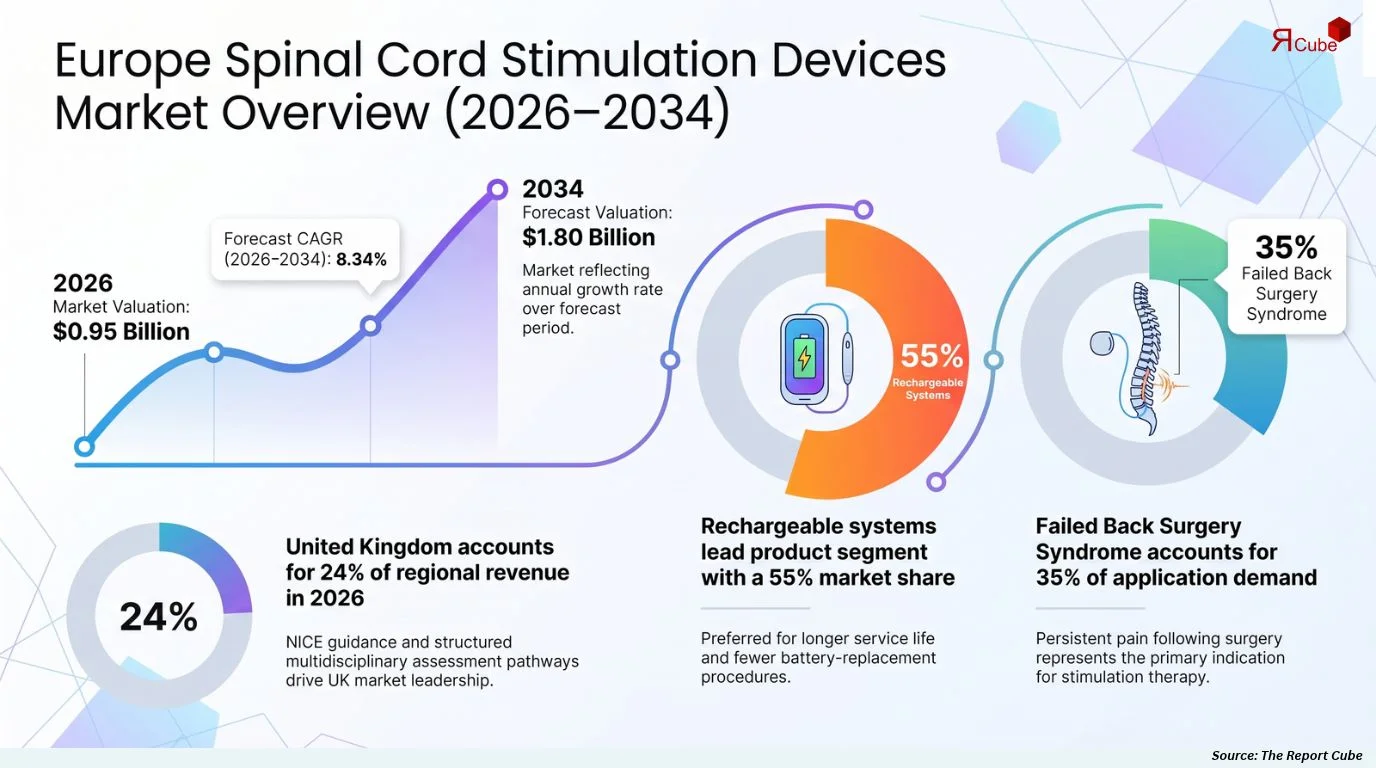
- Europe spinal cord stimulation devices market valued at USD 0.95 billion in 2026, reflecting established chronic pain treatment pathways.
- Industry projected to reach USD 1.80 billion by 2034 at 8.34% CAGR.
- Rechargeable systems lead the product segment with an estimated 55% share in 2026.
- Failed back surgery syndrome leads the application segment with an estimated 35% share in 2026.
- Hospitals remain the leading end-user setting for assessment, implantation and follow-up.
- The United Kingdom accounts for an estimated 24% of regional revenue in 2026.
- Abbott, Medtronic, Boston Scientific and Nevro lead device supply across Europe.
- Closed-loop sensing and rechargeable designs continue to shape product development.
Market Overview
Spinal cord stimulation devices are implantable neuromodulation systems that deliver controlled electrical pulses to the spinal cord to alter pain signals before they reach the brain. A system typically includes leads, an implantable pulse generator and an external programmer. Clinicians use them mainly for chronic neuropathic pain after conventional medical management has failed to provide adequate relief.
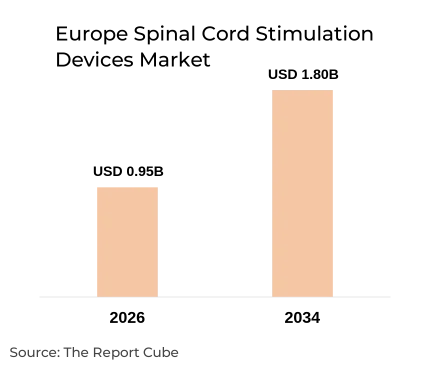
The Europe Spinal Cord Stimulation Devices Market is valued at USD 0.95 billion in 2026 and is expected to reach USD 1.80 billion by 2034. This Europe Spinal Cord Stimulation Devices Market Analysis shows demand tied to treatment pathways such as NICE guidance, which supports the therapy for selected adults after conventional management and a successful stimulation trial.
Hospitals and specialised pain centres adopt these systems for patients with persistent pain who meet established clinical criteria. Selection weighs battery longevity, rechargeability, stimulation requirements and support packages, with rechargeable systems holding a 55% share in 2026. The market is projected to grow at a CAGR of 8.34% during 2026–2034.
Europe Spinal Cord Stimulation Devices Market Dynamics
Demand, supply and adoption are shaped by clinical eligibility rules, device technology, reimbursement structures and specialist capacity. Manufacturers compete on battery longevity, programming flexibility and patient support, while pricing and national funding systems influence procurement. Europe Spinal Cord Stimulation Devices Market Growth therefore reflects clinical pathways and commercial innovation.
|
Factor |
Type |
Specific Impact on Market |
Magnitude |
|---|---|---|---|
|
Chronic neuropathic pain treatment need |
Driver |
Supports demand for implantable systems among eligible patients after conventional management |
High |
|
Rechargeable neuromodulation systems |
Driver |
Longer service life and fewer battery-replacement procedures support product selection |
Medium–High |
|
Multidisciplinary assessment pathways |
Opportunity |
Creates demand for pain centres, trial-stimulation services and follow-up programmes |
Medium |
|
Product differentiation |
Opportunity |
Battery life, charging convenience and patient support differentiate suppliers |
Medium |
|
Strict clinical eligibility |
Challenge |
Limits the addressable population to selected patients with a successful trial |
Medium–High |
|
Device costs and reimbursement |
Challenge |
National funding differences affect adoption and system choice |
High |
|
Patient-specific device selection |
Trend |
Shapes the choice between rechargeable and non-rechargeable systems |
Medium |
Europe Spinal Cord Stimulation Devices Market Growth Drivers
Chronic neuropathic pain that persists despite conventional treatment creates a defined clinical need. NICE supports spinal cord stimulation for selected adults who continue to experience significant pain after appropriate medical management and who respond to a stimulation trial. This guidance gives clinicians a structured pathway for eligible patients, supporting demand for implantable systems within United Kingdom pain services.
Rechargeable systems hold a 55% share in 2026, reflecting preference for devices that may offer longer service life and fewer battery-replacement procedures. Suitability still depends on patient needs, charging ability and the selected device. Continued development of rechargeable platforms supports replacement and new-implant decisions in clinics evaluating long-term cost and support requirements.
Europe Spinal Cord Stimulation Devices Market Opportunities
NICE states that spinal cord stimulation should follow assessment by a multidisciplinary team experienced in chronic pain and device management. This creates opportunities for specialised pain centres, structured assessment pathways, trial-stimulation services and long-term follow-up programmes, particularly for clinical providers able to coordinate patient selection, implantation and ongoing device optimisation.
Manufacturers can differentiate through battery longevity, charging convenience, programming flexibility and patient-support services. As rechargeable systems account for 55% of the market in 2026, product design and aftercare may influence selection by hospitals and pain clinics. These remain commercial opportunities and do not, on their own, guarantee improved clinical outcomes.
Europe Spinal Cord Stimulation Devices Industry Challenges
Clinical eligibility limits the addressable population. NICE recommends spinal cord stimulation for selected adults with chronic neuropathic pain who meet specified criteria and show a successful stimulation trial. These requirements, together with the need for specialist assessment, restrict implantation to eligible patients and can lengthen the pathway from referral to treatment.
Device selection must account for acquisition cost, expected longevity, stimulation requirements and the support package offered, according to NICE. Differences in national reimbursement systems, clinical resources and follow-up capacity across European countries may affect adoption and the choice between rechargeable and non-rechargeable systems. Hospital budget constraints can therefore influence procurement decisions.
Need Specific Data, Let’s Customize the Report for You
Request CustomizationEurope Spinal Cord Stimulation Devices Market Trends
Device selection for spinal cord stimulation is becoming more patient-specific. NICE requires a successful trial and multidisciplinary assessment, and advises that device choice consider cost, anticipated longevity, stimulation requirements and support packages. This approach shapes how clinicians choose between rechargeable and non-rechargeable systems, linking Europe Spinal Cord Stimulation Devices Market Trends to individual patient needs.
Neuromodulation technology continues to develop, with closed-loop sensing and rechargeable designs entering European markets. Medtronic received CE mark for its Inceptiv closed-loop rechargeable system in June 2026, and Saluda Medical announced CE certification for its EVA Sensing Technology. These launches indicate continued manufacturer investment, although commercial uptake will vary by country and clinical setting.
Europe Spinal Cord Stimulation Devices Market Segment Analysis
This Europe Spinal Cord Stimulation Devices Market Share assessment covers product, application and end-user segments. Each category reflects how clinical eligibility, device technology and care-setting capabilities shape demand for implantable pain therapy systems across European healthcare providers.
By Product
- Rechargeable
- Non-Rechargeable
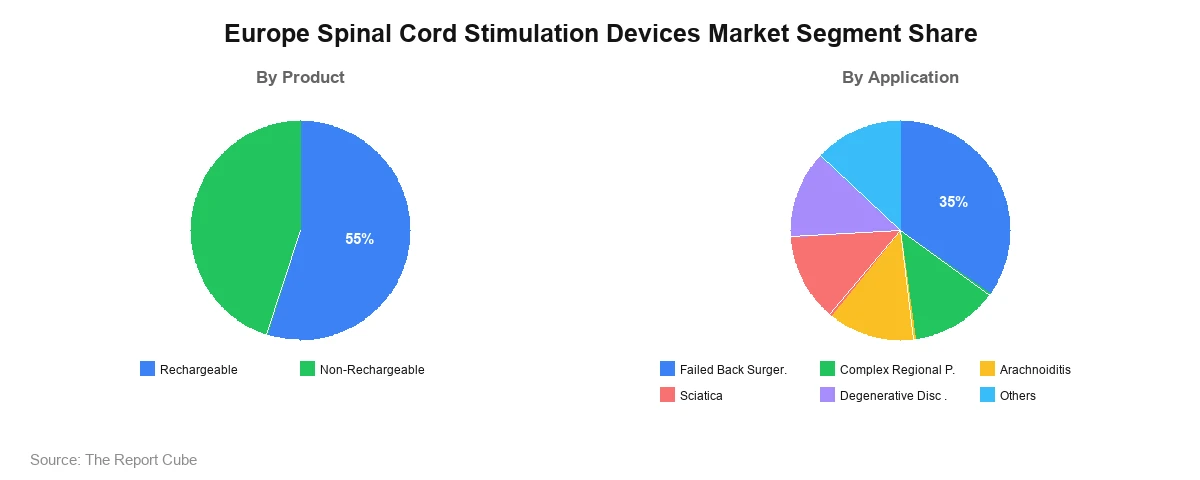
Rechargeable systems lead the product category with an estimated 55% share in 2026, supported by longer service life, fewer battery-replacement procedures and ongoing development of closed-loop platforms such as Medtronic’s Inceptiv, which carries CE mark approval. Rechargeable use still depends on patient needs and the ability to manage charging, so clinicians weigh device longevity against ease of use. Non-rechargeable systems remain relevant for patients who prefer or require a device without a charging routine. Suppliers including Boston Scientific and Abbott offer implantable pulse generators in both formats, while NICE guidance directs clinicians to consider cost, anticipated longevity, stimulation requirements and support packages when choosing between them.
By Application
- Failed Back Surgery Syndrome
- Complex Regional Pain Syndrome
- Arachnoiditis
- Sciatica
- Degenerative Disc Disease
- Others
Failed back surgery syndrome leads the application segment with an estimated 35% share in 2026, as persistent neuropathic back and leg pain after spinal surgery is a core indication for spinal cord stimulation once conventional management has been exhausted. Complex regional pain syndrome and arachnoiditis represent more specialised indications, while sciatica and degenerative disc disease contribute through chronic pain cases that meet clinical eligibility criteria. Others include additional chronic pain conditions assessed by multidisciplinary teams. Demand across all applications is shaped by stimulation-trial outcomes, specialist referral capacity and device-selection criteria. Abbott, Medtronic, Boston Scientific and Nevro compete across these indications through differentiated waveforms and programming options.
Regional Analysis
|
Region |
Estimated Market Share |
Key Growth Factors |
Industry Trends |
|---|---|---|---|
|
United Kingdom |
24% |
NICE eligibility guidance, multidisciplinary assessment and trial-stimulation requirements |
Structured, patient-specific device selection |
|
France, Germany, Italy, Spain, Belgium, Netherlands and Others |
76% combined |
National reimbursement policies, clinical guidelines and specialist pain-service capacity |
Country-level variation in adoption and follow-up resources |
The United Kingdom accounts for an estimated 24% of the Europe Spinal Cord Stimulation Devices Market in 2026, the country share identified for this report. NICE guidance defines eligibility for spinal cord stimulation, requiring multidisciplinary assessment and a successful stimulation trial, which structures referral and device selection within national pain services and supports demand for implantable systems among eligible adults.
France, Germany, Italy, Spain, Belgium, the Netherlands and other European countries together account for the remaining 76% of the market. Adoption across these countries depends on national reimbursement policies, clinical guidelines, specialist pain-service capacity and follow-up resources, which vary by country. Country-level shares are not separately disclosed, so regional comparisons should be treated as qualitative.
Market Share & Competitive Landscape
The Europe Spinal Cord Stimulation Devices Market is led by multinational neuromodulation suppliers alongside specialised technology developers. Competition centres on stimulation waveforms, closed-loop sensing, battery longevity, MRI compatibility and clinical support. Company positioning below reflects product capabilities rather than numerical market share.
|
Company |
Competitive Strength |
Primary Segment Served |
|---|---|---|
|
Abbott Laboratories |
BurstDR stimulation therapy and dorsal root ganglion neurostimulation portfolio |
Spinal cord and DRG stimulation for chronic pain |
|
Medtronic plc. |
Intellis platform and Inceptiv closed-loop rechargeable system (CE mark, June 2026) |
Rechargeable spinal cord stimulation |
|
Boston Scientific Corp. |
WaveWriter Alpha and Precision Spectra systems supporting up to 32 contacts |
Spinal cord and trunk peripheral nerve stimulation |
|
Nevro Corp. |
HFX high-frequency platform and Senza system; part of Globus Medical since April 2025 |
High-frequency spinal cord stimulation |
|
Saluda Medical Pty Ltd |
Evoke closed-loop system and CE-certified EVA Sensing Technology |
Closed-loop spinal cord stimulation |
|
Beijing PINS Medical Co. Ltd |
Implantable neurostimulation manufacturer based in Beijing |
Implantable neurostimulation systems |
|
Nalu Medical |
Miniaturised neuromodulation systems |
Peripheral nerve stimulation for pain |
|
Stimwave Technologies |
Wireless micro-implantable stimulation technology |
Wireless neurostimulation |
|
Synapse Biomedical Inc. |
Implantable neurostimulation systems with a respiratory pacing focus |
Implantable neurostimulation |
|
Gimer Medical |
Implantable neuromodulation technologies |
Neuromodulation devices |
Key Companies in the Europe Spinal Cord Stimulation Devices Market
Medtronic plc.: Medtronic plc is headquartered in Dublin, Ireland, and is a global medical technology company. In June 2026 it received CE mark approval for Inceptiv, a closed-loop rechargeable spinal cord stimulator, with European launch planned in the coming months. Closed-loop sensing strengthens its competitive position in rechargeable systems.
Nevro Corp.: Nevro Corp. is headquartered in Redwood City, California, and is known for its HFX high-frequency spinal cord stimulation platform and Senza system. Globus Medical completed its acquisition of Nevro on April 3, 2025, valuing it at about USD 250 million. The transaction positions HFX technology within Globus Medical’s musculoskeletal portfolio.
Recent Developments
|
Year / Month |
Company |
Development |
|---|---|---|
|
April 2025 |
Globus Medical / Nevro Corp. |
Globus Medical completed its acquisition of Nevro Corp., adding the HFX spinal cord stimulation platform to its portfolio. |
|
January 2026 |
Abbott Laboratories |
Abbott announced study results showing BurstDR therapy reduced pain-related healthcare visits by an average of 75% over five years. |
|
2026 (month to be confirmed) |
Saluda Medical Pty Ltd |
Saluda received CE certification for EVA Sensing Technology, with limited European release planned for Q1 2026. |
|
June 2026 |
Medtronic plc. |
Medtronic received CE mark approval for its Inceptiv closed-loop rechargeable spinal cord stimulator, with European launch planned. |
Europe Spinal Cord Stimulation Devices Market Future Outlook
The Europe Spinal Cord Stimulation Devices Market Forecast indicates growth from USD 0.95 billion in 2026 to USD 1.80 billion by 2034, at a CAGR of 8.34%. Expansion is expected to depend on adherence to clinical eligibility pathways, continued development of rechargeable and closed-loop systems, and the capacity of specialist pain services to assess, implant and follow up eligible patients across European healthcare systems.
Manufacturers are likely to compete on battery longevity, sensing capability, programming flexibility and patient-support services, while reimbursement decisions and device costs will continue to influence procurement. Regulatory approvals, such as recent CE marks, may widen clinical options, but actual adoption will vary by country and facility. These projections are conditional on clinical, economic and policy conditions and are not guaranteed outcomes.
Europe Spinal Cord Stimulation Devices Market Report Coverage
This Europe Spinal Cord Stimulation Devices Market Report outlines the scope, segmentation and coverage of the study.
|
Parameter |
Details |
|---|---|
|
Market Name |
Europe Spinal Cord Stimulation Devices Market |
|
Market Size 2026 |
USD 0.95 Billion |
|
Market Size 2034 |
USD 1.80 Billion |
|
Forecast Period |
2026–2034 |
|
CAGR |
8.34% |
|
Base Year |
2026 |
|
Historical Years |
2021–2025 |
|
Forecast Years |
2026–2034 |
|
Segments Covered |
By Product (Rechargeable, Non-Rechargeable); By Application (Failed Back Surgery Syndrome, Complex Regional Pain Syndrome, Arachnoiditis, Sciatica, Degenerative Disc Disease, Others); By End User (Hospitals, Ambulatory Surgical Centers, Others) |
|
Regions Covered |
France, Germany, Italy, Spain, United Kingdom, Belgium, Netherlands, Others |
|
Key Companies |
Abbott Laboratories, Medtronic plc., Boston Scientific Corp., Nevro Corp., Saluda Medical Pty Ltd, Beijing PINS Medical Co. Ltd, Nalu Medical, Stimwave Technologies, Synapse Biomedical Inc., Gimer Medical |
|
Report Format |
PDF, Excel, PPT |
|
Customization |
Available as per client requirements |
Why Choose This Europe Spinal Cord Stimulation Devices Market Report?
- Covers product, application and end-user segments of the European spinal cord stimulation landscape.
- Provides market sizing for 2026 with a forecast through 2034.
- Segments the market by rechargeable and non-rechargeable systems and by clinical indication.
- Offers country-level context, including the United Kingdom’s estimated 24% share.
- Profiles ten manufacturers and technology developers active in neuromodulation.
- Tracks closed-loop sensing, rechargeable design and patient-specific device selection trends.
- Supports planning with clinical-guideline and regulatory context, without guaranteeing business outcomes.
Table of Contents
- Introduction
- Objective of the Study
- Product Definition
- Market Segmentation
- Study Variables
- Research Methodology
- Secondary Data Points
- Companies Interviewed
- Primary Data Points
- Breakdown of Primary Interviews
- Secondary Data Points
- Executive Summary
- Market Dynamics
- Drivers
- Challenges
- Opportunity Assessment
- Recent Trends and Developments
- Policy and Regulatory Landscape
- Europe Spinal Cord Stimulation Devices Market Overview and Forecast Analysis (2021-2034)
- Market Size, By Value, By Growth Rate (CAGR/USD Billions)
- Demand – Supply Trends
- Market Share, By Product
- Rechargeable
- Non-Rechargeable
- Market Share, By Application
- Failed Back Surgery Syndrome
- Complex Regional Pain Syndrome
- Arachnoiditis
- Sciatica
- Degenerative Disc Disease
- Others
- Market Share, By End User
- Hospitals
- Ambulatory Surgical Centers
- Others
- Market Share, By Country
- France
- Germany
- Italy
- Spain
- United Kingdom
- Belgium
- Netherlands
- Others
- Market Share, By Competitors
- Competition Characteristics
- Revenue Shares
- Rechargeable Europe Spinal Cord Stimulation Devices Market Overview, 2021-2034F
- By Value (USD Million)
- By Application – Market Size & Forecast 2021-2034, USD Million
- Failed Back Surgery Syndrome
- Complex Regional Pain Syndrome
- Arachnoiditis
- Sciatica
- Degenerative Disc Disease
- Others
- Non-Rechargeable Europe Spinal Cord Stimulation Devices Market Overview, 2021-2034F
- By Value (USD Million)
- By Application – Market Size & Forecast 2021-2034, USD Million
- Failed Back Surgery Syndrome
- Complex Regional Pain Syndrome
- Arachnoiditis
- Sciatica
- Degenerative Disc Disease
- Others
- Competitive Outlook (Company Profile – Partial List)
- Abbott Laboratories
- Company Overview
- Business Segments
- Strategic Alliances/Partnerships
- Recent Developments
- Medtronic plc.
- Company Overview
- Business Segments
- Strategic Alliances/Partnerships
- Recent Developments
- Boston Scientific Corp.
- Company Overview
- Business Segments
- Strategic Alliances/Partnerships
- Recent Developments
- Nevro Corp.
- Company Overview
- Business Segments
- Strategic Alliances/Partnerships
- Recent Developments
- Saluda Medical Pty Ltd
- Company Overview
- Business Segments
- Strategic Alliances/Partnerships
- Recent Developments
- Beijing PINS Medical Co. Ltd
- Company Overview
- Business Segments
- Strategic Alliances/Partnerships
- Recent Developments
- Nalu Medical
- Company Overview
- Business Segments
- Strategic Alliances/Partnerships
- Recent Developments
- Stimwave Technologies
- Company Overview
- Business Segments
- Strategic Alliances/Partnerships
- Recent Developments
- Synapse Biomedical Inc.
- Company Overview
- Business Segments
- Strategic Alliances/Partnerships
- Recent Developments
- Gimer Medical
- Company Overview
- Business Segments
- Strategic Alliances/Partnerships
- Recent Developments
- Abbott Laboratories
- Contact Us & Disclaimer
Top Key Players & Market Share Outlook
- Abbott Laboratories
- Medtronic plc.
- Boston Scientific Corp.
- Nevro Corp.
- Saluda Medical Pty Ltd
- Beijing PINS Medical Co. Ltd
- Nalu Medical
- Stimwave Technologies
- Synapse Biomedical Inc.
- Gimer Medical
Frequently Asked Questions