



Build Your Custom Market Intelligence Report
Customize Your ReportUnited States Stem Cell Expansion Technologies Market Key Takeaways
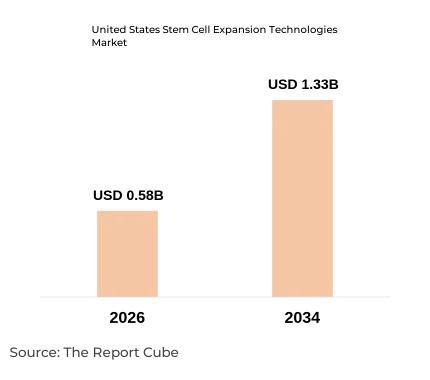
- Market valued at USD 0.58 billion in 2026, reflecting robust biomanufacturing investment momentum.
- Industry projected to reach USD 1.33 billion by 2034, expanding at a 10.89% CAGR.
- Cell and gene therapy remains the fastest-growing application segment driving platform innovation.
- Biotechnology and pharmaceutical companies lead end-user adoption through scaled manufacturing pipelines.
- The South region demonstrates strong growth backed by biotech cluster expansion and funding activity.
- Automated bioreactor systems and 3D culture platforms are reshaping upstream cell manufacturing workflows.
- Leading companies include Thermo Fisher Scientific, Merck KGaA, Danaher Corporation, Sartorius AG, and Miltenyi Biotec.
- Increasing FDA-approved cell therapy programs and NIH funding commitments sustain long-term market expansion.
United States Stem Cell Expansion Technologies Market Insights & Analysis
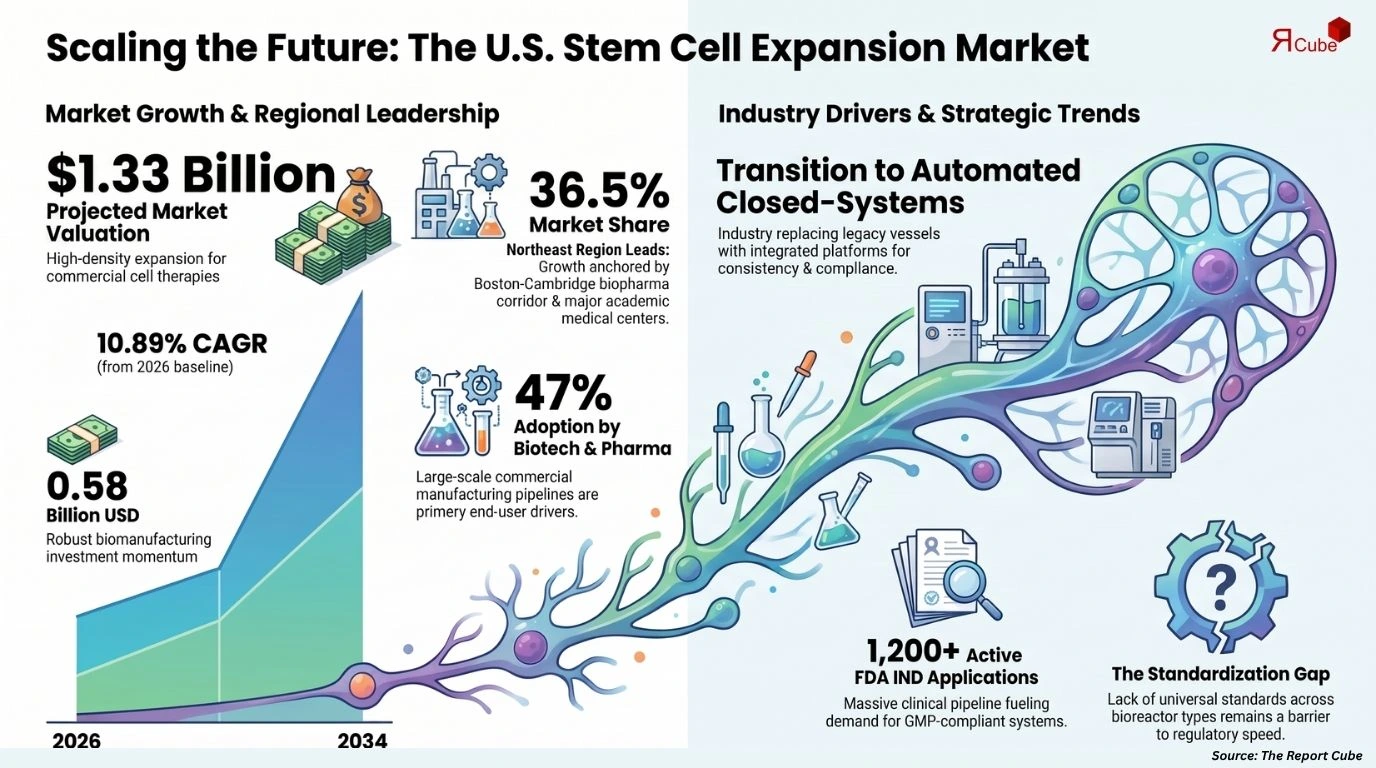
The United States Stem Cell Expansion Technologies Market is anticipated to register a 10.89% CAGR during 2026–2034. The market size was valued at USD 0.58 billion in 2026 and is projected to reach USD 1.33 billion by 2034. The industry is benefiting from surging clinical-stage cell and gene therapy pipelines, increasing FDA Breakthrough Therapy designations for stem cell-derived treatments, and expanding biomanufacturing infrastructure funded by public and private stakeholders. Strategic investments by the National Institutes of Health and the Advanced Research Projects Agency for Health (ARPA-H) are accelerating platform commercialization across academic and industry settings.
The cell therapy manufacturing infrastructure underpinning this market continues scaling as biopharmaceutical companies advance autologous and allogeneic programs toward commercialization. Single-use bioreactor technologies, closed-system processing platforms, and xeno-free expansion media formulations are replacing legacy open-vessel approaches, significantly improving lot consistency and regulatory compliance. Continued convergence of bioprocessing automation, quality-by-design principles, and digital process analytics is expected to sustain double-digit growth through the forecast horizon.
United States Stem Cell Expansion Technologies Market Dynamics
Demand for stem cell expansion platforms in the United States continues accelerating as cell and gene therapy developers, academic medical centers, and contract research organizations scale manufacturing capacity to meet clinical and commercial milestones. Regulatory clarity from the FDA, combined with increasing venture capital deployment into cell therapy startups, is reinforcing sustained infrastructure investment across upstream bioprocessing and expansion technology segments.
|
Factor |
Type |
Specific Impact on Market |
Magnitude |
|---|---|---|---|
|
Rising cell therapy IND filings |
Driver |
Accelerates adoption of scalable expansion platforms |
Very High |
|
xeno-free media innovation |
Opportunity |
Increases GMP-compliant expansion platform deployment |
High |
|
Bioreactor automation advances |
Trend |
Improves throughput, consistency, and regulatory readiness |
High |
|
Regulatory harmonization pressure |
Driver |
Boosts spending on validated, closed-system technologies |
High |
|
Workforce and skills gap |
Challenge |
Slows deployment of advanced automated expansion systems |
Medium |
Key Market Driver: Surging Cell Therapy Pipeline Demand
The United States hosts the world's largest clinical cell and gene therapy pipeline, with over 1,200 active IND applications on file with the FDA as of recent reporting cycles. This expansive pipeline is directly translating into procurement of scalable stem cell expansion systems capable of meeting GMP standards for phase II and phase III clinical manufacturing. Companies including Thermo Fisher Scientific and Sartorius AG are expanding their bioprocessing portfolios in direct response to client demand for integrated, validated expansion workflows that reduce batch variability and accelerate time-to-clinic timelines.
Major Industry Challenge: Standardization Across Heterogeneous Platforms
A persistent challenge facing the United States Stem Cell Expansion Technologies Market is the absence of universally accepted manufacturing standards across platform types, including spinner flasks, stirred-tank bioreactors, hollow-fiber systems, and microcarrier-based setups. Each technology carries distinct process parameters, making cross-platform comparability difficult for regulatory submissions. This bioreactor platform standardization gap requires organizations to invest heavily in process development, analytical characterization, and comparability studies, extending development timelines and increasing per-lot manufacturing costs without proportionate revenue uplift.
Emerging Trend Shaping Outlook: Closed-System and Automated Expansion Workflows
Contract research organizations and pharmaceutical manufacturers are rapidly transitioning toward fully closed, automated expansion systems that integrate real-time monitoring, automated feeding, and in-line cell density analytics. Platforms from Miltenyi Biotec and Terumo BCT now combine automated culture management with integrated harvest and wash modules, enabling end-to-end GMP processing in reduced facility footprints. This shift toward automation-first expansion architecture is compressing manual intervention requirements, lowering contamination risk, and enabling smaller specialized CROs to produce clinical-grade stem cell batches at previously inaccessible scale.
Need Specific Data, Let’s Customize the Report for You
Request CustomizationUnited States Stem Cell Expansion Technologies Market Segment-wise Analysis
The United States Stem Cell Expansion Technologies Market spans diverse application domains and end-user categories, each contributing distinct revenue streams and growth trajectories. Platform developers are increasingly designing modular, application-agnostic systems to serve the full breadth of regenerative medicine, gene therapy, and drug discovery workflows simultaneously.
By Application
- Regenerative Medicine
- Cell and Gene Therapy
- Drug Discovery & Development
- Others
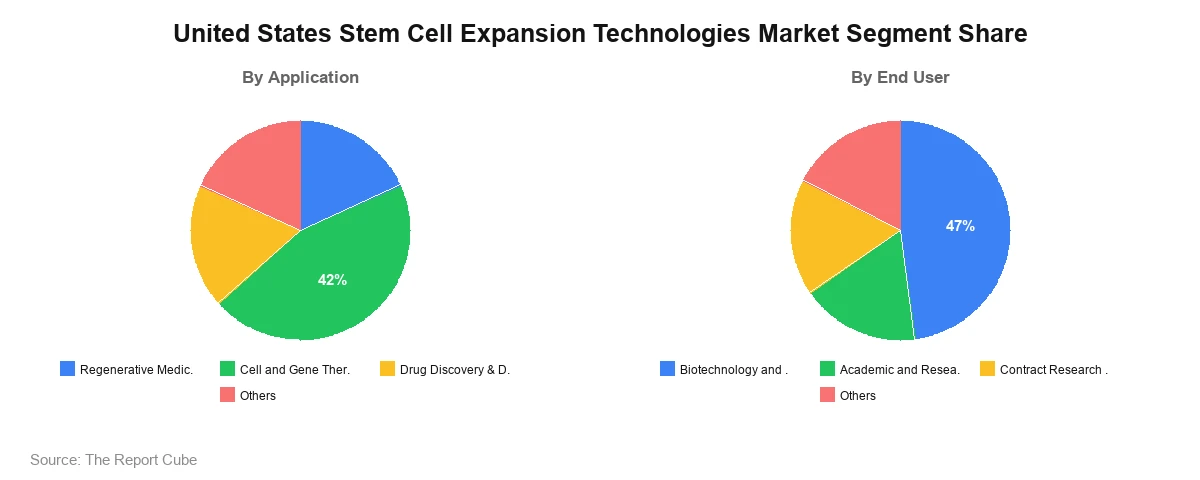
Cell and gene therapy commands the dominant application segment, representing an estimated 42% of total market revenue in 2026, driven by the accelerating pace of allogeneic CAR-T, natural killer cell, and induced pluripotent stem cell (iPSC) program entries into pivotal-stage clinical trials. The iPSC-derived therapy manufacturing advancements are creating particularly strong demand for high-density expansion systems capable of producing billions of cells per batch under stringent GMP conditions. Pharmaceutical sponsors are committing multiyear supply agreements with expansion technology vendors to secure manufacturing capacity ahead of anticipated BLA submissions between 2027 and 2030.
Regenerative medicine remains the second-largest application segment, contributing approximately 34% of 2026 market revenue, as orthopedic, cardiac, and neurological regenerative programs continue advancing through clinical development. Drug discovery and development applications are the fastest-growing adjacent segment, with academic pharmaceutical partnerships increasingly deploying patient-derived stem cell models for high-content screening, toxicology profiling, and disease modeling. Demand across the Others segment, including stem cell banking and veterinary applications, provides incremental but steady revenue contribution as platform costs normalize.
By End User
- Biotechnology and Pharmaceutical Companies
- Academic and Research Institutes
- Contract Research Organizations (CROs)
- Others
Biotechnology and pharmaceutical companies represent the leading end-user segment with an estimated 47% market share in 2026, reflecting their central role in advancing commercial-scale cell therapy manufacturing programs that require robust, validated expansion platforms. Major players including Takara Bio Inc. and STEMCELL Technologies Inc. are actively partnering with biotech clients to co-develop application-specific media and bioreactor configurations tailored to proprietary cell types. These companies are investing significantly in quality systems, process analytical technology, and regulatory documentation to support FDA inspections across commercial manufacturing sites.
Academic and research institutes constitute approximately 28% of market revenue, sustained by NIH and ARPA-H grant programs that fund cell biology research infrastructure, including automated expansion systems and specialized culture environments. Contract research organizations are the fastest-growing end-user category, as pharmaceutical sponsors increasingly outsource early- and clinical-stage cell expansion activities to specialized CDMOs equipped with GMP-compliant bioreactor suites. This outsourcing trend is compelling CROs to accelerate capital investment in next-generation expansion platforms, creating a durable procurement pipeline for technology vendors throughout the forecast period.
Regional Projection of United States Stem Cell Expansion Technologies Market
The United States Stem Cell Expansion Technologies Market exhibits meaningful geographic variation driven by biotech cluster density, academic medical center concentration, state-level life sciences investment incentives, and proximity to established cell therapy manufacturing hubs.
|
Region |
Estimated Market Share |
Key Growth Factors |
Consumer Trends |
|---|---|---|---|
|
Northeast |
36.5% |
Biopharma corridor density, academic medical centers, NIH proximity |
High adoption of automated GMP expansion systems |
|
South |
27.8% |
Biotech cluster growth, favorable tax incentives, CRO expansion |
Rising demand for scalable single-use bioreactor platforms |
|
West |
24.2% |
Venture capital concentration, iPSC research leadership, tech-bio convergence |
Increasing use of AI-integrated bioprocess monitoring |
|
Midwest |
11.5% |
University research programs, emerging CDMO presence |
Growing procurement of academic-grade expansion systems |
- Northeast: The Northeast commands approximately 36.5% market share, anchored by the Boston-Cambridge biopharma corridor, New York-based cell therapy developers, and proximity to major NIH-funded academic medical centers that drive both research procurement and commercial platform validation.
- South: The South region is demonstrating the fastest absolute growth trajectory, with Texas, North Carolina, and Maryland biotech clusters expanding CRO and CDMO manufacturing footprints, increasing procurement of validated expansion technologies and GMP-compliant culture systems.
- West: The West region, led by California's extensive iPSC research ecosystem and strong venture capital activity, sustains high demand for advanced expansion platforms as biotech startups advance novel cell therapy candidates from discovery through IND-enabling studies.
- Midwest: The Midwest contributes steadily through university-affiliated research programs and an emerging CDMO presence in Ohio, Michigan, and Illinois, with procurement concentrated in academic-grade expansion systems and early-phase clinical manufacturing platforms.
United States Stem Cell Expansion Technologies Market: Recent Development (2025)
- Thermo Fisher Scientific launched next-generation Gibco CTS bioreactor media optimized for large-scale allogeneic expansion.
- Sartorius AG partnered with a leading US cell therapy CDMO expanding GMP-compliant biostat bioreactor manufacturing capacity.
- Miltenyi Biotec received expanded US regulatory clearance for its CliniMACS Prodigy closed-system automated cell processing platform.
- Merck KGaA advanced its Mobius single-use bioreactor portfolio targeting commercial-scale iPSC and mesenchymal stem cell programs.
United States Stem Cell Expansion Technologies Market Future Outlook (2034)
The United States Stem Cell Expansion Technologies Market is projected to expand at a 10.89% CAGR, reaching approximately USD 1.33 billion by 2034. Increasing commercial approvals of cell and gene therapies, continued NIH investment in translational stem cell research, and the growing adoption of AI-driven bioprocess optimization will collectively transform how expansion platforms are designed, deployed, and validated. Vendors capable of delivering integrated, data-enabled expansion ecosystems will secure the strongest long-term positioning as manufacturing complexity increases alongside clinical program scale.
Future growth will be driven by the convergence of single-use technologies, automated process control, and advanced cell analytics that enable higher cell yields with reduced contamination risk and operator variability. The regenerative medicine manufacturing scale-up trajectory will further reinforce demand for modular, GMP-ready expansion platforms adaptable across multiple cell types and therapy modalities. Organizations investing in digital twin-based bioprocess modeling and continuous manufacturing frameworks will define the next frontier of stem cell expansion technology through 2034.
United States Stem Cell Expansion Technologies Market Report Coverage
|
Report Attribute |
Details |
|---|---|
|
Market Name |
United States Stem Cell Expansion Technologies Market |
|
Market Size (2026) |
USD 0.58 Billion |
|
Market Size (2034) |
USD 1.33 Billion |
|
Forecast Period |
2026–2034 |
|
CAGR |
10.89% |
|
Base Year |
2026 |
|
Historical Years |
2021–2025 |
|
Forecast Years |
2026–2034 |
|
Segments Covered |
By Application, By End User, By Cell Type, By Product, By Technology |
|
Regions Covered |
Northeast, Midwest, South, West |
|
Key Companies |
Merck KGaA, Corning Incorporated, Danaher Corporation, Miltenyi Biotec B.V. & Co. KG, Thermo Fisher Scientific Inc., Sartorius AG, Terumo BCT, Takara Bio Inc., STEMCELL Technologies Inc., Others |
|
Report Format |
PDF, Excel, PPT |
|
Customization |
Available as per client requirements |
Why Choose This Report?
- Comprehensive analysis of US stem cell expansion platform adoption and commercialization.
- Accurate market sizing with data-backed forecast projections through 2034.
- Detailed segmentation revealing high-growth application and end-user opportunities.
- Regional breakdown covering Northeast, South, West, and Midwest market dynamics.
- Competitive profiling of leading bioprocessing and cell culture technology vendors.
- Strategic coverage of GMP compliance, automation, and closed-system technology trends.
- Insight-driven analysis supporting investment, partnership, and product launch decisions.
- Data-driven research aligned with current FDA regulatory and clinical development priorities.
Table of Contents
- Introduction
- Objective of the Study
- Product Definition
- Market Segmentation
- Study Variables
- Research Methodology
- Secondary Data Points
- Companies Interviewed
- Primary Data Points
- Breakdown of Primary Interviews
- Secondary Data Points
- Executive Summary
- Market Dynamics
- Drivers
- Challenges
- Opportunity Assessment
- Recent Trends and Developments
- Policy and Regulatory Landscape
- United States Stem Cell Expansion Technologies Market Overview and Forecast Analysis (2021-2034)
- Market Size, By Value, By Growth Rate (CAGR/USD Billions)
- Demand – Supply Trends
- Market Share, By Technology
- Adherent Cell Expansion Technologies
- Suspension Cell Expansion Technologies
- Automated & Closed-System Expansion Technologies
- Others
- Market Share, By Product
- Consumables
- Bioreactors & Expansion Systems
- Culture Media and Reagents
- Others
- Market Share, By Cell Type
- Mesenchymal Stem Cells (MSCs)
- Hematopoietic Stem Cells (HSCs)
- Induced Pluripotent Stem Cells (iPSCs)
- Others
- Market Share, By Application
- Regenerative Medicine
- Cell and Gene Therapy
- Drug Discovery & Development
- Others
- Market Share, By End User
- Biotechnology and Pharmaceutical Companies
- Academic and Research Institutes
- Contract Research Organizations (CROs)
- Others
- Market Share, By Region
- Northeast
- Midwest
- South
- West
- Market Share, By Competitors
- Competition Characteristics
- Revenue Shares
- Adherent Cell Expansion Technologies United States Stem Cell Expansion Technologies Market Overview, 2021-2034F
- By Value (USD Million)
- By Product – Market Size & Forecast 2021-2034, USD Million
- Consumables
- Bioreactors & Expansion Systems
- Culture Media and Reagents
- Others
- Suspension Cell Expansion Technologies United States Stem Cell Expansion Technologies Market Overview, 2021-2034F
- By Value (USD Million)
- By Product – Market Size & Forecast 2021-2034, USD Million
- Consumables
- Bioreactors & Expansion Systems
- Culture Media and Reagents
- Others
- Automated & Closed-System Expansion Technologies United States Stem Cell Expansion Technologies Market Overview, 2021-2034F
- By Value (USD Million)
- By Product – Market Size & Forecast 2021-2034, USD Million
- Consumables
- Bioreactors & Expansion Systems
- Culture Media and Reagents
- Others
- Others United States Stem Cell Expansion Technologies Market Overview, 2021-2034F
- By Value (USD Million)
- By Product – Market Size & Forecast 2021-2034, USD Million
- Consumables
- Bioreactors & Expansion Systems
- Culture Media and Reagents
- Others
- Competitive Outlook (Company Profile – Partial List)
- Merck KGaA
- Company Overview
- Business Segments
- Strategic Alliances/Partnerships
- Recent Developments
- Corning Incorporated
- Company Overview
- Business Segments
- Strategic Alliances/Partnerships
- Recent Developments
- Danaher Corporation
- Company Overview
- Business Segments
- Strategic Alliances/Partnerships
- Recent Developments
- Miltenyi Biotec B.V. & Co. KG
- Company Overview
- Business Segments
- Strategic Alliances/Partnerships
- Recent Developments
- Thermo Fisher Scientific Inc.
- Company Overview
- Business Segments
- Strategic Alliances/Partnerships
- Recent Developments
- Sartorius AG
- Company Overview
- Business Segments
- Strategic Alliances/Partnerships
- Recent Developments
- Terumo BCT
- Company Overview
- Business Segments
- Strategic Alliances/Partnerships
- Recent Developments
- Takara Bio Inc.
- Company Overview
- Business Segments
- Strategic Alliances/Partnerships
- Recent Developments
- STEMCELL Technologies Inc.
- Company Overview
- Business Segments
- Strategic Alliances/Partnerships
- Recent Developments
- Others
- Merck KGaA
- Contact Us & Disclaimer
Top Key Players & Market Share Outlook
- Merck KGaA
- Corning Incorporated
- Danaher Corporation
- Miltenyi Biotec B.V. & Co. KG
- Thermo Fisher Scientific Inc.
- Sartorius AG
- Terumo BCT
- Takara Bio Inc.
- STEMCELL Technologies Inc.
- Others
Frequently Asked Questions