



Build Your Custom Market Intelligence Report
Customize Your ReportTetracyclines Market Insights & Analysis
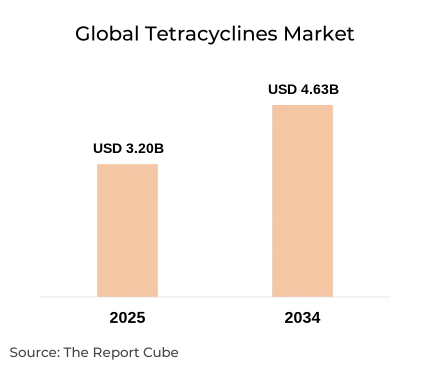
The Tetracyclines Market is anticipated to register a 4.20% during 2026-2034. The market size was valued at USD 3.2 Billion and is projected to reach USD 4.63 Billion by 2034. The global tetracyclines industry represents a vital segment of the broader antibiotics market, supporting the treatment of numerous bacterial infections across human and veterinary medicine. Tetracyclines remain widely prescribed due to their broad-spectrum antimicrobial activity against Gram-positive and Gram-negative bacteria, making them effective in treating respiratory infections, acne, urinary tract infections, and zoonotic diseases. Increasing awareness about early diagnosis and treatment of bacterial infections has contributed to stable demand for tetracycline-based drugs worldwide.
The market is also benefiting from the rising burden of infectious diseases and dermatological conditions across developing and developed economies. According to public health assessments, bacterial respiratory infections alone account for millions of clinical visits annually, creating steady demand for antibiotic therapies. Additionally, tetracyclines are increasingly used in veterinary medicine to treat livestock infections, improve animal health management, and prevent disease outbreaks in large-scale farming operations. The growing global population and rising meat consumption have intensified veterinary antibiotic demand, indirectly strengthening the tetracyclines market.
Pharmaceutical manufacturers are actively investing in improved formulations, combination therapies, and extended-release drug delivery systems to enhance treatment outcomes and patient compliance. Advances in pharmaceutical manufacturing technology have also enabled cost-efficient production of generic tetracyclines, making them more accessible in emerging markets. Moreover, expanding healthcare infrastructure, improved access to antibiotics in developing regions, and increasing awareness about bacterial infection treatment continue to support market growth. With consistent clinical demand, strong generic drug penetration, and ongoing pharmaceutical innovations, the tetracyclines market is expected to maintain steady expansion throughout the forecast period.
Tetracyclines Market Recent Developments
- 2025: Pfizer expanded manufacturing capacity for doxycycline formulations to meet growing global antibiotic demand.
- 2025: Lupin Limited launched an enhanced generic minocycline capsule targeting dermatology treatments in the U.S. pharmaceutical market.
Government Initiatives & Policies
- U.S. National Action Plan for Combating Antibiotic-Resistant Bacteria: Federal initiative promoting responsible antibiotic use and antimicrobial research.
- WHO Global Antimicrobial Resistance Strategy: International program encouraging proper antibiotic usage and strengthening infectious disease surveillance.
Tetracyclines Market Dynamics
Key Driver: Rising Global Prevalence of Bacterial and Dermatological Infections
The increasing prevalence of bacterial infections across both developed and emerging economies is one of the primary factors driving growth in the tetracyclines market. Respiratory tract infections, skin infections, and urinary tract infections continue to affect millions of patients globally each year. Tetracyclines are frequently prescribed because they provide broad-spectrum antimicrobial coverage and have demonstrated effectiveness against a wide range of bacterial pathogens. Their extensive clinical application in treating acne vulgaris, rosacea, and other dermatological conditions has also significantly boosted demand.
Book your FREE 30-minute expert consultation today
Contact UsDermatology-related antibiotic usage alone accounts for a notable portion of tetracycline prescriptions globally. For instance, dermatological disorders such as acne affect nearly 9–10% of the global population, particularly adolescents and young adults. Drugs like doxycycline and minocycline remain commonly prescribed therapies for moderate to severe acne due to their anti-inflammatory and antibacterial properties. These therapeutic benefits continue to support stable prescription volumes across dermatology clinics and hospitals.
Another important driver is the expanding use of tetracyclines in veterinary medicine. Livestock and poultry industries rely on antibiotics to treat bacterial diseases that could otherwise cause severe economic losses. Tetracycline antibiotics are widely used to control respiratory and intestinal infections in animals. As global food production expands to meet rising population needs, veterinary antibiotic demand continues to grow, indirectly strengthening the market for tetracycline-based drugs worldwide.
Industry Trends: Increasing Adoption of Advanced Antibiotic Formulations and Generics
The tetracyclines market is experiencing a significant shift toward advanced drug formulations and expanded generic production. Pharmaceutical companies are developing improved tetracycline derivatives and extended-release dosage forms that offer better therapeutic outcomes and improved patient compliance. For instance, controlled-release doxycycline tablets have gained traction in dermatology treatments as they allow once-daily dosing while maintaining effective plasma concentrations.
Generic drug penetration has also emerged as a dominant trend shaping the market landscape. Many original tetracycline patents have expired, allowing generic manufacturers to enter the market and significantly reduce treatment costs. This has increased accessibility of tetracycline medications in low- and middle-income countries where affordability remains a major factor influencing prescription patterns. Generic versions now represent a substantial share of tetracycline drug sales globally.
Another key industry trend is the increasing use of tetracyclines in combination therapies. Researchers are exploring synergistic combinations with other antibiotics or anti-inflammatory agents to improve treatment outcomes for resistant infections and chronic inflammatory conditions. Pharmaceutical companies are also focusing on improving manufacturing efficiency through advanced fermentation technologies and optimized supply chains. These innovations help reduce production costs while ensuring consistent drug quality.
Digital health technologies are further influencing antibiotic prescribing practices. Electronic prescription systems, clinical decision support tools, and antimicrobial stewardship programs are helping healthcare providers select appropriate antibiotics more effectively. These technological advancements promote responsible antibiotic use while ensuring that tetracycline treatments remain an important option within modern infectious disease management.
Major Challenge: Growing Concerns Regarding Antibiotic Resistance
One of the most significant challenges affecting the tetracyclines market is the increasing global concern surrounding antimicrobial resistance. Overuse and misuse of antibiotics have contributed to the emergence of resistant bacterial strains that reduce the effectiveness of conventional antibiotic treatments. Tetracycline resistance mechanisms, including efflux pumps and ribosomal protection proteins, have been identified in multiple bacterial species, which may limit the therapeutic effectiveness of these drugs.
Healthcare authorities worldwide have introduced antimicrobial stewardship programs aimed at reducing unnecessary antibiotic prescriptions. While these initiatives are essential for public health, they may also slow the growth of certain antibiotic markets, including tetracyclines. Hospitals and healthcare systems are implementing stricter guidelines regarding antibiotic use, which may reduce prescription frequency in some clinical settings.
Another challenge involves regulatory oversight on antibiotic usage in veterinary medicine. Several governments have introduced stricter policies to regulate antibiotics used in livestock production due to concerns about antimicrobial resistance transferring from animals to humans. These regulatory restrictions could potentially impact the volume of tetracycline consumption within the agricultural sector.
Additionally, the development of newer antibiotic classes and targeted antimicrobial therapies may gradually shift physician preference toward alternative treatment options. However, despite these challenges, tetracyclines remain essential antibiotics due to their affordability, long clinical history, and wide therapeutic applications across human and veterinary healthcare.
Opportunity: Expanding Healthcare Access in Emerging Markets
Emerging economies present significant growth opportunities for the tetracyclines market. Countries across Asia Pacific, Latin America, and parts of Africa are rapidly expanding their healthcare infrastructure to improve access to medical treatment. Increased government investments in hospitals, clinics, and pharmaceutical supply chains have enhanced the availability of essential medicines, including antibiotics.
In many developing regions, bacterial infections remain a major public health concern due to limited sanitation infrastructure and high population density. Affordable antibiotics such as tetracyclines are often among the most accessible treatment options for these conditions. The availability of low-cost generic formulations has enabled healthcare providers in these regions to deliver effective treatment while maintaining affordability.
The growth of pharmaceutical manufacturing capabilities in countries such as India and China also supports market expansion. These nations serve as major global producers of active pharmaceutical ingredients and generic antibiotics. Their expanding export networks allow tetracycline drugs to reach global markets efficiently and at competitive prices.
Telemedicine and digital healthcare platforms are also creating new opportunities for antibiotic access and prescription management. Patients in remote regions can now consult physicians and obtain prescriptions through online healthcare services, improving treatment accessibility. As healthcare accessibility continues to expand worldwide, the tetracyclines market is expected to experience sustained demand across multiple regions.
Tetracyclines Market Segment-wise Analysis
By Drug Type:
- Doxycycline
- Tetracycline
- Minocycline
- Oxytetracycline
Doxycycline currently represents the leading drug type segment in the tetracyclines market, accounting for approximately 38% of global market share. Its strong therapeutic effectiveness against respiratory infections, sexually transmitted infections, and dermatological conditions has made it one of the most frequently prescribed tetracycline antibiotics worldwide. Doxycycline also offers advantages such as improved absorption, longer half-life, and convenient dosing schedules compared to traditional tetracycline formulations. These features make it a preferred treatment option in both outpatient and hospital settings.
Access Key Market Segment Analysis?
Download SampleMinocycline and oxytetracycline also contribute significantly to market demand, particularly in dermatology and veterinary medicine. Minocycline is widely used in acne treatment and inflammatory skin disorders, while oxytetracycline remains a key antibiotic in livestock healthcare and veterinary infection control. Meanwhile, traditional tetracycline continues to be utilized in several emerging markets due to its affordability and availability in generic forms. The combination of these drug types ensures broad therapeutic coverage across human and animal health sectors, supporting consistent market demand.
By Application:
- Human Therapeutics
- Veterinary Medicine
- Infectious Disease Treatment
- Dermatology Applications
Human therapeutics remains the dominant application segment within the tetracyclines market, accounting for nearly 64% of the overall market share. Hospitals, clinics, and dermatology centers frequently prescribe tetracycline antibiotics to treat bacterial infections affecting respiratory systems, skin tissues, and urinary tracts. The widespread use of tetracyclines in dermatology, particularly for acne treatment, significantly contributes to this segment’s leadership. Acne treatments alone represent a large portion of tetracycline prescriptions globally due to the chronic nature of the condition and the long treatment durations often required.
Veterinary medicine also represents a critical application segment. Antibiotics are essential in maintaining livestock health and preventing disease outbreaks in poultry, cattle, and aquaculture. Oxytetracycline is widely used to control bacterial infections in animals due to its effectiveness and relatively low cost. Increasing global meat consumption and the expansion of intensive farming operations continue to drive veterinary antibiotic demand.
Additionally, tetracyclines are used for treating rare infectious diseases such as Lyme disease, cholera, and certain zoonotic infections. Research institutions also utilize tetracycline derivatives in molecular biology studies and protein regulation systems. As medical research continues to expand and infectious diseases remain prevalent, the application scope for tetracycline antibiotics is expected to broaden further during the forecast period.
Regional Projection of Tetracyclines Industry
- North America
- Europe
- Asia Pacific
- Middle East and Africa
North America currently leads the tetracyclines market and accounts for approximately 34% of global revenue share. The region benefits from a highly developed healthcare infrastructure, strong pharmaceutical manufacturing capacity, and high awareness regarding bacterial infection treatments. The United States represents the largest contributor within the region due to its advanced hospital network and strong demand for dermatological treatments such as acne therapies. Physicians frequently prescribe doxycycline and minocycline in dermatology and infectious disease management.
The presence of major pharmaceutical companies and well-established generic drug manufacturers further strengthens the regional market. Additionally, North America has implemented strong antimicrobial stewardship programs aimed at optimizing antibiotic usage. While these programs encourage responsible prescribing practices, they also promote appropriate use of effective antibiotics like tetracyclines when clinically necessary.
Asia Pacific is expected to experience the fastest growth during the forecast period. Rapid population growth, expanding healthcare access, and rising pharmaceutical manufacturing capabilities in countries such as India and China are driving antibiotic demand. The region also serves as a global production hub for generic antibiotics and active pharmaceutical ingredients. Increasing government investments in healthcare infrastructure and improved disease surveillance systems are further supporting regional market expansion.
Europe remains another important market due to its strong pharmaceutical regulatory framework and widespread antibiotic use in both human and veterinary medicine. Meanwhile, Middle East and Africa markets are gradually expanding as healthcare systems improve and access to essential antibiotics increases. Overall, regional demand patterns indicate stable and diversified growth opportunities for tetracycline drugs worldwide.
Need insights for a specific region within this market?
Request Regional DataWhy Choose This Report?
- Provides a comprehensive overview of the overall market analysis, encompassing key trends, consumer behavior analysis, and risk assessment to support strategic decision-making.
- Provides accurate, up-to-date insights into market size, segmentation, and emerging opportunities, helping to minimize risk & capitalizing on growth.
- Gives deep understanding of target audience preferences, investment habits, and communication channels for enhanced product development & marketing effectiveness.
- Delivers competitive analysis & benchmarking, uncovering the strengths & weaknesses of market competitors to guide strategies.
- Consolidate comprehensive market intelligence, reducing reasoning & streamlining research efforts.
- Facilitates customized market segmentation & risk mitigation strategies, fine-tuned to the business objectives.
- Aids in identifying both market challenges & untapped opportunities within the industry to drive long-term business growth.
- Provides valuable information based on actual customer data & search trends.
Table of Contents
- Introduction
- Objective of the Study
- Product and Category Definition
- Market Segmentation
- Study Variables
- Research Methodology
- Secondary Data Points
- Breakdown of Secondary Sources
- Primary Data Points
- Breakdown of Primary Interviews
- Secondary Data Points
- Executive Summary
- Market Dynamics
- Drivers
- Challenges
- Opportunity Assessment
- Recent Trends and Developments
- Regulatory and Policy Landscape
- Global Tetracyclines Market Overview (2026-2034)
- Market Size, By Value (USD Billion)
- Market Share, By Drug Type
- Doxycycline
- Tetracycline
- Minocycline
- Oxytetracycline
- Others
- Market Share, By Application
- Human Therapeutics
- Veterinary Medicine
- Market Share, By Route of Administration
- Oral
- Injectable
- Topical
- Market Share, By Distribution Channel
- Hospital Pharmacies
- Retail Pharmacies
- Online Pharmacies
- Market Share, By End User
- Hospitals
- Clinics
- Veterinary Clinics
- Research Institutions
- Market Share, By Region
- North America
- Europe
- Asia Pacific
- Middle East and Africa
- South America
- Market Share, By Company
- Revenue Shares and Analysis
- Competitive Landscape
- North America Tetracyclines Market
- Market Size, By Value (USD Billion/Million)
- Market Share, By Drug Type
- Market Share, By Application
- Market Share, By Route of Administration
- Market Share, By Distribution Channel
- Europe Tetracyclines Market
- Market Size, By Value (USD Billion/Million)
- Market Share, By Drug Type
- Market Share, By Application
- Market Share, By Route of Administration
- Market Share, By Distribution Channel
- Asia Pacific Tetracyclines Market
- Market Size, By Value (USD Billion/Million)
- Market Share, By Drug Type
- Market Share, By Application
- Market Share, By Route of Administration
- Market Share, By Distribution Channel
- Middle East and Africa Tetracyclines Market
- Market Size, By Value (USD Billion/Million)
- Market Share, By Drug Type
- Market Share, By Application
- Market Share, By Route of Administration
- Market Share, By Distribution Channel
- South America Tetracyclines Market
- Market Size, By Value (USD Billion/Million)
- Market Share, By Drug Type
- Market Share, By Application
- Market Share, By Route of Administration
- Market Share, By Distribution Channel
- Competitive Outlook and Company Profiles
- Pfizer Inc.
- Company Overview
- Product Portfolio
- Strategic Alliances/Partnerships
- Recent Developments
- Teva Pharmaceutical Industries Ltd.
- Company Overview
- Product Portfolio
- Strategic Alliances/Partnerships
- Recent Developments
- Sun Pharmaceutical Industries Ltd.
- Company Overview
- Product Portfolio
- Strategic Alliances/Partnerships
- Recent Developments
- Lupin Limited
- Company Overview
- Product Portfolio
- Strategic Alliances/Partnerships
- Recent Developments
- GlaxoSmithKline plc
- Company Overview
- Product Portfolio
- Strategic Alliances/Partnerships
- Recent Developments
- Merck & Co., Inc.
- Company Overview
- Product Portfolio
- Strategic Alliances/Partnerships
- Recent Developments
- Bayer AG
- Company Overview
- Product Portfolio
- Strategic Alliances/Partnerships
- Recent Developments
- Pfizer Inc.
- Contact Us and Disclaimer
Top Key Players & Market Share Outlook
-
Pfizer Inc.
-
Teva Pharmaceutical Industries Ltd.
-
Sun Pharmaceutical Industries Ltd.
-
Lupin Limited
-
GlaxoSmithKline plc
-
Merck & Co., Inc.
-
Bayer AG
Frequently Asked Questions






