



Build Your Custom Market Intelligence Report
Customize Your ReportBrazil Textile Fabrics Market Insights & Analysis
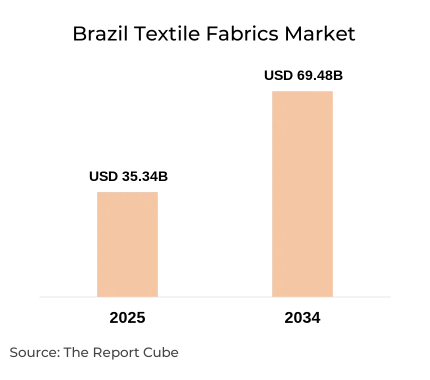
The Brazil Textile Fabrics Market is anticipated to register a 7.80% during 2026-2034. The market size was valued at USD 35.34 billion in 2025 and is projected to reach USD 69.48 billion by 2034. Brazil remains one of the largest textile producers in Latin America, supported by strong domestic consumption, vertically integrated supply chains, and abundant raw material availability. Cotton cultivation strength, expanding polyester capacity, and rising demand for blended fabrics are reinforcing industry resilience. The growing middle-class population and increasing fashion awareness are accelerating demand for affordable and performance-oriented fabrics.
Brazil’s textile ecosystem benefits from a well-established garment manufacturing base and export-oriented capabilities, particularly within South America. Rising athleisure trends, sports culture, and climate-driven demand for breathable fabrics are further shaping purchasing patterns. Sustainable fabric innovation, including recycled polyester and bio-based fibers, is gaining traction as consumers increasingly prioritize environmental responsibility. Technological advancements in digital printing, automated weaving, and energy-efficient dyeing processes are improving productivity and reducing operational waste. As retail modernization and e-commerce penetration expand nationwide, textile fabric producers are adapting to faster design cycles and diversified product portfolios. These structural advantages position the Brazil Textile Fabrics Market for consistent expansion through 2034.
Brazil Textile Fabrics Market Recent Developments
- 2025: Toray Industries expanded polyester production capacity in Latin America to meet rising sportswear demand.
- 2025: Lenzing AG introduced sustainable fiber blends targeting Brazil’s premium apparel segment.
Government Initiatives & Policies
- Brazil National Textile Development Program: Supports modernization and export competitiveness of textile manufacturers.
- Plano Nacional de Economia Circular: Encourages sustainable production and recycling within manufacturing sectors.
Brazil Textile Fabrics Market Dynamics
Key Driver: Expanding Apparel and Sportswear Consumption
Brazil’s expanding apparel and sportswear sector is a primary growth driver for textile fabrics. With over 210 million consumers and a vibrant fashion industry, Brazil ranks among the top global textile producers. Sports participation rates exceed 65% among urban populations, driving demand for breathable cotton, moisture-wicking polyester, and blended fabrics. Athleisure sales increased nearly 14% in 2024, boosting demand for polycotton and performance textiles. Additionally, Brazil’s tropical climate fuels year-round consumption of lightweight fabrics such as cotton and polyester blends. Domestic garment production accounts for nearly 80% of textile fabric demand, creating stable local supply chains. Growing fast-fashion brands and private-label retail expansion are further increasing fabric consumption volumes. These structural consumption trends are expected to sustain steady market expansion through 2034.
Industry Trends: Shift Toward Sustainable and Technical Fabrics
Sustainability and functional innovation are reshaping Brazil’s textile fabric landscape. Approximately 38% of Brazilian consumers now prefer eco-labeled apparel, encouraging manufacturers to adopt recycled polyester and organic cotton. Polyester fabrics incorporating recycled PET bottles are gaining traction, particularly in sportswear and outdoor clothing. Technical fabrics featuring UV protection, moisture management, and antimicrobial treatments are also witnessing rising demand. Digital textile printing adoption has grown by nearly 20% annually, enabling faster production cycles and reduced water usage. Export-oriented producers are aligning with global compliance standards to enhance competitiveness in North American and European markets. This strategic transition toward high-value fabrics strengthens Brazil’s position in both domestic and international textile supply chains.
Major Challenge: Volatility in Raw Material and Energy Costs
Raw material price volatility presents a significant challenge to the Brazil Textile Fabrics Market. Cotton price fluctuations linked to global commodity cycles directly impact fabric manufacturing costs. Polyester production depends on petrochemical derivatives, making it vulnerable to crude oil price swings. Energy costs have also risen due to grid instability and infrastructure upgrades, increasing operational expenses for dyeing and finishing processes. Nearly 45% of small textile producers report margin pressure due to input cost variability. Additionally, import competition from low-cost Asian markets intensifies pricing challenges for domestic manufacturers. Managing cost structures while maintaining quality standards remains a key strategic priority for industry participants.
Opportunity: Growth in Export Markets and Technical Textile Applications
Export diversification and technical textile expansion offer promising growth avenues. Brazil’s textile exports to neighboring Latin American countries increased by approximately 12% in 2024, reflecting improved trade partnerships. Technical textiles for performance wear, healthcare garments, and industrial applications are gaining prominence. The outdoor clothing segment alone recorded double-digit growth driven by rising adventure tourism. Additionally, government incentives supporting industrial modernization are encouraging automation and quality enhancement. Producers investing in value-added fabrics such as flame-retardant and high-durability blends can access premium pricing segments. As Brazil strengthens trade agreements and innovation capabilities, export-oriented and technical textile segments are expected to drive incremental revenue through 2034.
Brazil Textile Fabrics Market Segment-wise Analysis
By Type:
- Cotton
- Polycottons
- Polyester
Cotton dominates the Brazil Textile Fabrics Market, accounting for nearly 46% of total revenue share in 2025. Brazil is one of the world’s largest cotton producers, ensuring steady raw material supply and competitive pricing. Cotton fabrics are widely used in T-shirts and casual wear due to breathability and comfort. Polycottons represent a fast-growing segment, combining durability and affordability, particularly in uniforms and sportswear. Polyester holds a strong presence in performance wear and outdoor clothing due to moisture resistance and lightweight properties. The dominance of cotton is reinforced by domestic cultivation capacity and strong consumer preference for natural fibers.
By Application:
- T-shirts
- Sportswear
- Outdoor Clothing
- Performance Wear
T-shirts lead the application segment, contributing approximately 39% of market share in 2025. High-volume domestic consumption, affordable pricing, and widespread retail availability support this dominance. Sportswear follows closely, benefiting from rising fitness awareness and athleisure trends. Outdoor clothing demand is expanding due to tourism and adventure activities across Brazil’s diverse geography. Performance wear, incorporating technical fabrics, is witnessing the fastest growth as consumers seek durability and functionality. The T-shirt segment maintains leadership due to consistent everyday demand and mass production capabilities, while sportswear and performance wear generate higher margins.
Regional Projection of Brazil Textile Fabrics Industry
- Southeast Brazil
- South Brazil
- Northeast Brazil
- Midwest Brazil
Southeast Brazil leads the market, accounting for approximately 42% of national revenue in 2025. The region hosts major textile manufacturing hubs in São Paulo and Minas Gerais, supported by strong infrastructure and skilled labor availability. South Brazil also contributes significantly due to established garment clusters and export-oriented production facilities. Northeast Brazil is emerging as a competitive manufacturing destination due to lower labor costs and government incentives. Midwest and North regions are gradually expanding, driven by cotton cultivation and regional industrialization initiatives. Southeast Brazil’s dominance stems from integrated supply chains, advanced technology adoption, and proximity to major consumer markets.
Why Choose This Report?
- Provides a comprehensive overview of the overall market analysis, encompassing key trends, consumer behavior analysis, and risk assessment to support strategic decision-making.
- Provides accurate, up-to-date insights into market size, segmentation, and emerging opportunities, helping to minimize risk & capitalizing on growth.
- Gives deep understanding of target audience preferences, investment habits, and communication channels for enhanced product development & marketing effectiveness.
- Delivers competitive analysis & benchmarking, uncovering the strengths & weaknesses of market competitors to guide strategies.
- Consolidate comprehensive market intelligence, reducing reasoning & streamlining research efforts.
- Facilitates customized market segmentation & risk mitigation strategies, fine-tuned to the business objectives.
- Aids in identifying both market challenges & untapped opportunities within the industry to drive long-term business growth.
- Provides valuable information based on actual customer data & search trends.
Table of Contents
- Introduction
- Objective of the study
- Product Definition
- Market Segmentation
- Study Variables
- Research Methodology
- Secondary Data Points
- Companies Interviewed
- Primary Data Points
- Breakdown of Primary Interviews
- Secondary Data Points
- Executive Summary
- Market Dynamics
- Drivers
- Challenges
- Opportunity Assessment
- Recent Trends and Developments
- Policy and Regulatory Landscape
- Brazil Textile Fabrics Market Overview (2021-2034)
- Market Size, By Value (in USD Billions)
- Market Share, By Type
- Cotton
- Polycottons
- Polyester
- Market Share, By Application
- T-shirts
- Sportswear
- Outdoor Clothing
- Performance Wear
- Market Share, By Region
- Southeast Brazil
- South Brazil
- Northeast Brazil
- Midwest Brazil
- North Brazil
- Market Share, By Competitors
- Competition Characteristics
- Revenue Shares
- Brazil Cotton Textile Fabrics Market Overview, 2021-2034F
- By Value (USD Million/Billion)
- By Application - Market Size & Forecast 2021-2034, USD Million/Billion
- Brazil Polycottons Textile Fabrics Market Overview, 2021-2034F
- By Value (USD Million/Billion)
- By Application - Market Size & Forecast 2021-2034, USD Million/Billion
- Brazil Polyester Textile Fabrics Market Overview, 2021-2034F
- By Value (USD Million/Billion)
- By Application - Market Size & Forecast 2021-2034, USD Million/Billion
- Competitive Outlook (Company Profile - Partial List)
- Burlington Industries
- Company Overview
- Business Segments
- Strategic Alliances/Partnerships
- Recent Developments
- Toray Industries
- Company Overview
- Business Segments
- Strategic Alliances/Partnerships
- Recent Developments
- Milliken & Company
- Company Overview
- Business Segments
- Strategic Alliances/Partnerships
- Recent Developments
- Lenzing AG
- Company Overview
- Business Segments
- Strategic Alliances/Partnerships
- Recent Developments
- Invista
- Company Overview
- Business Segments
- Strategic Alliances/Partnerships
- Recent Developments
- Huntsman Corporation
- Company Overview
- Business Segments
- Strategic Alliances/Partnerships
- Recent Developments
- Tencel
- Company Overview
- Business Segments
- Strategic Alliances/Partnerships
- Recent Developments
- Shaw Industries
- Company Overview
- Business Segments
- Strategic Alliances/Partnerships
- Recent Developments
- Ahlstrom-Munksjö
- Company Overview
- Business Segments
- Strategic Alliances/Partnerships
- Recent Developments
- Others
- Burlington Industries
- Contact Us & Disclaimer
Top Key Players & Market Share Outlook
- Burlington Industries
- Toray Industries
- Milliken & Company
- Lenzing AG
- Invista
- Huntsman Corporation
- Tencel
- Shaw Industries
- Ahlstrom-Munksjö
Frequently Asked Questions






