



Build Your Custom Market Intelligence Report
Customize Your ReportEgypt Textiles Market Statistics and Insights
Market Size Statistics
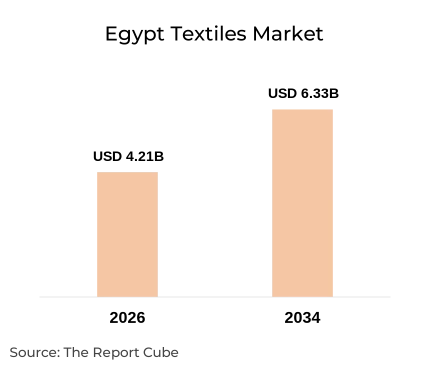
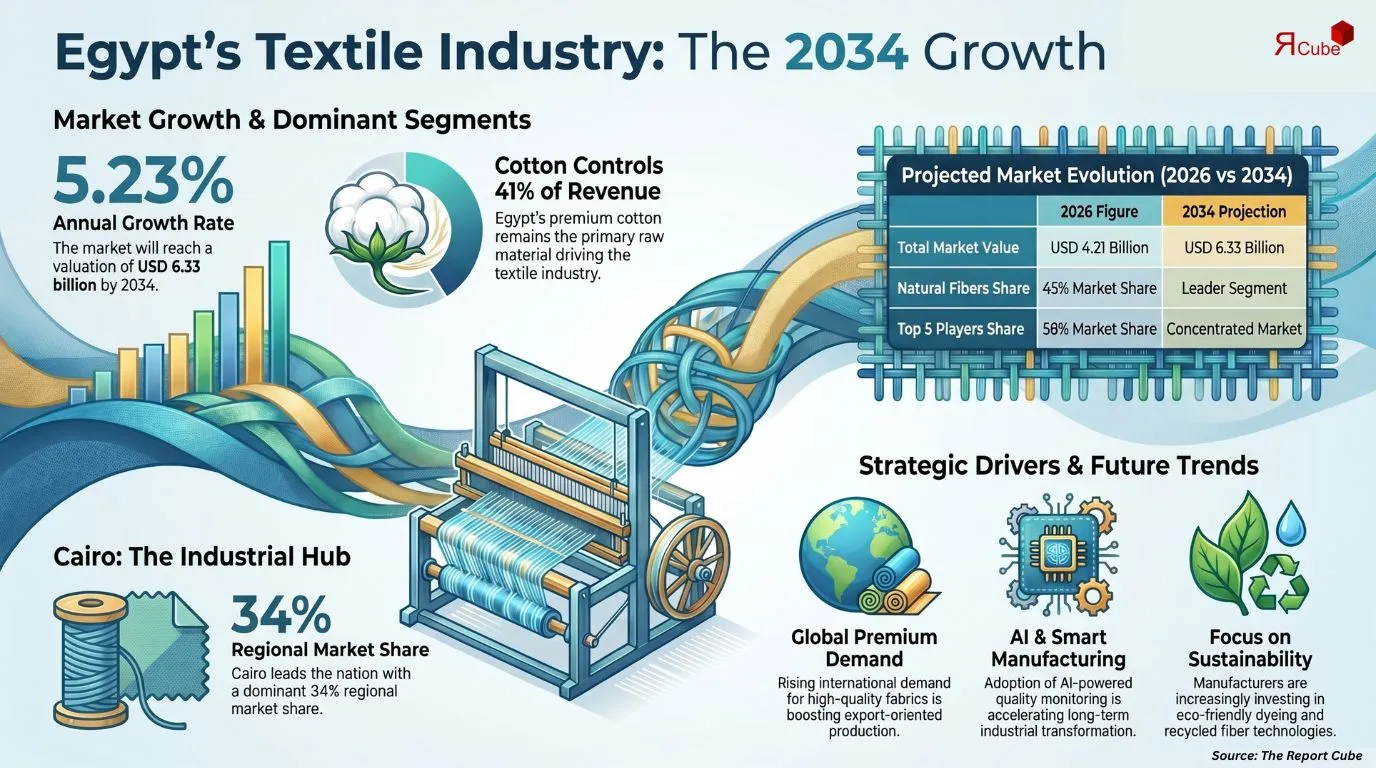
- Egypt Textiles market valuation reached USD 4.21 billion during 2026.
- Egypt Textiles industry projected reaching USD 6.33 billion by 2034.
- Egypt Textiles market expected registering stable 5.23% CAGR through forecast.
By Raw Material
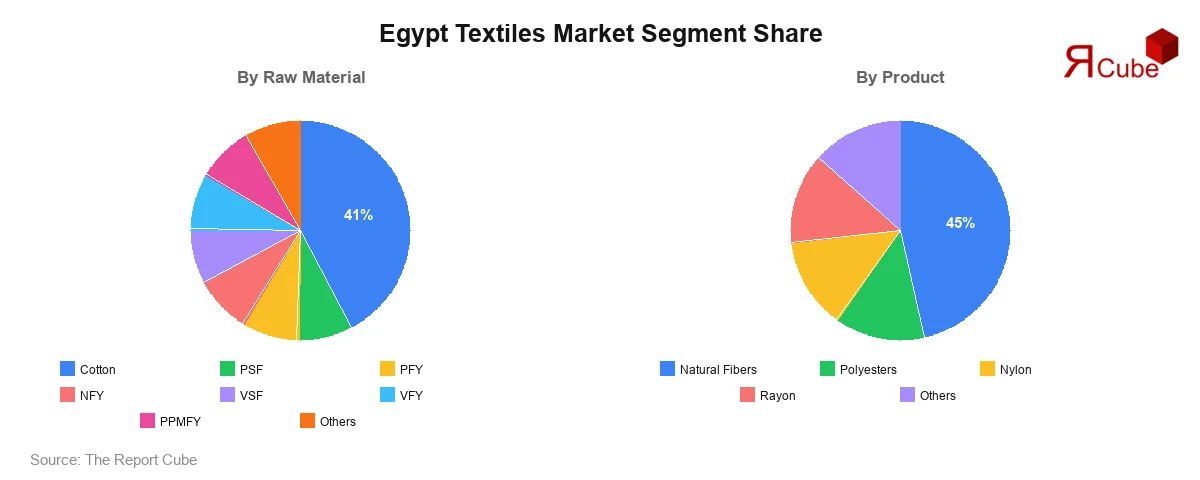
- Cotton segment captured approximately 41% revenue share during 2026.
Competitive Landscape
- More than 10 companies are actively engaged in producing Egypt Textiles Market.
- Top 5 companies acquired around 58% of the market share.
- Oriental Weavers Co, Lotus Garments Co., Giza Spinning and Weaving, MAC Carpet Egypt, and others.
By Product
- Natural fibers segment accounted for nearly 45% market revenue contribution.
Egypt Textiles Market Insights & Analysis
The Egypt Textiles Market is anticipated to register a 5.23% CAGR during 2026-2034. The market size was valued at USD 4.21 billion in 2026 and is projected to reach USD 6.33 billion by 2034. The Egypt textiles industry is witnessing stable expansion driven by increasing apparel demand, rising export activities, and growing investments in textile manufacturing modernization. Egypt’s strong cotton production capabilities and established textile manufacturing infrastructure are significantly strengthening domestic production and international textile exports. Consumers and apparel manufacturers are increasingly preferring premium-quality natural fibers, sustainable fabrics, and cost-efficient textile materials supporting fashion, home furnishing, and industrial textile applications. Additionally, rapid urbanization and expanding retail apparel industries are contributing to higher textile consumption throughout Egypt.
Government initiatives supporting industrial modernization, export competitiveness, and textile sector investments are further accelerating market expansion. Textile manufacturers are increasingly integrating AI-powered quality monitoring systems, automated spinning technologies, and smart weaving infrastructure to improve operational efficiency and product consistency. Rising investments in sustainable textile production, eco-friendly dyeing technologies, and advanced fabric innovation are additionally strengthening industry competitiveness. Furthermore, increasing partnerships between textile exporters, apparel manufacturers, and global retail brands are supporting innovation, operational scalability, and long-term product diversification throughout Egypt’s evolving textile ecosystem.
Egypt Textiles Market Dynamics
|
Market Dynamic |
Type |
Impact Level |
Key Influence on Market |
Long-Term Industry Effect |
|---|---|---|---|---|
|
Strong Cotton Production Base |
Driver |
High |
Supports premium textile manufacturing and exports |
Strengthens Egypt’s global textile positioning |
|
Rising Global Demand for Premium Fabrics |
Driver |
High |
Expands apparel and home textile production |
Increases export revenue opportunities |
|
Raw Material Price Volatility |
Challenge |
High |
Raises production costs and margin pressure |
Slows profitability and operational stability |
|
Rising Energy & Compliance Costs |
Challenge |
Medium-High |
Increases manufacturing expenditure |
Forces efficiency-focused modernization |
|
AI & Smart Manufacturing Adoption |
Trend |
Very High |
Enhances automation, quality control, and scalability |
Accelerates long-term industrial transformation |
Key Market Driver: Cotton Production Supporting Textile Expansion
Egypt’s strong cotton cultivation capabilities and increasing global demand for premium-quality fabrics are significantly driving growth within the Egypt Textiles Market. Textile manufacturers across Egypt increasingly utilize high-quality cotton fibers supporting apparel production, home furnishing applications, and textile exports. More than 69% of textile manufacturers within Egypt prefer natural cotton fibers because of superior softness, durability, and international export demand.
Manufacturers are increasingly expanding spinning facilities, weaving operations, and sustainable textile production systems targeting premium apparel and furnishing markets. Additionally, rising retail apparel demand, expanding export activities, and increasing industrial textile applications are significantly supporting textile production growth throughout Egypt’s evolving manufacturing ecosystem.
Need Specific Data, Let’s Customize the Report for You
Request CustomizationMajor Industry Challenge: Raw Material Volatility Affecting Production
Fluctuating raw material prices and energy-intensive manufacturing processes remain major operational challenges within the Egypt textiles industry. Variations in cotton pricing, imported synthetic fiber costs, and global supply chain disruptions significantly impact textile production expenses and profitability margins across multiple product categories. Manufacturers frequently encounter limitations while maintaining product consistency and implementing advanced textile processing technologies.
Additionally, rising energy costs and regulatory compliance requirements continue affecting manufacturing efficiency and operational scalability. Smaller textile producers also face financial pressure while upgrading production facilities and adopting sustainable textile manufacturing practices. These factors collectively continue creating operational pressure throughout Egypt’s evolving textile ecosystem.
Emerging Trend Shaping Outlook: Smart Manufacturing Enhancing Textile Innovation
Artificial intelligence and automated textile manufacturing technologies are increasingly transforming the Egypt textiles market. Manufacturers are integrating AI-powered fabric inspection systems, automated spinning infrastructure, and predictive quality control technologies to improve production efficiency and product consistency. Increasing adoption of sustainable textile production methods and eco-friendly dyeing technologies is additionally improving environmental performance and export competitiveness across textile categories.
Advanced digital inventory systems and automated weaving technologies are further enabling manufacturers to strengthen supply chain management capabilities. Furthermore, rising popularity of recycled fibers, functional textiles, and performance fabrics is strengthening product diversification. These technological advancements are expected to significantly improve operational scalability, product innovation, and long-term competitiveness across Egypt’s textile industry.
Egypt Textiles Market Segment-wise Analysis
The Egypt textiles industry is undergoing substantial transformation due to increasing export competitiveness, evolving fashion trends, and rising demand for sustainable textile materials. Textile manufacturers and apparel producers are increasingly investing in AI-powered manufacturing systems, automated spinning infrastructure, and advanced quality assurance technologies to strengthen operational efficiency and product consistency throughout the regional textile ecosystem.
By Raw Material
- Cotton
- PSF
- PFY
- NFY
- VSF
- VFY
- PPMFY
- Others
The cotton segment dominated the Egypt Textiles Market with nearly 41% market share during 2026. Egypt’s globally recognized cotton quality, strong domestic cultivation capabilities, and rising international textile export demand substantially contributed to segment leadership. Textile manufacturers increasingly prefer cotton fibers because they provide superior softness, durability, and versatility across apparel and furnishing applications. Manufacturers are additionally integrating AI-powered spinning technologies and automated weaving systems to improve product consistency and operational efficiency.
PSF and PFY materials are also witnessing strong growth because manufacturers increasingly prefer cost-efficient synthetic fibers supporting industrial textile applications and blended fabric production. Rayon and viscose-based materials continue expanding because consumers increasingly demand lightweight, breathable, and affordable fabric products supporting fashion apparel applications. Additionally, increasing investments in recycled fibers and sustainable textile processing technologies are improving product differentiation capabilities throughout the market. Technological advancements in spinning systems and digital textile manufacturing infrastructure are expected to continue accelerating raw material segment expansion across Egypt’s evolving textile ecosystem.
By Product
- Natural Fibers
- Polyesters
- Nylon
- Rayon
- Others
The natural fibers segment accounted for approximately 45% market share during 2026 because consumers and apparel manufacturers increasingly prefer breathable, eco-friendly, and premium-quality textile materials supporting sustainable fashion trends. Egypt’s strong cotton production infrastructure significantly strengthened natural fiber textile manufacturing and export competitiveness throughout international markets. Manufacturers are additionally investing in automated weaving technologies and sustainable textile finishing systems to improve operational efficiency and product quality assurance.
Polyester textiles are also witnessing strong growth because manufacturers increasingly prefer durable and cost-efficient fabrics supporting sportswear, industrial textiles, and home furnishing applications. Rayon products continue maintaining stable demand because consumers increasingly seek lightweight and affordable fashion fabrics supporting casual apparel production. Nylon textiles are additionally expanding because of rising demand across industrial textile applications and performance-oriented clothing products. Technological advancements in textile processing systems and sustainable fabric manufacturing technologies are expected to continue accelerating product segment expansion across Egypt’s textile market.
Regional Projection of Egypt Textiles Market
- Cairo
- Alexandria
- Giza
- Nile Delta
- Suez Canal Economic Zone
Cairo dominated the Egypt Textiles Market with nearly 34% market share during 2026 due to strong textile manufacturing infrastructure, expanding apparel production industries, and increasing export-oriented textile operations throughout the capital region. The region benefits from established industrial zones, strong labor availability, and extensive textile processing facilities supporting market growth. Major textile manufacturers are increasingly investing in AI-powered spinning technologies, automated weaving infrastructure, and sustainable fabric processing systems throughout Cairo. Additionally, rising apparel retail demand, expanding export partnerships, and increasing adoption of sustainable textile manufacturing practices are reinforcing regional market growth, positioning Cairo as the leading hub within Egypt’s evolving textile ecosystem.
Egypt Textiles Market: Recent Develpoment (2025)
- Oriental Weavers expanded automated textile manufacturing infrastructure supporting premium fabric production and export distribution capabilities significantly nationwide.
- MAC Carpet Egypt invested in AI-powered weaving technologies improving textile consistency and operational efficiency throughout Egypt regionally substantially.
- Giza Spinning and Weaving strengthened sustainable cotton processing capabilities supporting premium textile diversification and export competitiveness regionally.
- Lotus Garments enhanced eco-friendly textile finishing infrastructure improving product quality and environmental manufacturing performance significantly nationwide.
Egypt Textiles Market Future Outlook (2034)
The Egypt Textiles Market is expected to witness stable long-term growth through 2034, supported by increasing export competitiveness and rising demand for sustainable textile materials. The market is projected to reach USD 6.33 billion by 2034 while registering a steady 5.23% CAGR during the forecast period. Rising investments in AI-powered manufacturing systems, automated weaving technologies, and sustainable textile processing infrastructure are anticipated to create substantial opportunities for textile manufacturers and apparel producers.
Technological advancements in recycled fiber processing, smart textile manufacturing, and eco-friendly dyeing systems will continue reshaping operational strategies throughout the industry. Additionally, increasing global demand for premium cotton fabrics, expanding apparel retail industries, and stronger government support for industrial modernization are expected to strengthen long-term competitiveness, operational scalability, and market expansion across Egypt’s evolving textile ecosystem.
Why Choose This Report?
- Provides a comprehensive overview of the overall market analysis, encompassing key trends, consumer behavior analysis, and risk assessment to support strategic decision-making.
- Provides accurate, up-to-date insights into market size, segmentation, and emerging opportunities, helping to minimize risk & capitalizing on growth.
- Gives deep understanding of target audience preferences, investment habits, and communication channels for enhanced product development & marketing effectiveness.
- Delivers competitive analysis & benchmarking, uncovering the strengths & weaknesses of market competitors to guide strategies.
- Consolidate comprehensive market intelligence, reducing reasoning & streamlining research efforts.
- Facilitates customized market segmentation & risk mitigation strategies, fine-tuned to the business objectives.
- Aids in identifying both market challenges & untapped opportunities within the industry to drive long-term business growth.
- Provides valuable information based on actual customer data & search trends.
Table of Contents
- Introduction
- Objective of the study
- Product Definition
- Market Segmentation
- Study Variables
- Research Methodology
- Secondary Data Points
- Companies Interviewed
- Primary Data Points
- Breakdown of Primary Interviews
- Secondary Data Points
- Executive Summary
- Market Dynamics
- Drivers
- Challenges
- Opportunity Assessment
- Recent Trends and Developments
- Policy and Regulatory Landscape
- Egypt Textiles Market Overview and Forecast Analysis (2021-2034)
- Market Size, By Value, By growth rate (CAGR/USD Billions)
- Demand - Supply Trends
- Market Share, By Type
- Yarn & Fiber
- Processed Fabrics & Apparel
- Market Share, By Raw Material
- Cotton
- PSF
- PFY
- NFY
- VSF
- VFY
- PPMFY
- Others
- Market Share, By Product
- Natural Fibers
- Polyesters
- Nylon
- Rayon
- Others
- Market Share, By Process
- Woven
- Non-woven
- Market Share, By Application
- Household
- Technical
- Fashion & Clothing
- Others
- Market Share, By Region
- Cairo
- Alexandria
- Giza
- Nile Delta
- Suez Canal Economic Zone
- Market Share, By Competitors
- Competition Characteristics
- Revenue Shares
- Egypt Yarn & Fiber Textiles Market Overview, 2021-2034F
- By Value (USD Million)
- By Raw Material- Market Size & Forecast 2021-2034, USD Million
- By Product- Market Size & Forecast 2021-2034, USD Million
- By Process- Market Size & Forecast 2021-2034, USD Million
- By Application- Market Size & Forecast 2021-2034, USD Million
- Egypt Processed Fabrics & Apparel Textiles Market Overview, 2021-2034F
- By Value (USD Million)
- By Raw Material- Market Size & Forecast 2021-2034, USD Million
- By Product- Market Size & Forecast 2021-2034, USD Million
- By Process- Market Size & Forecast 2021-2034, USD Million
- By Application- Market Size & Forecast 2021-2034, USD Million
- Competitive Outlook (Company Profile - Partial List)
- Oriental Weavers Co
- Company Overview
- Business Segments
- Strategic Alliances/Partnerships
- Recent Developments
- Cotton & Textile Industries Holding Co
- Company Overview
- Business Segments
- Strategic Alliances/Partnerships
- Recent Developments
- Lotus Garments Co.
- Company Overview
- Business Segments
- Strategic Alliances/Partnerships
- Recent Developments
- Giza spinning and weaving S.A.E.
- Company Overview
- Business Segments
- Strategic Alliances/Partnerships
- Recent Developments
- AlHesn Textiles
- Company Overview
- Business Segments
- Strategic Alliances/Partnerships
- Recent Developments
- Kazareen Textile Company
- Company Overview
- Business Segments
- Strategic Alliances/Partnerships
- Recent Developments
- MAC Carpet Egypt
- Company Overview
- Business Segments
- Strategic Alliances/Partnerships
- Recent Developments
- HESNI Textile
- Company Overview
- Business Segments
- Strategic Alliances/Partnerships
- Recent Developments
- El Nasr Clothing and Textiles (Kabo)
- Company Overview
- Business Segments
- Strategic Alliances/Partnerships
- Recent Developments
- Others
- Oriental Weavers Co
- Contact Us & Disclaimer
Top Key Players & Market Share Outlook
- Oriental Weavers Co
- Cotton & Textile Industries Holding Co
- Lotus Garments Co.
- Giza spinning and weaving S.A.E.
- AlHesn Textiles
- Kazareen Textile Company
- MAC Carpet Egypt
- HESNI Textile
- El Nasr Clothing and Textiles (Kabo)
- Others
Frequently Asked Questions






