




Build Your Custom Market Intelligence Report
Customize Your ReportAsia-Pacific Tire Market Insights & Analysis
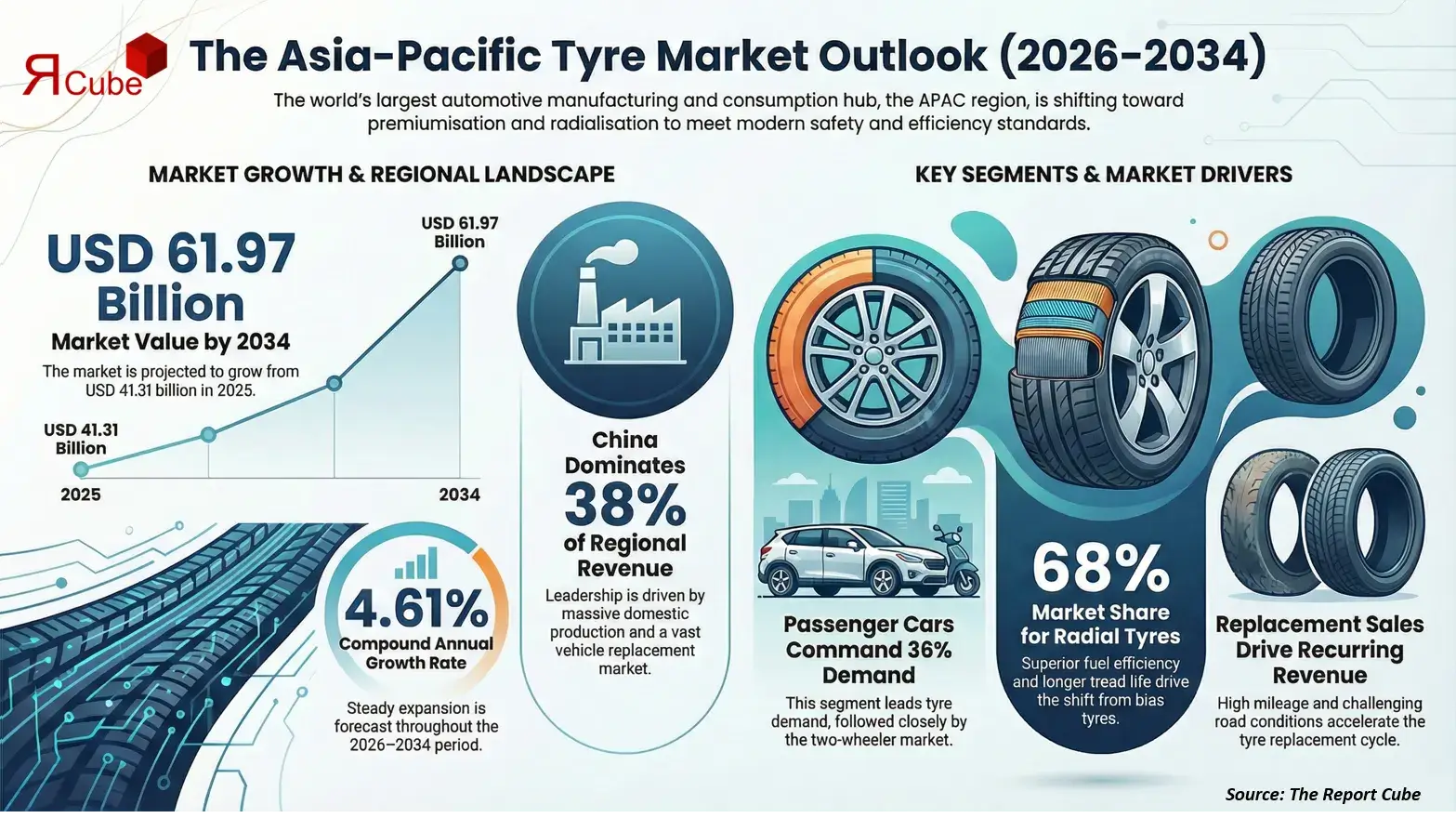
The Asia-Pacific Tire Market is anticipated to register a CAGR of 4.61% during the forecast period 2026-2034. The market size was valued at USD 41.31 billion in 2025 and is projected to reach USD 61.97 billion by 2034. This growth reflects the Asia-Pacific region’s position as the world’s largest automotive manufacturing and consumption hub, supported by rapid urbanization, expanding vehicle ownership, and continuous infrastructure development. The region accounts for a significant share of global tire demand due to its diverse vehicle mix, ranging from passenger cars and commercial vehicles to two-wheelers, agricultural machinery, and off-the-road equipment. Strong domestic demand, coupled with export-oriented manufacturing capabilities, continues to reinforce the region’s strategic importance within the global tire industry.
Market expansion is further driven by rising replacement demand as vehicle parc size increases and usage intensity remains high across both developed and emerging economies. Countries such as China and India are experiencing sustained growth in passenger and commercial vehicle ownership, while Japan, South Korea, and Australia contribute stable demand through replacement cycles and premium tire adoption. Southeast Asian economies increasingly serve as cost-competitive manufacturing bases for global tire brands, benefiting from favorable trade policies and skilled labor availability. The presence of leading multinational tire manufacturers alongside strong regional players promotes continuous innovation, competitive pricing, and localized product offerings, ensuring long-term market resilience.
Asia-Pacific Tire Market Recent Developments
- 2025: Bridgestone Corporation expanded radial tire production capacity in Southeast Asia to address rising aftermarket demand.
- 2025: Michelin launched new low rolling resistance tire ranges tailored for Asia-Pacific passenger and commercial vehicles.
Government Initiatives & Policies
- China Automotive Industry Development Plan: National policy promoting vehicle efficiency, safety standards, and domestic manufacturing.
- India National Automotive Policy: Government initiative supporting local manufacturing, infrastructure growth, and vehicle safety norms.
Asia-Pacific Tire Market Dynamics
Key Driver: Expanding vehicle ownership and replacement demand
The primary driver of the Asia-Pacific tire market is the rapid expansion of the regional vehicle population combined with high replacement frequency. Rising urbanization, increasing disposable incomes, and improved access to vehicle financing have accelerated passenger car and two-wheeler ownership across emerging economies such as China, India, Indonesia, and Vietnam. Additionally, challenging road conditions, high daily mileage, and heavy load usage in commercial vehicles result in faster tire wear, boosting replacement demand. Growth in logistics, e-commerce, mining, construction, and agriculture further supports demand for commercial, OTR, and specialty tires. These combined factors create a resilient and recurring demand base that underpins steady market growth across economic cycles.
Major Challenge: Raw material price volatility and cost pressures
A key challenge facing the Asia-Pacific tire market is volatility in raw material prices, particularly natural rubber, synthetic rubber, carbon black, and petrochemical derivatives. The region’s dependence on agricultural output and global commodity markets makes input costs sensitive to weather patterns, geopolitical developments, and currency fluctuations. Intense competition and price-sensitive consumers restrict manufacturers’ ability to fully pass on cost increases, leading to margin pressure. Additionally, compliance with tightening environmental regulations, labeling requirements, and safety standards raises production and testing costs. Smaller manufacturers are especially vulnerable, increasing the likelihood of consolidation across the regional tire industry.
Industry Trends: Radialization and premiumization of tires
A defining trend in the Asia-Pacific tire market is the steady shift from bias to radial tires across passenger and commercial vehicle segments. Radial tires provide superior fuel efficiency, improved handling, longer tread life, and enhanced driving comfort, aligning with regulatory priorities and evolving consumer expectations. Premiumization is also gaining traction, particularly in urban and developed markets, with increasing demand for low-noise, all-season, and high-performance tires. Manufacturers are investing in advanced materials, digital manufacturing processes, and smart tire technologies to enhance product differentiation. These trends indicate a gradual transition from volume-led growth toward higher value-added offerings.
Opportunity Ahead: Electric vehicles and sustainable tire solutions
The accelerating adoption of electric vehicles and sustainability-focused mobility policies present significant growth opportunities for tire manufacturers in Asia-Pacific. Electric vehicles require specialized tires capable of handling higher torque, lower rolling resistance, and reduced noise levels, creating new premium product segments. Governments across the region are encouraging cleaner transportation, recycling initiatives, and reduced carbon footprints, driving innovation in eco-friendly materials and production processes. Manufacturers that invest in sustainable tire designs, circular economy models, and localized production capabilities are well-positioned to gain competitive advantage, while expanding regional trade further supports long-term growth.
Asia-Pacific Tire Market Segment-wise Analysis
By Vehicle Type:
- Passenger Cars
- Light Commercial Vehicles (LCV)
- Medium & Heavy Commercial Vehicles (M&HCV)
- Two-Wheelers
- Three-Wheelers
- Off-the-Road (OTR)
- Agricultural & Specialty Vehicles
Passenger cars represent the leading vehicle type segment, accounting for approximately 36% of total tire demand in Asia-Pacific in 2025. Rising passenger vehicle ownership in China and India, combined with consistent replacement cycles in Japan, South Korea, and Australia, supports this dominance. Two-wheelers contribute significantly in volume terms across South and Southeast Asia, while commercial, OTR, and agricultural segments generate higher revenue per unit due to durability and performance requirements. The diverse vehicle mix ensures balanced growth across OEM and aftermarket channels.
By Tire Type:
- Radial Tires
- Bias Tires
Radial tires dominate the market with an estimated 68% share, driven by superior performance, fuel efficiency, and longer service life. Adoption is strongest in passenger cars and modern commercial fleets, supported by regulatory standards and consumer preference for quality. Bias tires remain relevant in agricultural, rural, and off-road applications where robustness and cost efficiency are prioritized. However, the long-term outlook favors continued radialization across all major vehicle categories in the region.
Regional Projection of Asia-Pacific Tire Industry
- China
- India
- Japan
- South Korea
- Australia & New Zealand
- Indonesia
- Thailand
- Malaysia
- Vietnam
- Rest of Asia-Pacific
China leads the Asia-Pacific tire market, accounting for approximately 38% of regional revenue in 2025. Its leadership is driven by large-scale automotive production, a massive replacement market, and strong domestic tire manufacturing capabilities. India follows as a high-growth market supported by infrastructure expansion and rising vehicle ownership. Japan and South Korea contribute through premium tire demand and technological leadership, while Southeast Asian countries function as both fast-growing consumption markets and key export-oriented manufacturing hubs.
Why Choose This Report?
- Provides a comprehensive overview of the overall market analysis, encompassing key trends, consumer behavior analysis, and risk assessment to support strategic decision-making.
- Provides accurate, up-to-date insights into market size, segmentation, and emerging opportunities, helping to minimize risk & capitalizing on growth.
- Gives deep understanding of target audience preferences, investment habits, and communication channels for enhanced product development & marketing effectiveness.
- Delivers competitive analysis & benchmarking, uncovering the strengths & weaknesses of market competitors to guide strategies.
- Consolidate comprehensive market intelligence, reducing reasoning & streamlining research efforts.
- Facilitates customized market segmentation & risk mitigation strategies, fine-tuned to the business objectives.
- Aids in identifying both market challenges & untapped opportunities within the industry to drive long-term business growth.
- Provides valuable information based on actual customer data & search trends.
Table of Contents
- Introduction
- Objective of the Study
- Product/Category Definition
- Market Segmentation
- Study Variables
- Research Methodology
- Secondary Data Points
- Breakdown of Secondary Sources
- Primary Data Points
- Breakdown of Primary Interviews
- Secondary Data Points
- Executive Summary
- Market Dynamics
- Drivers
- Challenges
- Opportunity Assessment
- Recent Trends and Developments
- Policy and Regulatory Landscape
- Asia-Pacific Tire Market Overview (2020-2034)
- Market Size, By Volume & Value (Units / USD Billion)
- Market Share, By Vehicle Type
- Passenger Cars
- Light Commercial Vehicles (LCV)
- Medium & Heavy Commercial Vehicles (M&HCV)
- Two-Wheelers
- Three-Wheelers
- Off-the-Road (OTR)
- Agricultural & Specialty Vehicles
- Market Share, By Tire Type
- Radial Tires
- Bias Tires
- Market Share, By Demand Category
- OEM
- Replacement
- Market Share, By Rim Size
- Up to 13"
- 14"-15"
- 16"-18"
- 19"-21"
- Above 21"
- Market Share, By Price Range
- Budget
- Mid-Range
- Premium
- Market Share, By Distribution Channel
- Offline (Dealers, Retailers, Workshops)
- Online
- Market Share, By Country
- China
- India
- Japan
- South Korea
- Australia & New Zealand
- Indonesia
- Thailand
- Malaysia
- Vietnam
- Rest of Asia-Pacific
- Market Share, By Company
- Revenue Shares
- Competitive Landscape
- China Tire Market
- Market Size, By Volume & Value (USD Billion)
- Market Share, By Vehicle Type
- Market Share, By Tire Type
- Market Share, By Demand Category
- Market Share, By Rim Size
- Market Share, By Price Range
- India Tire Market
- Market Size, By Volume & Value (USD Billion)
- Market Share, By Vehicle Type
- Market Share, By Tire Type
- Market Share, By Demand Category
- Market Share, By Rim Size
- Market Share, By Price Range
- Japan Tire Market
- Market Size, By Volume & Value (USD Billion)
- Market Share, By Vehicle Type
- Market Share, By Tire Type
- Market Share, By Demand Category
- Market Share, By Rim Size
- Market Share, By Price Range
- South Korea Tire Market
- Market Size, By Volume & Value (USD Billion)
- Market Share, By Vehicle Type
- Market Share, By Tire Type
- Market Share, By Demand Category
- Market Share, By Rim Size
- Market Share, By Price Range
- Australia & New Zealand Tire Market
- Market Size, By Volume & Value (USD Billion)
- Market Share, By Vehicle Type
- Market Share, By Tire Type
- Market Share, By Demand Category
- Market Share, By Rim Size
- Market Share, By Price Range
- Indonesia Tire Market
- Market Size, By Volume & Value (USD Billion)
- Market Share, By Vehicle Type
- Market Share, By Tire Type
- Market Share, By Demand Category
- Market Share, By Rim Size
- Market Share, By Price Range
- Thailand Tire Market
- Market Size, By Volume & Value (USD Billion)
- Market Share, By Vehicle Type
- Market Share, By Tire Type
- Market Share, By Demand Category
- Market Share, By Rim Size
- Market Share, By Price Range
- Malaysia Tire Market
- Market Size, By Volume & Value (USD Billion)
- Market Share, By Vehicle Type
- Market Share, By Tire Type
- Market Share, By Demand Category
- Market Share, By Rim Size
- Market Share, By Price Range
- Vietnam Tire Market
- Market Size, By Volume & Value (USD Billion)
- Market Share, By Vehicle Type
- Market Share, By Tire Type
- Market Share, By Demand Category
- Market Share, By Rim Size
- Market Share, By Price Range
- Rest of Asia-Pacific Tire Market
- Market Size, By Volume & Value (USD Billion)
- Market Share, By Vehicle Type
- Market Share, By Tire Type
- Market Share, By Demand Category
- Market Share, By Rim Size
- Market Share, By Price Range
- Market Share, By Key Countries
- Competitive Outlook & Company Profiles
- Bridgestone Corporation
- Company Overview
- Product Portfolio
- Strategic Alliances/Partnerships
- Recent Developments
- Michelin
- Company Overview
- Product Portfolio
- Strategic Alliances/Partnerships
- Recent Developments
- Goodyear Tire & Rubber Company
- Company Overview
- Product Portfolio
- Strategic Alliances/Partnerships
- Recent Developments
- Continental AG
- Company Overview
- Product Portfolio
- Strategic Alliances/Partnerships
- Recent Developments
- Yokohama Rubber Company
- Company Overview
- Product Portfolio
- Strategic Alliances/Partnerships
- Recent Developments
- Sumitomo Rubber Industries
- Company Overview
- Product Portfolio
- Strategic Alliances/Partnerships
- Recent Developments
- Apollo Tyres Ltd.
- Company Overview
- Product Portfolio
- Strategic Alliances/Partnerships
- Recent Developments
- MRF Limited
- Company Overview
- Product Portfolio
- Strategic Alliances/Partnerships
- Recent Developments
- Hankook Tire & Technology
- Company Overview
- Product Portfolio
- Strategic Alliances/Partnerships
- Recent Developments
- Maxxis / Cheng Shin Rubber
- Company Overview
- Product Portfolio
- Strategic Alliances/Partnerships
- Recent Developments
- Others
- Company Overview
- Product Portfolio
- Strategic Alliances/Partnerships
- Recent Developments
- Bridgestone Corporation
- Contact Us / Disclaimer
Top Key Players & Market Share Outlook
- Bridgestone Corporation
- Michelin
- Goodyear Tire & Rubber Company
- Continental AG
- Yokohama Rubber Company
- Sumitomo Rubber Industries
- Apollo Tyres Ltd.
- MRF Limited
- Hankook Tire & Technology
- Maxxis / Cheng Shin Rubber
- Others
Frequently Asked Questions






