



Build Your Custom Market Intelligence Report
Customize Your ReportGlobal Transcranial Magnetic Stimulation Market Insights & Analysis
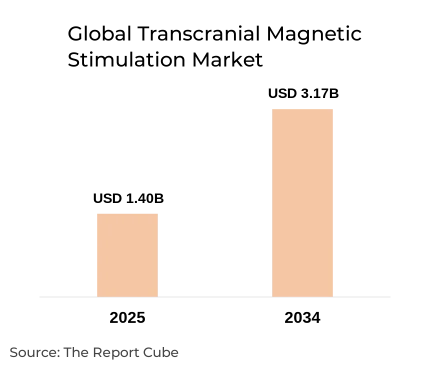
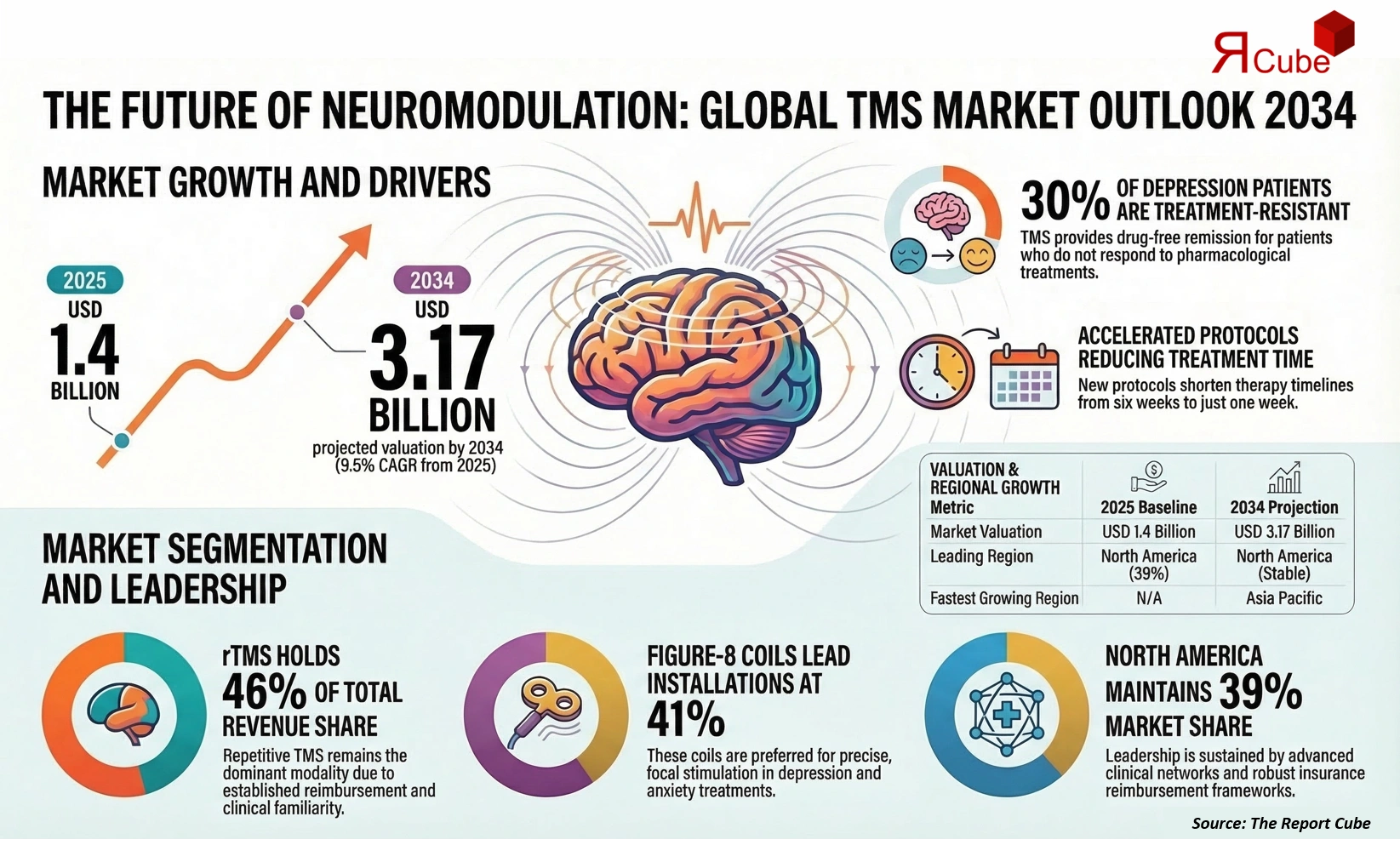
The Global Transcranial Magnetic Stimulation Market is anticipated to register a CAGR of 9.50% during the forecast period 2026-2034. The market size was valued at USD 1.4 billion in 2025 and is projected to reach USD 3.17 billion by 2034. This strong growth trajectory reflects rising clinical acceptance of non-invasive neuromodulation therapies and the increasing global burden of neurological and psychiatric disorders. Transcranial magnetic stimulation is increasingly positioned as an effective alternative for patients who do not respond adequately to pharmacological treatments, particularly in major depressive disorder. The market benefits from expanding clinical indications, higher treatment adoption rates in outpatient settings, and growing investments in neuroscience-focused medical technologies.
Beyond depression therapy, the market is expanding due to increasing research activity and regulatory approvals supporting the use of transcranial magnetic stimulation across a broader range of conditions. These include obsessive-compulsive disorder, chronic pain, post-traumatic stress disorder, and stroke rehabilitation. Growing awareness among clinicians and patients, coupled with favorable reimbursement progress in developed healthcare systems, continues to accelerate adoption. Supporting keywords such as non-invasive brain stimulation, neuromodulation therapy, and neuropsychiatric treatment devices are increasingly prominent in industry discourse, reflecting evolving clinical practice patterns. As healthcare systems emphasize personalized and precision-based mental health care, transcranial magnetic stimulation is emerging as a cornerstone therapy within advanced neurotechnology portfolios.
Global Transcranial Magnetic Stimulation Market Recent Developments
- 2025: BrainsWay expanded FDA-cleared indications for its deep TMS system targeting additional psychiatric disorders.
- 2025: Neuronetics introduced workflow-optimized TMS platforms to improve clinic throughput and patient experience.
Government Initiatives & Policies
- U.S. National Institute of Mental Health (NIMH) Neurotechnology Programs: Supports funding for non-invasive brain stimulation research.
- European Brain Research Area (EBRA): Promotes collaborative neuroscience research and advanced therapeutic technologies.
Global Transcranial Magnetic Stimulation Market Dynamics
Key Driver: Rising Prevalence of Treatment-Resistant Depression
The primary growth driver for the transcranial magnetic stimulation market is the increasing prevalence of treatment-resistant depression worldwide. Clinical studies indicate that nearly 30% of patients with major depressive disorder do not respond adequately to first-line antidepressant therapies, creating a substantial unmet medical need. Transcranial magnetic stimulation offers a non-invasive, drug-free option with remission rates ranging between 30% and 40% after a standard treatment course. As mental health awareness improves and stigma declines, patient willingness to explore advanced neurostimulation therapies continues to rise. This driver is further supported by growing psychiatrist adoption and the integration of neuromodulation therapies into standardized treatment algorithms.
Major Challenge: High Equipment and Treatment Costs
Despite strong clinical demand, high upfront equipment costs and treatment expenses remain a notable challenge for market expansion. A single transcranial magnetic stimulation system can cost between USD 70,000 and USD 100,000, limiting accessibility for smaller clinics and emerging healthcare markets. Additionally, a full treatment course may require 20-30 sessions, increasing total therapy costs for patients without comprehensive insurance coverage. While reimbursement policies are improving in North America and parts of Europe, limited coverage in developing regions continues to restrict adoption. Addressing affordability through pricing strategies and scalable clinic models remains critical for broader market penetration.
Industry Trends: Expansion of Deep and Accelerated TMS Protocols
A significant industry trend is the rapid expansion of deep TMS and accelerated stimulation protocols. Deep TMS systems, capable of targeting broader and deeper brain regions, now account for an estimated 38% of new system installations globally. Accelerated protocols, delivering multiple sessions per day, are reducing treatment timelines from six weeks to as few as one week in select clinical settings. These advancements improve patient compliance and clinic efficiency, enhancing overall therapy economics. Supporting keywords such as deep brain stimulation alternatives and advanced neuromodulation systems are increasingly shaping competitive positioning and product development strategies.
Opportunity Ahead: Growing Adoption in Neurological Rehabilitation
The use of transcranial magnetic stimulation in neurological rehabilitation represents a high-growth opportunity. Research indicates that TMS-assisted stroke rehabilitation can improve motor recovery outcomes by over 20% compared to conventional therapy alone. Applications in Parkinson’s disease, epilepsy research, and chronic pain management are also gaining traction. As clinical evidence expands and regulatory pathways mature, device manufacturers have opportunities to diversify indications and address new patient populations. This diversification is expected to enhance revenue stability and reduce reliance on psychiatric indications alone.
Global Transcranial Magnetic Stimulation Market Segment-wise Analysis
By Type:
- Repetitive TMS (rTMS)
- Deep TMS (dTMS)
- Other TMS Modalities
Among type segments, repetitive TMS (rTMS) remains the dominant modality, accounting for approximately 46% of total market revenue in 2025. Its leadership is driven by widespread clinical familiarity, extensive supporting evidence, and broad regulatory approvals. rTMS systems are commonly deployed in outpatient mental health clinics due to their standardized protocols and predictable outcomes. While deep TMS is growing rapidly, rTMS continues to benefit from lower system costs and established reimbursement pathways, particularly in the United States and Western Europe.
By Coil Type:
- Figure-8 Coils
- H-Coils
- Double-cone Coils
- Other Coil Designs
The figure-8 coil segment leads the market, representing nearly 41% of global installations. These coils offer precise focal stimulation, making them suitable for targeted cortical treatment in depression and anxiety disorders. Their widespread use in research and clinical environments has reinforced their dominant position. H-coils follow closely, driven by the growth of deep TMS systems, while double-cone coils remain primarily used in motor cortex and rehabilitation-focused applications.
Regional Projection of Global Transcranial Magnetic Stimulation Industry
- North America
- Europe
- Asia Pacific
- Latin America
- Middle East and Africa
North America leads the global market, accounting for approximately 39% of total revenue in 2025. The region benefits from strong reimbursement frameworks, high mental health awareness, and a dense network of specialized TMS clinics. The United States dominates regional demand, supported by favorable FDA approvals and growing outpatient adoption. Europe follows with robust clinical research activity, while Asia Pacific is the fastest-growing region, driven by expanding private healthcare infrastructure and rising mental health diagnosis rates.
Why Choose This Report?
- Provides a comprehensive overview of the overall market analysis, encompassing key trends, consumer behavior analysis, and risk assessment to support strategic decision-making.
- Provides accurate, up-to-date insights into market size, segmentation, and emerging opportunities, helping to minimize risk & capitalizing on growth.
- Gives deep understanding of target audience preferences, investment habits, and communication channels for enhanced product development & marketing effectiveness.
- Delivers competitive analysis & benchmarking, uncovering the strengths & weaknesses of market competitors to guide strategies.
- Consolidate comprehensive market intelligence, reducing reasoning & streamlining research efforts.
- Facilitates customized market segmentation & risk mitigation strategies, fine-tuned to the business objectives.
- Aids in identifying both market challenges & untapped opportunities within the industry to drive long-term business growth.
- Provides valuable information based on actual customer data & search trends.
Table of Contents
- Introduction
- Objective of the Study
- Product and Category Definition
- Market Segmentation
- Study Variables
- Research Methodology
- Secondary Data Points
- Breakdown of Secondary Sources
- Primary Data Points
- Breakdown of Primary Interviews
- Secondary Data Points
- Executive Summary
- Market Dynamics
- Drivers
- Challenges
- Opportunity Assessment
- Recent Trends and Developments
- Regulatory and Policy Landscape
- Global Transcranial Magnetic Stimulation Market Overview (2020-2034)
- Market Size, By Value (USD Billion)
- Market Size, By Volume (Installed Base or Units)
- Market Share, By Type
- Repetitive TMS (rTMS)
- Deep TMS (dTMS)
- Other TMS Modalities
- Market Share, By Coil Type
- Figure‑8 Coils
- H‑Coils
- Double‑cone Coils
- Other Coil Designs
- Market Share, By Application
- Major Depressive Disorder
- Obsessive‑Compulsive Disorder
- Alzheimer’s Disease
- Cognitive Disorders
- Parkinson’s Disease
- Movement Disorders
- Chronic Pain
- Migraine
- Other Psychiatric
- Neurological Indications
- Market Share, By End User
- Hospitals
- Specialty Clinics
- TMS Centers
- Academic Institutes
- Research Institutes
- Other
- Market Share, By Distribution Model
- Direct Sales
- Distributors
- Channel Partners
- Leasing
- Pay‑per‑use Models
- Market Share, By Region
- North America
- Europe
- Asia Pacific
- Latin America
- Middle East and Africa
- Market Share, By Company
- Revenue Shares
- Installed Base Shares
- Competitive Landscape
- North America Transcranial Magnetic Stimulation Market
- Market Size, By Value (USD Billion)
- Market Size, By Volume
- Market Share, By Type
- Market Share, By Coil Type
- Market Share, By Application
- Market Share, By End User
- Market Share, By Distribution Model
- Market Share, By Region/Country Group
- Market Share, By Country
- United States
- Canada
- Mexico
- Europe Transcranial Magnetic Stimulation Market
- Market Size, By Value (USD Billion)
- Market Size, By Volume
- Market Share, By Type
- Market Share, By Coil Type
- Market Share, By Application
- Market Share, By End User
- Market Share, By Distribution Model
- Market Share, By Region/Country Group
- Market Share, By Country
- Germany
- France
- United Kingdom
- Italy
- Spain
- Northern and Nordic Countries
- Rest of Europe
- Asia Pacific Transcranial Magnetic Stimulation Market
- Market Size, By Value (USD Billion)
- Market Size, By Volume
- Market Share, By Type
- Market Share, By Coil Type
- Market Share, By Application
- Market Share, By End User
- Market Share, By Distribution Model
- Market Share, By Region/Country Group
- Market Share, By Country
- China
- Japan
- India
- South Korea
- Australia
- Rest of Asia Pacific
- Latin America Transcranial Magnetic Stimulation Market
- Market Size, By Value (USD Billion)
- Market Size, By Volume
- Market Share, By Type
- Market Share, By Coil Type
- Market Share, By Application
- Market Share, By End User
- Market Share, By Distribution Model
- Market Share, By Region/Country Group
- Market Share, By Country
- Brazil
- Mexico
- Argentina
- Rest of Latin America
- Middle East and Africa Transcranial Magnetic Stimulation Market
- Market Size, By Value (USD Billion)
- Market Size, By Volume
- Market Share, By Type
- Market Share, By Coil Type
- Market Share, By Application
- Market Share, By End User
- Market Share, By Distribution Model
- Market Share, By Region/Country Group
- Market Share, By Country
- Turkey
- Saudi Arabia
- United Arab Emirates
- South Africa
- Rest of Middle East and Africa
- Competitive Outlook and Company Profiles
- BrainsWay
- Company Overview
- Product Portfolio
- Strategic Alliances/Partnerships
- Recent Developments
- Magstim
- Company Overview
- Product Portfolio
- Strategic Alliances/Partnerships
- Recent Developments
- Nexstim
- Company Overview
- Product Portfolio
- Strategic Alliances/Partnerships
- Recent Developments
- Neuronetics
- Company Overview
- Product Portfolio
- Strategic Alliances/Partnerships
- Recent Developments
- MagVenture
- Company Overview
- Product Portfolio
- Strategic Alliances/Partnerships
- Recent Developments
- eNeura
- Company Overview
- Product Portfolio
- Strategic Alliances/Partnerships
- Recent Developments
- Neurosoft
- Company Overview
- Product Portfolio
- Strategic Alliances/Partnerships
- Recent Developments
- Axilum Robotics
- Company Overview
- Product Portfolio
- Strategic Alliances/Partnerships
- Recent Developments
- TMS Neuro Solutions
- Company Overview
- Product Portfolio
- Strategic Alliances/Partnerships
- Recent Developments
- Soterix Medical
- Company Overview
- Product Portfolio
- Strategic Alliances/Partnerships
- Recent Developments
- BrainsWay
- Contact Us and Disclaimer
Top Key Players & Market Share Outlook
- BrainsWay
- Magstim
- Nexstim
- Neuronetics
- MagVenture
- eNeura
- Neurosoft
- Axilum Robotics
- TMS Neuro Solutions
- Soterix Medical
Frequently Asked Questions






