



Build Your Custom Market Intelligence Report
Customize Your ReportKey Highlights
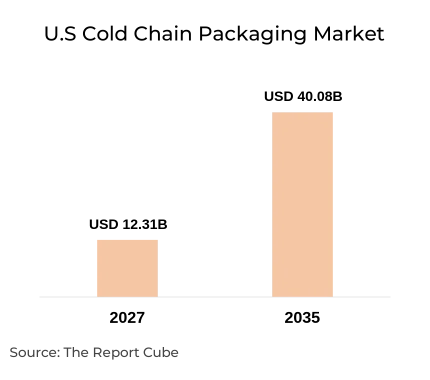
- The U.S. Cold Chain Packaging Market is estimated at USD 12.31 billion in 2027 and is projected to reach USD 40.08 billion by 2035, registering a CAGR of 15.90% during 2027-2035.
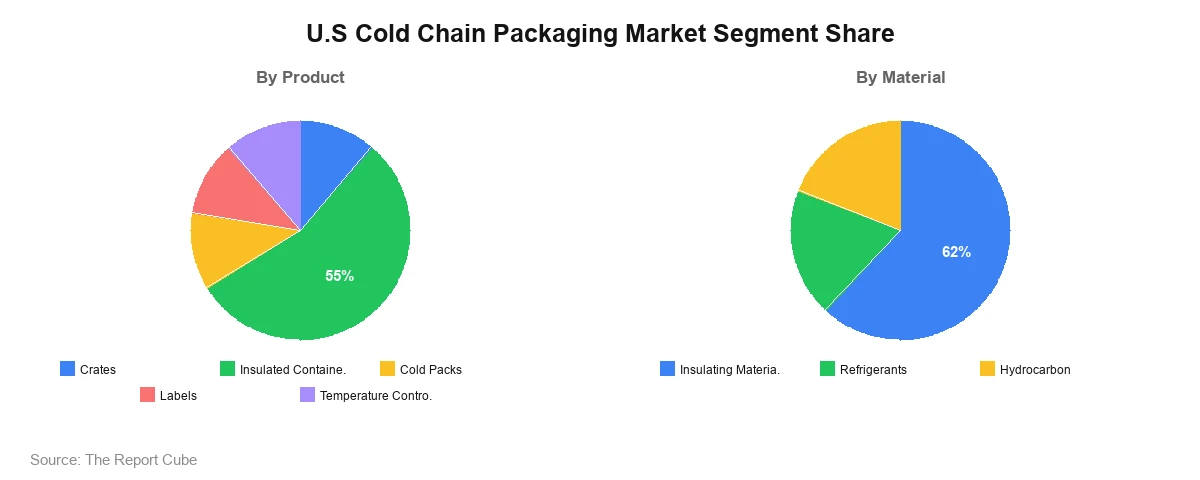
- Insulated containers and boxes are estimated to account for approximately 55% of the market by product in 2026, supported by their role in protecting temperature-sensitive food, pharmaceutical, and biological shipments.
- Insulating material is estimated to represent approximately 62% of the market by material in 2026, reflecting the importance of thermal barriers in maintaining product temperature during transportation and distribution.
- Demand is supported by the movement of perishable food products, including fruits, vegetables, dairy, meat, seafood, and processed foods, through temperature-controlled distribution networks.
- Pharmaceutical and biotechnology distribution represents an important application area because temperature-sensitive medicines and biological products require qualified shipping systems and documented handling conditions.
- Reusable packaging systems, phase-change materials, vacuum-insulated panels, and temperature-monitoring technologies are influencing product development and purchasing decisions.
- FDA sanitary transportation requirements and pharmaceutical quality-control expectations reinforce the importance of temperature management, protective packaging, and validated distribution procedures.
- Market participants are increasingly emphasizing reusable packaging, recyclable insulation materials, packaging qualification, and integrated monitoring services to improve shipment reliability and reduce environmental impact.
U.S. Cold Chain Packaging Market Outlook
The U.S. Cold Chain Packaging Market is experiencing growing demand for packaging solutions designed to protect temperature-sensitive products throughout storage, transportation, and last-mile distribution. Cold chain packaging includes insulated containers, boxes, crates, refrigerants, cold packs, temperature-controlled pallet shippers, and other protective systems. These solutions help maintain product quality when shipments are exposed to changing ambient temperatures, handling conditions, and transportation delays.
The food and beverage industry represents a significant demand base for cold chain packaging. Fruits and vegetables, dairy products, meat, seafood, fruit concentrates, and processed foods require appropriate temperature management to maintain freshness and reduce spoilage. The movement of these products through manufacturers, processors, distributors, retailers, food-service operators, and e-commerce channels creates demand for insulated packaging and temperature-protection materials.
Between 2027 and 2035, the market is expected to benefit from the expansion of temperature-sensitive distribution, the adoption of reusable packaging systems, and continued development of high-performance insulation technologies. The supplied forecast estimates the market at USD 12.31 billion in 2027 and USD 40.08 billion in 2035, representing a CAGR of 15.90%. These figures are supplied market estimates and should be interpreted as forecast assumptions rather than independently verified government statistics.
Government Regulations and Industry Standards
The U.S. cold chain packaging industry operates within food safety, pharmaceutical quality, transportation, and environmental regulatory frameworks. The U.S. Food and Drug Administration's (FDA) Food Safety Modernization Act (FSMA) Sanitary Transportation of Human and Animal Food rule requires covered transportation operations to use appropriate measures to prevent food contamination and ensure adequate temperature control for food requiring temperature management for safety.
The requirements also address protective packaging, written temperature specifications, appropriate vehicle conditions, and the responsibilities of shippers, loaders, carriers, and receivers. In pharmaceutical distribution, FDA current good manufacturing practice requirements address appropriate storage conditions, product containers, and distribution procedures. FDA guidance and inspection expectations emphasize documented and validated shipping processes and the maintenance of specified product temperatures. Separately, the Environmental Protection Agency (EPA) administers the American Innovation and Manufacturing (AIM) Act, which phases down hydrofluorocarbon production and consumption and regulates certain refrigeration and air-conditioning applications. These requirements influence the wider cold chain infrastructure and refrigerant ecosystem, although they do not prescribe a single packaging material or design for all shipments. Packaging manufacturers and users must therefore select systems according to the product, required temperature range, transit duration, applicable regulations, and validated performance requirements.
U.S. Cold Chain Packaging Market Dynamics
The U.S. Cold Chain Packaging Market is shaped by the need to maintain product quality and safety across temperature-sensitive food and pharmaceutical distribution networks. Regulatory expectations, the expansion of specialized healthcare shipments, food supply chain requirements, insulation innovation, and packaging sustainability initiatives influence purchasing decisions. However, packaging costs, material disposal, temperature excursions, and reverse-logistics complexity remain important industry considerations.
| Factor | Type | Specific Impact on Market | Magnitude |
|---|---|---|---|
| Expansion of temperature-sensitive food distribution | Growth Driver | Transportation of fresh produce, dairy, meat, seafood, and processed foods creates demand for insulated containers, cold packs, refrigerants, and protective packaging systems. | High |
| Pharmaceutical and biologics distribution requirements | Growth Driver | Temperature-sensitive medicines and biological products require qualified packaging, thermal protection, and documented shipping conditions, supporting demand for advanced packaging systems. | High |
| Reusable and recyclable thermal packaging | Opportunity | Reusable parcel and pallet shippers, recyclable insulation, and refurbishment services create opportunities for suppliers offering lower-waste packaging models. | High |
| Advanced insulation and monitoring technologies | Opportunity | Vacuum-insulated panels, phase-change materials, temperature indicators, and digital monitoring can improve shipment visibility and thermal performance. | High |
| Packaging material and qualification costs | Challenge | High-performance insulation, specialized refrigerants, thermal testing, and qualification processes can increase initial packaging costs and procurement complexity. | Medium |
| Temperature excursions and reverse-logistics complexity | Challenge | Unexpected delays, incorrect pack-outs, extreme weather, and the return of reusable containers can increase operational costs and create product-integrity risks. | High |
Growth Drivers: Increasing Distribution of Perishable Food Products
The distribution of temperature-sensitive food products is an important demand driver for cold chain packaging in the United States. Fruits and vegetables, dairy products, meat, seafood, and processed foods require suitable transportation and storage conditions to maintain freshness and reduce spoilage. USDA research on U.S. food flows identifies refrigerated transportation as an important part of the movement of perishable products through domestic supply chains. As food producers, processors, distributors, retailers, and online grocery businesses manage increasingly complex distribution networks, demand for insulated boxes, crates, cold packs, and temperature-protection materials is expected to remain important. Packaging solutions that protect products during loading, transportation, temporary storage, and last-mile delivery can support the reliability of these distribution operations.
Market Opportunities: Expansion of Reusable and Sustainable Packaging Solutions
Reusable cold chain packaging represents an opportunity for manufacturers seeking to reduce dependence on single-use packaging and offer lifecycle-based services. Reusable parcel shippers, pallet containers, and thermal covers can be deployed across recurring distribution routes when collection, refurbishment, cleaning, and redistribution are operationally practical. Suppliers can differentiate through rental programs, packaging-as-a-service models, return logistics, and refurbishment networks. Cold Chain Technologies, for example, offers reusable parcel and pallet solutions supported by return and refurbishment programs, while other manufacturers are developing reusable platforms for pharmaceutical distribution. Reusable packaging may improve lifecycle economics on suitable shipping lanes, although its benefits depend on return rates, utilization, cleaning requirements, transportation distances, and asset management costs.
Industry Challenges: High Material, Testing, and Packaging Costs
Cold chain packaging can involve higher costs than conventional protective packaging because systems may require specialized insulation, refrigerants, temperature-control components, and performance qualification. Packaging suppliers must design solutions around payload dimensions, temperature ranges, shipment duration, ambient conditions, and transportation routes. Pharmaceutical applications may require additional testing and documented qualification to demonstrate that a packaging configuration can maintain the required conditions. These requirements can increase development and procurement costs, particularly for smaller manufacturers, distributors, and businesses with irregular shipping volumes. Suppliers must balance thermal performance, packaging weight, material consumption, and total distribution cost.
Need Specific Data, Let’s Customize the Report for You
Request CustomizationMarket Trends: Adoption of Reusable and Circular Packaging Models
Reusable packaging is becoming an important product-development direction in the cold chain industry, particularly for pharmaceutical and life sciences shipments. Manufacturers are offering reusable parcel shippers, pallet containers, thermal covers, and rental-based systems designed for repeat distribution routes. These solutions can be supported by refurbishment, return logistics, and asset management services. Reusable systems may reduce single-use packaging consumption when the shipping network has efficient reverse logistics and sufficiently high asset utilization. The development of reusable packaging models is also encouraging suppliers to focus on durability, standardized pack-outs, repairability, and lifecycle performance.
U.S. Cold Chain Packaging Market Segment Analysis
The U.S. Cold Chain Packaging Market is segmented by product, material, application, and region. Product segmentation covers the primary packaging formats used to protect temperature-sensitive goods, while material segmentation reflects the insulation and temperature-control components used in packaging systems. Application segmentation includes food, beverage, and pharmaceutical shipments that require controlled transportation conditions. The regional segmentation covers the Midwest, West, South, and Northeast markets.
By Product
- Crates
- Insulated Container & Boxes
- Cold Packs
- Labels
- Temperature Controlled Pallet Shippers
Insulated containers and boxes are estimated to account for approximately 55% of the U.S. Cold Chain Packaging Market by product in 2026. These products provide thermal barriers that help protect temperature-sensitive shipments from external temperature fluctuations during transportation and temporary storage. Their applications include food distribution, pharmaceutical shipments, biotechnology products, and other temperature-sensitive goods. Product designs can incorporate expanded polystyrene, polyurethane, vacuum-insulated panels, and other insulation technologies. The segment's estimated leadership reflects the broad use of insulated packaging across parcel and bulk shipment formats; the supplied 55% figure should be treated as an analyst estimate rather than a published official market statistic.
By Material
- Insulating Material
- Refrigerants
- Hydrocarbon
Insulating material is estimated to represent approximately 62% of the market by material in 2026. Insulation is central to cold chain packaging because it helps limit heat transfer between the external environment and the packaged product. Common packaging approaches use expanded polystyrene, polyurethane, vacuum-insulated panels, and other engineered thermal barriers. Refrigerants and phase-change materials support temperature management by absorbing or releasing thermal energy during transportation. The supplied category Hydrocarbon is retained as provided, but its classification should be confirmed because hydrocarbons are not conventionally grouped as a primary insulation material in standard cold chain packaging taxonomies. The 62% share is a supplied analyst estimate and is not independently verified.
U.S. Cold Chain Packaging Market Regional Analysis
Regional demand for cold chain packaging in the United States is influenced by the concentration of food production, pharmaceutical distribution, logistics infrastructure, and population centers. Each region has different transportation patterns and temperature-sensitive product flows. Packaging demand also depends on the distance between production facilities, distribution centers, retailers, healthcare facilities, and end users.
| Region | Key Growth Factors | Industry Trends |
|---|---|---|
| Midwest | Food processing, agricultural production, dairy distribution, meat processing, and central distribution infrastructure. | Demand for insulated containers, reusable transport packaging, temperature-controlled pallet systems, and packaging suitable for regional food distribution. |
| West | Fresh produce distribution, biotechnology and pharmaceutical activity, major ports, and long-distance transportation networks. | Growing use of high-performance insulated packaging, temperature monitoring, and packaging solutions designed for longer transit durations. |
| South | Population growth, food processing, regional distribution centers, pharmaceutical logistics, and expanding retail distribution networks. | Demand for thermal packaging suitable for warm ambient conditions, last-mile distribution, and temperature-sensitive food shipments. |
| Northeast | Dense population centers, healthcare facilities, pharmaceutical distribution, food-service networks, and specialty medicine shipments. | Use of compact insulated parcel shippers, reusable pharmaceutical packaging, and temperature-assurance solutions for frequent deliveries. |
U.S. Cold Chain Packaging Market Competitive Landscape
The competitive landscape includes manufacturers of insulated containers, temperature-controlled parcel and pallet shippers, refrigerants, reusable packaging systems, and protective packaging solutions. Companies compete through thermal performance, product qualification, material innovation, packaging durability, reusable service models, and geographic distribution capabilities. The listed companies have different product portfolios and market positions; some focus primarily on pharmaceutical and life sciences packaging, while others also serve food and general protective packaging applications.
| Company | Competitive Strength | Primary Segment Served |
|---|---|---|
| Cold Chain Technologies | Broad portfolio of single-use and reusable parcel and pallet shippers, thermal covers, monitoring solutions, and refurbishment services. | Pharmaceutical and life sciences thermal packaging |
| Cryopak | Insulated containers, phase-change materials, reusable shippers, packaging engineering, and thermal testing capabilities. | Pharmaceutical, food, and temperature-sensitive shipments |
| Sonoco ThermoSafe | Established temperature-assurance packaging portfolio, including reusable systems and pallet shippers. The ThermoSafe business was sold by Sonoco to Arsenal Capital Partners in 2025 and subsequently operates as ThermoSafe. | Pharmaceutical and life sciences packaging |
| SOFRIGAM | Insulated shipping boxes, cold accumulators, pallet shippers, containers, temperature loggers, and active temperature-controlled solutions. | Pharmaceutical and temperature-controlled logistics |
| Softbox Systems Ltd | Engineered passive temperature-controlled packaging systems using insulation and refrigerant configurations for different temperature ranges. | Pharmaceutical, biotechnology, and clinical trial shipments |
| Pelican Products Inc. (Peli BioThermal) | Reusable Crēdo systems, single-use shippers, phase-change materials, vacuum-insulated panels, and packaging rental services. | Pharmaceutical and life sciences thermal packaging |
| CSafe | Passive and active temperature-controlled shipping solutions, reusable pallet shippers, thermal covers, and shipment monitoring. | Pharmaceutical and biologics transportation |
| TOWER Cold Chain Solutions | Reusable passive temperature-controlled containers using phase-change technology, insulation, and integrated monitoring options. | Pharmaceutical and high-value life sciences shipments |
| Sealed Air Corporation | Protective packaging and temperature-assurance products, including insulated bags, liners, and customizable thermal packaging. | Food, e-commerce, pharmaceutical, and temperature-sensitive distribution |
- Cold Chain Technologies: Cold Chain Technologies is a major supplier of thermal packaging solutions for pharmaceutical and life sciences distribution. Its portfolio includes single-use parcel shippers, reusable parcel systems, pallet shippers, thermal covers, and monitoring solutions. The company also offers return and refurbishment programs for reusable packaging, supporting customers that operate recurring distribution routes. Its acquisition of Global Cold Chain Solutions in March 2025 expanded its international manufacturing and service capabilities. The company's product portfolio and acquisition strategy support its position in temperature-sensitive pharmaceutical logistics.
- ThermoSafe: ThermoSafe provides temperature-assurance packaging for pharmaceutical, biotechnology, and healthcare distribution. Its portfolio includes insulated shipping systems, pallet shippers, and reusable platforms. In April 2025, the company announced its ChillTherm Bio biodegradable EPS QPMC pallet shipper, designed to provide up to 120 hours of thermal performance at 2°C to 8°C under its stated conditions. In September 2025, Sonoco announced the sale of ThermoSafe to Arsenal Capital Partners, with the acquisition completed in November 2025. ThermoSafe's continued product development and investment in U.S.-based manufacturing strengthen its position in specialized temperature-controlled packaging.
Recent Developments and Updates
- February 5, 2026: ThermoSafe announced the launch of Orion Express, an expansion of its reusable Orion temperature-assurance platform. The configuration is designed for domestic and express shipping lanes and offers up to 67 hours of thermal performance under the company's stated conditions.
- May 26, 2026: ThermoSafe announced an expansion of its U.S.-based vacuum-insulated panel manufacturing capabilities to strengthen supply assurance for life sciences customers.
- September 1, 2026: CSafe introduced Silverskin RE PMC, a reusable thermal cover designed for multi-pallet pharmaceutical air freight. The solution uses a modular design, supports specified refrigerated and controlled-room-temperature applications, and is backed by a refurbishment model.
U.S. Cold Chain Packaging Market Future Outlook
The U.S. Cold Chain Packaging Market is expected to benefit from the continued movement of temperature-sensitive food and pharmaceutical products through domestic and international distribution networks. Food safety requirements, pharmaceutical quality standards, specialty medicine shipments, and the expansion of temperature-sensitive e-commerce distribution will continue to influence packaging selection. Demand is likely to remain relevant across insulated containers, cold packs, temperature-controlled pallet shippers, refrigerants, and packaging materials designed to maintain product-specific temperature conditions.
Technology and sustainability are expected to influence competition over the forecast period. Reusable packaging, vacuum-insulated panels, phase-change materials, recyclable insulation, digital monitoring, and refurbishment services are likely to remain important areas of product development. Suppliers that combine validated thermal performance with efficient packaging design, monitoring, and return logistics may strengthen their competitive positions. The supplied market forecast estimates growth from USD 12.31 billion in 2027 to USD 40.08 billion in 2035, at a CAGR of 15.90%; this forecast should be considered an analyst estimate pending independent market-data validation.
U.S. Cold Chain Packaging Market Report Coverage
The report provides an overview of the U.S. Cold Chain Packaging Market, covering market size estimates, forecast growth, market dynamics, segmentation, regional analysis, competitive positioning, and recent industry developments. It examines the role of insulated packaging, refrigerants, temperature-controlled shipping systems, and packaging solutions used in food and pharmaceutical distribution.
| Parameter | Details |
|---|---|
| Market Name | U.S. Cold Chain Packaging Market |
| Market Size (Base Year) | 2026 |
| Market Size (Forecast Year) | USD 40.08 billion (2035) |
| 2027 Market Size | USD 12.31 billion |
| CAGR | 15.90% (2027-2035) |
| Base Year | 2026 |
| Historical Period | 2022-2026 |
| Forecast Period | 2027-2035 |
| Geographic Scope | United States |
| Segmentation | By Product, By Material, By Application, and By Region |
| Regions Covered | Midwest, West, South, and Northeast |
| Key Companies | Cold Chain Technologies, Cryopak, Sonoco ThermoSafe, SOFRIGAM, Softbox Systems Ltd, Pelican Products Inc., CSafe, TOWER Cold Chain Solutions, Sealed Air Corporation, and Others |
| Customization | Available based on additional segment, regional, company, and application requirements |
Why Choose This U.S. Cold Chain Packaging Market Report?
- Provides market size estimates and forecast analysis for the 2027-2035 period.
- Examines key growth drivers, market opportunities, industry challenges, and emerging packaging trends.
- Analyzes product categories, including insulated containers and boxes, crates, cold packs, labels, and temperature-controlled pallet shippers.
- Evaluates material categories and the role of insulation and refrigerants in temperature-controlled packaging.
- Examines applications across fruits and vegetables, dairy products, meat and seafood, processed food, pharmaceuticals, and other temperature-sensitive products.
- Provides regional analysis covering the Midwest, West, South, and Northeast.
- Reviews major market participants, their product portfolios, competitive strengths, and recent developments.
- Supports strategic planning for manufacturers, packaging suppliers, food distributors, pharmaceutical companies, and cold chain logistics providers.
Table of Contents
- Introduction
- Objective of the Study
- Product Definition
- Market Segmentation
- Study Variables
- Research Methodology
- Secondary Data Points
- Companies Interviewed
- Primary Data Points
- Breakdown of Primary Interviews
- Secondary Data Points
- Executive Summary
- Market Dynamics
- Drivers
- Challenges
- Opportunity Assessment
- Recent Trends and Developments
- Policy and Regulatory Landscape
- U.S Cold Chain Packaging Market Overview and Forecast Analysis (2022-2035)
- Market Size, By Value, By Growth Rate (CAGR/USD Billions)
- Demand – Supply Trends
- Market Share, By Product
- Crates
- Insulated Container & Boxes
- Cold Packs
- Labels
- Temperature Controlled Pallet Shippers
- Market Share, By Material
- InsulatingMaterial
- Refrigerants
- Hydrocarbon
- Market Share, By Application
- Fruits & Vegetables
- Fruit & Pulp Concentrates
- Dairy Products
- Fish, Meat & Seafood
- Processed Food
- Pharmaceuticals
- Bakery & Confectionaries
- Others
- Market Share, By Region
- Midwest
- West
- South
- Northeast
- Market Share, By Competitors
- Competition Characteristics
- Revenue Shares
- Crates U.S Cold Chain Packaging Market Overview, 2022-2035F
- By Value (USD Million)
- By Material – Market Size & Forecast 2022-2035, USD Million
- InsulatingMaterial
- Refrigerants
- Hydrocarbon
- Insulated Container & Boxes U.S Cold Chain Packaging Market Overview, 2022-2035F
- By Value (USD Million)
- By Material – Market Size & Forecast 2022-2035, USD Million
- InsulatingMaterial
- Refrigerants
- Hydrocarbon
- Cold Packs U.S Cold Chain Packaging Market Overview, 2022-2035F
- By Value (USD Million)
- By Material – Market Size & Forecast 2022-2035, USD Million
- InsulatingMaterial
- Refrigerants
- Hydrocarbon
- Labels U.S Cold Chain Packaging Market Overview, 2022-2035F
- By Value (USD Million)
- By Material – Market Size & Forecast 2022-2035, USD Million
- InsulatingMaterial
- Refrigerants
- Hydrocarbon
- Temperature Controlled Pallet Shippers U.S Cold Chain Packaging Market Overview, 2022-2035F
- By Value (USD Million)
- By Material – Market Size & Forecast 2022-2035, USD Million
- InsulatingMaterial
- Refrigerants
- Hydrocarbon
- Competitive Outlook (Company Profile – Partial List)
- Cold chain Technologies
- Company Overview
- Business Segments
- Strategic Alliances/Partnerships
- Recent Developments
- Cryopak
- Company Overview
- Business Segments
- Strategic Alliances/Partnerships
- Recent Developments
- Sonoco Thermosafe
- Company Overview
- Business Segments
- Strategic Alliances/Partnerships
- Recent Developments
- SOFRIGAM
- Company Overview
- Business Segments
- Strategic Alliances/Partnerships
- Recent Developments
- Softbox Systems Ltd
- Company Overview
- Business Segments
- Strategic Alliances/Partnerships
- Recent Developments
- Pelican Products Inc.
- Company Overview
- Business Segments
- Strategic Alliances/Partnerships
- Recent Developments
- CSafe
- Company Overview
- Business Segments
- Strategic Alliances/Partnerships
- Recent Developments
- TOWER Cold Chain Solutions
- Company Overview
- Business Segments
- Strategic Alliances/Partnerships
- Recent Developments
- Sealed Air Corporation
- Company Overview
- Business Segments
- Strategic Alliances/Partnerships
- Recent Developments
- Others
- Cold chain Technologies
- Contact Us & Disclaimer
Top Key Players & Market Share Outlook
- Cold chain Technologies
- Cryopak
- Sonoco Thermosafe
- SOFRIGAM
- Softbox Systems Ltd
- Pelican Products Inc
- CSafe
- TOWER Cold Chain Solutions
- Sealed Air Corporation
- Others
Frequently Asked Questions