



Build Your Custom Market Intelligence Report
Customize Your ReportKey Highlights
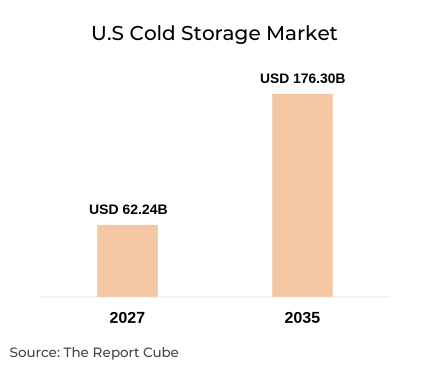
- The U.S. Cold Storage Market is estimated to reach USD 62.24 billion in 2027 and USD 176.30 billion by 2035, registering a CAGR of 13.90% during the forecast period.
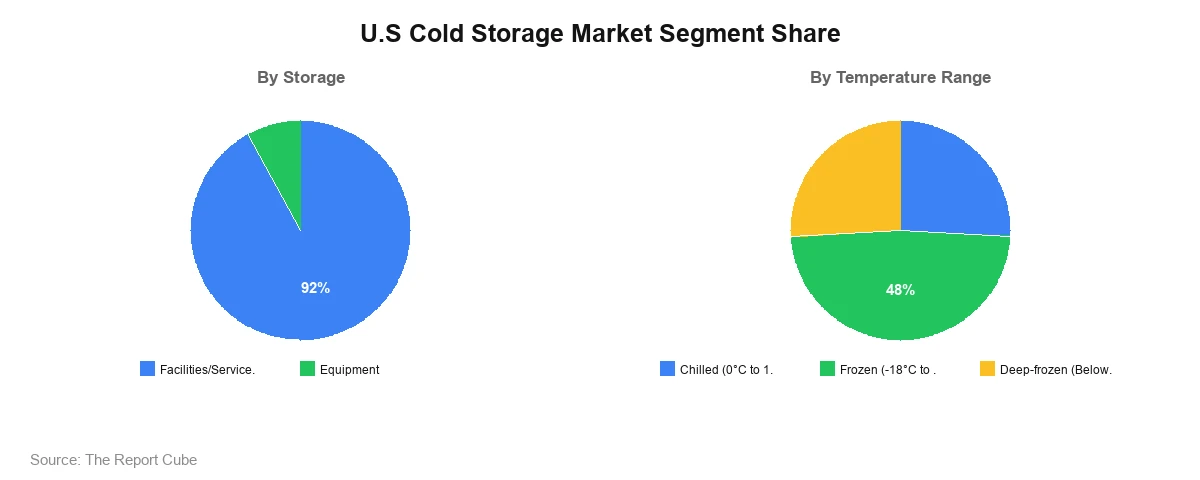
- Facilities and services are estimated to account for approximately 92% of the market by storage category in 2026, reflecting the importance of temperature-controlled warehousing, storage operations, handling, and logistics services.
- The frozen temperature range (-18°C to -25°C) is estimated to represent approximately 48% of the market in 2026, supported by demand for frozen food storage and distribution.
- Food and beverages represent a major application area for cold storage facilities, driven by the need to preserve meat, seafood, dairy products, fruits, vegetables, and processed food products.
- Pharmaceutical cold storage is an important specialized application, particularly for vaccines, biologics, specialty medicines, and other temperature-sensitive healthcare products.
- Warehouse automation, high-density storage systems, energy-efficient refrigeration, and real-time temperature monitoring are influencing investment and operational strategies across the industry.
- USDA data reported 3.99 billion cubic feet of gross refrigerated warehouse capacity in the United States as of October 1, 2025, highlighting the scale of the country's temperature-controlled storage infrastructure.
- Major market participants are investing in facility expansion, automated warehouses, integrated transportation networks, and strategic partnerships to strengthen their cold chain capabilities.
U.S. Cold Storage Market Outlook
The U.S. Cold Storage Market plays an important role in the country's food distribution, pharmaceutical supply chains, and temperature-sensitive logistics infrastructure. Cold storage facilities provide refrigerated and frozen environments for products that require controlled temperatures during inventory holding, processing, consolidation, and distribution. These facilities serve food manufacturers, agricultural producers, seafood processors, retailers, wholesalers, pharmaceutical companies, and logistics providers. The market includes third-party cold storage services, privately operated warehouses, temperature-controlled distribution facilities, and equipment used to maintain appropriate storage conditions.
Food and beverage distribution represents a major source of demand for cold storage infrastructure. Meat, seafood, dairy products, frozen foods, fruits, vegetables, and processed food products require temperature-controlled environments to preserve quality and reduce spoilage. Public refrigerated warehouses allow manufacturers, importers, distributors, and retailers to outsource storage and inventory management, while private and semiprivate facilities support companies operating their own supply chains. USDA's refrigerated warehouse survey reported 3.99 billion cubic feet of gross refrigerated storage capacity in the United States as of October 1, 2025, including public, private, and semiprivate facilities.
The market is expected to benefit from investments in automated warehousing, high-density storage, energy-efficient refrigeration, and integrated cold chain logistics. The increasing need for reliable food distribution and temperature-sensitive pharmaceutical storage is expected to support infrastructure development. Based on the supplied market estimates, the U.S. Cold Storage Market is projected to increase from USD 62.24 billion in 2027 to USD 176.30 billion by 2035, at a CAGR of 13.90%. These market values are supplied estimates and should not be interpreted as independently verified government statistics.
Government Regulations and Industry Standards
The U.S. cold storage industry operates under food safety, pharmaceutical quality, occupational safety, environmental, and refrigeration-related regulatory frameworks. The U.S. Food and Drug Administration (FDA) administers the Food Safety Modernization Act (FSMA), including the Sanitary Transportation of Human and Animal Food rule, which establishes requirements for covered shippers, loaders, carriers, and receivers to maintain appropriate sanitary conditions and temperature control during food transportation. Although the rule primarily addresses transportation operations, it also emphasizes the importance of properly prepared refrigerated compartments, suitable equipment, and procedures that prevent food from becoming unsafe. FDA food safety requirements and applicable food manufacturing regulations influence the handling and storage practices of cold chain operators.
Pharmaceutical storage and distribution are subject to applicable FDA current good manufacturing practice and drug supply chain requirements, depending on the products and activities involved. The Environmental Protection Agency (EPA) regulates refrigerants and certain refrigeration-system applications under environmental laws, including the American Innovation and Manufacturing Act and applicable refrigerant management requirements. Occupational safety requirements administered by the Occupational Safety and Health Administration (OSHA) are also relevant to warehouse operations, including worker protection, machinery, material handling, and ammonia refrigeration hazards. These regulatory frameworks influence facility design, refrigeration equipment selection, monitoring, maintenance, sanitation, and operating procedures across the U.S. cold storage industry.
U.S. Cold Storage Market Dynamics
The U.S. Cold Storage Market is influenced by the expansion of temperature-sensitive food distribution, pharmaceutical storage requirements, investments in automated facilities, and the need for reliable refrigeration infrastructure. Food safety practices and specialized product-handling requirements support demand for professional storage services. At the same time, high construction costs, energy consumption, refrigeration-system maintenance, and labor requirements create operational challenges for cold storage providers.
| Factor | Type | Specific Impact on Market | Magnitude |
|---|---|---|---|
| Increasing demand for temperature-controlled food distribution | Growth Driver | Food manufacturers, processors, retailers, and distributors require refrigerated and frozen storage facilities to preserve product quality and manage inventory across distribution networks. | High |
| Growth in pharmaceutical and biologics storage requirements | Growth Driver | Temperature-sensitive medicines, vaccines, biologics, and specialty healthcare products require controlled storage environments, qualified facilities, and monitoring systems. | High |
| Automated and high-density cold storage facilities | Opportunity | Automated storage and retrieval systems, robotics, warehouse management software, and high-density storage layouts create opportunities to improve capacity utilization and operational efficiency. | High |
| Energy-efficient refrigeration and sustainable facility development | Opportunity | Advanced refrigeration systems, heat recovery, energy management, and alternative refrigerants create opportunities for facility modernization and lower operating costs. | High |
| High capital expenditure and energy consumption | Challenge | Cold storage facilities require specialized construction, insulation, refrigeration systems, backup infrastructure, and continuous electricity consumption, increasing investment and operating costs. | High |
| Refrigeration reliability, maintenance, and workforce requirements | Challenge | Equipment failures, temperature excursions, refrigeration leaks, maintenance needs, and shortages of specialized technical personnel can affect operating reliability and product integrity. | Medium |
Growth Drivers: Increasing Demand for Temperature-Controlled Food Storage
The growing movement of perishable and frozen food products through U.S. supply chains is an important driver of cold storage demand. Meat, seafood, dairy products, frozen foods, fruits, and vegetables require suitable temperature-controlled environments to preserve product quality and manage inventory before distribution. Food processors, importers, wholesalers, retailers, and food-service operators use public refrigerated warehouses and dedicated storage facilities to manage seasonal production, inventory fluctuations, and regional distribution requirements. USDA's National Agricultural Statistics Service publishes regular data on refrigerated warehouse capacity and commodity holdings, demonstrating the importance of cold storage infrastructure in the U.S. food supply chain. The expansion and modernization of these facilities are expected to support demand for refrigerated warehousing, frozen storage, handling, and distribution services.
Market Opportunities: Expansion of Automated and High-Density Cold Storage Warehouses
Automated cold storage facilities represent an important investment opportunity for warehouse operators and technology providers. Automated storage and retrieval systems, pallet shuttles, robotics, automated material handling, and warehouse management software can improve storage density and reduce the need for repetitive manual handling in low-temperature environments. High-density automated facilities can help operators manage land constraints and increase storage capacity within existing building footprints. Automation can also improve inventory accuracy, throughput, and operating consistency. New facility developments that integrate automated storage systems with refrigeration controls, digital monitoring, and transportation management can provide competitive advantages to operators serving large food manufacturers, retailers, and pharmaceutical distributors.
Industry Challenges: High Construction and Operating Costs
Cold storage facilities require higher capital investment than many conventional warehouses because they need insulated building envelopes, specialized floors, refrigeration systems, temperature-control infrastructure, backup power, and suitable material-handling equipment. Construction costs can increase further when operators develop automated facilities or facilities designed for multiple temperature zones. Energy consumption also represents a significant recurring expense because refrigeration systems must operate continuously to maintain the required storage conditions. In addition, land availability, utility infrastructure, labor, equipment procurement, and maintenance requirements can affect project economics. These costs can create barriers to entry for smaller operators and influence the pricing of storage and handling services.
Need Specific Data, Let’s Customize the Report for You
Request CustomizationMarket Trends: Adoption of Automated Warehousing and Digital Inventory Systems
Cold storage operators are increasingly adopting automated storage and retrieval systems, robotics, warehouse management software, and digital inventory platforms. These technologies help improve storage density, inventory visibility, order accuracy, and material-handling efficiency. Automated systems are particularly relevant to frozen warehouses, where low temperatures create additional operational requirements for workers and equipment. Operators are investing in high-density pallet storage, automated picking, conveyor systems, and integrated warehouse controls to improve throughput. Digital platforms can also connect warehouse operations with transportation scheduling, customer inventory systems, and distribution networks, supporting more coordinated cold chain operations.
U.S. Cold Storage Market Segment Analysis
The U.S. Cold Storage Market is segmented by storage category, temperature range, application, and region. Storage segmentation distinguishes facilities and services from equipment used to operate temperature-controlled warehouses. Temperature-range segmentation covers chilled, frozen, and deep-frozen storage environments. Application segmentation includes food and beverages, pharmaceuticals, and other temperature-sensitive products. Regional segmentation covers the Midwest, West, South, and Northeast, reflecting differences in food production, distribution infrastructure, population centers, and pharmaceutical activity.
By Storage
- Facilities/Services
- Equipment
Facilities and services are estimated to account for approximately 92% of the U.S. Cold Storage Market by storage category in 2026. This category includes temperature-controlled warehousing, inventory holding, product handling, order preparation, consolidation, and related logistics services. Public refrigerated warehouses provide storage services to multiple customers, while private and semiprivate facilities support dedicated or affiliated supply chains. The large estimated share reflects the service-intensive nature of the cold storage industry, where customers pay for access to refrigerated and frozen capacity and associated warehouse operations. Equipment represents the infrastructure and machinery required to operate cold storage facilities, including industrial refrigeration systems, compressors, evaporators, condensers, insulated panels, storage systems, material-handling equipment, and monitoring technologies. The supplied 92% figure is retained as an analyst estimate and should be validated against the underlying market revenue methodology.
By Temperature Range
- Chilled (0°C to 15°C)
- Frozen (-18°C to -25°C)
- Deep-frozen (Below -25°C)
Frozen storage is estimated to account for approximately 48% of the U.S. Cold Storage Market by temperature range in 2026. Frozen warehouses maintain products at sub-zero temperatures to support the storage of frozen meat, seafood, poultry, vegetables, prepared foods, and other products requiring extended frozen preservation. Chilled storage, defined in this segmentation as 0°C to 15°C, supports products such as fresh produce, dairy, certain beverages, and other temperature-sensitive goods that do not require freezing. Deep-frozen storage, defined as below -25°C, serves specialized applications that require lower temperature conditions, including selected food and pharmaceutical products. Actual storage temperatures depend on product specifications and applicable handling requirements. The 48% figure is a supplied analyst estimate and is not equivalent to USDA's reported share of physical freezer capacity.
U.S. Cold Storage Market Regional Analysis
Regional cold storage demand in the United States is influenced by the location of food production and processing facilities, population centers, import gateways, pharmaceutical distribution networks, and transportation infrastructure. Each region has different requirements for chilled, frozen, and deep-frozen storage. Operators select facility locations based on customer proximity, access to highways and ports, labor availability, utility infrastructure, and the economics of serving regional and national distribution networks.
| Region | Key Growth Factors | Industry Trends |
|---|---|---|
| Midwest | Meat processing, dairy production, agricultural supply chains, food manufacturing, and central distribution networks. | Investment in large-scale refrigerated warehouses, automated frozen storage, inventory management systems, and temperature-controlled food distribution. |
| West | Fresh produce distribution, seafood imports, agricultural processing, port infrastructure, and large consumer markets. | Demand for facilities near ports and production centers, modern refrigeration systems, and integrated storage and transportation services. |
| South | Poultry and meat processing, food manufacturing, population growth, imports, and expanding retail distribution networks. | Development of additional refrigerated capacity, automated warehouses, and facilities supporting frozen food and regional distribution. |
| Northeast | Dense population centers, food wholesalers, healthcare institutions, pharmaceutical distribution, and access to major import gateways. | Greater emphasis on urban distribution facilities, multi-temperature storage, specialized pharmaceutical storage, and efficient last-mile logistics. |
U.S. Cold Storage Market Competitive Landscape
The U.S. Cold Storage Market includes large temperature-controlled warehouse operators, integrated logistics companies, regional refrigerated storage providers, and equipment suppliers. Competition is based on warehouse capacity, geographic coverage, customer relationships, automation, storage specialization, transportation integration, and operational efficiency. Lineage and Americold are among the largest temperature-controlled warehousing providers, while United States Cold Storage and Burris Logistics are established participants in refrigerated storage and distribution. Some companies in the supplied list have been acquired or integrated into larger operators, while equipment manufacturers such as Wabash National serve an adjacent part of the cold chain value chain rather than operating a comparable national warehouse network.
| Company | Competitive Strength | Primary Segment Served |
|---|---|---|
| Americold Logistics Inc. | Large temperature-controlled warehouse network, integrated transportation services, food supply chain relationships, and warehouse development capabilities. | Refrigerated and frozen warehousing, food logistics, and temperature-controlled distribution |
| AGRO Merchants Group North America | Historically operated temperature-controlled facilities and logistics services across several markets. The business was acquired by Americold in 2020 and is no longer an independent competitor under its former ownership. | Historical refrigerated warehousing and food logistics operations |
| Burris Logistics | Integrated cold chain logistics, refrigerated warehousing, transportation, food distribution, and supply chain services. | Food-grade cold storage, distribution, and transportation |
| Henningsen Cold Storage Co. | Established refrigerated warehousing business with a strong historical presence in the Pacific Northwest. Acquired by Lineage in 2020. | Historical refrigerated and frozen warehousing operations |
| Lineage Logistics Holdings LLC | Large global temperature-controlled warehouse network, automated facilities, integrated logistics, and technology-enabled warehouse operations. | Refrigerated and frozen warehousing, food logistics, and integrated cold chain services |
| Nordic Logistics | Included in the supplied competitive set; its current U.S. cold storage operating footprint and independent market position require further entity-level verification. | Cold chain logistics - scope requires verification |
| Preferred Freezer Services | Historically operated specialized refrigerated warehouses, including frozen seafood facilities. Acquired by Lineage in 2019 and no longer an independent competitor under its former identity. | Historical frozen food and seafood warehousing |
| VersaCold Logistics Services | Established Canadian cold chain operator with temperature-controlled facilities and transportation services. Acquired by Lineage in 2022; its core footprint is Canadian rather than a standalone U.S. competitor. | Canadian refrigerated warehousing and cross-border cold chain logistics |
| United States Cold Storage | National refrigerated warehouse network, food supply chain expertise, temperature-controlled storage, and logistics capabilities. | Public refrigerated warehousing, frozen storage, and food logistics |
| Wabash National Corporation | Manufacturer of transportation equipment and solutions, including refrigerated trailers and related equipment. It is an adjacent equipment supplier rather than a direct cold storage warehouse operator. | Refrigerated transportation equipment and cold chain infrastructure |
- Americold Logistics Inc.: Americold is a major temperature-controlled warehousing and logistics company serving food producers, processors, distributors, and retailers. Its operations include refrigerated warehouse facilities, transportation services, and third-party managed activities. The company uses a combination of conventional and automated warehouse infrastructure to support storage and distribution requirements across major cold chain locations. Its September 2026 investor materials reported a global network of 208 warehouses and approximately 1.2 billion cubic feet of capacity, including 163 warehouses in North America. Americold's large network, customer relationships, and facility development capabilities support its competitive position in temperature-controlled logistics. Company website.
- Lineage Logistics Holdings LLC: Lineage is a major temperature-controlled warehousing and logistics provider with a broad network of refrigerated and frozen facilities. Its business combines warehouse operations, transportation, automation, and technology-enabled supply chain services. The company has expanded through acquisitions, facility development, and strategic customer relationships. Its acquisition of Preferred Freezer Services in 2019 and Henningsen Cold Storage in 2020 strengthened its warehouse network, while its acquisition of VersaCold in 2022 expanded its Canadian operations. Lineage's scale, automated storage capabilities, and integrated logistics services make it a significant competitor in North American cold storage. Company website.
Recent Developments and Updates
- February 9, 2026: USDA's National Agricultural Statistics Service released its 2025 Capacity of Refrigerated Warehouses report. It reported 3.99 billion cubic feet of gross refrigerated storage capacity across 931 U.S. warehouses as of October 1, 2025. Public warehouses accounted for 62% of gross capacity, while private and semiprivate warehouses accounted for 38%.
- May 2026: Americold and EQT announced a North American cold storage joint venture involving 12 U.S. temperature-controlled warehouse properties with more than USD 1.3 billion in gross asset value. The transaction was designed to support investment and capital allocation across the cold storage portfolio.
- June 18, 2026: Americold announced the opening of an integrated cold chain facility at Port Saint John in New Brunswick, Canada, developed with DP World and Canadian Pacific Kansas City. The facility combines cold storage, maritime logistics, and rail connectivity and is relevant to North American cross-border cold chain infrastructure.
- August 31, 2026: Americold announced the completion of its USD 1.3 billion North American cold storage joint venture with EQT. EQT acquired a 70% interest in the partnership, while Americold retained a 30% interest and the role of platform manager. The portfolio includes 12 U.S. temperature-controlled warehouse facilities.
U.S. Cold Storage Market Report Coverage
The report provides an overview of the U.S. Cold Storage Market, covering market size estimates, forecast growth, market dynamics, segmentation, regional analysis, competitive positioning, and recent industry developments. It evaluates the role of refrigerated and frozen storage facilities, cold storage services, equipment, and temperature-controlled distribution infrastructure across food and pharmaceutical supply chains.
| Parameter | Details |
|---|---|
| Market Name | U.S. Cold Storage Market |
| Market Size (Base Year) | 2026 |
| Market Size (Forecast Year) | USD 176.30 billion (2035) |
| 2027 Market Size | USD 62.24 billion |
| CAGR | 13.90% (2027-2035) |
| Base Year | 2026 |
| Historical Period | 2022-2026 |
| Forecast Period | 2027-2035 |
| Geographic Scope | United States |
| Segmentation | By Storage, By Temperature Range, By Application, and By Region |
| Regions Covered | Midwest, West, South, and Northeast |
| Key Companies | Americold Logistics Inc., AGRO Merchants Group North America, Burris Logistics, Henningsen Cold Storage Co., Lineage Logistics Holdings LLC, Nordic Logistics, Preferred Freezer Services, VersaCold Logistics Services, United States Cold Storage, Wabash National Corporation |
| Customization | Available based on additional segment, regional, company, and application requirements |
Why Choose This U.S. Cold Storage Market Report?
- Provides market size estimates and forecast analysis for the 2027-2035 period.
- Examines the key growth drivers, market opportunities, industry challenges, and emerging cold storage trends.
- Analyzes facilities and services alongside equipment used in temperature-controlled storage operations.
- Evaluates chilled, frozen, and deep-frozen storage requirements across different product categories.
- Examines demand from food and beverages, pharmaceuticals, and other temperature-sensitive applications.
- Provides regional analysis covering the Midwest, West, South, and Northeast.
- Reviews major cold storage operators, logistics providers, and adjacent equipment suppliers.
- Highlights automation, refrigeration modernization, energy efficiency, and investment developments across the industry.
- Supports strategic planning for warehouse operators, food manufacturers, retailers, pharmaceutical distributors, logistics companies, and equipment suppliers.
Table of Contents
- Introduction
- Objective of the Study
- Product Definition
- Market Segmentation
- Study Variables
- Research Methodology
- Secondary Data Points
- Companies Interviewed
- Primary Data Points
- Breakdown of Primary Interviews
- Secondary Data Points
- Executive Summary
- Market Dynamics
- Drivers
- Challenges
- Opportunity Assessment
- Recent Trends and Developments
- Policy and Regulatory Landscape
- U.S Cold Storage Market Overview and Forecast Analysis (2022-2035)
- Market Size, By Value, By Growth Rate (CAGR/USD Billions)
- Demand – Supply Trends
- Market Share, By Storage
- Facilities/Services
- Equipment
- Market Share, By Temperature Range
- Chilled (0°C to 15°C)
- Frozen (-18°C to -25°C)
- Deep-frozen (Below -25°C)
- Market Share, By Application
- Food & Beverages
- Pharmaceuticals
- Others
- Market Share, By Region
- Midwest
- West
- South
- Northeast
- Market Share, By Competitors
- Competition Characteristics
- Revenue Shares
- Facilities/Services U.S Cold Storage Market Overview, 2022-2035F
- By Value (USD Million)
- By Temperature Range – Market Size & Forecast 2022-2035, USD Million
- Chilled (0°C to 15°C)
- Frozen (-18°C to -25°C)
- Deep-frozen (Below -25°C)
- Equipment U.S Cold Storage Market Overview, 2022-2035F
- By Value (USD Million)
- By Temperature Range – Market Size & Forecast 2022-2035, USD Million
- Chilled (0°C to 15°C)
- Frozen (-18°C to -25°C)
- Deep-frozen (Below -25°C)
- Competitive Outlook (Company Profile – Partial List)
- AmericoldLogistics Inc.
- Company Overview
- Business Segments
- Strategic Alliances/Partnerships
- Recent Developments
- AGRO Merchants Group North America
- Company Overview
- Business Segments
- Strategic Alliances/Partnerships
- Recent Developments
- Burris Logistics
- Company Overview
- Business Segments
- Strategic Alliances/Partnerships
- Recent Developments
- Henningsen Cold Storage Co.
- Company Overview
- Business Segments
- Strategic Alliances/Partnerships
- Recent Developments
- Lineage Logistics Holdings LLC
- Company Overview
- Business Segments
- Strategic Alliances/Partnerships
- Recent Developments
- Nordic Logistics
- Company Overview
- Business Segments
- Strategic Alliances/Partnerships
- Recent Developments
- Preferred Freezer Services
- Company Overview
- Business Segments
- Strategic Alliances/Partnerships
- Recent Developments
- VersaCold Logistics Services
- Company Overview
- Business Segments
- Strategic Alliances/Partnerships
- Recent Developments
- United States Cold Storage
- Company Overview
- Business Segments
- Strategic Alliances/Partnerships
- Recent Developments
- Wabash National Corporation
- Company Overview
- Business Segments
- Strategic Alliances/Partnerships
- Recent Developments
- AmericoldLogistics Inc.
- Contact Us & Disclaimer
Top Key Players & Market Share Outlook
- AmericoldLogistics Inc
- AGRO Merchants Group North America
- Burris Logistics
- Henningsen Cold Storage Co
- Lineage Logistics Holdings LLC
- Nordic Logistics
- Preferred Freezer Services
- VersaCold Logistics Services
- United States Cold Storage
- Wabash National Corporation
Frequently Asked Questions