


Build Your Custom Market Intelligence Report
Customize Your ReportKey Highlights
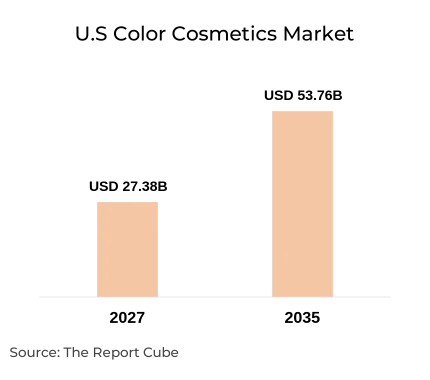
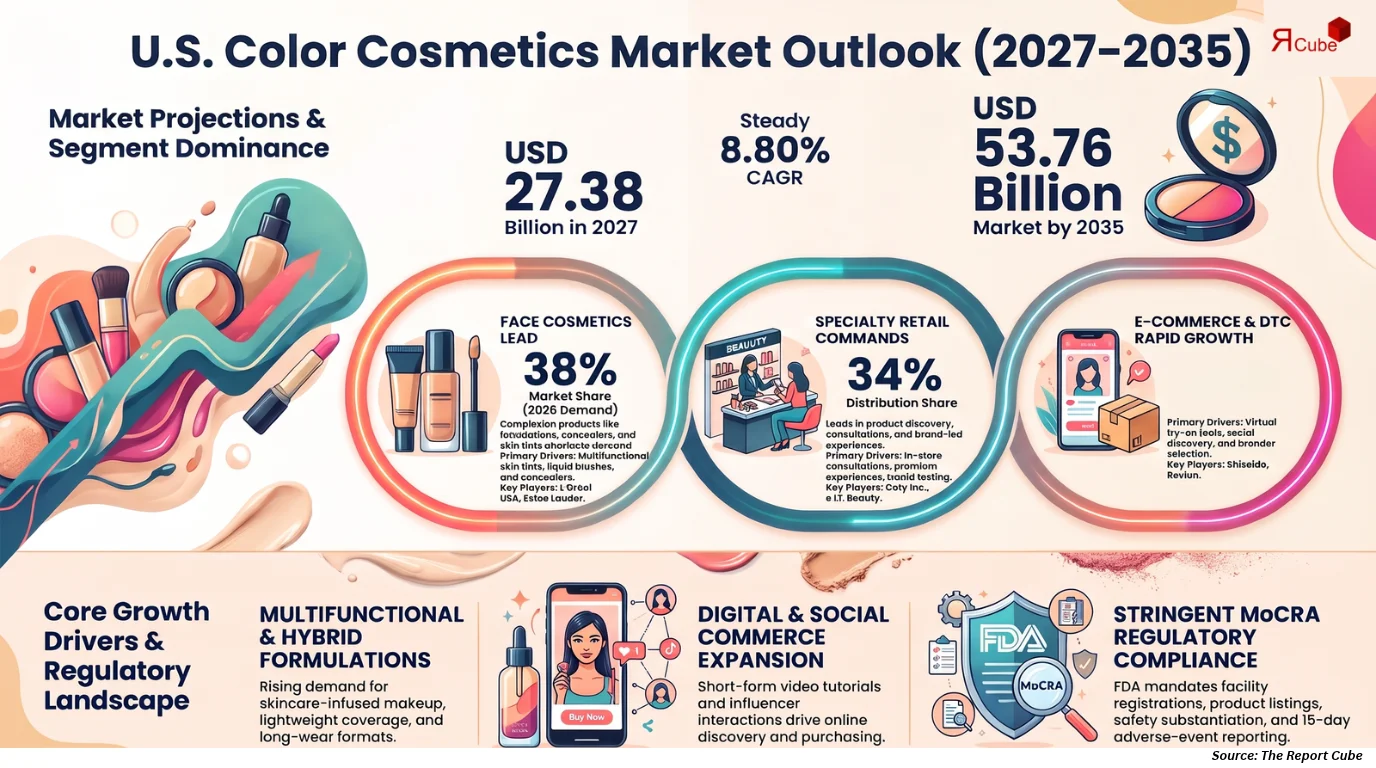
- The U.S. color cosmetics market is projected to increase from USD 27.38 billion in 2027 to USD 53.76 billion by 2035, registering a CAGR of 8.80% during the forecast period.
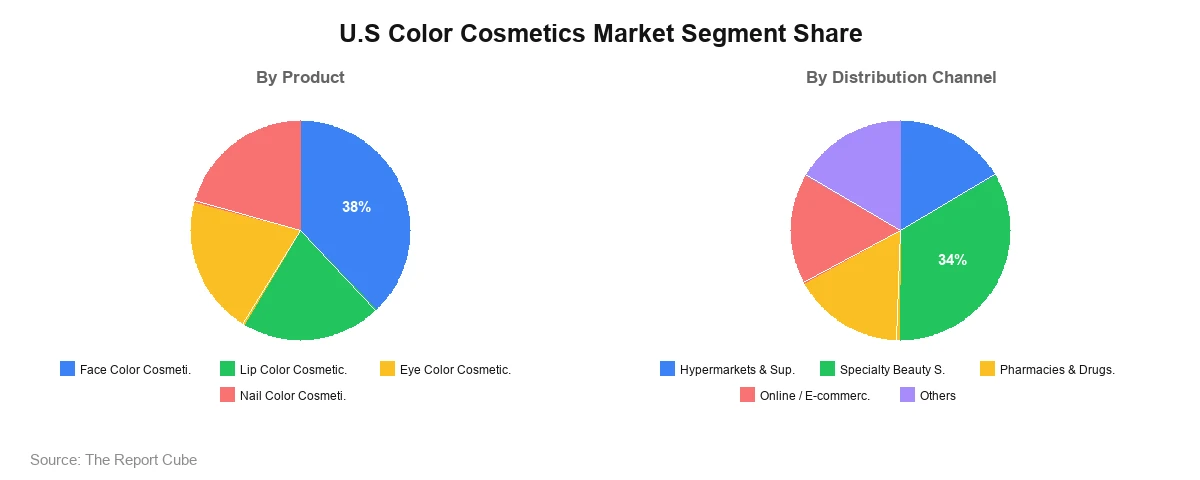
- Face color cosmetics represent the leading product segment, accounting for an estimated 38% market share in 2026, supported by demand for foundations, concealers, blushes, bronzers, and complexion-enhancing products.
- Specialty beauty stores account for an estimated 34% market share in 2026, reflecting their importance in product discovery, beauty consultations, premium product selection, and brand-led retail experiences.
- Growing interest in multifunctional makeup, skincare-infused cosmetics, long-wear formulations, and convenient product formats is influencing product development across the U.S. market.
- Social media platforms, beauty influencers, and short-form video content are increasingly influencing product discovery, consumer preferences, and purchasing decisions.
- Online and e-commerce distribution is creating additional opportunities for cosmetics brands through direct-to-consumer platforms, digital product recommendations, and virtual try-on technologies.
U.S. Color Cosmetics Market Overview
The U.S. color cosmetics market comprises products designed to enhance, modify, or add color to the face, lips, eyes, and nails. The category includes foundations, concealers, blushes, bronzers, lipsticks, lip glosses, eyeliners, mascaras, eyeshadows, and nail polishes. Market demand is influenced by changing beauty preferences, product innovation, consumer spending patterns, brand positioning, and the availability of cosmetics across mass-market, specialty, prestige, and online retail channels.
The market is experiencing product development focused on multifunctional formulations, skincare-infused makeup, lightweight complexion products, long-lasting color, and convenient application formats. Consumers are increasingly exposed to new product launches through social media, creator-led recommendations, beauty tutorials, and digital retail platforms. These developments are encouraging established companies and emerging brands to compete through formulation innovation, shade inclusivity, accessible pricing, and differentiated brand experiences.
The competitive landscape includes large multinational beauty companies with diversified product portfolios and specialist brands focused on particular consumer groups or product categories. Companies are strengthening their distribution through specialty beauty retailers, department stores, pharmacies, mass merchants, and e-commerce platforms. At the same time, regulatory requirements under MoCRA are increasing the importance of product safety documentation, ingredient management, manufacturing oversight, and adverse-event reporting across the cosmetics supply chain.
U.S. Color Cosmetics Market Size and Forecast
The U.S. color cosmetics market is estimated to reach USD 27.38 billion in 2027 and is projected to grow to USD 53.76 billion by 2035, expanding at a CAGR of 8.80% during the forecast period. The forecast reflects the expected contribution of product innovation, increasing digital product discovery, evolving beauty preferences, and the expansion of omnichannel distribution.
Face products remain an important part of the market because complexion products serve multiple consumer needs, including coverage, color correction, skin-tone enhancement, and appearance customization. Product innovation in liquid foundations, skin tints, concealers, cream blushes, bronzers, and multifunctional complexion products is supporting differentiation within this category.
Distribution is also evolving as specialty beauty stores combine product availability with in-store consultations, sampling, brand experiences, and access to prestige products. E-commerce platforms complement these channels by providing broader product selection, consumer reviews, personalized recommendations, and digital discovery. The market's future performance will depend on consumers' willingness to spend on makeup, the ability of brands to sustain product relevance, and their capacity to manage competitive and regulatory pressures.
Market Outlook
The U.S. color cosmetics market is expected to benefit from continued demand for products that combine aesthetic benefits with convenient application and skin-compatible formulations. Lightweight foundations, skin tints, concealers, lip oils, liquid blushes, and multifunctional makeup products are creating opportunities for brands to develop differentiated offerings across price categories.
Consumer discovery is increasingly influenced by social media, online reviews, beauty creators, and digital retail experiences. These channels allow brands to introduce new products, demonstrate application techniques, and reach niche consumer groups. However, the conversion of digital engagement into repeat purchases will depend on product performance, pricing, availability, and consumer trust.
Distribution strategies are expected to remain omnichannel, with specialty beauty stores, department stores, mass merchants, drugstores, and online platforms serving different purchasing needs. Specialty retailers can support premium positioning and product discovery, while e-commerce provides convenience, wider selection, and direct consumer engagement. The U.S. Census Bureau reported that total retail e-commerce sales reached USD 347.3 billion in the third quarter of 2026, representing 17.9% of total retail sales. This is a broad retail indicator and should not be interpreted as a color cosmetics-specific growth rate.
Government Regulations in the U.S. Color Cosmetics Market
The U.S. color cosmetics industry is regulated primarily by the Food and Drug Administration (FDA) under the Federal Food, Drug, and Cosmetic Act and the Modernization of Cosmetics Regulation Act of 2022 (MoCRA). Under MoCRA, manufacturers and processors are generally required to register their facilities with the FDA and renew registrations every two years, while responsible persons must list marketed cosmetic products, including their ingredients, and update applicable listings annually. Responsible persons must report serious adverse events to the FDA within 15 business days and maintain records supporting adequate safety substantiation.
The legislation also provides the FDA with additional records-access and mandatory-recall authorities under specified conditions. Color additives used in cosmetics must be approved for their intended uses, and certain additives are subject to batch certification. Restrictions can differ according to whether a product is intended for the eye area, lips, or external application. Products marketed with therapeutic claims, including certain sun-protection claims, may be regulated as drugs or as both cosmetics and drugs. The Federal Trade Commission (FTC) additionally oversees advertising and endorsement practices, including influencer disclosures and claims that could mislead consumers. These requirements influence product formulation, testing, labeling, manufacturing controls, marketing practices, and regulatory documentation across the U.S. cosmetics market.
U.S. Color Cosmetics Market Dynamics
The U.S. color cosmetics market is influenced by evolving consumer preferences, product innovation, digital retail expansion, and regulatory requirements. Demand is shaped by the ability of brands to introduce differentiated formulations, maintain consumer trust, and reach customers through multiple retail channels. The following factors outline the major drivers, opportunities, trends, and challenges affecting the market.
| Factor | Type | Specific Impact on Market | Magnitude |
|---|---|---|---|
| Product Innovation and Multifunctional Formulations | Driver | New textures, lightweight complexion products, skincare-infused makeup, and multi-use formats encourage product upgrades and create opportunities for premium and mass-market brands. | High |
| Social Media and Digital Product Discovery | Driver | Beauty creators, tutorials, consumer reviews, and short-form video increase product visibility and influence purchasing decisions across online and offline channels. | High |
| Expansion of Digital and Omnichannel Retail | Opportunity | Direct-to-consumer platforms, virtual product experiences, and integrated retail strategies enable brands to reach new consumer groups and improve product accessibility. | High |
| Inclusive Shade Development and Niche Brand Positioning | Opportunity | Broader shade ranges and differentiated formulations create opportunities to serve consumers with varied skin tones, preferences, and makeup requirements. | Medium to High |
| Intense Competition and Changing Consumer Preferences | Challenge | Established companies and independent brands compete for consumer attention, retail placement, and repeat purchases, increasing the need for continuous product differentiation. | High |
| Regulatory Compliance and Product Safety Requirements | Challenge | MoCRA-related safety substantiation, facility registration, product listing, adverse-event reporting, and color-additive restrictions increase compliance responsibilities and operating complexity. | High |
Growth Drivers: Increasing Demand for Multifunctional and Skincare-Infused Makeup
Consumers are showing interest in makeup products that combine color application with additional benefits such as hydration, lightweight coverage, long wear, and skin-compatible formulations. This preference is encouraging brands to develop products that serve multiple functions within a single application routine. Foundations with skincare-oriented positioning, tinted moisturizers, skin tints, concealers, and hybrid lip products are examples of formats that combine cosmetic performance with additional product attributes.
Product innovation is also creating opportunities across face cosmetics through liquid blushes, cream bronzers, multi-use sticks, and lightweight complexion products. These formats provide brands with opportunities to differentiate their portfolios through texture, finish, convenience, and application performance. Companies that maintain consistent formulation quality while responding to changing consumer expectations can strengthen product relevance and repeat-purchase potential.
Market Opportunities: Expansion of E-commerce and Direct-to-Consumer Distribution
Online retail provides color cosmetics companies with opportunities to reach consumers beyond the geographic limitations of physical stores. Brand-owned websites, online marketplaces, and specialty beauty platforms allow customers to access broader product selections, compare shades, review product information, and purchase products at their convenience. Digital channels also provide companies with direct access to customer feedback and purchasing behavior, supporting product development and marketing decisions.
Virtual try-on tools, shade-matching technologies, personalized product recommendations, and interactive product demonstrations can further improve online shopping experiences. Companies that combine digital discovery with reliable fulfillment, accessible return policies, and accurate product information can strengthen customer confidence and reduce uncertainty when selecting complexion and color products online.
Industry Challenges: Intense Competition and Rapidly Changing Beauty Trends
The U.S. color cosmetics market includes multinational beauty groups, established prestige brands, mass-market companies, and independent digital-first businesses. Competition is visible across product pricing, shade selection, formulation quality, brand positioning, retail distribution, and promotional activity. New product launches and social media-driven trends can create short product cycles, making it difficult for companies to maintain consumer attention over extended periods.
Brands also face the risk of relying heavily on a limited number of popular products or short-lived trends. Consumer preferences can shift between product textures, finishes, shades, and price categories. Companies must therefore balance rapid product development with inventory management, product quality, marketing expenditure, and long-term brand differentiation.
Need Specific Data, Let’s Customize the Report for You
Request CustomizationMarket Trends: Growth of Hybrid Makeup and Innovative Product Textures
Product development is increasingly focused on hybrid makeup formats that combine color, convenience, and additional cosmetic benefits. Examples include skin tints, tinted moisturizers, lip oils, lip balms with color, cream blushes, liquid bronzers, and multi-use sticks. These products provide alternatives to traditional powder and cream formats while allowing brands to address preferences for lightweight application, natural finishes, and simplified beauty routines.
Texture innovation is also influencing face cosmetics. Liquid, balm, jelly, cream, and stick formulations allow companies to differentiate their products through application experience, finish, portability, and coverage. Brands are using these product formats to develop new collections and encourage consumers to experiment with makeup routines.
U.S. Color Cosmetics Market Segment Analysis
The U.S. color cosmetics market is segmented by product and distribution channel. Product segmentation reflects the different cosmetic applications and consumer requirements served by face, lip, eye, and nail products. Distribution-channel segmentation highlights the role of specialty beauty stores, mass retail, pharmacies, and e-commerce platforms in making cosmetics accessible to consumers.
By Product
- Face Color Cosmetics
- Lip Color Cosmetics
- Eye Color Cosmetics
- Nail Color Cosmetics
Face color cosmetics represent the leading product segment, accounting for an estimated 38% market share in 2026, according to the supplied market estimate. This category includes foundations, concealers, blushes, bronzers, face powders, primers, and other complexion-enhancing products. Its broad product range and relevance across everyday and occasion-based makeup routines support its market position. Innovation in skin tints, lightweight foundations, liquid blushes, and multifunctional complexion products is creating additional opportunities for brands.
By Distribution Channel
- Hypermarkets & Supermarkets
- Specialty Beauty Stores
- Pharmacies & Drugstores
- Online / E-commerce
- Others
Specialty beauty stores account for an estimated 34% market share in 2026, based on the supplied analyst estimate. These stores provide consumers with access to a wide range of cosmetics brands, product demonstrations, shade consultations, and beauty-related services. Their ability to combine product discovery with personalized shopping experiences supports their importance in prestige and masstige cosmetics distribution. Online and e-commerce platforms are also important channels, offering convenience, wider product availability, and direct access to brand collections.
U.S. Color Cosmetics Market Regional Analysis
The U.S. color cosmetics market is analyzed across the Midwest, West, South, and Northeast. Regional demand is influenced by population distribution, household spending, retail infrastructure, urbanization, consumer preferences, and the presence of major retail and beauty markets. Differences in demographics and retail access create varied opportunities for brands across the country. The following regional analysis describes the principal market characteristics without assigning unsupported regional revenue shares.
| Region | Key Growth Factors | Industry Trends |
|---|---|---|
| Midwest | Broad retail distribution, urban consumer markets, department stores, mass merchants, and pharmacy networks support cosmetics accessibility. | Demand spans affordable everyday makeup, established beauty brands, seasonal collections, and products available through omnichannel retail. |
| West | Major metropolitan markets, beauty-focused retail ecosystems, digital-first consumers, and strong brand visibility support product discovery. | Influencer-led discovery, premium beauty experiences, innovative formulations, inclusive shade ranges, and direct-to-consumer engagement remain relevant. |
| South | Large population centers, expanding retail infrastructure, and varied consumer demographics create opportunities across mass and prestige categories. | Brands can target different price segments through accessible makeup, complexion products, seasonal collections, and omnichannel distribution. |
| Northeast | Dense urban markets, established department-store networks, specialty beauty retailers, and premium consumer markets support brand accessibility. | Prestige cosmetics, specialty retail experiences, premium product launches, and digital-to-store purchasing journeys remain important. |
U.S. Color Cosmetics Market Competitive Landscape
The competitive landscape consists of multinational beauty companies, prestige cosmetics groups, mass-market manufacturers, and independent brands. Large companies compete through diversified portfolios, research and development capabilities, marketing investment, and established retail relationships. Specialist brands compete through differentiated positioning, product innovation, digital engagement, and focused consumer communities. The companies listed below operate at different corporate and brand levels; they should not be interpreted as identical business entities or as companies with equivalent product portfolios.
| Company | Competitive Strength | Primary Segment Served |
|---|---|---|
| L’Oréal USA | Extensive portfolio of mass-market, professional, and prestige beauty brands, supported by research, product innovation, and broad retail distribution. | Face, lip, eye, and nail cosmetics across mass and prestige categories. |
| The Estée Lauder Companies Inc. | Established prestige beauty portfolio, global brand equity, product development capabilities, and strong specialty retail relationships. | Prestige face, lip, and eye makeup. |
| Coty Inc. | Portfolio of prestige and consumer beauty brands, supported by licensing relationships and established retail distribution. | Mass and prestige makeup, including lip, face, and nail products. |
| e.l.f. Beauty | Value-oriented positioning, digital marketing capabilities, accessible pricing, and a growing portfolio of beauty brands. | Mass-market face, lip, and eye cosmetics. |
| Revlon | Long-established cosmetics brand recognition and presence across mass-market makeup categories. | Face, lip, eye, and nail cosmetics. |
| Shiseido Americas | Prestige beauty portfolio, established international brand recognition, and expertise in premium beauty products. | Prestige face, lip, and eye cosmetics through brands including SHISEIDO and NARS. |
- The Estée Lauder Companies Inc.: The company operates a portfolio of prestige beauty brands and competes in the U.S. color cosmetics market through makeup brands such as M·A·C, Bobbi Brown, and TOM FORD. Its competitive position is supported by established brand recognition, premium retail relationships, product innovation, and global distribution. In its fiscal 2026 results, the company reported total net sales of USD 15.049 billion, an increase of 5% compared with fiscal 2025. Makeup net sales were USD 4.276 billion, compared with USD 4.205 billion in the prior year. The company also reported growth associated with M·A·C's U.S. Sephora distribution expansion and continued demand for selected lip products.
- e.l.f. Beauty: e.l.f. Beauty competes through accessible pricing, product innovation, digital marketing, and a portfolio of beauty brands. Its core e.l.f. Cosmetics brand has a strong presence across face, lip, and eye cosmetics, while the wider company portfolio provides additional exposure to adjacent beauty categories. For fiscal 2026, e.l.f. Beauty reported net sales of USD 1.6365 billion, an increase of 25% year over year. The company attributed growth to retailer and e-commerce channels in the U.S. and internationally. Its value-oriented positioning and digital engagement capabilities support competition in the mass-market cosmetics category.
Recent Developments and Updates
- May 20, 2026 – e.l.f. Beauty: The company announced fiscal 2026 results, reporting annual net sales of USD 1.6365 billion, up 25% year over year. It reported growth across retailer and e-commerce channels and stated that all five of its brands grew during the fiscal year.
- August 19, 2026 – The Estée Lauder Companies: The company reported fiscal 2026 net sales of USD 15.049 billion, up 5% from fiscal 2025. Makeup sales were USD 4.276 billion. The company highlighted M·A·C's U.S. Sephora distribution expansion and continued strength in selected lip products.
- September 2026 – Coty Inc.: Coty reported that its Marc Jacobs Beauty makeup launch was performing ahead of online sell-out targets at Sephora and outlined plans to expand distribution into hundreds of Sephora stores in the U.S. and travel retail.
- November 2026 – Coty Inc.: In its first-quarter fiscal 2027 update, Coty reported continued progress across selected prestige and consumer beauty brands. The company highlighted Marc Jacobs makeup as a contributor to growth within its core prestige brand portfolio and reported improved U.S. category performance for CoverGirl and Sally Hansen.
U.S. Color Cosmetics Market Report Coverage
The U.S. Color Cosmetics Market report provides an assessment of market size, forecast growth, product categories, distribution channels, regional characteristics, competitive positioning, regulatory developments, and industry trends. It evaluates the competitive environment across multinational beauty companies, prestige cosmetics groups, and specialist makeup brands operating in the United States.
| Parameter | Details |
|---|---|
| Market Name | U.S. Color Cosmetics Market |
| Market Size (2027) | USD 27.38 Billion |
| Market Size (2035) | USD 53.76 Billion |
| CAGR | 8.80% (2027–2035) |
| Base Year | 2026 |
| Historical Period | 2022–2026 |
| Forecast Period | 2027–2035 |
| Geographic Scope | United States |
| Segmentation | By Product and By Distribution Channel |
| Regions Covered | Midwest, West, South, Northeast |
| Key Companies | L’Oréal USA, The Estée Lauder Companies Inc., Coty Inc., e.l.f. Beauty, Revlon, Shiseido Americas, LVMH Moët Hennessy Louis Vuitton SE, Fenty Beauty, Huda Beauty, Haus Labs by Lady Gaga |
| Customization | Market segmentation, regional analysis, competitive benchmarking, company profiling, and customized research requirements. |
Why Choose This U.S. Color Cosmetics Market Report?
- Provides market size and forecast analysis for the U.S. color cosmetics industry through 2035.
- Examines key product categories, including face, lip, eye, and nail color cosmetics.
- Analyzes distribution channels, including specialty beauty stores, hypermarkets, pharmacies, and e-commerce platforms.
- Evaluates market drivers, opportunities, trends, and challenges affecting cosmetics manufacturers and brands.
- Includes regional analysis across the Midwest, West, South, and Northeast.
- Reviews the competitive positioning of established beauty companies and specialist cosmetics brands.
- Assesses important regulatory requirements under FDA and FTC oversight, including MoCRA and color-additive restrictions.
- Supports strategic planning, market entry assessments, product development, competitive benchmarking, and business decision-making.
Table of Contents
- Introduction
- Objective of the Study
- Product Definition
- Market Segmentation
- Study Variables
- Research Methodology
- Secondary Data Points
- Companies Interviewed
- Primary Data Points
- Breakdown of Primary Interviews
- Secondary Data Points
- Executive Summary
- Market Dynamics
- Drivers
- Challenges
- Opportunity Assessment
- Recent Trends and Developments
- Policy and Regulatory Landscape
- U.S Color Cosmetics Market Overview and Forecast Analysis (2022-2035)
- Market Size, By Value, By Growth Rate (CAGR/USD Billions)
- Demand – Supply Trends
- Market Share, By Product
- Face Color Cosmetics
- Lip Color Cosmetics
- Eye Color Cosmetics
- Nail Color Cosmetics
- Market Share, By Distribution Channel
- Hypermarkets & Supermarkets
- Specialty Beauty Stores
- Pharmacies & Drugstores
- Online/ E-commerce
- Others
- Market Share, By Region
- Midwest
- West
- South
- Northeast
- Market Share, By Competitors
- Competition Characteristics
- Revenue Shares
- Face Color Cosmetics U.S Color Cosmetics Market Overview, 2022-2035F
- By Value (USD Million)
- By Distribution Channel – Market Size & Forecast 2022-2035, USD Million
- Hypermarkets & Supermarkets
- Specialty Beauty Stores
- Pharmacies & Drugstores
- Online/ E-commerce
- Others
- Lip Color Cosmetics U.S Color Cosmetics Market Overview, 2022-2035F
- By Value (USD Million)
- By Distribution Channel – Market Size & Forecast 2022-2035, USD Million
- Hypermarkets & Supermarkets
- Specialty Beauty Stores
- Pharmacies & Drugstores
- Online/ E-commerce
- Others
- Eye Color Cosmetics U.S Color Cosmetics Market Overview, 2022-2035F
- By Value (USD Million)
- By Distribution Channel – Market Size & Forecast 2022-2035, USD Million
- Hypermarkets & Supermarkets
- Specialty Beauty Stores
- Pharmacies & Drugstores
- Online/ E-commerce
- Others
- Nail Color Cosmetics U.S Color Cosmetics Market Overview, 2022-2035F
- By Value (USD Million)
- By Distribution Channel – Market Size & Forecast 2022-2035, USD Million
- Hypermarkets & Supermarkets
- Specialty Beauty Stores
- Pharmacies & Drugstores
- Online/ E-commerce
- Others
- Competitive Outlook (Company Profile – Partial List)
- L’Oréal USA
- Company Overview
- Business Segments
- Strategic Alliances/Partnerships
- Recent Developments
- The Estée Lauder Companies Inc.
- Company Overview
- Business Segments
- Strategic Alliances/Partnerships
- Recent Developments
- Coty Inc.
- Company Overview
- Business Segments
- Strategic Alliances/Partnerships
- Recent Developments
- e.l.f. Beauty
- Company Overview
- Business Segments
- Strategic Alliances/Partnerships
- Recent Developments
- Revlon
- Company Overview
- Business Segments
- Strategic Alliances/Partnerships
- Recent Developments
- Shiseido Americas
- Company Overview
- Business Segments
- Strategic Alliances/Partnerships
- Recent Developments
- LVMH Moët Hennessy Louis Vuitton SE
- Company Overview
- Business Segments
- Strategic Alliances/Partnerships
- Recent Developments
- Fenty Beauty
- Company Overview
- Business Segments
- Strategic Alliances/Partnerships
- Recent Developments
- Huda Beauty
- Company Overview
- Business Segments
- Strategic Alliances/Partnerships
- Recent Developments
- Haus Labs by Lady Gaga
- Company Overview
- Business Segments
- Strategic Alliances/Partnerships
- Recent Developments
- L’Oréal USA
- Contact Us & Disclaimer
Top Key Players & Market Share Outlook
- L’Oréal USA
- The Estée Lauder Companies Inc
- Coty Inc
- e.l.f. Beauty
- Revlon
- Shiseido Americas
- LVMH Moët Hennessy Louis Vuitton SE
- Fenty Beauty
- Huda Beauty
- Haus Labs by Lady Gaga
Frequently Asked Questions