


Build Your Custom Market Intelligence Report
Customize Your ReportKey Takeaways
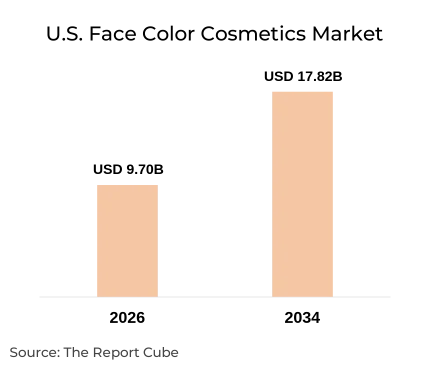
- U.S. Face Color Cosmetics Market is valued at USD 9.70 billion in 2026.
- The market is projected to reach USD 17.82 billion by 2034.
- Market expansion is expected at a CAGR of 7.90% during the 2026–2034 forecast period.
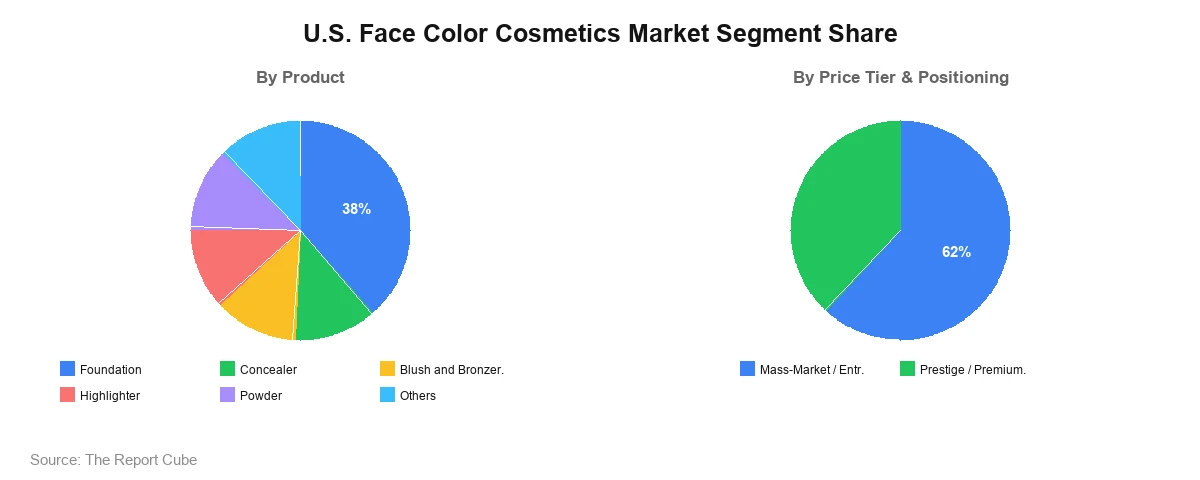
- Foundation leads the product segment with an estimated 38% share in 2026.
- Mass-market and entry positioning leads the price tier segment with an estimated 62% share in 2026.
- North is the leading region with an estimated 32% share in 2026.
- L’Oréal, Estée Lauder Companies, e.l.f. Beauty, Coty, and Shiseido are among the key players.
- Multifunctional, skincare-inspired makeup and social commerce are important market trends.
Market Overview
Face color cosmetics are makeup products applied to the face to even skin tone, add dimension, and create color. The category includes foundation, concealer, blush, bronzer, highlighter, and powder. Consumers use these products for everyday wear, professional settings, and content creation, with formulations ranging from light tints to full coverage.
The U.S. Face Color Cosmetics Market Analysis shows a market valued at USD 9.70 billion in 2026, shaped by product innovation, digital retail, and regulatory requirements. Consumers compare shade range, formulation, finish, and price across mass-market and prestige brands, while manufacturers must follow federal cosmetic safety, labeling, and product-listing rules.
Demand is supported by multifunctional, skincare-inspired complexion products and wider shade availability, while social platforms and online retail influence product discovery. Market value is expected to reach USD 17.82 billion by 2034, rising steadily across the forecast period. The market is projected to grow at a CAGR of 7.90% during 2026–2034.
U.S. Face Color Cosmetics Market Dynamics
U.S. Face Color Cosmetics Market Growth is influenced by product innovation, consumer purchasing power, retail-channel developments, and regulatory requirements. Consumers evaluate makeup on performance, shade availability, formulation, and price, while manufacturers must comply with federal cosmetic safety, ingredient, labeling, and product-listing requirements that affect development, sourcing, and pricing decisions.
|
Factor |
Type |
Specific Impact on Market |
Magnitude |
|---|---|---|---|
|
Demand for innovative complexion products |
Driver |
Lightweight foundations, multifunctional products, blush, and bronzer encourage product refreshes and repeat purchasing |
High |
|
Expansion of digital beauty retail |
Driver |
Online channels allow comparison of brands, prices, shades, and reviews |
Medium–High |
|
Inclusive shade ranges and personalization |
Opportunity |
Broader undertone coverage addresses product-fit gaps in foundation and concealer |
Medium–High |
|
Organic and natural formulation development |
Opportunity |
Naturally derived and transparent formulations create differentiation for brands |
Medium |
|
Product safety and regulatory compliance |
Challenge |
Facility registration, product listing, and safety substantiation increase compliance requirements |
Medium–High |
|
Shade matching and product performance |
Challenge |
Oxidation, creasing, and poor shade fit can reduce satisfaction and repeat purchases |
Medium |
|
Multifunctional and skincare-inspired makeup |
Trend |
Skin tints and hybrid complexion products combine coverage with skin-focused benefits |
High |
|
Social commerce and digital discovery |
Trend |
Creator-led content and social shopping influence product discovery |
Medium–High |
U.S. Face Color Cosmetics Market Growth Drivers
Demand for lightweight foundations, multifunctional complexion products, blush, bronzer, and skin-enhancing makeup supports category activity. Foundation holds an estimated 38% share in 2026, reflecting its role as the base product in most routines. Product development increasingly focuses on finish, coverage, and skincare-inspired benefits, which encourages manufacturers to refresh formulations and shade assortments.
Online retail allows consumers to compare brands, prices, shades, and product reviews before purchase. The U.S. Census Bureau reported e-commerce sales of USD 340.2 billion in the second quarter of 2026, equal to 17.1% of total U.S. retail sales. This is broad retail evidence rather than a cosmetics-specific sales figure.
U.S. Face Color Cosmetics Market Opportunities
Brands can expand shade availability, improve undertone accuracy, and develop complexion products for different skin types and preferences. Foundation and concealer purchases depend on suitable shade, undertone, finish, and coverage, so broader shade ranges and personalization tools address a recurring consumer product-fit gap and may support repeat purchasing among consumers.
Brands can also develop organic and naturally derived formulations with transparent ingredient communication and skincare-inspired benefits. The segmentation separates conventional and organic formulations, which gives manufacturers a defined category in which to differentiate products, although current evidence does not establish the size of the organic segment within face color cosmetics.
U.S. Face Color Cosmetics Industry Challenges
Under the Modernization of Cosmetics Regulation Act (MoCRA), applicable cosmetic manufacturers and processors must register facilities, while responsible persons must list marketed products and update listings. Companies must also maintain records supporting adequate product safety substantiation, which can increase compliance requirements for manufacturers and brands, particularly smaller operators with limited regulatory resources.
Foundation and concealer performance depends on shade, undertone, finish, coverage, and wear. Issues such as oxidation, creasing, and product separation can reduce consumer satisfaction and repeat purchases. Online channels add difficulty because consumers cannot test shades directly, which places pressure on brands to provide accurate shade descriptions, sampling, and return policies.
Need Specific Data, Let’s Customize the Report for You
Request CustomizationU.S. Face Color Cosmetics Market Trends
U.S. Face Color Cosmetics Market Trends increasingly point toward multifunctional and skincare-inspired makeup. Lightweight foundations, skin tints, and multifunctional blush and bronzer formats combine coverage with skin-focused benefits, reflecting a gradual shift toward lighter complexion products designed for comfort, natural finish, everyday wear, and flexible shade choice.
Social platforms and creator-led content increasingly influence product discovery and purchasing in beauty. An industry survey reported that 30% of U.S. beauty shoppers had purchased beauty products through TikTok Shop in 2026. Tutorials, reviews, and shade demonstrations help consumers evaluate complexion products before purchase, supporting online discovery alongside traditional retail.
U.S. Face Color Cosmetics Market Segment Analysis
The U.S. Face Color Cosmetics Market Share is distributed across product type, price tier, formulation, and distribution channel, reflecting differences in consumer needs, retail access, and brand positioning. Estimated 2026 shares are available for the leading product and price tier segments, while other splits require validation.
By Product
- Foundation
- Concealer
- Blush and Bronzer
- Highlighter
- Powder
- Others
Foundation leads the product category with an estimated 38% share in 2026, as it serves as the base of most complexion routines and is repurchased as consumers adjust shade, finish, and coverage preferences. Concealer follows, supporting targeted coverage and shade-matching needs, while blush and bronzer reflect interest in multifunctional, skin-focused color products. Highlighter adds dimension and finish options, and powder supports setting, oil control, and touch-ups. Other products complete the assortment. L’Oréal, Estée Lauder Companies, e.l.f. Beauty, Coty, and Shiseido operate across face makeup through brands such as L’Oréal Paris, Maybelline New York, MAC, e.l.f. Cosmetics, CoverGirl, and NARS. Product innovation, expanded shade ranges, and social media discovery influence demand across categories, although category-level growth rates require validation.
By Price Tier & Positioning
- Mass-Market / Entry
- Prestige / Premium
Mass-market and entry products lead the price tier category with an estimated 62% share in 2026, supported by wide retail availability, lower price points, and frequent product launches. e.l.f. Cosmetics, Maybelline New York, L’Oréal Paris, and CoverGirl compete in this tier through drugstore, mass retail, and online channels. Prestige and premium products follow, driven by brand positioning, ingredient storytelling, extended shade ranges, and specialty retail presence. Estée Lauder Companies, LVMH, Shiseido, and Kosé participate through brands such as MAC, Dior Beauty, NARS, and Tarte, while Kendo Brands, the LVMH-linked beauty incubator, adds further prestige-oriented brand activity.
Regional Analysis
|
Region |
Estimated Market Share |
Key Growth Factors |
Industry Trends |
|---|---|---|---|
|
West |
- |
Large metropolitan retail and beauty-media presence |
Demand for shade-inclusive and skin-focused complexion products |
|
Southwest |
- |
Expanding retail networks and growing consumer base |
Interest in lightweight, wear-resistant formulations |
|
North |
32% |
Dense metropolitan markets and established beauty distribution |
Strong presence of both prestige and mass-market complexion brands |
|
Midwest |
- |
Broad mass retail and drugstore access |
Value-oriented purchasing and growing online discovery |
North is the leading region in the U.S. Face Color Cosmetics Market with an estimated 32% share in 2026, reflecting the concentration of population, retail networks, and established beauty distribution in the area. Dense metropolitan markets support access to department stores, specialty beauty retailers, drugstores, and e-commerce delivery, which allows both mass-market and prestige brands to maintain broad assortments.
West, Southwest, and Midwest hold the remaining 68% share, which was not supplied for individual regions. Differences in climate, demographics, retail formats, and shade preferences influence product mix across these regions, while federal cosmetic regulations apply uniformly. Regional share estimates require validation before publication, and online retail narrows geographic differences in product availability.
Market Share & Competitive Landscape
The U.S. Face Color Cosmetics Market includes multinational beauty groups, mass-market brands, prestige houses, and digitally focused companies. The table summarizes the supplied companies by general capability and segment served. It does not represent numerical market share, and U.S.-specific sales should be validated.
|
Company |
Competitive Strength |
Primary Segment Served |
|---|---|---|
|
L’Oréal |
Broad makeup portfolio including L’Oréal Paris, Maybelline New York, NYX Professional Makeup, and Lancôme |
Mass-market and prestige complexion products |
|
Estée Lauder Companies |
Prestige brands including Estée Lauder, MAC, and Bobbi Brown |
Prestige and premium face makeup |
|
e.l.f. Beauty |
Value-priced makeup with e.l.f. Cosmetics and a skin-focused portfolio expanded through rhode |
Mass-market face color and online channels |
|
Procter & Gamble |
Large consumer goods company with a beauty portfolio; direct face color participation requires validation |
Beauty and skin care adjacent categories |
|
Revlon |
Long-established color cosmetics brand with foundation and face makeup ranges |
Mass-market face makeup |
|
Coty Inc. |
Brands including CoverGirl, Rimmel, and Max Factor |
Mass-market foundation, powder, and face makeup |
|
LVMH |
Prestige beauty brands including Dior Beauty, Guerlain, and Benefit |
Prestige and premium face makeup |
|
Shiseido Company |
Brands including Shiseido and NARS |
Prestige complexion products |
|
Kendo Brands |
LVMH-linked beauty incubator associated with Fenty Beauty |
Inclusive shade-focused prestige makeup |
|
Kosé Corporation |
Japanese cosmetics group that owns the Tarte brand |
Prestige and premium face makeup |
Key Companies in the U.S. Face Color Cosmetics Market
L’Oréal: L’Oréal is headquartered in Clichy, France, and was founded in 1909. Its first nine months of 2025 sales reached EUR 32.80 billion, with makeup outpacing the market. The portfolio includes L’Oréal Paris, Maybelline New York, and NYX Professional Makeup, supporting positions across mass-market and prestige complexion products.
e.l.f. Beauty: e.l.f. Beauty is headquartered in Oakland, California, and was founded in 2004. On August 5, 2025, the company completed its acquisition of rhode, the skin-focused brand founded by Hailey Bieber, funded partly through a USD 600 million term loan. The deal extends its portfolio beyond value-priced e.l.f. Cosmetics makeup.
Recent Developments
|
Year / Month |
Company |
Development |
|---|---|---|
|
May 2025 |
e.l.f. Beauty |
Signed a merger agreement dated May 28, 2025 to acquire rhode |
|
August 2025 |
e.l.f. Beauty |
Completed the rhode acquisition on August 5, 2025 |
|
October 2026 |
L’Oréal |
Reported nine-month 2026 sales of EUR 35.34 billion, up 7.7%, with North America growth of 6.3% |
U.S. Face Color Cosmetics Market Future Outlook
The U.S. Face Color Cosmetics Market Forecast indicates expansion from USD 9.70 billion in 2026 to USD 17.82 billion by 2034 at a CAGR of 7.90%. Growth is expected to depend on product innovation, shade inclusivity, online retail development, social commerce, and the continued adoption of multifunctional complexion products across mass-market and prestige tiers, although these projections remain estimates rather than confirmed outcomes.
Competition among mass-market, prestige, and digitally native brands is likely to remain active, with acquisitions, portfolio expansion, and shade-range development shaping brand positioning and retail presence. Risks include compliance costs under federal cosmetic regulations, product-performance issues in shade matching, and consumer price sensitivity. Actual results will depend on consumer spending power, retail execution, and regulatory developments during the forecast period.
U.S. Face Color Cosmetics Market Report Coverage
This U.S. Face Color Cosmetics Market Report summarizes the supplied valuation, forecast, segmentation, regional framework, and competitive ecosystem.
|
Parameter |
Details |
|---|---|
|
Market Name |
U.S. Face Color Cosmetics Market |
|
Market Size 2026 |
USD 9.70 billion |
|
Market Size 2034 |
USD 17.82 billion |
|
Forecast Period |
2026–2034 |
|
CAGR |
7.90% |
|
Base Year |
2026 |
|
Historical Years |
2021–2025 |
|
Forecast Years |
2026–2034 |
|
Segments Covered |
By Product; By Price Tier & Positioning; By Product Formulation; By Distribution Channels |
|
Regions Covered |
West, Southwest, North, Midwest |
|
Key Companies |
L’Oréal, Estée Lauder Companies, e.l.f. Beauty, Procter & Gamble, Revlon, Coty Inc., LVMH, Shiseido Company, Kendo Brands, Kosé Corporation |
|
Customization |
Available as per client requirements |
Why Choose This U.S. Face Color Cosmetics Market Report?
- Coverage of the face color cosmetics category across foundation, concealer, blush, bronzer, highlighter, and powder.
- Clear presentation of the 2026 valuation, 2034 forecast, and 7.90% CAGR based on supplied estimates.
- Segmentation across product, price tier, formulation, and distribution channel for planning and positioning analysis.
- Regional framework covering West, Southwest, North, and Midwest, with the leading regional share identified.
- Competitive profiling of ten global and domestic beauty companies across mass-market and prestige tiers.
- Trend analysis covering skincare-inspired makeup, social commerce, shade inclusivity, and digital retail.
- Policy context on federal cosmetic safety, registration, listing, and labeling requirements affecting industry operators.
Table of Contents
- Introduction
- Objective of the Study
- Product Definition
- Market Segmentation
- Study Variables
- Research Methodology
- Secondary Data Points
- Companies Interviewed
- Primary Data Points
- Breakdown of Primary Interviews
- Secondary Data Points
- Executive Summary
- Market Dynamics
- Drivers
- Challenges
- Opportunity Assessment
- Recent Trends and Developments
- Policy and Regulatory Landscape
- U.S. Face Color Cosmetics Market Overview and Forecast Analysis (2021-2034)
- Market Size, By Value, By Growth Rate (CAGR/USD Billions)
- Demand – Supply Trends
- Market Share, By Product
- Foundation
- Concealer
- Blush and Bronzer
- Highlighter
- Powder
- Others
- Market Share, By Price Tier & Positioning
- Mass-Market / Entry
- Prestige / Premium
- Market Share, By Product Formulation
- Market Share, By Product Formulation
- Conventional
- Organic
- Market Share, By Distribution Channels
- Online
- Offline
- Market Share, By Region
- West
- Southwest
- North
- Midwest
- Market Share, By Competitors
- Competition Characteristics
- Revenue Shares
- Foundation U.S. Face Color Cosmetics Market Overview, 2021-2034F
- By Value (USD Million)
- By Price Tier & Positioning – Market Size & Forecast 2021-2034, USD Million
- Mass-Market / Entry
- Prestige / Premium
- Concealer U.S. Face Color Cosmetics Market Overview, 2021-2034F
- By Value (USD Million)
- By Price Tier & Positioning – Market Size & Forecast 2021-2034, USD Million
- Mass-Market / Entry
- Prestige / Premium
- Blush and Bronzer U.S. Face Color Cosmetics Market Overview, 2021-2034F
- By Value (USD Million)
- By Price Tier & Positioning – Market Size & Forecast 2021-2034, USD Million
- Mass-Market / Entry
- Prestige / Premium
- Highlighter U.S. Face Color Cosmetics Market Overview, 2021-2034F
- By Value (USD Million)
- By Price Tier & Positioning – Market Size & Forecast 2021-2034, USD Million
- Mass-Market / Entry
- Prestige / Premium
- Powder U.S. Face Color Cosmetics Market Overview, 2021-2034F
- By Value (USD Million)
- By Price Tier & Positioning – Market Size & Forecast 2021-2034, USD Million
- Mass-Market / Entry
- Prestige / Premium
- Others U.S. Face Color Cosmetics Market Overview, 2021-2034F
- By Value (USD Million)
- By Price Tier & Positioning – Market Size & Forecast 2021-2034, USD Million
- Mass-Market / Entry
- Prestige / Premium
- Competitive Outlook (Company Profile – Partial List)
- L’Oréal
- Company Overview
- Business Segments
- Strategic Alliances/Partnerships
- Recent Developments
- Estée Lauder Companies
- Company Overview
- Business Segments
- Strategic Alliances/Partnerships
- Recent Developments
- e.l.f. Beauty
- Company Overview
- Business Segments
- Strategic Alliances/Partnerships
- Recent Developments
- Procter & Gamble
- Company Overview
- Business Segments
- Strategic Alliances/Partnerships
- Recent Developments
- Revlon
- Company Overview
- Business Segments
- Strategic Alliances/Partnerships
- Recent Developments
- Coty Inc.
- Company Overview
- Business Segments
- Strategic Alliances/Partnerships
- Recent Developments
- LVMH
- Company Overview
- Business Segments
- Strategic Alliances/Partnerships
- Recent Developments
- Shiseido Company
- Company Overview
- Business Segments
- Strategic Alliances/Partnerships
- Recent Developments
- Kendo Brands
- Company Overview
- Business Segments
- Strategic Alliances/Partnerships
- Recent Developments
- Kosé Corporation
- Company Overview
- Business Segments
- Strategic Alliances/Partnerships
- Recent Developments
- L’Oréal
- Contact Us & Disclaimer
Top Key Players & Market Share Outlook
- L’Oréal
- Estée Lauder Companies
- e.l.f. Beauty
- Procter & Gamble
- Revlon
- Coty Inc.
- LVMH
- Shiseido Company
- Kendo Brands
- Kosé Corporation
Frequently Asked Questions