


Build Your Custom Market Intelligence Report
Customize Your ReportKey Highlights
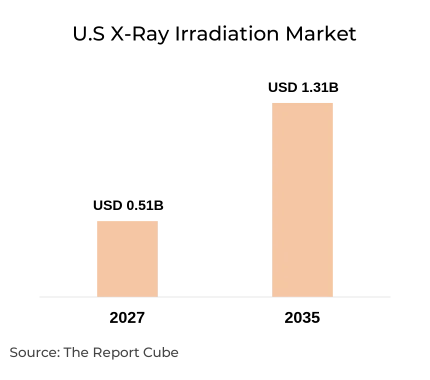
- The U.S. X-ray irradiation market is projected to increase from USD 0.51 billion in 2027 to USD 1.31 billion by 2035, registering a recalculated CAGR of approximately 12.52% during the forecast period.
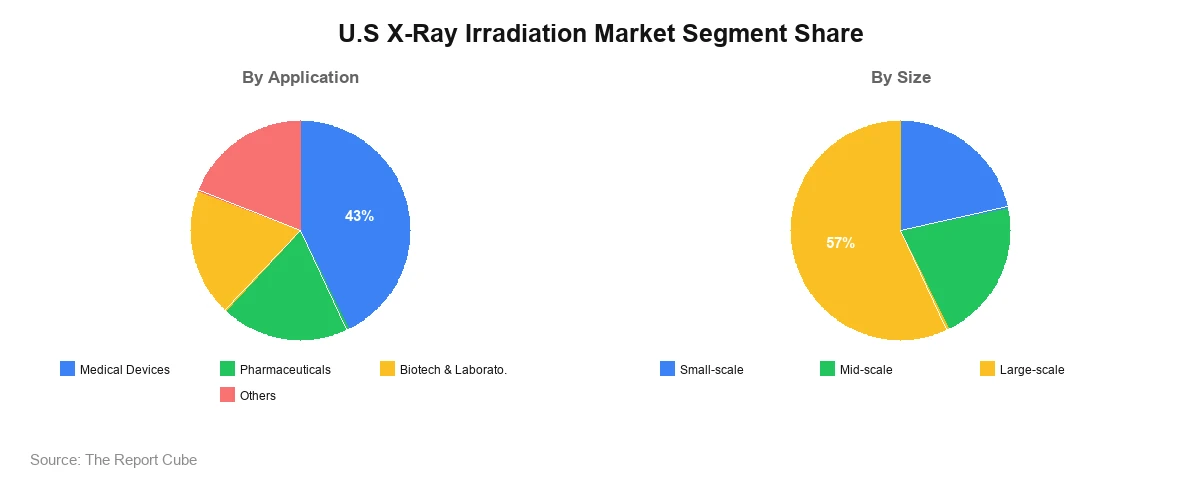
- Medical devices represent the leading application segment, accounting for an estimated 43% market share in 2026, based on the supplied market estimate.
- Large-scale irradiation facilities account for an estimated 57% market share in 2026, reflecting the importance of high-throughput irradiation capacity and commercial processing operations.
- Demand for radiation-based sterilization is supported by the need to process medical devices, healthcare products, and selected pharmaceutical and biotechnology materials under validated conditions.
- X-ray irradiation provides an alternative to conventional gamma sterilization and electron-beam processing, with technology selection depending on product density, packaging configuration, dose requirements, throughput, and process validation.
U.S. X-Ray Irradiation Market Overview
The U.S. X-ray irradiation market comprises technologies, equipment, and processing services that use high-energy X-rays to irradiate materials, products, and biological samples for sterilization, research, and other specialized applications. The technology is used in medical device sterilization, pharmaceutical and biotechnology processing, laboratory research, blood irradiation, and selected industrial applications. Commercial applications require appropriate radiation-dose control, product handling, process validation, and safety measures according to the intended use.
Medical device sterilization is an important application because manufacturers require validated processes to achieve specified sterility assurance levels while maintaining product functionality and packaging integrity. X-ray irradiation can process products in packaged configurations and provides an alternative to gamma irradiation and electron-beam sterilization. Its suitability depends on material compatibility, product density, required penetration, dose distribution, processing capacity, and operating economics. The FDA recognizes ISO 11137-1 for radiation sterilization processes employing X-ray generators, electron generators, and specified radionuclide sources.
U.S. X-Ray Irradiation Market Size and Forecast
The U.S. X-ray irradiation market is estimated to reach USD 0.51 billion in 2027 and is projected to increase to USD 1.31 billion by 2035. Based on these supplied market values, the market is expected to expand at a recalculated CAGR of approximately 12.52% during 2027–2035. Growth is associated with the expansion of radiation-based sterilization capacity, increasing demand for medical device processing, and investments in industrial irradiation infrastructure.
Medical devices are an important application because manufacturers require validated sterilization processes for products such as surgical instruments, implants, single-use medical components, and packaged healthcare products. X-ray irradiation can provide an alternative to gamma and electron-beam technologies, depending on product characteristics and processing requirements. The selection of irradiation technology depends on dose uniformity, material compatibility, product density, packaging configuration, and the ability to validate the process.
Market Outlook
The U.S. X-ray irradiation market is expected to benefit from continued investment in medical sterilization infrastructure and the development of alternative radiation-processing technologies. Medical device manufacturers are evaluating irradiation options based on product compatibility, packaging requirements, sterilization validation, and supply-chain considerations. X-ray technology can provide an additional processing option within a diversified sterilization strategy.
Government-supported domestic manufacturing and medical countermeasure preparedness initiatives are creating opportunities for additional irradiation capacity. The ASPR Industrial Base Expansion portfolio includes projects involving X-ray and electron-beam sterilization infrastructure, indicating the strategic importance of maintaining domestic medical sterilization capabilities. These initiatives may support investments in commercial processing facilities and associated equipment.
Regulatory and technical requirements will continue to influence industry development. Radiation sterilization of medical devices requires appropriate process development, validation, and routine control. The FDA's recognition of ISO 11137-1 and implementation of the Quality Management System Regulation in February 2026 reinforce the importance of quality systems and validated manufacturing processes. Companies that combine technical expertise, reliable capacity, and regulatory support may be better positioned to serve medical and pharmaceutical customers.
U.S. X-Ray Irradiation Market Dynamics
The U.S. X-ray irradiation market is influenced by medical device sterilization requirements, investments in domestic irradiation capacity, advances in accelerator technology, and the need for validated processing solutions. Demand also depends on product compatibility, facility economics, and regulatory compliance. The following factors outline the major drivers, opportunities, trends, and challenges shaping the market.
| Factor | Type | Specific Impact on Market | Magnitude |
|---|---|---|---|
| Increasing Demand for Radiation-Based Medical Device Sterilization | Driver | Medical device manufacturers require validated sterilization processes for packaged healthcare products, supporting demand for contract irradiation services and alternative sterilization technologies. | High |
| Government Investment in Domestic Medical Sterilization Capacity | Driver | ASPR-supported industrial base expansion projects are encouraging investment in domestic irradiation infrastructure and strengthening the availability of medical sterilization capacity. | High |
| Expansion of High-Throughput X-Ray Processing Facilities | Opportunity | New facilities and accelerator installations can increase processing capacity, improve product-handling flexibility, and enable service providers to address larger commercial sterilization requirements. | High |
| Development of Specialized Irradiation Equipment and Applications | Opportunity | Research irradiators, blood irradiators, and application-specific X-ray systems create opportunities for equipment manufacturers to serve laboratories, hospitals, biotechnology organizations, and specialized research customers. | Medium to High |
| High Capital Investment and Technical Validation Requirements | Challenge | Facility construction, accelerator acquisition, shielding, material handling, dosimetry, and validation requirements can increase investment costs and lengthen project development timelines. | High |
| Product Compatibility and Regulatory Compliance | Challenge | Radiation sensitivity, dose distribution, packaging configurations, and quality-system requirements can complicate process qualification and restrict the suitability of X-ray irradiation for certain products. | High |
Growth Drivers: Increasing Demand for Radiation-Based Medical Device Sterilization
Medical device manufacturers require validated sterilization processes to ensure that healthcare products meet specified microbiological safety requirements before reaching hospitals, clinics, and other healthcare providers. Products such as surgical instruments, implants, single-use medical devices, and packaged healthcare components may require terminal sterilization depending on their intended use and manufacturing specifications. Radiation-based sterilization is an established approach for suitable medical devices, with X-ray irradiation providing an alternative to gamma and electron-beam processing.
The FDA recognizes ISO 11137-1 for radiation sterilization processes using X-ray generators, electron generators, and specified radionuclide sources. This recognition provides an established technical framework for developing, validating, and controlling radiation sterilization processes. Manufacturers evaluating X-ray technology consider product density, material compatibility, dose uniformity, packaging configuration, and process-validation requirements. These considerations support demand for specialist contract irradiation providers and application-specific technical services.
Market Opportunities: Expansion of High-Throughput X-Ray Processing Facilities
Increasing investment in high-throughput irradiation facilities creates opportunities for contract sterilization companies and industrial accelerator suppliers. Large-scale facilities can process higher volumes of products and serve manufacturers requiring routine commercial sterilization. Accelerator-based X-ray systems can also support different product densities and packaging configurations, depending on equipment design and operating parameters.
Facility expansions can improve processing capacity and provide manufacturers with additional sterilization options. Sterigenics' Haw River, North Carolina facility and Steri-Tek's planned Texas X-ray system installation illustrate investment in this area. Equipment suppliers can benefit from demand for accelerator systems, conveyor infrastructure, shielding, dosimetry, installation, process development, and validation services.
Industry Challenges: High Capital Investment and Technical Validation Requirements
Establishing an industrial X-ray irradiation facility requires substantial investment in accelerator systems, shielding structures, radiation safety infrastructure, material-handling equipment, conveyor systems, and process monitoring. Facility operators must also establish appropriate product-handling procedures, dosimetry systems, quality controls, and process-validation capabilities. These requirements can increase project costs and extend the time required to develop operational capacity.
Large-scale facilities also require sufficient customer demand to support equipment utilization and long-term operating economics. New installations may require equipment commissioning, product qualification, dose mapping, and validation before routine commercial processing can begin. These factors can create financial and operational barriers for new market entrants, particularly companies attempting to establish high-throughput irradiation capacity.
Need Specific Data, Let’s Customize the Report for You
Request CustomizationIndustry Challenges: Product Compatibility and Regulatory Compliance
Not every medical device, pharmaceutical product, or biological material is suitable for X-ray irradiation. Radiation exposure can affect polymer properties, product functionality, packaging materials, biological activity, and other product characteristics. Manufacturers must assess radiation sensitivity and determine whether the selected irradiation process can achieve the required outcome without compromising product quality or intended performance.
Regulatory and technical validation requirements add further complexity. Radiation sterilization processes must be developed and validated according to applicable standards and product-specific requirements. Medical device manufacturers must maintain appropriate quality management systems, while irradiation providers must demonstrate control over process parameters and dose delivery. These requirements increase the importance of technical expertise, documentation, testing, and customer collaboration.
Market Trends: Increasing Focus on Automation, Dosimetry, and Process Control
Automation and process monitoring are becoming important considerations in the development of modern irradiation facilities. Automated material handling, conveyor systems, process monitoring, and integrated data management can support operational consistency and improve facility throughput. These capabilities are particularly important for commercial irradiation operations handling large product volumes and different packaging configurations.
Dosimetry and dose mapping also remain central to radiation-processing operations. Operators must establish and monitor appropriate dose distributions to ensure that products receive the intended radiation exposure. Advances in measurement systems, calibration procedures, process documentation, and validation support can help service providers improve operational control and meet customer requirements. The integration of technical services with commercial processing is therefore an important competitive consideration.
U.S. X-Ray Irradiation Market Segment Analysis
The U.S. X-ray irradiation market is segmented by application and size. Application segmentation reflects the different industries and product categories that require irradiation, including medical devices, pharmaceuticals, and biotechnology and laboratory supplies. Size segmentation distinguishes irradiation operations according to facility or processing scale. The commercial importance of each segment depends on product requirements, processing capacity, equipment configuration, and customer demand.
By Application
- Medical Devices
- Pharmaceuticals
- Biotech & Laboratory Supplies
- Others
Medical devices represent the leading application segment, accounting for an estimated 43% market share in 2026, based on the supplied analyst estimate. Medical device manufacturers use validated sterilization processes for suitable products, including surgical instruments, implants, single-use components, and packaged healthcare products. X-ray irradiation provides an additional radiation-processing option for products that meet applicable material compatibility and validation requirements. Demand is influenced by medical device production, sterilization outsourcing, product packaging, and manufacturers' requirements for alternative sterilization technologies.
By Size
- Small-scale
- Mid-scale
- Large-scale
Large-scale irradiation operations account for an estimated 57% market share in 2026, according to the supplied market estimate. These facilities are designed to support higher processing volumes and commercial customer requirements. Large-scale facilities can provide irradiation services across multiple product categories and support routine production programs. Their competitive position depends on processing capacity, equipment utilization, product-handling flexibility, facility location, and the ability to maintain validated operating procedures. The small-, mid-, and large-scale categories should be defined by measurable facility throughput, processing capacity, or equipment configuration to ensure consistent market classification.
U.S. X-Ray Irradiation Market Regional Analysis
The U.S. X-ray irradiation market is analyzed across the Midwest, West, South, and Northeast. Regional market development is influenced by the concentration of medical device manufacturers, pharmaceutical and biotechnology organizations, research institutions, industrial infrastructure, and contract sterilization facilities. Facility investments and the availability of specialized irradiation services can influence customer access to processing capacity. The following analysis highlights regional industry characteristics without assigning unsupported regional market shares.
| Region | Key Growth Factors | Industry Trends |
|---|---|---|
| Midwest | Established medical manufacturing activity, industrial infrastructure, and existing irradiation and radiation-testing facilities support regional demand. | Commercial sterilization services, radiation validation, dose mapping, and technology diversification are important market activities. STERIS operates X-ray processing and radiation technology capabilities in Libertyville, Illinois. |
| West | Medical technology companies, biotechnology organizations, research institutions, and specialized irradiation equipment suppliers support regional demand. | Research-focused X-ray irradiators, specialized processing applications, and contract irradiation services are relevant to the regional market. Steri-Tek operates facilities in California and Texas. |
| South | Investment in new sterilization infrastructure, pharmaceutical and biotechnology activity, and domestic medical supply-chain initiatives support regional opportunities. | New X-ray sterilization capacity and high-throughput facility development are important trends. Sterigenics opened its Haw River, North Carolina X-ray facility in 2026. |
| Northeast | Medical device manufacturers, hospitals, research organizations, and biotechnology clusters create demand for specialized irradiation technologies and related services. | Specialized equipment distribution, medical research applications, radiation testing, and irradiation services contribute to regional industry activity. |
U.S. X-Ray Irradiation Market Competitive Landscape
The U.S. X-ray irradiation market includes companies operating across commercial sterilization, industrial accelerator systems, specialized irradiators, research equipment, and radiation measurement. STERIS and Sterigenics operate commercial sterilization facilities, while Steri-Tek provides contract irradiation services and is developing additional X-ray capacity. IBA Industrial Solutions supplies accelerator-based X-ray technology, whereas Precision X-Ray, KUBTEC Scientific, and Hopewell Designs focus on specialized irradiation equipment and research applications. E-BEAM Services primarily provides electron-beam processing rather than X-ray services. PTW Freiburg operates in dosimetry and radiation measurement, and Raycision is a China-based imaging and radiation technology supplier whose direct U.S. commercial market participation requires further verification.
| Company | Competitive Strength | Primary Segment Served |
|---|---|---|
| STERIS | Contract sterilization network, X-ray processing facilities, radiation technology centers, validation support, and laboratory services. | Commercial medical device, pharmaceutical, consumer, and industrial irradiation services. |
| SteriTek Inc. | Contract irradiation services, dual-beam electron-beam infrastructure, technical support, and planned expansion of X-ray processing capacity. | Medical devices, pharmaceuticals, biotechnology, and research-related irradiation services. |
| Sterigenics U.S. LLC | Large contract sterilization network, X-ray processing capabilities, process development, and validation services. | Medical device, pharmaceutical, biopharmaceutical, and commercial sterilization services. |
| IBA Industrial Solutions | Industrial accelerator technology, Rhodotron-based X-ray systems, installation, commissioning, and process support. | Industrial irradiation equipment and high-throughput sterilization systems. |
| E-BEAM Services Inc. | Contract electron-beam sterilization, polymer modification, processing infrastructure, and technical support. | Medical device and pharmaceutical irradiation using electron-beam technology; adjacent competitor rather than a confirmed X-ray service provider. |
| KUB Technologies Inc. (KUBTEC) | XCELL X-ray irradiator portfolio, cabinet systems, and specialized scientific research equipment. | Small-animal research, cell research, laboratory irradiation, and selected agricultural applications. |
| Precision X-Ray | Specialized X-ray irradiator systems and blood irradiation equipment, including the RADGIL2 product distributed in the U.S. | Blood irradiation, laboratory research, and specialized X-ray irradiation applications. |
- STERIS: STERIS is a global provider of infection prevention, sterilization, and related healthcare services. Through its Applied Sterilization Technologies (AST) business, the company offers contract sterilization and radiation-processing services for medical device, pharmaceutical, consumer, and industrial manufacturers. Its Libertyville II facility in Illinois provides gamma and X-ray sterilization services, while its Libertyville Radiation Technology Center supports process development, experimental studies, dose audits, product testing, and validation activities. STERIS completed an expansion of its Libertyville II facility to include X-ray processing in June 2024, adding to its radiation-processing capabilities in the United States. The company's combination of commercial processing, technical support, and laboratory services supports its competitive position in the irradiation-services market.
- Sterigenics U.S. LLC: Sterigenics, a Sotera Health company, is a major provider of outsourced terminal sterilization and irradiation services. Its service portfolio includes gamma irradiation, ethylene oxide processing, electron-beam irradiation, nitrogen dioxide sterilization, and X-ray sterilization. The company expanded its Haw River, North Carolina campus with a dedicated X-ray sterilization facility, officially celebrating the opening in April 2026. The facility provides additional irradiation capacity for manufacturers in medical devices, pharmaceuticals, biopharmaceuticals, food safety, and commercial applications. Its established sterilization network, process-development capabilities, and investment in additional X-ray infrastructure support its competitive position in the U.S. market.
Recent Developments and Updates
- April 7, 2026 – Sterigenics: Sterigenics announced the opening of its new X-ray sterilization facility at its Haw River, North Carolina campus. The facility provides additional irradiation capacity and supports medical device, pharmaceutical, biopharmaceutical, food safety, and commercial processing applications.
- February 2, 2026 – FDA: The FDA's Quality Management System Regulation became effective, amending 21 CFR Part 820 and incorporating ISO 13485:2016 by reference. The regulation changed the quality management framework applicable to finished medical device manufacturers and introduced an updated FDA inspection process.
U.S. X-Ray Irradiation Market Report Coverage
The U.S. X-Ray Irradiation Market report provides an assessment of market size, forecast growth, application categories, facility-size segmentation, regional characteristics, competitive positioning, industry developments, and regulatory requirements. It evaluates commercial irradiation providers, accelerator technology suppliers, specialized X-ray equipment manufacturers, and companies operating in adjacent radiation measurement and research applications.
| Parameter | Details |
|---|---|
| Market Name | U.S. X-Ray Irradiation Market |
| Market Size (2027) | USD 0.51 Billion |
| Market Size (2035) | USD 1.31 Billion |
| CAGR | 12.52% |
| Base Year | 2026 |
| Historical Period | 2022–2026 |
| Forecast Period | 2027–2035 |
| Geographic Scope | United States |
| Segmentation | By Application and By Size |
| Regions Covered | Midwest, West, South, Northeast |
| Key Companies | STERIS, SteriTek Inc., Sterigenics U.S. LLC, IBA Industrial Solutions, E-BEAM Services Inc., KUB Technologies Inc., Precision X-Ray, Hopewell Designs Inc., Raycision Medical Technology Co., PTW Freiburg GmbH |
| Customization | Market segmentation, regional analysis, competitive benchmarking, company profiling, technology assessment, and customized research requirements. |
Why Choose This U.S. X-Ray Irradiation Market Report?
- Provides market size and forecast analysis for the U.S. X-ray irradiation industry through 2035.
- Examines key applications, including medical devices, pharmaceuticals, and biotechnology and laboratory supplies.
- Analyzes market segmentation by small-, mid-, and large-scale irradiation operations.
- Evaluates the impact of medical sterilization requirements, domestic capacity investment, and accelerator technology development.
- Includes regional analysis across the Midwest, West, South, and Northeast.
- Reviews commercial sterilization providers, industrial accelerator suppliers, and specialized X-ray irradiator manufacturers.
- Assesses FDA-recognized radiation sterilization standards and the Quality Management System Regulation.
- Supports strategic planning, technology assessment, market entry, competitive benchmarking, and business decision-making.
Table of Contents
- Introduction
- Objective of the Study
- Product Definition
- Market Segmentation
- Study Variables
- Research Methodology
- Secondary Data Points
- Companies Interviewed
- Primary Data Points
- Breakdown of Primary Interviews
- Secondary Data Points
- Executive Summary
- Market Dynamics
- Drivers
- Challenges
- Opportunity Assessment
- Recent Trends and Developments
- Policy and Regulatory Landscape
- U.S X Ray Irradiation Market Overview and Forecast Analysis (2022-2035)
- Market Size, By Value, By Growth Rate (CAGR/USD Billions)
- Demand – Supply Trends
- Market Share, By Application
- Medical Devices
- Pharmaceuticals
- Biotech & Laboratory Supplies
- Others
- Market Share, By Size
- Small-scale
- Mid-scale
- Large-scale
- Market Share, By Region
- Midwest
- West
- South
- Northeast
- Market Share, By Competitors
- Competition Characteristics
- Revenue Shares
- Medical Devices U.S X Ray Irradiation Market Overview, 2022-2035F
- By Value (USD Million)
- By Size – Market Size & Forecast 2022-2035, USD Million
- Small-scale
- Mid-scale
- Large-scale
- Pharmaceuticals U.S X Ray Irradiation Market Overview, 2022-2035F
- By Value (USD Million)
- By Size – Market Size & Forecast 2022-2035, USD Million
- Small-scale
- Mid-scale
- Large-scale
- Biotech & Laboratory Supplies U.S X Ray Irradiation Market Overview, 2022-2035F
- By Value (USD Million)
- By Size – Market Size & Forecast 2022-2035, USD Million
- Small-scale
- Mid-scale
- Large-scale
- Others U.S X Ray Irradiation Market Overview, 2022-2035F
- By Value (USD Million)
- By Size – Market Size & Forecast 2022-2035, USD Million
- Small-scale
- Mid-scale
- Large-scale
- Competitive Outlook (Company Profile – Partial List)
- STERIS
- Company Overview
- Business Segments
- Strategic Alliances/Partnerships
- Recent Developments
- SteriTek Inc.
- Company Overview
- Business Segments
- Strategic Alliances/Partnerships
- Recent Developments
- Sterigenics U.S. LLC
- Company Overview
- Business Segments
- Strategic Alliances/Partnerships
- Recent Developments
- IBA Industrial Solutions
- Company Overview
- Business Segments
- Strategic Alliances/Partnerships
- Recent Developments
- E-BEAM Services Inc
- Company Overview
- Business Segments
- Strategic Alliances/Partnerships
- Recent Developments
- KUB Technologies Inc.
- Company Overview
- Business Segments
- Strategic Alliances/Partnerships
- Recent Developments
- Precision X-Ray
- Company Overview
- Business Segments
- Strategic Alliances/Partnerships
- Recent Developments
- Hopewell Designs Inc
- Company Overview
- Business Segments
- Strategic Alliances/Partnerships
- Recent Developments
- Raycision Medical Technology Co.
- Company Overview
- Business Segments
- Strategic Alliances/Partnerships
- Recent Developments
- PTW Freiburg GmbH
- Company Overview
- Business Segments
- Strategic Alliances/Partnerships
- Recent Developments
- STERIS
- Contact Us & Disclaimer
Top Key Players & Market Share Outlook
- STERIS
- SteriTek Inc
- Sterigenics U.S. LLC
- IBA Industrial Solutions
- E-BEAM Services Inc
- KUB Technologies Inc
- Precision X-Ray
- Hopewell Designs Inc
- Raycision Medical Technology Co
- PTW Freiburg GmbH
Frequently Asked Questions