



Build Your Custom Market Intelligence Report
Customize Your ReportKey Highlights
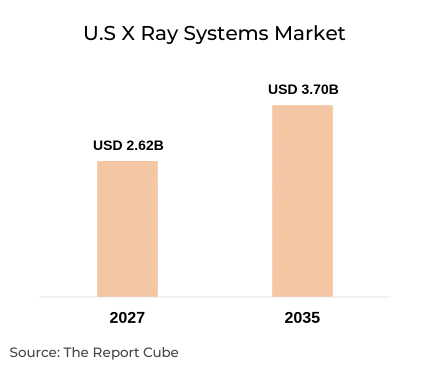
- The U.S. X-ray systems market is projected to increase from USD 2.62 billion in 2027 to USD 3.70 billion by 2035, registering a CAGR of approximately 4.41% during the forecast period.
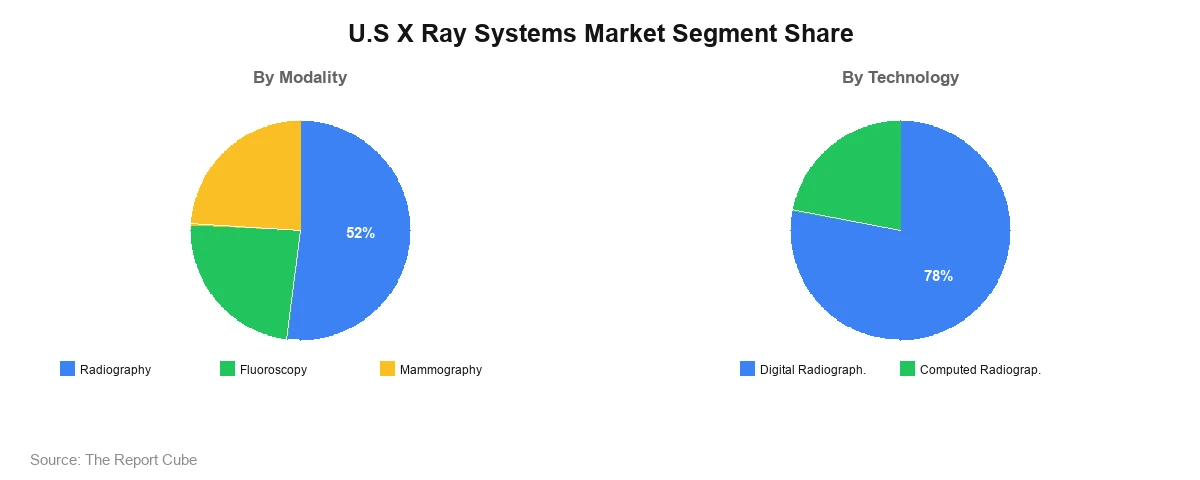
- Radiography represents the leading modality segment, accounting for an estimated 52% market share in 2026, based on the supplied market estimate.
- Digital radiography is the dominant technology segment, with an estimated 78% market share in 2026, reflecting the increasing adoption of digital image acquisition across healthcare facilities.
- Hospitals represent an important end-user category because they require X-ray systems for emergency care, inpatient diagnostics, orthopedic imaging, chest examinations, and other routine clinical applications.
- Mobile X-ray systems are gaining importance in intensive care units, emergency departments, operating rooms, and bedside imaging environments where transporting patients to fixed imaging rooms may be difficult.
- Artificial intelligence, automated image processing, workflow optimization, and dose-management technologies are influencing the development of modern radiography and fluoroscopy equipment.
U.S. X-Ray Systems Market Overview
The U.S. X-ray systems market comprises medical imaging equipment used to produce diagnostic images of internal body structures through X-ray radiation. These systems are used across hospitals, diagnostic imaging centers, outpatient facilities, and other healthcare environments. Major equipment categories include conventional and digital radiography systems, fluoroscopy systems, and mammography equipment. The market also includes stationary and mobile configurations designed to support different clinical workflows and patient-care requirements.
Radiography is an essential component of diagnostic imaging because it is widely used for chest examinations, skeletal imaging, trauma assessment, and routine clinical evaluation. Digital radiography has become an important technology within the market because it supports rapid image acquisition, digital storage, image processing, and integration with hospital information systems and picture archiving and communication systems. Computed radiography remains relevant in facilities using imaging plates and reader-based workflows, including organizations transitioning from conventional film-based imaging.
Market Outlook
The U.S. X-ray systems market is expected to experience steady growth as hospitals and diagnostic imaging centers continue upgrading their imaging infrastructure. Digital radiography is likely to remain an important technology because of its ability to support faster image acquisition, digital workflows, and integration with healthcare information systems. Replacement demand from aging equipment and the modernization of imaging departments may also support equipment sales.
Radiography is expected to maintain a significant position across routine diagnostic imaging applications. Mobile systems may attract additional demand from hospitals seeking to improve bedside imaging capabilities in emergency departments, intensive care units, and inpatient wards. Equipment manufacturers are responding through compact system designs, automated positioning, improved detector performance, and workflow software.
Government Regulations in the U.S. X-Ray Systems Market
The U.S. X-ray systems market is regulated through federal requirements covering medical device safety, radiation-emitting product performance, equipment manufacturing, and mammography quality assurance. The U.S. Food and Drug Administration (FDA) regulates medical X-ray equipment under the Federal Food, Drug, and Cosmetic Act and the Electronic Product Radiation Control provisions. Manufacturers and assemblers must comply with applicable requirements under 21 CFR Parts 1000–1005, which address general radiation-control obligations, records and reporting, defect notifications, repairs, and importation. Diagnostic X-ray systems must also meet applicable performance standards under 21 CFR 1010 and 1020, including 21 CFR 1020.30 for diagnostic X-ray systems, 1020.31 for radiographic equipment, and 1020.32 for fluoroscopic equipment.
U.S. X-Ray Systems Market Dynamics
The U.S. X-ray systems market is influenced by demand for routine diagnostic imaging, the transition toward digital radiography, investments in hospital imaging infrastructure, and advances in imaging automation. Equipment replacement cycles, capital expenditure, regulatory requirements, and the need for radiation-dose optimization also affect market development. The following factors highlight the major drivers, opportunities, trends, and challenges shaping the industry.
| Factor | Type | Specific Impact on Market | Magnitude |
|---|---|---|---|
| Increasing Demand for Diagnostic Imaging Services | Driver | Routine radiography, emergency imaging, orthopedic examinations, and hospital diagnostic requirements support the need for X-ray equipment across healthcare facilities. | High |
| Transition Toward Digital Radiography Systems | Driver | Digital detectors, faster image acquisition, electronic image storage, and integration with hospital information systems encourage equipment upgrades and digital technology adoption. | High |
| Expansion of Mobile and AI-Enabled Imaging Solutions | Opportunity | Bedside imaging requirements and AI-supported image acquisition create opportunities for manufacturers offering mobile systems, automated workflows, and advanced software capabilities. | High |
| Modernization of Mammography and Fluoroscopy Infrastructure | Opportunity | Replacement of aging equipment and adoption of advanced imaging capabilities create opportunities in specialized diagnostic and interventional imaging applications. | Medium to High |
| High Equipment Acquisition and Maintenance Costs | Challenge | Capital investment, detector replacement, installation, maintenance, software upgrades, and service costs can delay equipment purchases, particularly among smaller healthcare facilities. | High |
| Regulatory Compliance and Radiation-Dose Management | Challenge | Radiation performance standards, equipment testing, mammography certification, quality assurance, and patient-dose optimization increase compliance and operational requirements. | High |
Growth Drivers: Increasing Demand for Diagnostic Imaging Services
Demand for diagnostic imaging services supports the use of X-ray systems across hospitals, diagnostic imaging centers, and other healthcare facilities. Radiography is commonly used for chest imaging, skeletal examinations, trauma assessment, and routine diagnostic investigations. Its availability across emergency departments, inpatient units, outpatient facilities, and specialized departments makes X-ray equipment an important part of healthcare imaging infrastructure.
The U.S. healthcare system's continued requirement for timely diagnostic examinations supports equipment utilization and replacement demand. According to the FDA, X-ray imaging examinations should be appropriately justified and optimized to achieve diagnostic image quality while limiting unnecessary radiation exposure. This places emphasis on equipment performance, maintenance, quality assurance, and imaging protocols. Healthcare providers consequently consider image quality, operational reliability, detector performance, and dose-management features when purchasing new systems.
Market Opportunities: Expansion of Mobile and AI-Enabled Imaging Solutions
Mobile X-ray systems provide an opportunity for manufacturers to address imaging requirements in emergency departments, intensive care units, operating rooms, and inpatient wards. Bedside imaging can reduce the need to transport patients to fixed radiology rooms, particularly in critical-care environments. Compact equipment designs, improved battery performance, motorized movement, and enhanced detector technology can support operational flexibility and patient-care workflows.
AI-enabled imaging software also creates opportunities for equipment manufacturers. Applications include automated image acquisition, positioning assistance, image-quality assessment, and selected clinical decision-support functions. For example, GE HealthCare received FDA 510(k) clearance for its Critical Care Suite 3.0 in November 2026, introducing AI-enabled feeding-tube detection support on mobile X-ray equipment for adult and pediatric patients. Such developments demonstrate how software capabilities are becoming part of the competitive offering for X-ray systems.
Industry Challenges: High Equipment Acquisition and Maintenance Costs
X-ray systems require capital investment in imaging equipment, detectors, workstations, installation, room preparation, and associated infrastructure. Advanced digital radiography and fluoroscopy platforms can involve additional expenses for software, connectivity, accessories, and service agreements. Mammography systems may require specialized equipment configurations and quality assurance arrangements. These costs can influence procurement decisions, particularly for smaller diagnostic imaging centers and healthcare facilities with constrained capital budgets.
Lifecycle costs also influence purchasing decisions. Healthcare providers must account for equipment maintenance, detector replacement, software updates, calibration, technical support, and periodic performance testing. The need to maintain equipment availability and minimize downtime can increase dependence on manufacturer service networks and qualified technical personnel. As a result, hospitals often evaluate total cost of ownership, service response times, system reliability, and upgrade flexibility alongside the initial equipment price.
Need Specific Data, Let’s Customize the Report for You
Request CustomizationMarket Trends: Increasing Adoption of AI and Automated Imaging Workflows
Artificial intelligence and automation are becoming important development areas in the X-ray systems market. Manufacturers are integrating AI-assisted image acquisition, automated positioning, image enhancement, and selected clinical assessment capabilities into radiography platforms. These technologies are intended to support imaging consistency, reduce repetitive workflow tasks, and improve the efficiency of radiology departments. AI-enabled tools may also help technologists manage high examination volumes and support the acquisition of diagnostic-quality images.
Manufacturers are increasingly combining imaging hardware with software and analytics platforms. These solutions can help facilities monitor equipment utilization, image quality, radiation dose, reject rates, and workflow performance. GE HealthCare's Critical Care Suite 3.0, announced in November 2026, demonstrates the growing integration of AI capabilities into mobile X-ray workflows. Adoption will depend on clinical utility, regulatory authorization, system compatibility, and the ability to demonstrate measurable operational value.
U.S. X-Ray Systems Market Segment Analysis
The U.S. X-ray systems market is segmented by modality, technology, mobility, and end use. Modality segmentation reflects the clinical imaging applications supported by different X-ray systems, while technology segmentation distinguishes digital radiography from computed radiography. Mobility categories include fixed installations and portable or mobile equipment, and end-use segmentation covers hospitals, diagnostic imaging centers, and other healthcare providers. These categories reflect differences in clinical requirements, procurement decisions, equipment configurations, and imaging workflows.
By Modality
- Radiography
- Fluoroscopy
- Mammography
Radiography represents the leading modality segment, accounting for an estimated 52% market share in 2026, based on the supplied analyst estimate. Radiography systems are widely used for chest examinations, skeletal imaging, trauma assessment, and routine diagnostic procedures. Their broad application across hospitals, outpatient facilities, and diagnostic imaging centers supports demand for stationary and mobile systems. Equipment purchasing decisions are influenced by image quality, detector performance, radiation-dose optimization, workflow integration, and maintenance requirements.
By Technology
- Digital Radiography
- Computed Radiography
Digital radiography accounts for an estimated 78% market share in 2026, based on the supplied market estimate. Digital systems use electronic detectors to capture images and support rapid image acquisition, processing, storage, and electronic distribution. Healthcare facilities increasingly consider digital radiography for its workflow advantages and compatibility with modern imaging infrastructure. Computed radiography uses imaging plates that require a separate reader to convert the stored image into a digital format. It remains relevant in facilities operating existing CR infrastructure or seeking lower-cost transition options.
U.S. X-Ray Systems Market Regional Analysis
The U.S. X-ray systems market is analyzed across the Midwest, West, South, and Northeast. Regional demand is influenced by hospital infrastructure, diagnostic imaging center networks, population healthcare requirements, medical technology investment, and the concentration of healthcare providers. Equipment replacement cycles, regional capital expenditure, access to imaging services, and the adoption of digital radiography and mobile systems also contribute to differences in regional market development. The following analysis highlights the major regional characteristics without assigning unsupported market shares.
| Region | Key Growth Factors | Industry Trends |
|---|---|---|
| Midwest | Established hospital networks, medical technology manufacturing, academic medical centers, and demand for replacement imaging equipment support regional market activity. | Digital radiography modernization, equipment replacement, mobile imaging adoption, and hospital imaging workflow upgrades are important regional trends. |
| West | Large healthcare systems, outpatient imaging networks, medical technology innovation, and investment in advanced diagnostic infrastructure support equipment demand. | Digital imaging, AI-assisted workflows, portable radiography, and connected diagnostic imaging platforms are relevant market developments. |
| South | Expanding healthcare infrastructure, population growth, hospital development, and increasing demand for diagnostic imaging services create opportunities for equipment manufacturers. | Procurement of stationary and mobile radiography systems, modernization of imaging departments, and expansion of outpatient diagnostic services support regional activity. |
| Northeast | Concentrated hospital systems, academic medical centers, specialized breast imaging facilities, and established diagnostic imaging networks contribute to market demand. | Advanced mammography, fluoroscopy, digital radiography, and equipment upgrades remain relevant across hospital and specialized imaging environments. |
U.S. X-Ray Systems Market Competitive Landscape
The U.S. X-ray systems market is characterized by multinational medical imaging manufacturers and specialized digital radiography and mammography equipment providers. Philips, Siemens Healthineers, GE HealthCare, Canon Medical Systems, and Shimadzu offer broad diagnostic imaging portfolios, including radiography and fluoroscopy systems. Carestream and AGFA participate in digital radiography and medical imaging solutions, while Hologic has a strong focus on breast imaging and mammography equipment. Mindray provides diagnostic imaging equipment across several healthcare categories. FUJIFILM Healthcare Americas offers radiography and broader medical imaging solutions, although FUJIFILM SonoSite itself is primarily associated with ultrasound products. Competitive positioning is influenced by imaging performance, digital detector technology, AI-enabled workflows, equipment reliability, product pricing, regulatory compliance, and after-sales service capabilities.
| Company | Competitive Strength | Primary Segment Served |
|---|---|---|
| Koninklijke Philips N.V. | Broad diagnostic imaging portfolio, digital radiography systems, mobile X-ray equipment, image processing, and connected healthcare solutions. | Radiography, mobile X-ray, fluoroscopy, and integrated diagnostic imaging. |
| Siemens Healthineers AG | Advanced diagnostic imaging systems, multifunctional radiography and fluoroscopy platforms, imaging software, and workflow optimization. | Radiography, fluoroscopy, and specialized diagnostic imaging. |
| GE HealthCare | Digital radiography portfolio, mobile X-ray systems, AI-enabled imaging software, detector technologies, and hospital workflow solutions. | Radiography, mobile X-ray, fluoroscopy, and diagnostic imaging technologies. |
| Canon Medical Systems | Diagnostic imaging technology, digital radiography equipment, image processing, and integration with broader medical imaging solutions. | Radiography, fluoroscopy, and diagnostic imaging. |
| Shimadzu Corporation | Medical X-ray equipment, general radiography, fluoroscopy systems, and specialized diagnostic imaging technologies. | Radiography, fluoroscopy, and medical X-ray systems. |
- GE HealthCare: GE HealthCare is a major medical imaging technology provider with a broad portfolio of radiography, mobile X-ray, computed tomography, magnetic resonance imaging, ultrasound, and related healthcare solutions. Its radiography portfolio includes fixed and mobile digital X-ray platforms designed for hospitals and diagnostic imaging facilities. The company has been investing in automation, image processing, and AI-enabled capabilities to improve imaging workflows and clinical operations. In July 2025, GE HealthCare announced commercial availability of its Definium Pace Select ET floor-mounted digital X-ray system, designed to support high-throughput environments through workflow automation and motorized features. In November 2026, the company announced FDA 510(k) clearance for Critical Care Suite 3.0, an AI-enabled software solution supporting feeding-tube assessment on mobile X-ray images in adult and pediatric care. These developments demonstrate its focus on combining imaging equipment with software-enabled clinical workflows.
- Siemens Healthineers AG: Siemens Healthineers provides diagnostic imaging systems and healthcare technology solutions across radiography, fluoroscopy, computed tomography, magnetic resonance imaging, and interventional imaging. Its X-ray portfolio includes multifunctional platforms designed for diagnostic and real-time imaging procedures. The company emphasizes image quality, dose optimization, automation, and integration of imaging systems with clinical workflows. In July 2025, Siemens Healthineers received FDA clearance for the Luminos Q.namix R and Luminos Q.namix T radiography and fluoroscopy platforms. The systems support remote-controlled and tableside examinations and are designed to simplify complex procedures through integrated workflow guidance and AI-supported features. The development reinforces the company's competitive position in specialized X-ray imaging equipment.
Recent Developments and Updates
- March 25, 2026 – Carestream: Carestream announced completion of a refinancing transaction that reduced outstanding debt and extended its maturity profile. The announcement is a corporate financial development rather than a new X-ray system launch.
- November 17, 2026 – GE HealthCare: GE HealthCare announced FDA 510(k) clearance for Critical Care Suite 3.0, an AI-enabled software solution designed to support feeding-tube placement assessment on X-ray images for adult and pediatric patients. The software extends AI-assisted capabilities in mobile X-ray workflows.
- November 2026 – FDA: The FDA's MQSA 2026 scorecard reported 9,140 certified mammography facilities or total accredited units as presented in its November statistics, alongside 27,933 total accredited units. The FDA also reported 13,668 accredited digital breast tomosynthesis units and more than 45 million annual mammography procedures in the reported statistics. These figures demonstrate the scale of the regulated mammography infrastructure; they should not be interpreted as total U.S. X-ray equipment installations.
U.S. X-Ray Systems Market Report Coverage
The U.S. X-Ray Systems Market report provides an assessment of market size, forecast growth, modality segmentation, imaging technologies, mobility categories, end-user demand, regional characteristics, competitive positioning, regulatory requirements, and recent industry developments. The report evaluates major medical imaging manufacturers and specialized X-ray equipment providers, with particular attention to digital radiography, fluoroscopy, mammography, and mobile imaging technologies.
| Parameter | Details |
|---|---|
| Market Name | U.S. X-Ray Systems Market |
| Market Size (2027) | USD 2.62 Billion |
| Market Size (2035) | USD 3.70 Billion |
| CAGR | 4.41% |
| Base Year | 2026 |
| Historical Period | 2022–2026 |
| Forecast Period | 2027–2035 |
| Geographic Scope | United States |
| Segmentation | By Modality, By Technology, By Mobility, and By End Use |
| Regions Covered | Midwest, West, South, Northeast |
| Key Companies | Koninklijke Philips N.V., Siemens Healthineers AG, GE HealthCare, Canon Medical Systems, Shimadzu Corporation, FUJIFILM Healthcare Americas, Carestream, Mindray Medical International Limited, Hologic Inc., AGFA |
| Customization | Market segmentation, regional analysis, competitive benchmarking, company profiling, technology assessment, and customized research requirements. |
Why Choose This U.S. X-Ray Systems Market Report?
- Provides market size and forecast analysis of the U.S. X-ray systems industry through 2035.
- Examines major imaging modalities, including radiography, fluoroscopy, and mammography.
- Analyzes digital radiography and computed radiography technology adoption.
- Evaluates stationary and mobile X-ray equipment demand across healthcare facilities.
- Includes end-user analysis covering hospitals, diagnostic imaging centers, and other healthcare providers.
- Provides regional analysis across the Midwest, West, South, and Northeast.
- Reviews major medical imaging manufacturers and their competitive positioning in the U.S. market.
- Examines AI-enabled imaging, digital detector technologies, mobile imaging, and workflow automation trends.
- Assesses FDA radiation-emitting product requirements and MQSA regulations affecting mammography equipment and facilities.
- Supports strategic planning, market entry, competitive benchmarking, technology assessment, and business decision-making.
Table of Contents
- Introduction
- Objective of the Study
- Product Definition
- Market Segmentation
- Study Variables
- Research Methodology
- Secondary Data Points
- Companies Interviewed
- Primary Data Points
- Breakdown of Primary Interviews
- Secondary Data Points
- Executive Summary
- Market Dynamics
- Drivers
- Challenges
- Opportunity Assessment
- Recent Trends and Developments
- Policy and Regulatory Landscape
- U.S X Ray Systems Market Overview and Forecast Analysis (2022-2035)
- Market Size, By Value, By Growth Rate (CAGR/USD Billions)
- Demand – Supply Trends
- Market Share, By Modality
- Radiography
- Fluoroscopy
- Mammography
- Market Share, By Technology
- Digital Radiography
- Computed Radiography
- Market Share, By Mobility
- Stationary
- Mobile
- Market Share, By End Use
- Hospitals
- Diagnostic imaging centers
- Other end users
- Market Share, By Region
- Midwest
- West
- South
- Northeast
- Market Share, By Competitors
- Competition Characteristics
- Revenue Shares
- Radiography U.S X Ray Systems Market Overview, 2022-2035F
- By Value (USD Million)
- By Technology – Market Size & Forecast 2022-2035, USD Million
- Digital Radiography
- Computed Radiography
- Fluoroscopy U.S X Ray Systems Market Overview, 2022-2035F
- By Value (USD Million)
- By Technology – Market Size & Forecast 2022-2035, USD Million
- Digital Radiography
- Computed Radiography
- Mammography U.S X Ray Systems Market Overview, 2022-2035F
- By Value (USD Million)
- By Technology – Market Size & Forecast 2022-2035, USD Million
- Digital Radiography
- Computed Radiography
- Competitive Outlook (Company Profile – Partial List)
- Koninklijke Philips N.V.
- Company Overview
- Business Segments
- Strategic Alliances/Partnerships
- Recent Developments
- Siemens Healthineers AG
- Company Overview
- Business Segments
- Strategic Alliances/Partnerships
- Recent Developments
- GE Healthcare
- Company Overview
- Business Segments
- Strategic Alliances/Partnerships
- Recent Developments
- Canon Medical Systems
- Company Overview
- Business Segments
- Strategic Alliances/Partnerships
- Recent Developments
- Shimadzu Corporation
- Company Overview
- Business Segments
- Strategic Alliances/Partnerships
- Recent Developments
- FUJIFILM SonoSite Inc.
- Company Overview
- Business Segments
- Strategic Alliances/Partnerships
- Recent Developments
- Carestream
- Company Overview
- Business Segments
- Strategic Alliances/Partnerships
- Recent Developments
- Mindray Medical International Limited
- Company Overview
- Business Segments
- Strategic Alliances/Partnerships
- Recent Developments
- Hologic Inc
- Company Overview
- Business Segments
- Strategic Alliances/Partnerships
- Recent Developments
- AGFA
- Company Overview
- Business Segments
- Strategic Alliances/Partnerships
- Recent Developments
- Koninklijke Philips N.V.
- Contact Us & Disclaimer
Top Key Players & Market Share Outlook
- Koninklijke Philips N.V
- Siemens Healthineers AG
- GE Healthcare
- Canon Medical Systems
- Shimadzu Corporation
- FUJIFILM SonoSite Inc
- Carestream
- Mindray Medical International Limited
- Hologic Inc
- AGFA
Frequently Asked Questions