



Build Your Custom Market Intelligence Report
Customize Your ReportKey Highlights
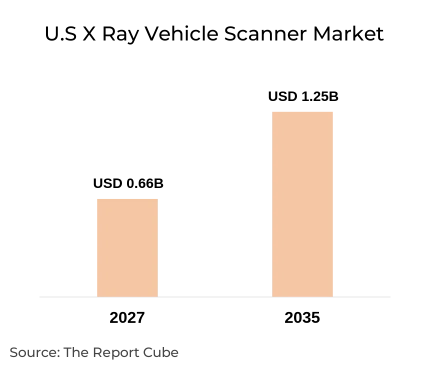
- The U.S. X-ray vehicle scanner market is projected to grow from USD 0.66 billion in 2027 to USD 1.25 billion by 2035, registering a recalculated CAGR of approximately 8.32% during the forecast period.
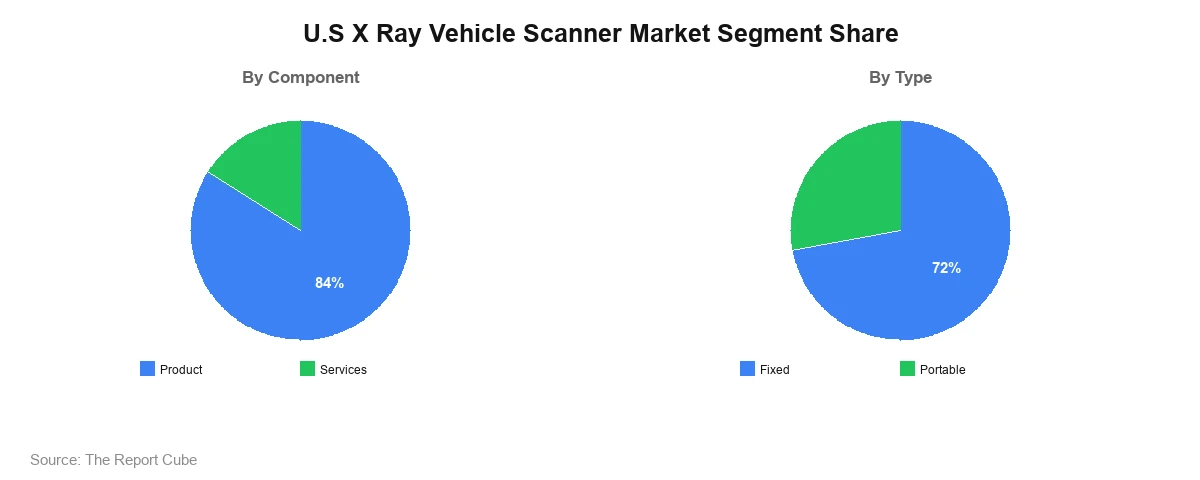
- The product segment accounts for an estimated 84% market share in 2026, based on the supplied analyst estimate, reflecting the importance of vehicle-scanning equipment in the overall market.
- Fixed vehicle scanners represent an estimated 72% market share in 2026, supported by their application at border crossings, ports, customs checkpoints, and high-security infrastructure facilities.
- U.S. Customs and Border Protection (CBP) is an important institutional demand source through its Non-Intrusive Inspection (NII) program, which deploys X-ray systems to inspect passenger vehicles, commercial vehicles, and cargo.
- According to the Government Accountability Office, CBP increased passenger vehicle scanning rates from 2% in FY2020 to 8% in FY2024 and commercial vehicle scanning rates from 16% to 27% during the same period.
U.S. X-Ray Vehicle Scanner Market Overview
The U.S. X-ray vehicle scanner market comprises security inspection systems designed to examine passenger vehicles, commercial trucks, buses, cargo-carrying vehicles, and other transportation equipment without requiring conventional manual disassembly. These systems use X-ray imaging technologies to identify concealed objects, weapons, explosives, narcotics, unauthorized cargo, and other security threats. They are deployed at border crossings, customs facilities, seaports, military installations, correctional facilities, government buildings, and selected private-sector security checkpoints.
Government agencies represent an important customer category because border security, customs enforcement, and critical infrastructure protection require advanced vehicle inspection capabilities. CBP's NII program demonstrates the scale of federal investment in this area. Private-sector applications include security checkpoints at industrial facilities, transportation infrastructure, logistics sites, corporate campuses, and other locations where vehicle-borne threats require inspection. Market competition is influenced by imaging performance, radiation safety, scanning throughput, installation requirements, operational availability, software integration, and maintenance support.
U.S. X-Ray Vehicle Scanner Market Size and Forecast
The U.S. X-ray vehicle scanner market is estimated to reach USD 0.66 billion in 2027 and is projected to increase to USD 1.25 billion by 2035. Based on the supplied market values, the market is expected to register a recalculated CAGR of approximately 8.32% during 2027–2035. Increasing investment in border security infrastructure, customs inspection capabilities, vehicle-borne threat detection, and modernization of non-intrusive inspection equipment is expected to support market development.
Product sales represent the largest component of the market, accounting for an estimated 84% share in 2026 based on the supplied analyst estimate. Vehicle scanner products include fixed inspection portals, mobile scanning vehicles, relocatable systems, portable vehicle inspection equipment, X-ray generators, detectors, imaging workstations, and associated software. Equipment procurement is influenced by scanning capacity, vehicle compatibility, image quality, radiation dose, installation requirements, and lifecycle costs.
Market Outlook
The U.S. X-ray vehicle scanner market is expected to experience continued growth as government agencies strengthen border inspection infrastructure and modernize vehicle screening operations. CBP's Non-Intrusive Inspection program demonstrates the importance of large-scale X-ray systems in detecting concealed contraband and identifying anomalies in passenger and commercial vehicles. Public-sector investment in inspection equipment, system replacement, and deployment at additional ports of entry is likely to remain an important source of demand.
Despite favorable demand conditions, market expansion will depend on government procurement budgets, site readiness, regulatory compliance, system installation timelines, and equipment maintenance. The deployment of large-scale scanners requires suitable land, electrical infrastructure, data connectivity, radiation safety arrangements, and trained personnel. Suppliers that provide reliable systems alongside installation, training, maintenance, and technical support may be better positioned to compete for long-term government and private-sector contracts.
Government Regulations in the U.S. X-Ray Vehicle Scanner Market
The U.S. X-ray vehicle scanner market is subject to federal requirements governing electronic radiation-emitting products, radiation safety, equipment performance, and operational protection. The U.S. Food and Drug Administration (FDA) regulates applicable radiation-emitting electronic products under the Electronic Product Radiation Control provisions of the Federal Food, Drug, and Cosmetic Act. Manufacturers and assemblers must comply with applicable requirements under 21 CFR Parts 1000–1005, which cover general radiation-control obligations, records and reporting, defect notifications, corrective actions, and importation. The FDA identifies vehicle and cargo X-ray scanners under product code RCH, which covers large cabinet X-ray systems used to inspect cargo or very large structures that encompass entire vehicles.
U.S. X-Ray Vehicle Scanner Market Dynamics
The U.S. X-ray vehicle scanner market is influenced by border security modernization, increasing investment in non-intrusive inspection infrastructure, and the need to detect concealed threats in passenger and commercial vehicles. Government procurement and critical infrastructure protection create significant demand opportunities, while high installation costs, radiation safety requirements, and deployment complexity influence market adoption. The following factors highlight the major drivers, opportunities, trends, and challenges shaping the industry.
| Factor | Type | Specific Impact on Market | Magnitude |
|---|---|---|---|
| Expansion of Border Security and Non-Intrusive Inspection Programs | Driver | Federal investment in vehicle inspection systems supports procurement of fixed portals, mobile scanners, and advanced imaging equipment at U.S. ports of entry. | High |
| Increasing Need for Detection of Concealed Contraband and Security Threats | Driver | Demand for improved vehicle inspection capabilities encourages government agencies and security operators to adopt advanced X-ray scanning technologies. | High |
| Modernization of Critical Infrastructure Security | Opportunity | Transportation facilities, industrial sites, military installations, and other sensitive locations create opportunities for fixed and relocatable vehicle scanning systems. | High |
| Development of AI-Enabled and Multi-Energy Inspection Technologies | Opportunity | Advanced imaging, automated image analysis, material discrimination, and vehicle identification integration create opportunities for differentiated equipment and software solutions. | Medium to High |
| High Installation and Infrastructure Requirements | Challenge | Large-scale scanning installations require suitable land, power supply, civil works, data connectivity, safety arrangements, and acceptance testing, increasing project costs and deployment timelines. | High |
| Radiation Safety, Regulatory Compliance, and System Reliability | Challenge | Radiation performance requirements, operational safety, equipment availability, maintenance, and qualified personnel increase the complexity of system procurement and operation. | High |
Growth Drivers: Expansion of Border Security and Non-Intrusive Inspection Programs
Expansion of border security infrastructure is an important growth driver for the U.S. X-ray vehicle scanner market. Government agencies require advanced inspection systems to examine passenger vehicles, commercial trucks, buses, and cargo without relying exclusively on manual searches. Non-intrusive inspection technology allows authorities to produce images of vehicle interiors and identify anomalies that may require additional investigation. Large-scale scanning portals are particularly relevant at busy land ports of entry and customs facilities where vehicle volumes can create operational pressure.
According to the Government Accountability Office, CBP's scanning of passenger vehicles increased from 2% in FY2020 to 8% in FY2024, while commercial vehicle scanning increased from 16% to 27% during the same period. GAO also reported that CBP had planned 153 large-scale NII systems for land ports of entry, including low-energy portals, multi-energy portals, and high-energy rail inspection systems. These developments demonstrate the scale of public-sector investment and the potential for additional equipment procurement and system replacement.
Market Opportunities: Modernization of Critical Infrastructure Security
Modernization of critical infrastructure security creates opportunities for vehicle scanner manufacturers beyond traditional border inspection. Military installations, government buildings, transportation facilities, energy infrastructure, industrial plants, and selected commercial sites require vehicle screening to protect sensitive assets and restricted areas. Fixed scanning portals can be installed at permanent entry checkpoints, while relocatable systems can support temporary security operations and facilities with changing inspection requirements.
Private-sector operators are also evaluating vehicle screening solutions for logistics facilities, high-security industrial locations, and transportation-related infrastructure. Systems capable of screening cars, vans, minibuses, and commercial vehicles can address different site requirements. Manufacturers offering flexible installation configurations, high-throughput scanning, automated vehicle identification, and maintenance services may benefit from demand across government and commercial security applications.
Industry Challenges: High Installation and Infrastructure Requirements
Large-scale vehicle scanning systems require more than the procurement of X-ray equipment. Fixed installations may involve site preparation, concrete foundations, electrical infrastructure, safety zones, control rooms, communication networks, and integration with existing inspection lanes. These requirements can increase project costs and extend deployment schedules, particularly at older border facilities where infrastructure upgrades are necessary. Mobile systems can reduce some permanent installation requirements, but they still require suitable operating locations, trained personnel, transport arrangements, and maintenance support.
GAO reported that CBP's deployment of large-scale NII systems has experienced schedule delays and increased costs. Some ports of entry required additional construction, power connections, data infrastructure, and command-center upgrades before systems could become operational. Vendor-related issues during installation and site acceptance testing also affected implementation schedules. These factors demonstrate how project readiness and installation complexity can influence procurement execution and revenue recognition for equipment suppliers.
Need Specific Data, Let’s Customize the Report for You
Request CustomizationMarket Trends: Increasing Adoption of High-Throughput Drive-Through Scanning Systems
High-throughput drive-through scanning is an important trend in the vehicle inspection market. These systems are designed to scan vehicles as they pass through fixed or relocatable portals, reducing the need for conventional stop-and-search procedures for every vehicle. This approach is relevant to busy border crossings, customs facilities, ports, and security checkpoints where inspection capacity and traffic flow are important operational considerations. System designs increasingly emphasize vehicle compatibility, scanning speed, image quality, and automated inspection workflows.
Manufacturers are developing systems that can inspect passenger cars, vans, buses, trucks, and cargo-carrying vehicles through different configurations. Leidos' VACIS product portfolio includes mobile and integrated systems for vehicle and cargo inspection, while Smiths Detection offers mobile high-energy vehicle inspection systems and drive-through portals. These products illustrate the industry's focus on matching scanning configurations to different inspection volumes and site requirements.
U.S. X-Ray Vehicle Scanner Market Segment Analysis
The U.S. X-ray vehicle scanner market is segmented by component, type, and application. Component segmentation distinguishes equipment products from associated services, including installation, maintenance, technical support, and system upgrades. Type segmentation covers fixed and portable scanning configurations, while application segmentation reflects demand from government and critical infrastructure protection activities and private-sector security operators. These categories reflect differences in procurement requirements, installation environments, inspection volumes, and operational needs.
By Component
- Product
- Services
The product segment accounts for an estimated 84% market share in 2026, based on the supplied analyst estimate. This segment includes fixed vehicle scanning portals, mobile inspection systems, portable X-ray equipment, X-ray generators, detectors, imaging workstations, and associated software. Product demand is influenced by border security procurement, inspection facility modernization, vehicle scanning capacity, and replacement of aging equipment. Services include system installation, commissioning, training, maintenance, technical support, software updates, and equipment upgrades. Service requirements are particularly important for government customers and large inspection facilities that depend on continuous system availability.
By Type
- Fixed
- Portable
Fixed vehicle scanners account for an estimated 72% market share in 2026, based on the supplied analyst estimate. These systems are installed at permanent inspection facilities such as land border crossings, customs checkpoints, ports, and critical infrastructure entry points. Fixed installations are suitable for recurring inspection operations and can be integrated with traffic management, surveillance, and inspection systems. Portable vehicle scanners are designed for flexible deployment at temporary checkpoints, military facilities, law enforcement operations, special events, and other locations where permanent infrastructure may not be practical. Portable configurations may include relocatable portals, trailer-mounted equipment, mobile X-ray inspection vehicles, and compact hand-portable systems designed for targeted vehicle inspection.
U.S. X-Ray Vehicle Scanner Market Regional Analysis
The U.S. X-ray vehicle scanner market is analyzed across the Midwest, West, South, and Northeast. Regional demand is influenced by border crossings, seaport activity, freight transportation networks, government and military facilities, industrial infrastructure, and the presence of high-security locations. The South and West are particularly relevant to border inspection and transportation security requirements, while the Northeast and Midwest have important logistics, industrial, and transportation infrastructure. Regional procurement opportunities are also influenced by facility modernization, federal funding, and the availability of suitable installation sites.
| Region | Key Growth Factors | Industry Trends |
|---|---|---|
| Midwest | Major freight corridors, industrial facilities, transportation infrastructure, logistics networks, and government security installations contribute to regional vehicle inspection requirements. | Demand for fixed vehicle scanning systems at industrial and transportation facilities, along with portable inspection solutions for specialized security operations. |
| West | International trade gateways, seaports, transportation facilities, military installations, and critical infrastructure create demand for advanced vehicle and cargo screening. | Adoption of high-throughput vehicle portals, mobile inspection systems, multi-view imaging, and integrated security screening technologies. |
| South | Southwest border crossings, commercial vehicle traffic, customs inspection facilities, logistics networks, and critical infrastructure protection support market demand. | Expansion and modernization of border inspection infrastructure, deployment of non-intrusive inspection equipment, and demand for fixed and mobile vehicle scanners. |
| Northeast | Major seaports, transportation hubs, government facilities, industrial locations, and high-security commercial infrastructure contribute to inspection equipment requirements. | Modernization of vehicle screening facilities, use of relocatable inspection equipment, and integration of scanning technologies with broader access-control systems. |
U.S. X-Ray Vehicle Scanner Market Competitive Landscape
The U.S. X-ray vehicle scanner market includes international security technology manufacturers, specialized vehicle inspection equipment providers, and companies offering portable X-ray inspection solutions. Leidos, Rapiscan Systems, Smiths Detection, LINEV Systems, and Astrophysics have established vehicle and cargo inspection product portfolios. Vantage Security offers vehicle inspection systems through its security equipment portfolio, while Smart Imaging Systems focuses on compact and portable X-ray technologies for vehicle and threat inspection. Safelon also markets vehicle X-ray scanning equipment. Competitive positioning is influenced by scanning throughput, X-ray energy, penetration capability, image quality, material discrimination, radiation safety, installation flexibility, software integration, and maintenance support. The companies differ in their product configurations and geographic market presence, and not all have equivalent scale or demonstrated U.S. government procurement participation.
| Company | Competitive Strength | Primary Segment Served |
|---|---|---|
| Vantage Security | Vehicle and cargo X-ray inspection systems, drive-through scanning configurations, and security screening equipment. | Fixed and relocatable vehicle scanners, cargo inspection, and security screening. |
| Leidos | VACIS non-intrusive inspection portfolio, mobile and integrated X-ray systems, dual-energy imaging, and government and commercial inspection experience. | Fixed vehicle portals, mobile vehicle scanners, cargo inspection, and border security. |
| LINEV Systems | Drive-through portal systems, multi-energy and dual-view imaging, relocatable inspection platforms, and vehicle and cargo scanning technology. | Fixed, relocatable, and mobile vehicle and cargo inspection systems. |
| Smiths Detection Group Ltd. | High-energy vehicle and cargo inspection systems, drive-through portals, mobile scanning solutions, and security detection technologies. | Fixed vehicle portals, mobile vehicle scanners, and cargo inspection. |
| Astrophysics Inc. | High-energy X-ray vehicle inspection portals, cargo scanning systems, mobile screening equipment, and imaging software. | Vehicle and freight inspection, cargo scanning, and mobile security screening. |
- Leidos: Leidos is an established security technology and non-intrusive inspection provider with its VACIS portfolio covering cargo containers, trucks, railcars, buses, and passenger vehicles. Its vehicle inspection systems use X-ray imaging and, depending on configuration, dual-energy material discrimination to help identify concealed contraband and suspicious materials. The VACIS product range includes mobile systems such as the MLX and M6500, integrated inspection platforms, and passenger vehicle scanning systems. The company also provides installation, training, maintenance, and technical support, which are important requirements for large government inspection programs. Its portfolio includes systems designed for high-throughput operations and occupied-vehicle scanning, supporting applications at ports of entry, military facilities, and security checkpoints.
- Rapiscan Systems: Rapiscan Systems, part of OSI Systems, provides security screening and inspection technologies for transportation, border security, cargo, and critical infrastructure applications. Its vehicle inspection portfolio includes the Z Portal for passenger vehicles, CarView systems, truck and cargo portals, mobile screening equipment, and trailer-mounted X-ray inspection platforms. The Z Portal uses multi-view imaging and Z Backscatter technology, with optional dual-energy transmission imaging, to help identify organic and metallic threats. CarView provides a relocatable passenger vehicle inspection configuration designed for locations such as parking facilities, events, and high-threat environments. The company's broader portfolio includes fixed, mobile, gantry, trailer, and rail inspection systems, allowing it to address different operational requirements.
Recent Developments and Updates
- February 9, 2026 – U.S. Customs and Border Protection: CBP published a presolicitation for Non-Intrusive Inspection Mobile X-Ray Vehicles under Notice ID 70B03C26R00000031. The procurement relates to mobile X-ray inspection vehicles and demonstrates continued federal interest in mobile inspection capabilities. The opportunity was subsequently marked inactive on SAM.gov after its stated response period.
- January 22, 2026 – U.S. Government Accountability Office: GAO published report GAO-26-108767, examining vehicle scanning at U.S. land ports of entry. The report documented CBP's deployment status for 153 planned large-scale NII systems as of February 2025, including 96 low-energy portals, 45 multi-energy portals, and 12 high-energy rail systems. It also highlighted cost increases, schedule delays, infrastructure requirements, and the need for improved performance measurement.
- March 31, 2026 – CBP Relocatable Passenger Vehicle Scanning Systems: A revised solicitation document associated with CBP's Relocatable Passenger Vehicle Scanning Systems IDIQ procurement was published on March 31, 2026. The procurement documentation described a requirement for relocatable passenger vehicle scanning systems and highlighted capabilities such as low-dose X-ray inspection, high vehicle throughput, rapid relocation, and system integration. The solicitation is relevant to the development of flexible vehicle inspection infrastructure.
U.S. X-Ray Vehicle Scanner Market Report Coverage
The U.S. X-ray Vehicle Scanner Market report provides an assessment of market size, forecast growth, component segmentation, scanner types, application demand, regional characteristics, competitive positioning, regulatory requirements, and recent industry developments. The report examines fixed and portable vehicle inspection technologies, product and service revenue categories, government and critical infrastructure applications, and the competitive strategies of major vehicle scanning equipment providers.
| Parameter | Details |
|---|---|
| Market Name | U.S. X-Ray Vehicle Scanner Market |
| Market Size (2027) | USD 0.66 Billion |
| Market Size (2035) | USD 1.25 Billion |
| CAGR | 8.32% |
| Base Year | 2026 |
| Historical Period | 2022–2026 |
| Forecast Period | 2027–2035 |
| Geographic Scope | United States |
| Segmentation | By Component, By Type, and By Application |
| Regions Covered | Midwest, West, South, Northeast |
| Key Companies | Vantage Security, Leidos, LINEV Systems, Smiths Detection Group Ltd., Astrophysics Inc., Rapiscan Systems, Smart Imaging Systems Inc., Safelon |
| Customization | Market segmentation, regional analysis, competitive benchmarking, company profiling, technology assessment, and customized research requirements. |
Why Choose This U.S. X-Ray Vehicle Scanner Market Report?
- Provides market size and forecast analysis of the U.S. X-ray vehicle scanner industry through 2035.
- Examines product and service categories and their contribution to the overall market.
- Analyzes fixed and portable vehicle scanning technologies and their operational applications.
- Evaluates government, critical infrastructure protection, and private-sector demand.
- Reviews border security modernization and federal non-intrusive inspection programs.
- Provides regional analysis across the Midwest, West, South, and Northeast.
- Profiles major vehicle scanning equipment manufacturers and evaluates their product portfolios.
- Examines developments in dual-energy imaging, multi-view scanning, automated image analysis, and vehicle identification integration.
- Reviews FDA radiation-emitting product requirements and other relevant safety and operational considerations.
- Supports strategic planning, market entry, competitive benchmarking, procurement analysis, and investment decisions.
Table of Contents
- Introduction
- Objective of the Study
- Product Definition
- Market Segmentation
- Study Variables
- Research Methodology
- Secondary Data Points
- Companies Interviewed
- Primary Data Points
- Breakdown of Primary Interviews
- Secondary Data Points
- Executive Summary
- Market Dynamics
- Drivers
- Challenges
- Opportunity Assessment
- Recent Trends and Developments
- Policy and Regulatory Landscape
- U.S X Ray Vehicle Scanner Market Overview and Forecast Analysis (2022-2035)
- Market Size, By Value, By Growth Rate (CAGR/USD Billions)
- Demand – Supply Trends
- Market Share, By Component
- Product
- Services
- Market Share, By Type
- Fixed
- Portable
- Market Share, By Application
- Government/ Critical Infrastructure Protection
- Private
- Market Share, By Region
- Midwest
- West
- South
- Northeast
- Market Share, By Competitors
- Competition Characteristics
- Revenue Shares
- Product U.S X Ray Vehicle Scanner Market Overview, 2022-2035F
- By Value (USD Million)
- By Type – Market Size & Forecast 2022-2035, USD Million
- Fixed
- Portable
- Services U.S X Ray Vehicle Scanner Market Overview, 2022-2035F
- By Value (USD Million)
- By Type – Market Size & Forecast 2022-2035, USD Million
- Fixed
- Portable
- Competitive Outlook (Company Profile – Partial List)
- Vantage Security
- Company Overview
- Business Segments
- Strategic Alliances/Partnerships
- Recent Developments
- Leidos
- Company Overview
- Business Segments
- Strategic Alliances/Partnerships
- Recent Developments
- LINEV Systems
- Company Overview
- Business Segments
- Strategic Alliances/Partnerships
- Recent Developments
- Smiths Detection Group Ltd.
- Company Overview
- Business Segments
- Strategic Alliances/Partnerships
- Recent Developments
- Astrophysics Inc.
- Company Overview
- Business Segments
- Strategic Alliances/Partnerships
- Recent Developments
- Rapiscan Systems
- Company Overview
- Business Segments
- Strategic Alliances/Partnerships
- Recent Developments
- Smart Imaging Systems Inc.
- Company Overview
- Business Segments
- Strategic Alliances/Partnerships
- Recent Developments
- Safelon
- Company Overview
- Business Segments
- Strategic Alliances/Partnerships
- Recent Developments
- Vantage Security
- Contact Us & Disclaimer
Top Key Players & Market Share Outlook
- Vantage Security
- Leidos
- LINEV Systems
- Smiths Detection Group Ltd
- Astrophysics Inc
- Rapiscan Systems
- Smart Imaging Systems Inc
- Safelon
Frequently Asked Questions