


Build Your Custom Market Intelligence Report
Customize Your ReportKey Highlights
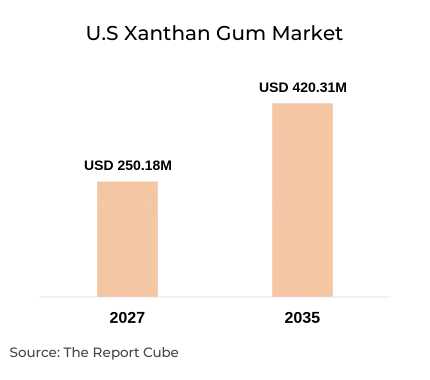
- The U.S. xanthan gum market is estimated at USD 250.18 million in 2027 and is projected to reach USD 420.31 million by 2035, registering a CAGR of approximately 6.70% during 2027–2035.
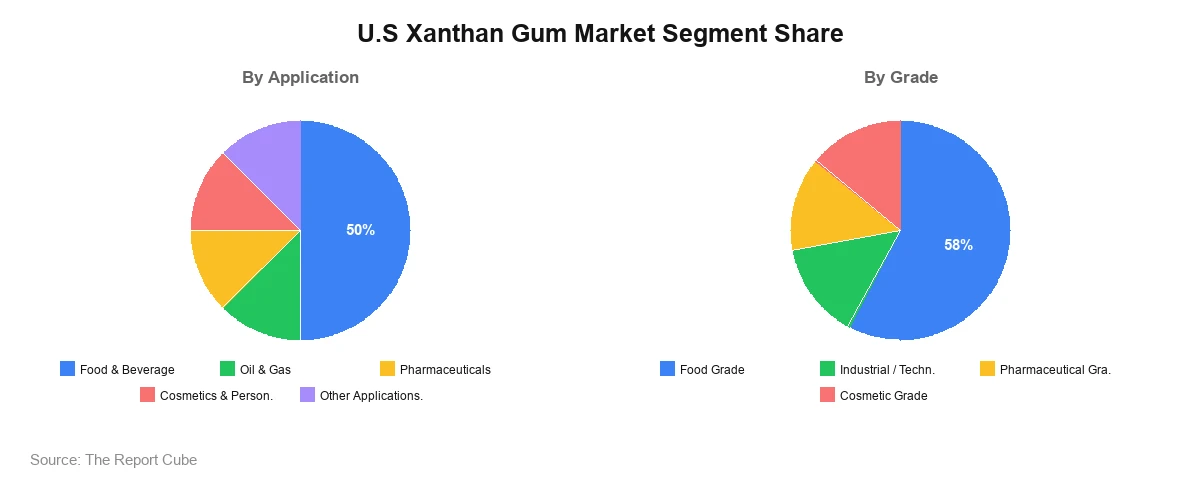
- The food and beverage application segment accounts for an estimated 50% market share in 2026, supported by xanthan gum's extensive use as a thickener, stabilizer, emulsifier, and texture modifier.
- Food-grade xanthan gum represents an estimated 58% market share in 2026, reflecting its importance in bakery products, sauces, dressings, beverages, dairy products, and processed foods.
- Dry xanthan gum in powder and granular forms is widely used because of its storage convenience, transportation efficiency, and suitability for industrial food processing and formulation applications.
- Oil and gas applications represent an important industrial demand category, where xanthan gum is used as a rheology modifier, viscosifier, and suspension agent in drilling, completion, and workover fluids.
- Pharmaceutical and personal care manufacturers use xanthan gum in selected formulations as a thickening, stabilizing, suspending, and rheology-controlling ingredient.
U.S. Xanthan Gum Market Overview
The U.S. xanthan gum market comprises the production, importation, distribution, and consumption of xanthan gum used across food and beverages, oil and gas, pharmaceuticals, cosmetics and personal care, and other industrial applications. Xanthan gum is a high-molecular-weight polysaccharide produced through microbial fermentation using Xanthomonas campestris. It is commercially available in different grades and physical forms, with product specifications varying according to viscosity, purity, particle size, hydration characteristics, and intended application. Its ability to modify viscosity and stabilize formulations makes it an important hydrocolloid in food processing and industrial manufacturing.
The U.S. market is supported by a combination of domestic ingredient suppliers, international manufacturers, importers, and specialty chemical distributors. Companies such as ADM and Cargill offer xanthan gum portfolios for food and industrial applications, while Deosen and Fufeng are significant international manufacturers. Foodchem and Scimplify provide supply and sourcing channels, while consumer-facing companies such as Bob's Red Mill sell xanthan gum in packaged food ingredient formats. Market participants compete through product quality, fermentation capabilities, technical formulation support, regulatory documentation, supply reliability, and pricing.
U.S. Xanthan Gum Market Size and Forecast
The U.S. xanthan gum market is estimated to reach USD 250.18 million in 2027 and is projected to increase to USD 420.31 million by 2035. Based on these supplied market values, the market is expected to register a CAGR of approximately 6.70% during the forecast period. Market development is supported by the use of xanthan gum in processed foods, gluten-free bakery products, beverages, pharmaceutical formulations, personal care products, and industrial applications.
Dry xanthan gum in powder and granular forms represents an important commercial product format because of its storage, transportation, handling, and formulation advantages. Liquid xanthan gum is used in selected industrial and formulation applications where pre-dispersion or ready-to-use ingredient systems are beneficial. The market is also influenced by specialized functional requirements, including thickening, suspension, stabilization, and rheology control. Manufacturers that offer consistent viscosity performance, improved dispersion, application-specific grades, and dependable supply are positioned to serve a broad range of industrial customers.
Market Outlook
The U.S. xanthan gum market is expected to experience continued growth as food manufacturers increasingly depend on hydrocolloids to improve texture, stability, and consistency across processed food products. Xanthan gum's ability to provide thickening and suspension properties at relatively low concentrations supports its use in sauces, dressings, bakery products, dairy formulations, and beverages. Demand for gluten-free products and reformulated food products also creates opportunities for ingredient suppliers offering application-specific xanthan gum grades.
However, market expansion will depend on raw material costs, fermentation efficiency, international trade conditions, import availability, and regulatory compliance. U.S. trade actions involving Chinese xanthan gum suppliers may influence sourcing strategies and landed costs. Manufacturers with diversified production, strong quality systems, technical support, and dependable distribution networks may be better positioned to manage supply fluctuations and meet customer requirements.
Government Regulations in the U.S. Xanthan Gum Market
The U.S. xanthan gum market is subject to regulatory requirements that vary according to its intended application and product grade. For food applications, the U.S. Food and Drug Administration (FDA) regulates xanthan gum under 21 CFR Section 172.695, which permits its use as a food additive under specified conditions. The regulation defines xanthan gum as a polysaccharide produced through pure-culture fermentation using Xanthomonas campestris and purified through recovery with isopropyl alcohol. It specifies requirements relating to the production organism, absence of viable production cells, residual isopropyl alcohol, viscosity, and other product characteristics. The regulation permits its use in accordance with good manufacturing practice as a stabilizer, emulsifier, thickener, suspending agent, bodying agent, and foam enhancer in eligible food products. The container label must identify the additive as food grade and include adequate directions for use. The FDA's Substances Added to Food inventory also identifies xanthan gum and references applicable food additive, food-contact, and food-standard provisions.
U.S. Xanthan Gum Market Dynamics
The U.S. xanthan gum market is influenced by demand from food processing, industrial fluid formulations, pharmaceuticals, and personal care manufacturing. Its thickening, stabilizing, suspending, and rheology-modifying properties support adoption across different end-use industries. At the same time, fermentation economics, raw material availability, international trade conditions, and application-specific quality requirements influence market competitiveness. The following factors highlight the major drivers, opportunities, trends, and challenges shaping the market.
| Factor | Type | Specific Impact on Market | Magnitude |
|---|---|---|---|
| Increasing Use of Hydrocolloids in Processed Food and Beverage Manufacturing | Driver | Food manufacturers use xanthan gum to improve viscosity, texture, suspension, and emulsion stability across sauces, dressings, bakery products, dairy products, and beverages. | High |
| Demand for Gluten-Free and Reformulated Food Products | Driver | Xanthan gum helps improve structure, moisture retention, and texture in gluten-free bakery and other reformulated food applications. | High |
| Expansion of Pharmaceutical and Personal Care Formulations | Opportunity | Application-specific xanthan gum grades can serve as stabilizers, suspending agents, thickeners, and rheology modifiers in pharmaceutical and cosmetic formulations. | Medium to High |
| Increasing Demand for Industrial and Oilfield Rheology Modifiers | Opportunity | Use in drilling, completion, and workover fluids creates opportunities for specialized industrial grades with appropriate viscosity and suspension characteristics. | Medium |
| Fermentation Production Costs and International Supply Dependence | Challenge | Raw material costs, fermentation yields, energy consumption, production capacity, and international freight influence product pricing and supply reliability. | High |
| Trade Measures, Product Specifications, and Regulatory Compliance | Challenge | Import duties, trade reviews, quality requirements, and application-specific regulatory obligations can increase sourcing complexity and affect supplier competitiveness. | High |
Growth Drivers: Increasing Use of Hydrocolloids in Processed Food and Beverage Manufacturing
Increasing use of hydrocolloids in processed food and beverage manufacturing is an important driver of the U.S. xanthan gum market. Food manufacturers use xanthan gum to control viscosity, stabilize emulsions, improve mouthfeel, and suspend particles in different formulations. Its functional properties support applications in salad dressings, sauces, dairy products, beverages, bakery fillings, frozen desserts, and processed foods. The ingredient can also provide viscosity across different temperature and pH conditions, making it suitable for formulations that undergo complex manufacturing and storage processes.
According to the FDA, xanthan gum is used as a direct food additive for technical functions including stabilizing, thickening, texturizing, emulsifying, and formulation support. The FDA's regulatory framework under 21 CFR 172.695 permits its use under specified conditions and good manufacturing practice. These established applications support continued demand from food processors seeking consistent texture and product stability.
Market Opportunities: Expansion of Pharmaceutical and Personal Care Formulations
Pharmaceutical and personal care formulations create opportunities for xanthan gum suppliers offering products with application-specific quality and performance characteristics. In pharmaceutical formulations, xanthan gum can be used as a suspending agent, thickener, stabilizer, and formulation aid in liquid, semi-solid, topical, and selected controlled-release products. Its ability to maintain suspension and modify viscosity supports the development of formulations that require consistent physical stability during storage and use.
Personal care manufacturers use xanthan gum in creams, lotions, cleansers, gels, and other products to improve consistency, texture, and stability. Demand in these applications is influenced by formulation performance, product compatibility, purity requirements, and the availability of technical documentation. Cargill's pharmaceutical xanthan gum portfolio includes materials designed for suspending, thickening, and stabilizing applications. Suppliers offering appropriate quality specifications and formulation support may benefit from opportunities in pharmaceutical and personal care ingredient markets.
Industry Challenges: Fermentation Production Costs and International Supply Dependence
Xanthan gum manufacturing relies on fermentation processes that require suitable carbohydrate feedstocks, microorganisms, fermentation equipment, downstream recovery, purification, drying, and quality testing. Production costs are influenced by raw material prices, energy consumption, fermentation yields, plant utilization, process efficiency, and logistics. Variations in feedstock and energy costs can affect manufacturers' operating margins and the price competitiveness of their products. Downstream processing and product drying also require specialized equipment and quality-control systems.
The U.S. market is supplied by domestic ingredient companies as well as international manufacturers and exporters. Dependence on imported xanthan gum can expose buyers to shipping costs, currency fluctuations, supply disruptions, and changes in trade policy. Food and pharmaceutical customers may also require consistent viscosity, microbiological quality, traceability, and documentation across multiple shipments. These requirements make supplier qualification and supply chain management important considerations for U.S. buyers.
Need Specific Data, Let’s Customize the Report for You
Request CustomizationMarket Trends: Growing Demand for Application-Specific and High-Performance Xanthan Gum Grades
Manufacturers are increasingly offering application-specific xanthan gum products designed to meet different viscosity, hydration, particle-size, dispersion, and purity requirements. Food manufacturers may require products that disperse efficiently, provide consistent texture, and maintain stability in acidic or high-salt formulations. Pharmaceutical customers may require materials with appropriate quality specifications and controlled performance in liquid and semi-solid formulations. Industrial users, particularly in oilfield applications, prioritize rheological behavior, salt tolerance, suspension performance, and compatibility with drilling fluid systems.
Specialty grades allow suppliers to address the requirements of different customers without relying exclusively on standard xanthan gum products. Companies such as ADM, Cargill, Deosen, and Tate & Lyle offer product portfolios that include different grades, brands, and formulation solutions. The development of customized hydrocolloid systems and improved dispersion characteristics can help manufacturers strengthen customer relationships and compete in specialized applications.
U.S. Xanthan Gum Market Segment Analysis
The U.S. xanthan gum market is segmented by application, grade, form, and function. Application segmentation reflects demand across food and beverage manufacturing, oil and gas operations, pharmaceuticals, cosmetics and personal care, and other industrial uses. Grade segmentation differentiates products according to their intended use and quality requirements. Form segmentation covers dry and liquid products, while function segmentation identifies broad functional roles and specialty variants. These categories reflect differences in product specifications, formulation requirements, processing methods, and customer purchasing behavior.
By Application
- Food & Beverage
- Oil & Gas
- Pharmaceuticals
- Cosmetics & Personal Care
- Other Applications
The food and beverage segment accounts for an estimated 50% market share in 2026, based on the supplied analyst estimate. Xanthan gum is used in sauces, salad dressings, bakery products, dairy products, beverages, frozen desserts, and processed foods to provide thickening, stabilization, suspension, and texture modification. Its functional properties support the development of products requiring consistent viscosity and emulsion stability. Oil and gas applications use xanthan gum in selected drilling, completion, and workover fluid formulations as a viscosifier and rheology modifier. Pharmaceutical manufacturers use appropriate grades as suspending agents, stabilizers, thickeners, and formulation aids. Cosmetics and personal care applications include lotions, creams, gels, cleansers, and other formulations where consistency and stability are important. Other applications include selected industrial, agricultural, and specialty formulations.
By Grade
- Food Grade
- Industrial / Technical Grade
- Pharmaceutical Grade
- Cosmetic Grade
Food-grade xanthan gum accounts for an estimated 58% market share in 2026, based on the supplied analyst estimate. It is manufactured and tested to meet the relevant food additive requirements and customer specifications for purity, viscosity, microbial quality, and other characteristics. Industrial and technical grades are used in drilling fluids, industrial formulations, coatings, and selected manufacturing processes where rheology modification and suspension properties are required. Pharmaceutical-grade xanthan gum is selected according to applicable pharmacopeial specifications and customer requirements for pharmaceutical formulations. Cosmetic-grade products are used in personal care formulations and are selected according to purity, compatibility, viscosity, and formulation performance requirements. Grade classifications are based on intended application and product specifications; they should not be interpreted as interchangeable regulatory approvals.
U.S. Xanthan Gum Market Regional Analysis
The U.S. xanthan gum market is analyzed across the Midwest, West, South, and Northeast. Regional demand is influenced by food and beverage manufacturing activity, industrial chemical consumption, pharmaceutical production, oil and gas operations, and the distribution infrastructure used by ingredient suppliers. The Midwest has an established food processing and ingredient manufacturing base, while the South has important industrial and energy-related demand. The West and Northeast contain food manufacturing, pharmaceutical, personal care, and specialty ingredient customers. Regional demand also depends on the location of distribution centers, import gateways, and manufacturing facilities.
| Region | Key Growth Factors | Industry Trends |
|---|---|---|
| Midwest | Food and beverage manufacturing, ingredient processing, industrial production, pharmaceutical manufacturing, and established distribution infrastructure support regional demand. | Use of xanthan gum in processed foods, bakery formulations, sauces, dressings, and industrial applications, supported by ingredient suppliers and manufacturing networks. |
| West | Food processing, specialty ingredient demand, pharmaceutical and personal care manufacturing, industrial applications, and access to international import channels support market activity. | Demand for customized hydrocolloid solutions, clean-label formulation ingredients, gluten-free products, and specialty xanthan gum grades. |
| South | Oil and gas operations, food manufacturing, industrial chemical consumption, logistics facilities, and regional ingredient distribution support demand. | Use of xanthan gum in drilling and completion fluids alongside applications in food processing and industrial formulations. |
| Northeast | Food and beverage production, pharmaceutical manufacturing, personal care products, specialty chemical distribution, and consumer food ingredient demand support market activity. | Demand for high-quality food-grade, pharmaceutical, and cosmetic xanthan gum products, along with specialized formulation and distribution services. |
U.S. Xanthan Gum Market Competitive Landscape
The U.S. xanthan gum market includes domestic ingredient suppliers, international fermentation-based manufacturers, specialty chemical distributors, and consumer food brands. Competition is influenced by production capacity, fermentation efficiency, product consistency, viscosity specifications, application-specific grades, regulatory documentation, and customer support. ADM and Cargill offer xanthan gum products for food and industrial applications, while Deosen Biochemical and Fufeng Group are important international manufacturers. Foodchem supplies xanthan gum through its ingredient distribution and manufacturing network, and Tate & Lyle offers KELTROL xanthan gum through its hydrocolloid solutions portfolio. Ingredion provides xanthan gum and broader hydrocolloid ingredient solutions. Scimplify operates as a specialty chemical sourcing and supply platform, Bob's Red Mill sells packaged xanthan gum for consumer food applications, and Economy Polymers & Chemicals supplies xanthan-based products for oilfield and industrial uses. The competitive landscape therefore includes manufacturers, suppliers, platforms, and consumer brands with different market roles.
| Company | Competitive Strength | Primary Segment Served |
|---|---|---|
| ADM | PurelyForm xanthan gum portfolio, food-grade and industrial hydrocolloid solutions, formulation support, and ingredient manufacturing capabilities. | Food & Beverage, Industrial / Technical, and specialty ingredient applications. |
| Foodchem International Corporation | Xanthan gum supply and export capabilities, food ingredient distribution, product specifications, and customer sourcing support. | Food-grade xanthan gum and ingredient supply. |
| Deosen Biochemical (Ordos) Ltd. | Fermentation-based hydrocolloid manufacturing, xanthan gum product brands, international distribution, and multiple application grades. | Food & Beverage, Oil & Gas, Pharmaceuticals, and industrial applications. |
| Cargill Incorporated | Satiaxane xanthan gum portfolio, food and pharmaceutical grades, bioindustrial applications, and formulation expertise. | Food & Beverage, Pharmaceuticals, Cosmetics & Personal Care, and Oil & Gas. |
| Ingredion | Ticaxan xanthan gum and broader hydrocolloid solutions, ingredient formulation capabilities, and food application expertise. | Food & Beverage and specialty ingredient applications. |
| Tate & Lyle | KELTROL xanthan gum portfolio, hydrocolloid formulation expertise, and food and beverage texture solutions. | Food & Beverage and selected personal care formulations. |
- Cargill Incorporated: Cargill is an established ingredient supplier with xanthan gum products serving food, pharmaceutical, and industrial markets. Its food portfolio includes regular and transparent xanthan gum products available in powdered and granulated forms under the Satiaxane brand. These products are used in bakery products, beverages, dairy applications, sauces, dressings, frozen desserts, and other food formulations where thickening and stabilization are required. Cargill also offers pharmaceutical xanthan gum products designed for applications such as thickening, stabilizing, suspending, and controlled release. In its bioindustrial portfolio, xanthan gum is used in brines, drilling fluids, and fracturing fluids as a rheology modifier and suspension agent. The company's ability to serve multiple end-use industries through application-specific product portfolios and formulation support strengthens its competitive positioning.
- Deosen Biochemical (Ordos) Ltd.: Deosen Biochemical is a fermentation-based hydrocolloid manufacturer with a product portfolio that includes xanthan gum, welan gum, and gellan gum. Its xanthan gum products are marketed under brands including Ziboxan and Zibozan and are supplied for food, petroleum, daily chemical, pharmaceutical, building material, fertilizer, and other industrial applications. The company reports international sales coverage across more than 70 countries and regions and identifies certifications including ISO 9001, BRC, Halal, and Kosher within its quality and compliance portfolio. Deosen's fermentation and downstream manufacturing capabilities, multiple product specifications, and international distribution network support its position as an important supplier in the global xanthan gum industry. Its involvement in U.S. Department of Commerce antidumping administrative reviews also demonstrates its relevance to U.S. import supply and trade conditions.
Recent Developments and Updates
- July 16, 2026 – U.S. Department of Commerce: The U.S. Department of Commerce published the final results of its antidumping duty administrative review covering xanthan gum imports from China for the July 2023–June 2024 period. Commerce determined that certain Fufeng entities and Deosen Biochemical (Ordos) Ltd. had sold xanthan gum at less than normal value during the period of review. The determination is relevant to U.S. sourcing conditions, import competition, and applicable company-specific trade requirements.
- September–October 2026 – U.S. Department of Commerce: Commerce extended the deadline for preliminary results in a subsequent administrative review of xanthan gum from China to no later than October 7, 2026. The proceeding involved Deosen Biochemical (Ordos) Ltd. and Fufeng entities as mandatory respondents. This review illustrates the continuing importance of trade policy and import compliance for international xanthan gum suppliers serving the U.S. market.
U.S. Xanthan Gum Market Report Coverage
The U.S. Xanthan Gum Market report provides an assessment of market size, forecast growth, application demand, product grade, physical form, functional segmentation, regional characteristics, competitive positioning, regulatory requirements, and recent industry developments. The report evaluates the role of xanthan gum across food and beverage manufacturing, oil and gas operations, pharmaceutical formulations, cosmetics and personal care products, and other industrial applications. It also examines leading suppliers, international manufacturers, trade developments, and product portfolio strategies shaping the U.S. market.
| Parameter | Details |
|---|---|
| Market Name | U.S. Xanthan Gum Market |
| Market Size (2027) | USD 250.18 Million |
| Market Size (2035) | USD 420.31 Million |
| CAGR | 6.70% (2027–2035) |
| Base Year | 2026 |
| Historical Period | 2022–2026 |
| Forecast Period | 2027–2035 |
| Geographic Scope | United States |
| Segmentation | By Application, By Grade, By Form, and By Function |
| Regions Covered | Midwest, West, South, Northeast |
| Key Companies | ADM, Foodchem International Corporation, Deosen Biochemical (Ordos) Ltd., Cargill Incorporated, Ingredion, Tate & Lyle, Fufeng Group, Scimplify, Bob's Red Mill, Economy Polymers & Chemicals |
| Customization | Market segmentation, regional analysis, competitive benchmarking, company profiling, product-grade assessment, application analysis, trade developments, and customized research requirements. |
Why Choose This U.S. Xanthan Gum Market Report?
- Provides market size and forecast analysis of the U.S. xanthan gum industry through 2035.
- Examines demand across food and beverage, oil and gas, pharmaceuticals, cosmetics and personal care, and other applications.
- Analyzes food-grade, industrial / technical, pharmaceutical, and cosmetic xanthan gum categories.
- Evaluates dry powder, granular, and liquid xanthan gum product formats.
- Reviews functional roles, including thickening, stabilization, emulsification, suspension, and rheology modification.
- Provides regional analysis across the Midwest, West, South, and Northeast.
- Profiles major xanthan gum manufacturers, suppliers, distributors, and consumer-facing ingredient brands.
- Examines developments in fermentation-based manufacturing, application-specific grades, and formulation technologies.
- Reviews relevant FDA food additive requirements and pharmaceutical quality specifications.
- Evaluates international trade developments and their potential implications for U.S. xanthan gum sourcing.
- Supports strategic planning, supplier evaluation, market entry, competitive benchmarking, and investment decisions.
Table of Contents
- Introduction
- Objective of the Study
- Product Definition
- Market Segmentation
- Study Variables
- Research Methodology
- Secondary Data Points
- Companies Interviewed
- Primary Data Points
- Breakdown of Primary Interviews
- Secondary Data Points
- Executive Summary
- Market Dynamics
- Drivers
- Challenges
- Opportunity Assessment
- Recent Trends and Developments
- Policy and Regulatory Landscape
- U.S Xanthan Gum Market Overview and Forecast Analysis (2022-2035)
- Market Size, By Value, By Growth Rate (CAGR/USD Millions)
- Demand – Supply Trends
- Market Share, By Application
- Food & Beverage
- Oil & Gas
- Pharmaceuticals
- Cosmetics & Personal Care
- Other Applications
- Market Share, By Grade
- Food Grade
- Industrial / Technical Grade
- Pharmaceutical Grade
- Cosmetic Grade
- Market Share, By Form
- Dry (Powder / Granular)
- Liquid
- Market Share, By Function
- Functional Roles
- Specialty Variants
- Market Share, By Region
- Midwest
- West
- South
- Northeast
- Market Share, By Competitors
- Competition Characteristics
- Revenue Shares
- Food & Beverage U.S Xanthan Gum Market Overview, 2022-2035F
- By Value (USD Million)
- By Grade – Market Size & Forecast 2022-2035, USD Million
- Food Grade
- Industrial / Technical Grade
- Pharmaceutical Grade
- Cosmetic Grade
- Oil & Gas U.S Xanthan Gum Market Overview, 2022-2035F
- By Value (USD Million)
- By Grade – Market Size & Forecast 2022-2035, USD Million
- Food Grade
- Industrial / Technical Grade
- Pharmaceutical Grade
- Cosmetic Grade
- Pharmaceuticals U.S Xanthan Gum Market Overview, 2022-2035F
- By Value (USD Million)
- By Grade – Market Size & Forecast 2022-2035, USD Million
- Food Grade
- Industrial / Technical Grade
- Pharmaceutical Grade
- Cosmetic Grade
- Cosmetics & Personal Care U.S Xanthan Gum Market Overview, 2022-2035F
- By Value (USD Million)
- By Grade – Market Size & Forecast 2022-2035, USD Million
- Food Grade
- Industrial / Technical Grade
- Pharmaceutical Grade
- Cosmetic Grade
- Other Applications U.S Xanthan Gum Market Overview, 2022-2035F
- By Value (USD Million)
- By Grade – Market Size & Forecast 2022-2035, USD Million
- Food Grade
- Industrial / Technical Grade
- Pharmaceutical Grade
- Cosmetic Grade
- Competitive Outlook (Company Profile – Partial List)
- ADM
- Company Overview
- Business Segments
- Strategic Alliances/Partnerships
- Recent Developments
- Foodchem International Corporation
- Company Overview
- Business Segments
- Strategic Alliances/Partnerships
- Recent Developments
- Deosen Biochemical (Ordos) Ltd.
- Company Overview
- Business Segments
- Strategic Alliances/Partnerships
- Recent Developments
- Cargill Incorporated
- Company Overview
- Business Segments
- Strategic Alliances/Partnerships
- Recent Developments
- Ingredion
- Company Overview
- Business Segments
- Strategic Alliances/Partnerships
- Recent Developments
- Tate & Lyle
- Company Overview
- Business Segments
- Strategic Alliances/Partnerships
- Recent Developments
- Fufeng Group
- Company Overview
- Business Segments
- Strategic Alliances/Partnerships
- Recent Developments
- Scimplify
- Company Overview
- Business Segments
- Strategic Alliances/Partnerships
- Recent Developments
- Bob’s Red Mill
- Company Overview
- Business Segments
- Strategic Alliances/Partnerships
- Recent Developments
- Economy Polymers & Chemicals
- Company Overview
- Business Segments
- Strategic Alliances/Partnerships
- Recent Developments
- ADM
- Contact Us & Disclaimer
Top Key Players & Market Share Outlook
- ADM
- Foodchem International Corporation
- Deosen Biochemical (Ordos) Ltd
- Cargill Incorporated
- Ingredion
- Tate & Lyle
- Fufeng Group
- Scimplify
- Bob’s Red Mill
- Economy Polymers & Chemicals
Frequently Asked Questions