




Build Your Custom Market Intelligence Report
Customize Your ReportNigeria Vacuum Cleaner Market Insights & Analysis
The Nigeria Vacuum Cleaner Market is anticipated to register a CAGR of 2.12% during 2026–2034. The market size was valued at USD 0.72 million in 2025 and is projected to reach USD 0.87 million by 2034. Demand for vacuum cleaners in Nigeria is gradually increasing as urbanization accelerates and awareness of hygiene, cleanliness, and indoor air quality improves. Growth is primarily concentrated in metropolitan areas where rising disposable incomes, modern housing developments, and exposure to global consumer electronics brands are influencing household purchasing behavior. Residential demand remains the core contributor, supported by expanding middle-income households and growing adoption of electrical home appliances.
Nigeria Vacuum Cleaner Market Recent Developments
- 2025: LG Electronics Nigeria expanded distribution of energy-efficient vacuum cleaners across major urban retail outlets.
- 2025: Panasonic Nigeria introduced compact canister vacuum models targeting space-constrained urban households.
Government Initiatives & Policies
- National Energy Efficiency Strategy: Program promoting adoption of energy-efficient household appliances.
- Urban Housing Development Programs: Government initiatives supporting modern residential construction and improved living standards.
Commercial demand from offices, hospitality facilities, healthcare centers, and shopping complexes also supports steady market expansion. Although penetration levels remain relatively low compared to developed markets, increasing availability of affordable models and improved retail access are expected to sustain moderate but consistent growth throughout the forecast period.
Nigeria Vacuum Cleaner Market Dynamics
Key Driver: Rising Urbanization & Growing Awareness of Home Hygiene
The primary driver of the Nigeria vacuum cleaner market is the steady rise in urbanization and increased awareness of hygiene and cleanliness among households and businesses. Urban residents, particularly in cities such as Lagos and Abuja, are adopting modern cleaning solutions to maintain healthier living environments. Exposure to global lifestyle trends through digital media has increased interest in time-saving appliances that reduce manual effort. Commercial establishments, including offices and hospitality venues, also prioritize cleanliness to meet customer expectations. These factors collectively support gradual adoption of vacuum cleaners across Nigeria’s urban centers.
Book your FREE 30-minute expert consultation today
Contact Us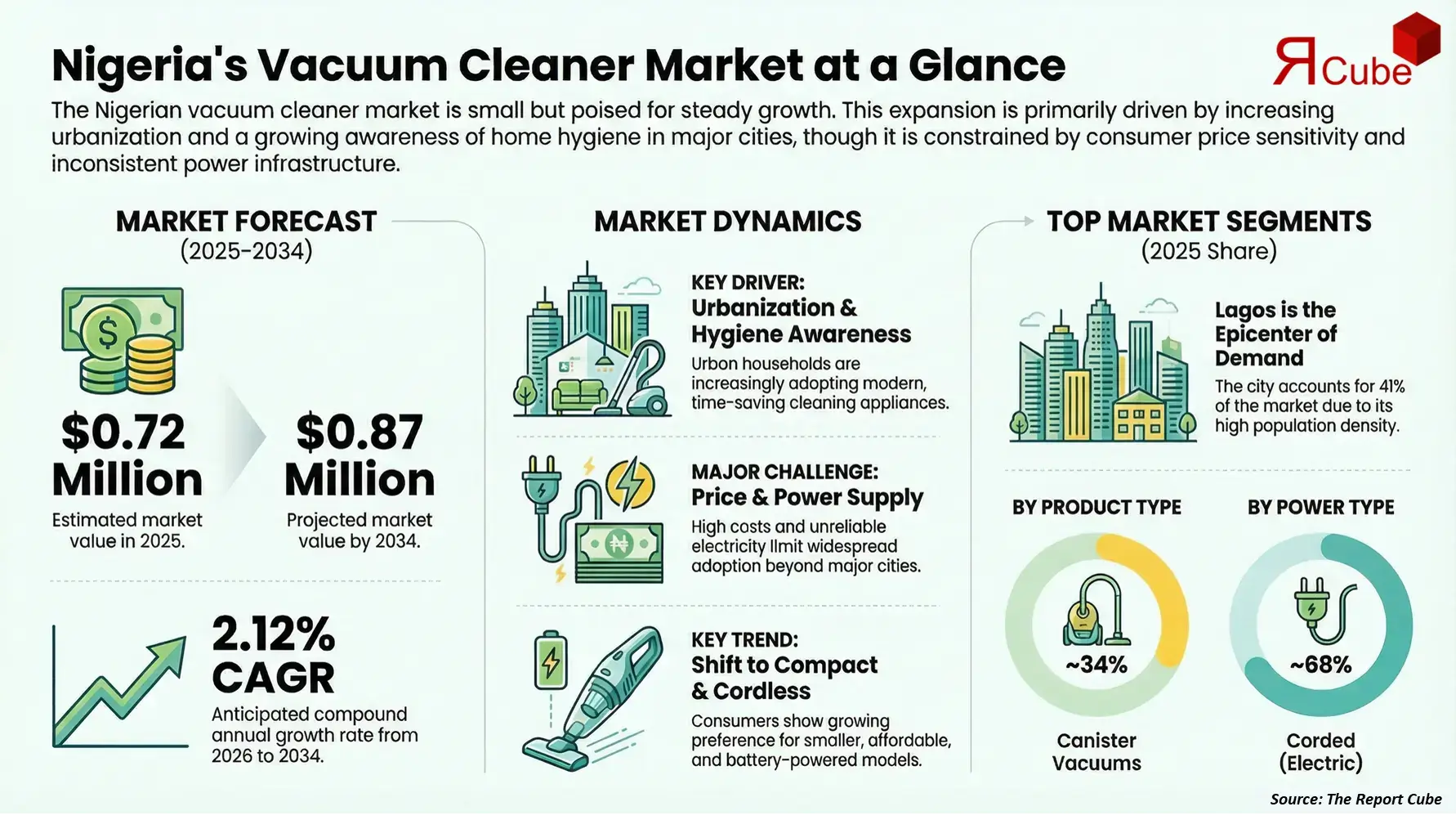
Major Challenge: Price Sensitivity & Inconsistent Power Supply
Price sensitivity remains a significant challenge for the Nigeria vacuum cleaner market, as many consumers prioritize essential household needs over discretionary appliance purchases. Vacuum cleaners are often perceived as non-essential in lower-income households, limiting widespread adoption. In addition, inconsistent electricity supply in many regions discourages reliance on electric appliances. Import dependence also exposes products to currency fluctuations and higher retail prices. These constraints slow market penetration, particularly outside major metropolitan areas, and encourage continued use of traditional manual cleaning methods.
Industry Trends: Shift Toward Compact, Affordable & Cordless Models
A notable trend in the Nigerian market is the increasing preference for compact and affordable vacuum cleaner models suited to smaller living spaces. Manufacturers are introducing lightweight designs that are easier to store and operate. Cordless vacuum cleaners are gradually gaining attention among higher-income consumers due to convenience and reduced dependence on power outlets. Handheld and stick vacuum cleaners are also emerging as popular options for quick cleaning tasks. While robot vacuum cleaners remain niche, growing awareness indicates potential long-term opportunities as affordability improves.
Opportunity Ahead: Expansion of Commercial Cleaning & Modern Retail Channels
There is strong opportunity in the expansion of commercial cleaning applications across offices, healthcare facilities, educational institutions, and retail spaces. As Nigeria’s service sector grows, demand for professional cleaning equipment is expected to rise. Additionally, the growth of modern retail formats and e-commerce platforms is improving product visibility and accessibility. Manufacturers and distributors that offer durable, energy-efficient, and competitively priced models, along with after-sales service, are well positioned to capture incremental market growth over the forecast period.
Nigeria Vacuum Cleaner Market Segment-wise Analysis
By Product Type:
- Upright Vacuum Cleaners
- Canister Vacuum Cleaners
- Handheld Vacuum Cleaners
- Robot Vacuum Cleaners
- Stick Vacuum Cleaners
- Commercial Vacuum Cleaners
Canister vacuum cleaners lead the market with approximately 34% share in 2025. Their popularity is driven by versatility, relatively affordable pricing, and suitability for both residential and light commercial applications. Canister models are effective for cleaning multiple surface types and are widely available through electronics retailers. Handheld and stick vacuum cleaners are growing steadily due to convenience and ease of use, while commercial vacuum cleaners maintain demand from offices and hospitality facilities. Robot vacuum cleaners currently represent a small share due to high cost and limited awareness.
By Power Type:
- Corded (Electric)
- Cordless (Battery)
- Manual
Corded electric vacuum cleaners dominate the market, accounting for nearly 68% of total demand in 2025. Their dominance is attributed to lower upfront costs and stronger suction performance compared to battery-powered alternatives. Cordless vacuum cleaners are gaining gradual acceptance among affluent urban consumers who value convenience and portability. Manual cleaning devices still exist in some segments but continue to decline as electric vacuum adoption increases. Overall, corded models remain the preferred choice due to affordability and widespread availability.
Regional Projection of Nigeria Vacuum Cleaner Industry
- Lagos
- Abuja
- Kano
- Port Harcourt
- Others
Lagos leads the Nigeria vacuum cleaner market with an estimated 41% share in 2025, driven by high population density, modern housing developments, and greater exposure to global consumer appliance brands. Abuja follows due to higher disposable incomes and demand from offices and commercial establishments. Port Harcourt contributes through commercial and hospitality demand linked to industrial activity. Kano and other regions show limited adoption due to lower purchasing power. Lagos remains the dominant region due to its economic scale and concentration of urban consumers.
Need insights for a specific region within this market?
Request Regional DataWhy Choose This Report?
- Provides a comprehensive overview of the overall market analysis, encompassing key trends, consumer behavior analysis, and risk assessment to support strategic decision-making.
- Provides accurate, up-to-date insights into market size, segmentation, and emerging opportunities, helping to minimize risk & capitalizing on growth.
- Gives deep understanding of target audience preferences, investment habits, and communication channels for enhanced product development & marketing effectiveness.
- Delivers competitive analysis & benchmarking, uncovering the strengths & weaknesses of market competitors to guide strategies.
- Consolidate comprehensive market intelligence, reducing reasoning & streamlining research efforts.
- Facilitates customized market segmentation & risk mitigation strategies, fine-tuned to the business objectives.
- Aids in identifying both market challenges & untapped opportunities within the industry to drive long-term business growth.
- Provides valuable information based on actual customer data & search trends.
Table of Contents
- Introduction
- Objective of the Study
- Product/Category Definition
- Market Segmentation
- Study Variables
- Research Methodology
- Secondary Data Points
- Breakdown of Secondary Sources
- Primary Data Points
- Breakdown of Primary Interviews
- Secondary Data Points
- Executive Summary
- Market Dynamics
- Drivers
- Challenges
- Opportunity Assessment
- Recent Trends and Developments
- Policy and Regulatory Landscape
- Nigeria Vacuum Cleaner Market Overview (2020-2034)
- Market Size, By Volume (Units) & Value (NGN Million / USD Million)
- Market Share, By Product Type
- Upright Vacuum Cleaners
- Canister Vacuum Cleaners
- Handheld Vacuum Cleaners
- Robot Vacuum Cleaners
- Stick Vacuum Cleaners
- Commercial Vacuum Cleaners
- Market Share, By Power Type
- Corded (Electric)
- Cordless (Battery)
- Manual
- Market Share, By Distribution Channel
- Modern Trade (Supermarkets/Hypermarkets)
- Specialty Electronics Stores
- Online Retail
- Independent Retailers & Market Stalls
- B2B/Institutional Sales
- Market Share, By End User
- Residential
- Commercial
- Industrial
- Others
- Market Share, By Region
- Lagos
- Abuja
- Kano
- Port Harcourt
- Others
- Market Share, By Company
- Revenue Shares
- Competitive Landscape
- Segment-wise & Industry-wise Market Forecast (2026-2034)
- By Product Type
- By Power Type
- By Distribution Channel
- By End User
- By Region
- Lagos Vacuum Cleaner Market
- Market Size, By Volume & Value (NGN Million)
- Market Share, By Product Type
- Market Share, By Power Type
- Market Share, By Distribution Channel
- Market Share, By Key Cities/Areas
- Abuja Vacuum Cleaner Market
- Market Size, By Volume & Value (NGN Million)
- Market Share, By Product Type
- Market Share, By Power Type
- Market Share, By Distribution Channel
- Market Share, By Key Cities/Areas
- Kano Vacuum Cleaner Market
- Market Size, By Volume & Value (NGN Million)
- Market Share, By Product Type
- Market Share, By Power Type
- Market Share, By Distribution Channel
- Market Share, By Key Cities/Areas
- Port Harcourt Vacuum Cleaner Market
- Market Size, By Volume & Value (NGN Million)
- Market Share, By Product Type
- Market Share, By Power Type
- Market Share, By Distribution Channel
- Market Share, By Key Cities/Areas
- Competitive Outlook & Company Profiles
- Electrolux Nigeria
- Company Overview
- Product Portfolio
- Strategic Alliances/Partnerships
- Recent Developments
- LG Electronics Nigeria
- Company Overview
- Product Portfolio
- Strategic Alliances/Partnerships
- Recent Developments
- Samsung Nigeria
- Company Overview
- Product Portfolio
- Strategic Alliances/Partnerships
- Recent Developments
- Philips Nigeria
- Company Overview
- Product Portfolio
- Strategic Alliances/Partnerships
- Recent Developments
- Panasonic Nigeria
- Company Overview
- Product Portfolio
- Strategic Alliances/Partnerships
- Recent Developments
- Bosch Nigeria
- Company Overview
- Product Portfolio
- Strategic Alliances/Partnerships
- Recent Developments
- Karcher Nigeria
- Company Overview
- Product Portfolio
- Strategic Alliances/Partnerships
- Recent Developments
- TCL Nigeria
- Company Overview
- Product Portfolio
- Strategic Alliances/Partnerships
- Recent Developments
- Sharp Nigeria
- Company Overview
- Product Portfolio
- Strategic Alliances/Partnerships
- Recent Developments
- Midea Nigeria
- Company Overview
- Product Portfolio
- Strategic Alliances/Partnerships
- Recent Developments
- Others
- Electrolux Nigeria
- Contact Us / Disclaimer
Top Key Players & Market Share Outlook
- Electrolux Nigeria
- LG Electronics Nigeria
- Samsung Nigeria
- Philips Nigeria
- Panasonic Nigeria
- Bosch Nigeria
- Karcher Nigeria
- TCL Nigeria
- Sharp Nigeria
- Midea Nigeria
- Others
Frequently Asked Questions






