




Build Your Custom Market Intelligence Report
Customize Your ReportGlobal Virtual Ward Services Market Statistics and Insights
Market Insight
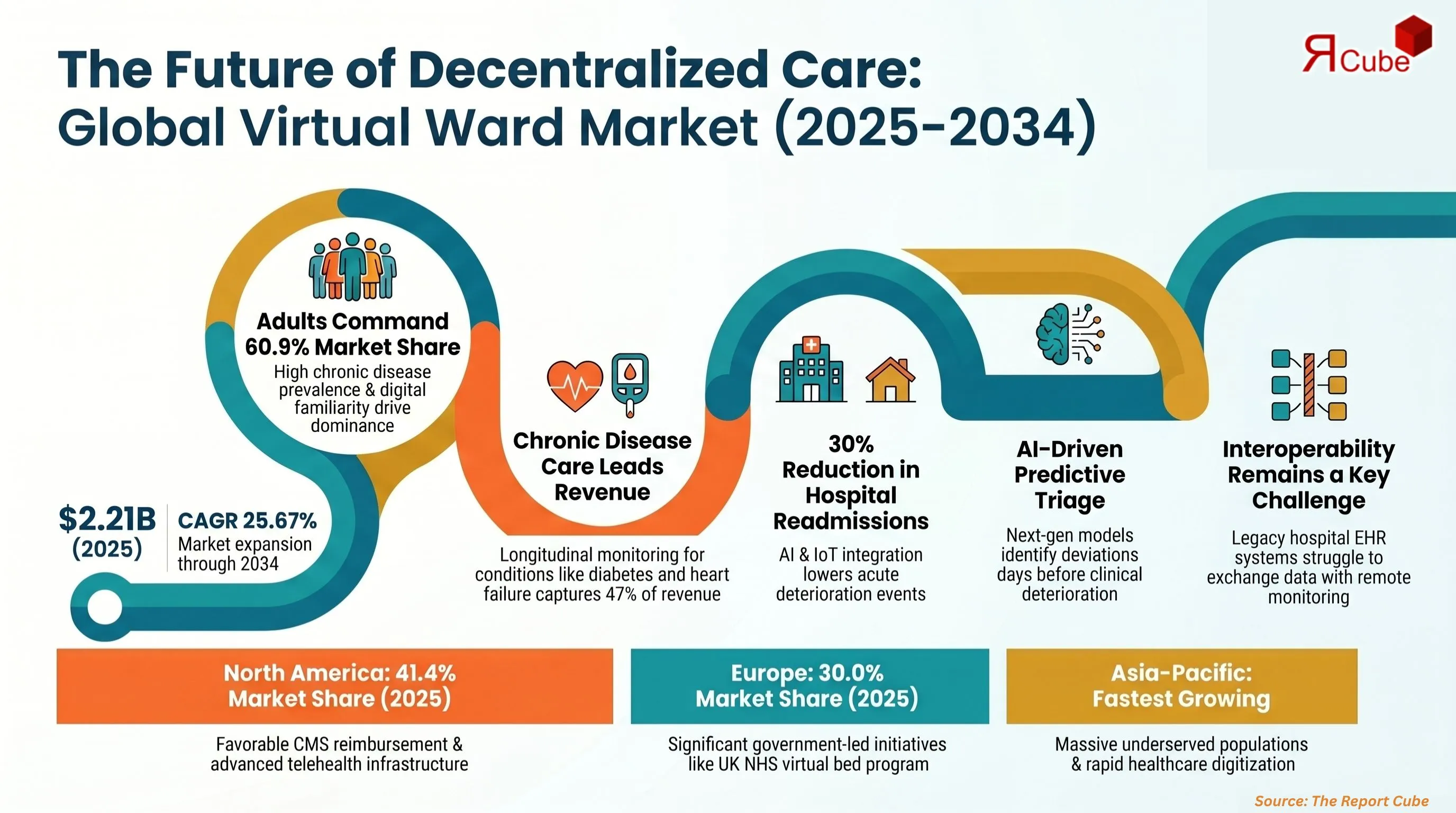
- Global Virtual Ward Services Market valued at USD 2.21 billion in 2025.
- Market projected to reach USD 17.28 billion by the forecast year 2034.
- Market anticipated to grow at a robust CAGR of 25.67% through 2034.
By Patient Demographics
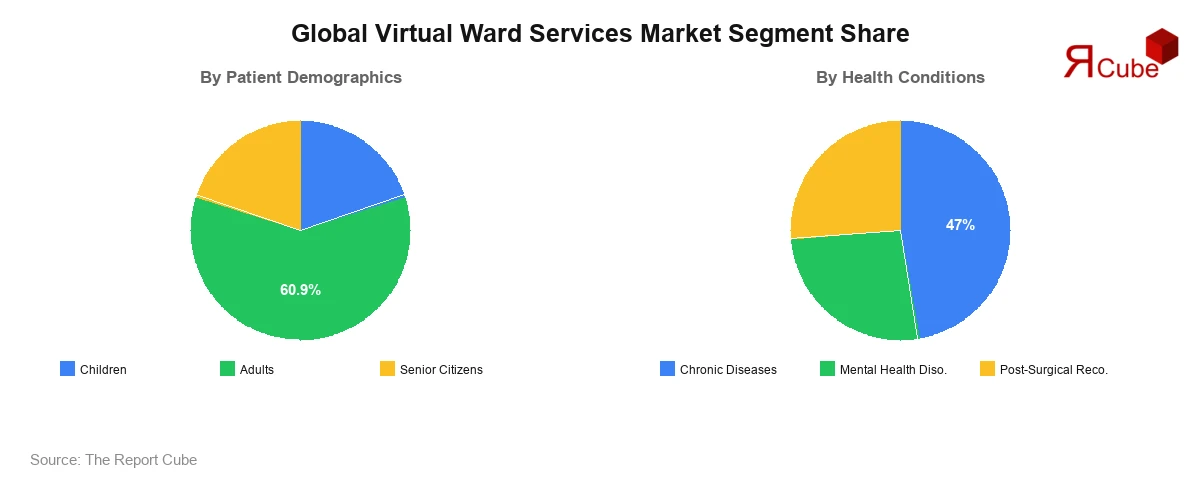
- Adults segment dominates with approximately 60.9% market share in 2025.
Competitive Landscape
- More than 10 companies are actively engaged in producing Global Virtual Ward Services.
- Top 5 companies acquired around 38% of the market share.
- Current Health, Doccla, Huma Therapeutics, Biofourmis, Vita Health Group, and others.
By Health Conditions
- Chronic Diseases segment leads, capturing approximately 47% of market revenue.
Global Virtual Ward Services Market Insights & Analysis
The Global Virtual Ward Services Market is anticipated to register a 25.67% CAGR during 2026–2034. The market size was valued at USD 2.21 billion in 2025 and is projected to reach USD 17.28 billion by 2034. This exceptional growth trajectory is underpinned by the accelerating global shift toward decentralized, patient-centric care models that prioritize clinical outcomes while reducing the financial burden on hospital systems. Virtual ward services, which deliver acute remote monitoring, telehealth consultations, and structured home-based treatment protocols, are emerging as a mainstream alternative to inpatient hospitalization. According to the World Health Organization, chronic diseases account for nearly 71% of all global deaths, creating substantial and sustained demand for scalable remote disease management solutions.
Government bodies across North America, Europe, and Asia-Pacific are actively supporting virtual ward deployment; the UK's National Health Service committed to establishing over 40,000 virtual ward beds by 2025, setting a landmark global policy precedent. In the United States, Centers for Medicare & Medicaid Services (CMS) reimbursement policies for remote patient monitoring (RPM) services have unlocked new revenue pathways for providers. In April 2025, Philips partnered with the NHS in England to deploy AI-driven monitoring solutions for chronic disease patients, further validating institutional confidence in virtual ward infrastructure. These structural policy tailwinds, combined with rapid advancements in wearable biosensors, IoT connectivity, and predictive analytics platforms, are collectively transforming virtual wards from pilot programs into foundational elements of future-ready healthcare delivery.
Global Virtual Ward Services Market Dynamics
Key Market Driver Rising Chronic Disease Burden Accelerates Adoption
The escalating global prevalence of chronic conditions, including heart failure, diabetes, and chronic obstructive pulmonary disease (COPD), is the single most powerful driver of the Global Virtual Ward Services Market. The WHO estimates that non-communicable diseases cause approximately 41 million deaths annually, placing enormous operational strain on conventional inpatient facilities.
Virtual ward platforms address this pressure by enabling continuous remote monitoring, real-time clinical alerts, and structured care pathways for high-risk patients outside of hospital walls. Integration of AI and IoT in virtual ward services has demonstrably led to a 30% reduction in hospital readmission rates for chronic disease patients, according to the HealthTech Journal (February 2025). As healthcare systems worldwide transition to value-based care reimbursement frameworks that prioritize outcomes over volume, virtual wards offer measurable advantages in reducing per-capita healthcare costs and preventing acute deterioration events.
Major Industry Challenge Interoperability Gaps Impede Seamless Clinical Integration
A significant structural challenge confronting the Global Virtual Ward Services Market is the lack of interoperability between virtual ward platforms and legacy hospital electronic health record (EHR) and electronic medical record (EMR) systems. Many healthcare facilities continue to operate on siloed digital infrastructures that were not architected for bidirectional data exchange with remote monitoring devices, wearable sensors, or third-party telehealth platforms.
This fragmentation creates clinical blind spots, delays data-driven decision-making, and complicates care coordination between virtual ward teams and in-hospital specialists. Regulatory variance across geographies further compounds the challenge; compliance with HIPAA in the United States and GDPR in Europe requires providers to maintain stringent data governance protocols that are difficult to harmonize with agile, multi-vendor virtual ward deployments. Until robust open-standards interoperability frameworks are universally adopted, integration complexity will remain a limiting factor in scaling virtual ward programs efficiently.
Emerging Trend Shaping Outlook AI-Driven Predictive Analytics Redefines Remote Triage
One of the most transformative trends reshaping the Global Virtual Ward Services Market is the deep integration of artificial intelligence-powered predictive analytics into remote patient monitoring workflows. Unlike traditional RPM systems that generate reactive alerts based on threshold breaches, next-generation AI models can identify subtle physiological trend deviations days before a clinical deterioration event occurs, enabling proactive intervention that prevents unnecessary hospital admissions.
In March 2025, Current Health announced the expansion of its remote patient monitoring platform across Europe, enhancing its capabilities with AI-driven analytics to improve patient stratification and care escalation decisions. Vendors such as Biofourmis and Huma Therapeutics are developing condition-specific digital biomarker models that translate continuous wearable data streams into clinically actionable risk scores. As these predictive capabilities mature and gain regulatory clearance, they are expected to fundamentally redefine remote triage protocols and position AI-integrated virtual ward services as a dominant segment in the global digital health ecosystem through 2034.
Need Specific Data, Let’s Customize the Report for You
Request CustomizationGlobal Virtual Ward Services Market Segment-wise Analysis
The Global Virtual Ward Services Market is characterized by diverse end-user populations and heterogeneous clinical use cases, making segmentation analysis critical to understanding revenue distribution and growth priority areas. Two primary segmentation lenses, By Patient Demographics and by Health Conditions, provide complementary perspectives on adoption patterns, unmet care needs, and technology deployment priorities across the forecast period of 2026–2034.
By Patient Demographics
- Children
- Adults
- Senior Citizens
The Adults segment is the commanding revenue leader within the By Patient Demographics classification, accounting for approximately 60.9% of global market share in 2025. The dominance of this segment is attributable to the high prevalence of chronic diseases among working-age populations, greater familiarity with digital health platforms, and a strong healthcare awareness culture that promotes proactive disease management. Adults represent the primary beneficiaries of virtual ward services for conditions such as diabetes management, cardiac monitoring, and post-surgical recovery, as these services facilitate continuity of care with minimal disruption to professional and personal responsibilities.
The Senior Citizens segment, while smaller in current share, is the fastest-growing demographic sub-segment within this classification. Aging populations across North America, Europe, and East Asia are placing unprecedented pressure on inpatient bed capacity, making virtual wards an operationally critical tool for elderly chronic care management. Governments are channeling significant investment into elderly home-based care infrastructure; Canada's province of Ontario, for example, has expanded virtual care programs specifically targeting elderly patients to reduce hospital strain. The Children segment, though representing a smaller share of the market, is expanding steadily as pediatric teleconsultation services and remote monitoring for childhood respiratory and metabolic conditions gain acceptance among caregivers and pediatric specialists.
By Health Conditions
- Chronic Diseases
- Mental Health Disorders
- Post-Surgical Recovery
The Chronic Diseases sub-segment dominates the by Health Conditions classification, capturing approximately 47% of global virtual ward service revenues in 2025. Conditions including heart failure, COPD, diabetes, and hypertension require sustained, longitudinal monitoring that aligns precisely with the clinical capabilities of virtual ward platforms. The ability to deliver continuous physiological data collection, medication adherence tracking, and early-warning alert systems makes virtual wards particularly suited to chronic disease management programs that were previously confined to outpatient clinics or inpatient settings.
The Mental Health Disorders segment is emerging as a high-growth niche, driven by the global recognition of a behavioral health crisis intensified by pandemic-era social isolation and persistent workforce mental health challenges. Virtual ward services are being deployed to deliver structured therapy sessions, psychiatrist-led teleconsultations, and crisis monitoring protocols for patients with depression, anxiety, and bipolar disorders, particularly in rural and underserved geographies where physical mental health infrastructure is sparse. The Post-Surgical Recovery segment is expanding rapidly as hospital discharge protocols shift toward earlier patient release, supported by virtual ward teams that monitor wound healing, vital signs, and rehabilitation compliance remotely, reducing readmission rates and hospital-acquired infection risks.
Regional Projection of Global Virtual Ward Services Market
North America leads the Global Virtual Ward Services Market, commanding approximately 41.4% of global revenues, driven by advanced telehealth infrastructure, widespread RPM adoption, and favorable CMS reimbursement policies for virtual care services. The U.S. alone accounts for approximately 35.7% of global market share. Regional breakdown by major segments is as follows:
- North America
- Europe
- Asia-Pacific
- Latin America
- Middle East & Africa
Europe represents the second-largest regional market, accounting for approximately 30% of global revenues, anchored by the UK's NHS-led virtual ward program targeting over 40,000 virtual beds and the EU's broader digital health investment agenda. Asia-Pacific is the fastest-growing regional segment, expanding at a projected CAGR exceeding 15% through 2034, driven by healthcare digitization in India, China, and Australia, along with government-backed telemedicine mandates and a large, underserved patient population requiring scalable remote care solutions. Latin America and the Middle East & Africa collectively account for approximately 10% of global market revenues but represent significant untapped growth opportunity as digital health infrastructure matures in these regions.
Global Virtual Ward Services Market: Recent Development (2025)
- In March 2025, Current Health expanded its AI-enhanced remote monitoring platform across Europe, reporting a 22% margin improvement.
- Doccla raised USD 35 million in Series B funding to scale its virtual ward operations across the UK and European markets in late 2024.
- Biofourmis launched a condition-specific digital biomarker platform in 2025, generating a 19% increase in recurring subscription revenue.
- Huma Therapeutics secured NHS framework agreements in Q1 2025, expanding virtual ward deployments for post-surgical recovery patients nationally.
Global Virtual Ward Services Market Future Outlook (2034)
The Global Virtual Ward Services Market is on course to reach USD 17.28 billion by 2034, sustaining a 25.67% CAGR across the forecast period. The long-term growth narrative is driven by the convergence of AI-powered predictive analytics, next-generation wearable biosensors, and cloud-native interoperability platforms that will enable virtual wards to manage increasingly complex clinical cases beyond their current acute care and chronic disease management mandates. Expanded payer coverage for remote monitoring services in the United States, combined with NHS-scale deployments in Europe and government-backed telemedicine investments in Asia-Pacific, will unlock new provider segments and patient populations.
By 2034, virtual ward services are expected to transition from episodic care supplements to fully integrated, continuous care ecosystems, serving as the primary locus of monitoring and treatment for millions of patients globally. Companies that invest in AI-driven personalization, regulatory-grade data security, and cross-platform EHR interoperability will capture disproportionate market share in this rapidly consolidating competitive landscape.
Why Choose This Report?
- Provides a comprehensive overview of the overall market analysis, encompassing key trends, consumer behavior analysis, and risk assessment to support strategic decision-making.
- Provides accurate, up-to-date insights into market size, segmentation, and emerging opportunities, helping to minimize risk & capitalizing on growth.
- Gives deep understanding of target audience preferences, investment habits, and communication channels for enhanced product development & marketing effectiveness.
- Delivers competitive analysis & benchmarking, uncovering the strengths & weaknesses of market competitors to guide strategies.
- Consolidate comprehensive market intelligence, reducing reasoning & streamlining research efforts.
- Facilitates customized market segmentation & risk mitigation strategies, fine-tuned to the business objectives.
- Aids in identifying both market challenges & untapped opportunities within the industry to drive long-term business growth.
- Provides valuable information based on actual customer data & search trends.
Table of Contents
- Introduction
- Objective of the study
- Product Definition
- Market Segmentation
- Study Variables
- Research Methodology
- Secondary Data Points
- Companies Interviewed
- Primary Data Points
- Breakdown of Primary Interviews
- Secondary Data Points
- Executive Summary
- Market Dynamics
- Drivers
- Challenges
- Opportunity Assessment
- Recent Trends and Developments
- Policy and Regulatory Landscape
- Global Virtual Ward Services Market Overview (2021-2034)
- Market Size, By Value (in USD Billions)
- Market Share, By Patient Demographics
- Children
- Adults
- Senior Citizens
- Market Share, By Health Conditions
- Chronic Diseases
- Mental Health Disorder
- Post-Surgical Recovery
- Market Share, By Technology Readiness
- Tech Savvy
- Users-Moderate
- Users-Minimal Users
- Market Share, By Service Utilization
- Frequency of Health Services
- Type of Services Used
- Payment Models
- Market Share, By Engagement and Experience level
- Proactive Patients
- Passive Patients
- Tech Averse Patients
- Market Share, By Region
- North America
- Europe
- Asia-Pacific
- Latin America
- Middle East & Africa
- Market Share, By Company
- Revenue Shares
- Competition Characteristics
- North America Virtual Ward Services Market Overview (2021-2034)
- Market Size, By Value (in USD Billions)
- Market Share, By Patient Demographics
- Market Share, By Health Conditions
- Market Share, By Technology Readiness
- Market Share, By Service Utilization
- Market Share, By Engagement and Experience level
- By Country
- The US
- Canada
- Mexico
- The US Virtual Ward Services Market Overview (2021-2034)
- Market Share, By Patient Demographics
- Market Share, By Health Conditions
- Market Share, By Technology Readiness
- Market Share, By Service Utilization
- Market Share, By Engagement and Experience level
- Canada Virtual Ward Services Market Overview (2021-2034)
- Market Share, By Patient Demographics
- Market Share, By Health Conditions
- Market Share, By Technology Readiness
- Market Share, By Service Utilization
- Market Share, By Engagement and Experience level
- Mexico Virtual Ward Services Market Overview (2021-2034)
- Market Share, By Patient Demographics
- Market Share, By Health Conditions
- Market Share, By Technology Readiness
- Market Share, By Service Utilization
- Market Share, By Engagement and Experience level
- South America Virtual Ward Services Market Overview (2021-2034)
- Market Size, By Value (in USD Billions)
- Market Share, By Patient Demographics
- Market Share, By Health Conditions
- Market Share, By Technology Readiness
- Market Share, By Service Utilization
- Market Share, By Engagement and Experience level
- By Country
- Brazil
- Argentina
- Rest of South America
- Brazil Virtual Ward Services Market Overview (2021-2034)
- Market Share, By Patient Demographics
- Market Share, By Health Conditions
- Market Share, By Technology Readiness
- Market Share, By Service Utilization
- Market Share, By Engagement and Experience level
- Argentina Virtual Ward Services Market Overview (2021-2034)
- Market Share, By Patient Demographics
- Market Share, By Health Conditions
- Market Share, By Technology Readiness
- Market Share, By Service Utilization
- Market Share, By Engagement and Experience level
- Europe Virtual Ward Services Market Overview (2021-2034)
- Market Size, By Value (in USD Billions)
- By Patient Demographics
- By Health Conditions
- By Technology Readiness
- By Service Utilization
- By Engagement and Experience level
- By Country
- Germany
- The UK
- France
- Spain
- Italy
- Rest of Europe
- Germany Virtual Ward Services Market Overview (2021-2034)
- Market Share, By Patient Demographics
- Market Share, By Health Conditions
- Market Share, By Technology Readiness
- Market Share, By Service Utilization
- Market Share, By Engagement and Experience level
- France Virtual Ward Services Market Overview (2021-2034)
- Market Share, By Patient Demographics
- Market Share, By Health Conditions
- Market Share, By Technology Readiness
- Market Share, By Service Utilization
- Market Share, By Engagement and Experience level
- The UK Virtual Ward Services Market Overview (2021-2034)
- Market Share, By Patient Demographics
- Market Share, By Health Conditions
- Market Share, By Technology Readiness
- Market Share, By Service Utilization
- Market Share, By Engagement and Experience level
- Spain Virtual Ward Services Market Overview (2021-2034)
- Market Share, By Patient Demographics
- Market Share, By Health Conditions
- Market Share, By Technology Readiness
- Market Share, By Service Utilization
- Market Share, By Engagement and Experience level
- Italy Virtual Ward Services Market Overview (2021-2034)
- Market Share, By Patient Demographics
- Market Share, By Health Conditions
- Market Share, By Technology Readiness
- Market Share, By Service Utilization
- Market Share, By Engagement and Experience level
- The Middle East & Africa Virtual Ward Services Market Overview (2021-2034)
- Market Size, By Value (in USD Billions)
- By Patient Demographics
- By Health Conditions
- By Technology Readiness
- By Service Utilization
- By Engagement and Experience level
- By Country
- The UAE
- Saudi Arabia
- South Africa
- Rest of the Middle East & Africa
- The UAE Virtual Ward Services Market Overview (2021-2034)
- Market Share, By Patient Demographics
- Market Share, By Health Conditions
- Market Share, By Technology Readiness
- Market Share, By Service Utilization
- Market Share, By Engagement and Experience level
- Saudi Arabia Virtual Ward Services Market Overview (2021-2034)
- Market Share, By Patient Demographics
- Market Share, By Health Conditions
- Market Share, By Technology Readiness
- Market Share, By Service Utilization
- Market Share, By Engagement and Experience level
- South Africa Virtual Ward Services Market Overview (2021-2034)
- Market Share, By Patient Demographics
- Market Share, By Health Conditions
- Market Share, By Technology Readiness
- Market Share, By Service Utilization
- Market Share, By Engagement and Experience level
- Asia-Pacific Virtual Ward Services Market Overview (2021-2034)
- Market Size, By Value (in USD Billions)
- By Patient Demographics
- By Health Conditions
- By Technology Readiness
- By Service Utilization
- By Engagement and Experience level
- By Country
- China
- India
- Japan
- South Korea
- Australia
- Rest of Asia-Pacific
- China Virtual Ward Services Market Overview (2021-2034)
- Market Share, By Patient Demographics
- Market Share, By Health Conditions
- Market Share, By Technology Readiness
- Market Share, By Service Utilization
- Market Share, By Engagement and Experience level
- India Virtual Ward Services Market Overview (2021-2034)
- Market Share, By Patient Demographics
- Market Share, By Health Conditions
- Market Share, By Technology Readiness
- Market Share, By Service Utilization
- Market Share, By Engagement and Experience level
- Japan Virtual Ward Services Market Overview (2021-2034)
- Market Share, By Patient Demographics
- Market Share, By Health Conditions
- Market Share, By Technology Readiness
- Market Share, By Service Utilization
- Market Share, By Engagement and Experience level
- South Korea Virtual Ward Services Market Overview (2021-2034)
- Market Share, By Patient Demographics
- Market Share, By Health Conditions
- Market Share, By Technology Readiness
- Market Share, By Service Utilization
- Market Share, By Engagement and Experience level
- Austraila Virtual Ward Services Market Overview (2021-2034)
- Market Share, By Patient Demographics
- Market Share, By Health Conditions
- Market Share, By Technology Readiness
- Market Share, By Service Utilization
- Market Share, By Engagement and Experience level
- Competitive Outlook (Company Profile - Partial List)
- Current Health
- Company Overview
- Business Segments
- Strategic Alliances/Partnerships
- Recent Developments
- Doccla
- Company Overview
- Business Segments
- Strategic Alliances/Partnerships
- Recent Developments
- Huma Therapeutics
- Company Overview
- Business Segments
- Strategic Alliances/Partnerships
- Recent Developments
- Vita Health Group
- Company Overview
- Business Segments
- Strategic Alliances/Partnerships
- Recent Developments
- Biofourmis
- Company Overview
- Business Segments
- Strategic Alliances/Partnerships
- Recent Developments
- Tunstall Group
- Company Overview
- Business Segments
- Strategic Alliances/Partnerships
- Recent Developments
- Health Recovery Solutions
- Company Overview
- Business Segments
- Strategic Alliances/Partnerships
- Recent Developments
- VitalConnect
- Company Overview
- Business Segments
- Strategic Alliances/Partnerships
- Recent Developments
- Lumeon
- Company Overview
- Business Segments
- Strategic Alliances/Partnerships
- Recent Developments
- PHL Digital
- Company Overview
- Business Segments
- Strategic Alliances/Partnerships
- Recent Developments
- Graphnet Health Limited
- Company Overview
- Business Segments
- Strategic Alliances/Partnerships
- Recent Developments
- Medoma AB
- Company Overview
- Business Segments
- Strategic Alliances/Partnerships
- Recent Developments
- Dignio
- Company Overview
- Business Segments
- Strategic Alliances/Partnerships
- Recent Developments
- Others
- Current Health
- Disclaimer
Top Key Players & Market Share Outlook
- Current Health
- Doccla
- Huma Therapeutics
- Vita Health Group
- Biofourmis
- Tunstall Group
- Health Recovery Solutions
- VitalConnect
- Lumeon
- PHL Digital
- Graphnet Health Limited
- Medoma AB
- Dignio
- Others
Frequently Asked Questions






