




Build Your Custom Market Intelligence Report
Customize Your ReportGlobal Vitamin C Serum Market Key Highlights
By Formulation Type:
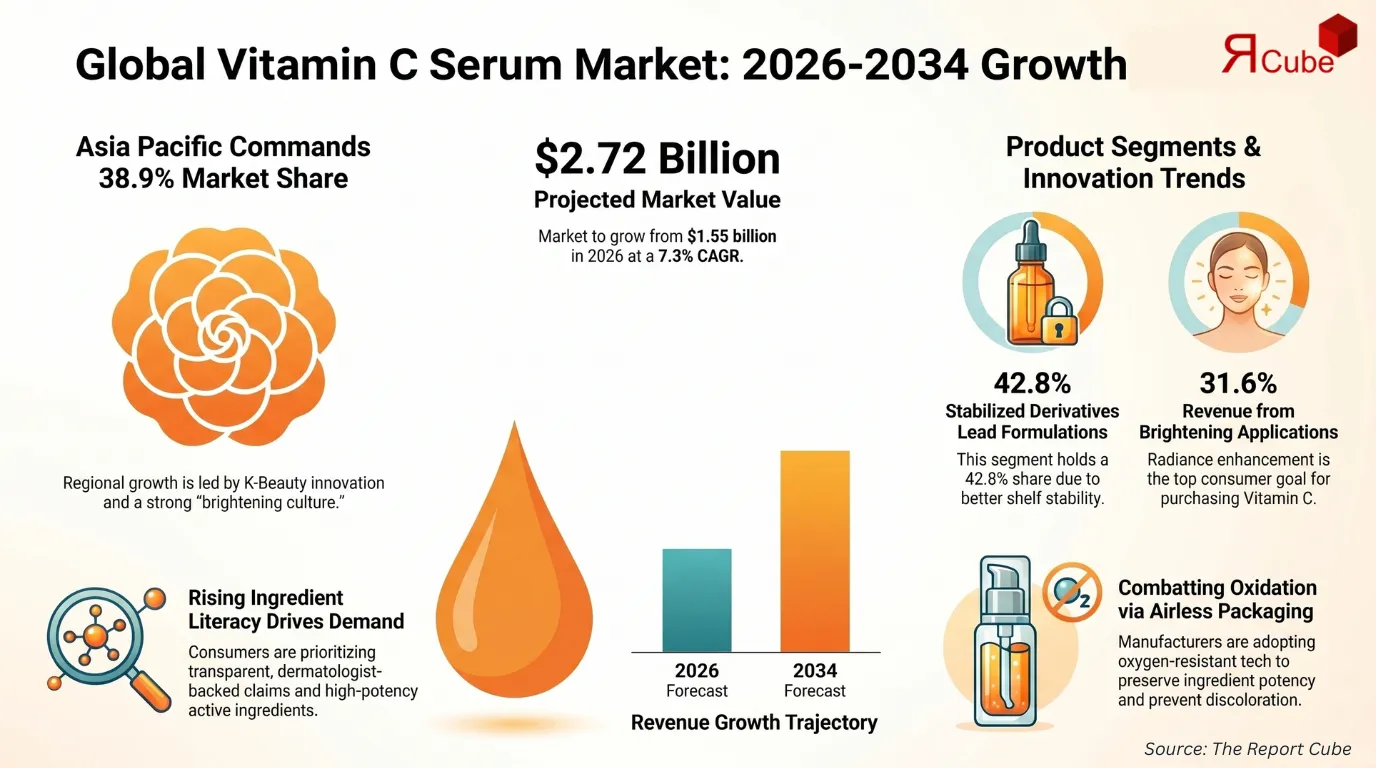
Stabilized Derivatives segment leads the market with nearly 42.8% share.
By Application:
Brightening & Radiance Enhancement segment dominates the market with around 31.6% of total revenue.
Regional Outlook:
Asia Pacific dominates the Global Vitamin C Serum Market with approximately 38.9% share.
Global Vitamin C Serum Market Insights & Analysis
The Global Vitamin C Serum Market is anticipated to register a CAGR of around 7.3% during the forecast period 2026-2034. The market size is valued at USD 1.55 billion in 2026 and is projected to reach USD 2.72 billion by 2034. Growth across the skincare industry continues to be influenced by increasing awareness regarding antioxidant-based facial care products that support brightening, collagen production, and environmental skin protection. Vitamin C serums are becoming a core part of preventive skincare routines among consumers seeking solutions for dullness, uneven skin tone, pigmentation, and early aging signs. Dermatology-backed skincare recommendations and ingredient transparency are also shaping purchasing decisions across both developed and emerging beauty markets.
Established cosmetic companies and emerging skincare brands are investing heavily in formulation science to improve ingredient stability and treatment effectiveness. Product launches in 2025 and 2026 increasingly focused on water-free serums, encapsulated Vitamin C technologies, and airless packaging systems to maintain potency for longer periods. Beauty manufacturers are also combining Vitamin C with ferulic acid, peptides, niacinamide, and ceramides to strengthen multifunctional skincare performance. Asia Pacific remains an important innovation center due to rapid advancements in Korean and Japanese skincare formulations, while North American and European brands continue emphasizing clinically tested and dermatologist-approved skincare products to strengthen consumer confidence and long-term brand credibility.
Global Vitamin C Serum Market Impact Analysis
| Factor | Type | Specific Impact on Market | Magnitude | Business Implication |
|---|---|---|---|---|
| Anti-Aging Demand Growth | Consumer | Rising need for collagen support and wrinkle reduction | High | Position clinical-grade formulas targeting fine lines and firmness |
| Ingredient Literacy Rise | Consumer | Consumers seek proven actives with visible brightening results | High | Lead with transparent labeling and efficacy-backed claims |
| E-Commerce Channel Expansion | Market | Online sales grow at 8.8% CAGR through 2030 via direct-to-consumer | High | Invest in digital campaigns, influencer partnerships, and D2C platforms |
| Social Media and Influencer Marketing | Technological | Beauty influencers amplify awareness and product trial among Gen Z | High | Launch creator collaborations and user-generated content campaigns |
| Clean Beauty Preference Shift | Consumer | Demand for natural, paraben-free, and cruelty-free formulations | Medium | Develop clean-label serums with certified organic and vegan claims |
| Urban Pollution Exposure | Environmental | City dwellers seek antioxidant defense against free radical damage | Medium | Market pollution-protection serums with antioxidant-rich blends |
| Dermatologist Endorsement Trends | Market | Clinical recommendations boost trust in pigmentation treatments | Medium | Secure dermatologist partnerships and in-clinic distribution |
| Formulation Stability Challenges | Technological | Heat instability limits shelf life in hot climates without encapsulation | Medium | Adopt encapsulated vitamin C and airless packaging for stability |
| K-Beauty and J-Beauty Influence | Competitive | Asian beauty trends drive global adoption of brightening serums | Medium | Integrate trending Asian skincare formats and multi-step routines |
| Regulatory and Halal Certification | Regulatory | Halal and SFDA compliance expands reach in Middle East markets | Low | Obtain halal certifications and comply with regional cosmetic standards |
Global Vitamin C Serum Market Dynamics
Key Driver: Increasing Preference for Preventive Skincare and Active Ingredient-Based Formulations
Growing interest in preventive skincare solutions is significantly accelerating the demand for Vitamin C serum products worldwide. Consumers are prioritizing skincare products that provide long-term protection against pollution, UV exposure, oxidative stress, and visible aging signs without requiring invasive cosmetic procedures. Vitamin C has gained strong recognition among dermatologists and skincare professionals for its antioxidant properties and ability to support collagen synthesis, skin radiance improvement, and pigmentation reduction. This growing clinical acceptance is helping strengthen the product’s position across premium skincare and pharmaceutical beauty categories.
The market is also benefiting from changing beauty routines among younger consumers who are increasingly investing in early-stage skincare maintenance. Rising urban pollution levels, prolonged screen exposure, and lifestyle-related skin concerns are encouraging consumers to adopt targeted skincare regimens. Beauty brands are responding by launching formulations with balanced concentration levels designed to improve efficacy while minimizing irritation risks. Demand for vegan, fragrance-free, cruelty-free, and dermatologist-tested skincare products is further encouraging innovation across the global Vitamin C serum market.
Industry Trends: Technological Advancements in Stability and Multifunctional Product Development
Innovation in ingredient stabilization technologies is becoming one of the most influential trends shaping the Vitamin C serum market growth. Traditional pure ascorbic acid products often experience oxidation when exposed to air, light, or moisture, reducing effectiveness over time. To address this challenge, skincare manufacturers are introducing oxygen-resistant formulations, encapsulation technologies, and airless packaging systems that help preserve product potency. Japanese and South Korean skincare companies are leading advancements in lightweight, stable formulations suitable for sensitive skin and humid climate conditions.
Another important trend involves the rapid expansion of multifunctional skincare products that combine treatment, hydration, and protection benefits into single formulations. Consumers increasingly prefer streamlined skincare routines that deliver multiple benefits through one product application. As a result, cosmetic companies are integrating Vitamin C with SPF protection, peptides, hyaluronic acid, and botanical antioxidants to improve convenience and skincare performance. Hybrid products offering brightening, anti-aging, and environmental defense functions are gaining strong traction across urban beauty markets and premium skincare channels.
Major Challenge: Formulation Sensitivity and Product Preservation Complexities
Maintaining the stability and effectiveness of Vitamin C remains a major challenge for skincare manufacturers operating within the competitive cosmetic industry. Pure ascorbic acid is highly sensitive to oxygen, heat, and sunlight exposure, which can result in product degradation, discoloration, and reduced treatment performance. Developing stable formulations often requires advanced manufacturing techniques, specialized packaging systems, and higher-quality preservation technologies, increasing production expenses for both established and emerging skincare companies.
Skin sensitivity concerns also create limitations for broader product adoption. Consumers with reactive or sensitive skin may experience redness, dryness, irritation, or peeling when using high-concentration Vitamin C formulations, particularly products exceeding 20% concentration levels. These concerns encourage manufacturers to invest more heavily in dermatological testing and clinical validation to strengthen product safety claims. Regulatory oversight regarding ingredient labeling and efficacy claims is also increasing across several international beauty markets, adding compliance complexity for cosmetic manufacturers expanding globally.
Opportunity: Expansion Across Emerging Beauty Markets and Premium Dermatological Skincare
Emerging economies are creating substantial growth opportunities for Vitamin C serum manufacturers due to increasing skincare awareness, rising disposable income, and expanding premium beauty consumption. Countries including India, Indonesia, Brazil, Thailand, and the United Arab Emirates are witnessing strong growth in demand for targeted skincare products designed to address pigmentation, sun exposure, and uneven skin tone concerns. Urban consumers are increasingly prioritizing dermatologist-recommended skincare products with clinically supported ingredients and visible treatment outcomes.
Premium dermatological skincare is also gaining momentum among consumers seeking science-backed beauty products with stronger efficacy profiles. This shift is encouraging skincare companies to invest in high-performance formulations, professional-grade serums, and personalized skincare solutions. Digital beauty retail platforms are helping brands strengthen product accessibility across regional markets while enabling educational awareness regarding ingredient benefits and skincare routines. Continued investment in advanced formulation science and personalized skincare technologies is expected to create strong long-term opportunities across the global Vitamin C serum market share landscape.
Global Vitamin C Serum Market Segment-wise Analysis
By Formulation Type:
- Blended Serum
- Stabilized Derivatives
- Pure Ascorbic Acid
The Stabilized Derivatives segment accounted for the highest revenue share within the Global Vitamin C Serum Market in 2026, contributing nearly 42.8% of total industry revenue. Growth within this segment is strongly linked to increasing consumer preference for formulations offering longer shelf stability and lower irritation potential. Stabilized Vitamin C derivatives such as sodium ascorbyl phosphate and tetrahexyldecyl ascorbate are widely adopted across mass-market and premium skincare products because they remain effective for longer durations compared to traditional pure ascorbic acid formulations.
Cosmetic manufacturers are increasingly incorporating these ingredients into brightening creams, facial serums, and anti-aging skincare solutions to improve formulation consistency and consumer satisfaction. Strong demand from sensitive-skin consumers and growing emphasis on product reliability are expected to support continued segment expansion during the forecast period.
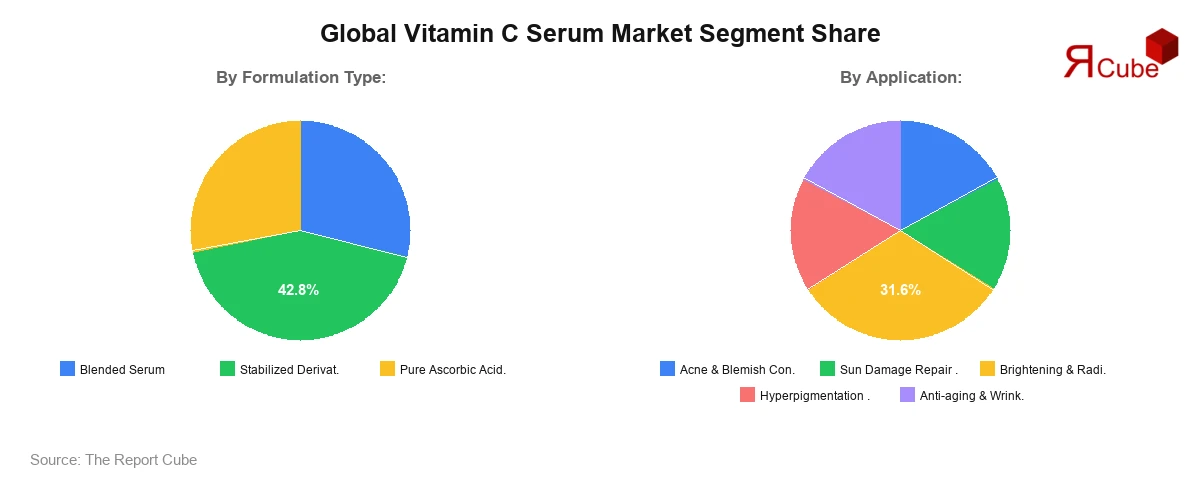
By Application:
- Acne & Blemish Control
- Sun Damage Repair & Protection
- Brightening & Radiance Enhancement
- Hyperpigmentation & Dark Spot Treatment
- Anti-aging & Wrinkle Reduction
Brightening & Radiance Enhancement emerged as the leading application segment, accounting for approximately 31.6% of the global Vitamin C serum market share in 2026. Increasing focus on healthy-looking, radiant skin among younger and working-age consumers continues driving product demand across multiple beauty markets. Vitamin C serums are widely recognized for supporting skin brightness improvement and reducing dullness caused by environmental stress, fatigue, and prolonged sun exposure.
Beauty brands are actively launching advanced formulations containing glutathione, niacinamide, and botanical extracts to strengthen brightening effects while maintaining skin hydration and comfort. Rising adoption of daily skincare routines across Asia Pacific and North America is also strengthening demand for radiance-focused skincare products designed for long-term skin tone improvement and preventive skin maintenance.
Regional Projection of Global Vitamin C Serum Industry
- North America
- Europe
- Asia Pacific
- Middle East & Africa
- South America
Asia Pacific continues to dominate the Global Vitamin C Serum Market, accounting for nearly 38.9% share in 2026. The region benefits from strong skincare product adoption, advanced cosmetic manufacturing capabilities, and rapidly evolving beauty innovation ecosystems. South Korea and Japan remain influential markets due to continuous investment in functional skincare technologies, lightweight formulations, and ingredient stabilization research. China continues experiencing strong growth in premium beauty consumption driven by rising disposable income and expanding urban middle-class populations. India is also emerging as a high-potential market due to growing awareness regarding pigmentation treatment, UV protection, and antioxidant skincare benefits.
Regional cosmetic manufacturers are increasingly introducing affordable yet clinically inspired skincare solutions tailored to local climate conditions and skin concerns. Expansion of online beauty retail platforms and pharmacy skincare distribution channels is improving product accessibility across metropolitan and tier-two cities. International beauty brands are also strengthening regional partnerships and localized product strategies to capture long-term market opportunities. Continued innovation in multifunctional skincare products and dermatological beauty formulations is expected to support sustained regional market growth across Asia Pacific throughout the forecast timeline.
Need insights for a specific region within this market?
Request Regional DataGlobal Vitamin C Serum Industry Regional Analysis
The global vitamin C serum market varies significantly across regions due to skincare awareness, income levels, and beauty culture dynamics.
| Region | Demand Level | Key Markets | System Dominance | Core Demand Logic | Growth Nature |
|---|---|---|---|---|---|
| North America | Very High | USA, Canada | Dermatologist-backed serums | Science-backed formulas & high spending power | Subscription-driven growth |
| Europe | High | Germany, France, UK | Clean & organic formulations | Eco-certified products & anti-aging demand | Sustainability-led expansion |
| Asia Pacific | Extremely High | China, Japan, South Korea, India | K-beauty & stabilized derivatives | Brightening culture & rising middle class | Fastest-growing segment |
| Middle East & Africa | Medium | Saudi Arabia, UAE, South Africa | Premium imported serums | Luxury beauty trends & sun protection needs | Emerging market expansion |
| South America | Medium | Brazil, Argentina | Multi-benefit formulations | Urbanization & growing beauty consciousness | Rising disposable income |
Government Initiatives & Policies
- U.S. FDA Modernization of Cosmetic Regulations Act (MoCRA) 2025: The U.S. Food and Drug Administration expanded cosmetic product safety compliance and adverse event reporting requirements for skincare manufacturers, improving transparency and consumer safety standards across active skincare categories including Vitamin C serums.
- South Korea K-Beauty Export Promotion Program 2026: South Korea’s Ministry of SMEs and Startups expanded export incentives and innovation funding for cosmetic manufacturers developing functional skincare products and advanced dermatological formulations to strengthen global K-beauty competitiveness.
Global Vitamin C Serum Industry Recent Developments
- February 2026: Pilgrim India Private Limited launched India’s first Vitamin C serum sunscreen formulated with 5% Vitamin C complex and SPF 50+ PA++++ technology. The product combines antioxidant skincare benefits with UV protection and reflects growing demand for multifunctional skincare products offering convenience, pigmentation prevention, and daily skin defense.
- February 2026: Mesoceutical introduced “VC Serum 31,” a water-free serum containing 31% pure Vitamin C supported by proprietary VCore-X™ penetration technology. The launch highlights increasing consumer preference for clinic-inspired, high-efficacy skincare products with advanced ingredient delivery systems and stronger dermatological positioning.
- February 2026: The LOCOSIM launched “Vitamin C 10.0 Serum” using oxygen-removal manufacturing technology and airless packaging systems to improve formulation stability. The product incorporates ferulic acid, glutathione, and CICA, reinforcing industry focus on oxidation-resistant skincare and high-performance antioxidant solutions.
Why Choose This Report?
- Provides a comprehensive overview of the overall market analysis, encompassing key trends, consumer behavior analysis, and risk assessment to support strategic decision-making.
- Provides accurate, up-to-date insights into market size, segmentation, and emerging opportunities, helping to minimize risk & capitalizing on growth.
- Gives deep understanding of target audience preferences, investment habits, and communication channels for enhanced product development & marketing effectiveness.
- Delivers competitive analysis & benchmarking, uncovering the strengths & weaknesses of market competitors to guide strategies.
- Consolidate comprehensive market intelligence, reducing reasoning & streamlining research efforts.
- Facilitates customized market segmentation & risk mitigation strategies, fine-tuned to the business objectives.
- Aids in identifying both market challenges & untapped opportunities within the industry to drive long-term business growth.
- Provides valuable information based on actual customer data & search trends.
Table of Contents
- Introduction
- Objective of the Study
- Product and Category Definition
- Market Segmentation
- Study Variables
- Research Methodology
- Secondary Data Points
- Breakdown of Secondary Sources
- Primary Data Points
- Breakdown of Primary Interviews
- Secondary Data Points
- Executive Summary
- Market Dynamics
- Emerging Opportunities
- Adoption Trends
- Demand Drivers
- Disruption Analysis (Challenges)
- Industry Analysis & Strategic Insights
- Supply/Value Chain Analysis
- Pricing Analysis
- Go-To-Market (GTM) Strategy
- BCG Matrix
- Recent Trends and Developments
- Import and Export Analysis
- Regulatory and Policy Landscape
- Region-wise Policies
- Government Initiatives
- Global Vitamin C Serum Market Overview and Forecast Analysis (2021-2034)
- Market Size, By Value, By Growth Rate (CAGR/USD Billion)
- Market Share, By Formulation Type
- Blended Serum
- Stabilized Derivatives
- Pure Ascorbic Acid
- Market Share, By Concentration Level
- Below 10%
- 10% - 20%
- Above 20%
- Market Share, By Type
- Luxury
- Mass
- Premium
- Market Share, By Skin Type
- Sensitive
- Combination
- Dry
- Oily
- Market Share, By Application
- Acne & Blemish Control
- Sun Damage Repair & Protection
- Brightening & Radiance Enhancement
- Hyperpigmentation & Dark Spot Treatment
- Anti-aging & Wrinkle Reduction
- Market Share, By Distribution Channel
- Specialty Stores
- Online
- Pharmacies & Drugstores
- Hypermarkets & Supermarkets
- Others
- Market Share, By Packaging Type
- Pump Bottles
- Ampoules
- Dropper Bottles
- Market Share, By Region
- North America
- Europe
- Asia Pacific
- Middle East & Africa
- South America
- Market Share, By Company
- Revenue Shares & Analysis
- Competitive Landscape
- North America Vitamin C Serum Market Overview and Forecast Analysis (2021-2034)
- Market Size, By Value, By Growth Rate (CAGR/USD Billion/Million)
- Market Overview, By Formulation Type
- Market Overview, By Concentration Level
- Market Overview, By Type
- Market Overview, By Skin Type
- Market Overview, By Application
- Market Overview, By Distribution Channel
- Market Overview, By Packaging Type
- Market Share, By Country
- United States
- Canada
- Mexico
- Rest of North America
- Europe Vitamin C Serum Market Overview and Forecast Analysis (2021-2034)
- Market Size, By Value, By Growth Rate (CAGR/USD Billion/Million)
- Market Overview, By Formulation Type
- Market Overview, By Concentration Level
- Market Overview, By Type
- Market Overview, By Skin Type
- Market Overview, By Application
- Market Overview, By Distribution Channel
- Market Overview, By Packaging Type
- Market Share, By Country
- Germany
- United Kingdom
- France
- Italy
- Spain
- Netherlands
- Russia
- Poland
- Belgium
- Sweden
- Rest of Europe
- Asia Pacific Vitamin C Serum Market Overview and Forecast Analysis (2021-2034)
- Market Size, By Value, By Growth Rate (CAGR/USD Billion/Million)
- Market Overview, By Formulation Type
- Market Overview, By Concentration Level
- Market Overview, By Type
- Market Overview, By Skin Type
- Market Overview, By Application
- Market Overview, By Distribution Channel
- Market Overview, By Packaging Type
- Market Share, By Country
- China
- India
- Japan
- South Korea
- Australia
- Indonesia
- Thailand
- Malaysia
- Vietnam
- Philippines
- Singapore
- New Zealand
- Rest of Asia Pacific
- Middle East & Africa Vitamin C Serum Market Overview and Forecast Analysis (2021-2034)
- Market Size, By Value, By Growth Rate (CAGR/USD Billion/Million)
- Market Overview, By Formulation Type
- Market Overview, By Concentration Level
- Market Overview, By Type
- Market Overview, By Skin Type
- Market Overview, By Application
- Market Overview, By Distribution Channel
- Market Overview, By Packaging Type
- Market Share, By Country
- Saudi Arabia
- United Arab Emirates
- South Africa
- Egypt
- Nigeria
- Morocco
- Turkey
- Rest of Middle East & Africa
- South America Vitamin C Serum Market Overview and Forecast Analysis (2021-2034)
- Market Size, By Value, By Growth Rate (CAGR/USD Billion/Million)
- Market Overview, By Formulation Type
- Market Overview, By Concentration Level
- Market Overview, By Type
- Market Overview, By Skin Type
- Market Overview, By Application
- Market Overview, By Distribution Channel
- Market Overview, By Packaging Type
- Market Share, By Country
- Brazil
- Argentina
- Chile
- Colombia
- Peru
- Rest of South America
- Competitive Analysis, 2026
- Market Share of Key Players
- Competitive Mapping for Each Formulation Type, Concentration Level, Type, Skin Type, Application, Distribution Channel, and Packaging Type
- North America Vitamin C Serum Companies/Brands & Competitive Analysis, 2026
- Europe Vitamin C Serum Companies/Brands & Competitive Analysis, 2026
- Asia Pacific Vitamin C Serum Companies/Brands & Competitive Analysis, 2026
- Middle East & Africa Vitamin C Serum Companies/Brands & Competitive Analysis, 2026
- South America Vitamin C Serum Companies/Brands & Competitive Analysis, 2026
- Company Profile (Partial List)
- Sunday Riley Modern Skincare, LLC
- Company Overview
- Product Portfolio
- Strategic Alliances/Partnerships
- Recent Developments
- Johnson & Johnson
- Company Overview
- Product Portfolio
- Strategic Alliances/Partnerships
- Recent Developments
- Mad Hippie LLC
- Company Overview
- Product Portfolio
- Strategic Alliances/Partnerships
- Recent Developments
- Topix Pharmaceuticals, Inc.
- Company Overview
- Product Portfolio
- Strategic Alliances/Partnerships
- Recent Developments
- L'Oréal S.A.
- Company Overview
- Product Portfolio
- Strategic Alliances/Partnerships
- Recent Developments
- Amorepacific Corporation
- Company Overview
- Product Portfolio
- Strategic Alliances/Partnerships
- Recent Developments
- Naturium LLC
- Company Overview
- Product Portfolio
- Strategic Alliances/Partnerships
- Recent Developments
- Obagi Cosmeceuticals LLC
- Company Overview
- Product Portfolio
- Strategic Alliances/Partnerships
- Recent Developments
- Shiseido Company, Limited
- Company Overview
- Product Portfolio
- Strategic Alliances/Partnerships
- Recent Developments
- Beiersdorf AG
- Company Overview
- Product Portfolio
- Strategic Alliances/Partnerships
- Recent Developments
- TruSkin Naturals LLC
- Company Overview
- Product Portfolio
- Strategic Alliances/Partnerships
- Recent Developments
- DECIEM Beauty Group Inc.
- Company Overview
- Product Portfolio
- Strategic Alliances/Partnerships
- Recent Developments
- Procter & Gamble Company
- Company Overview
- Product Portfolio
- Strategic Alliances/Partnerships
- Recent Developments
- The Estée Lauder Companies Inc.
- Company Overview
- Product Portfolio
- Strategic Alliances/Partnerships
- Recent Developments
- Unilever PLC
- Company Overview
- Product Portfolio
- Strategic Alliances/Partnerships
- Recent Developments
- Others (Partial List)
- Sunday Riley Modern Skincare, LLC
- Contact Us and Disclaimer
Top Key Players & Market Share Outlook
- Sunday Riley Modern Skincare, LLC
- Johnson & Johnson
- Mad Hippie LLC
- Topix Pharmaceuticals, Inc.
- L'Oréal S.A.
- Amorepacific Corporation
- Naturium LLC
- Obagi Cosmeceuticals LLC
- Shiseido Company, Limited
- Beiersdorf AG
- TruSkin Naturals LLC
- DECIEM Beauty Group Inc.
- Procter & Gamble Company
- The Estée Lauder Companies Inc.
- Unilever PLC
- Others
Frequently Asked Questions






