



Build Your Custom Market Intelligence Report
Customize Your ReportGCC Waste Sorting Equipment Market Key Highlights
By Waste Type:
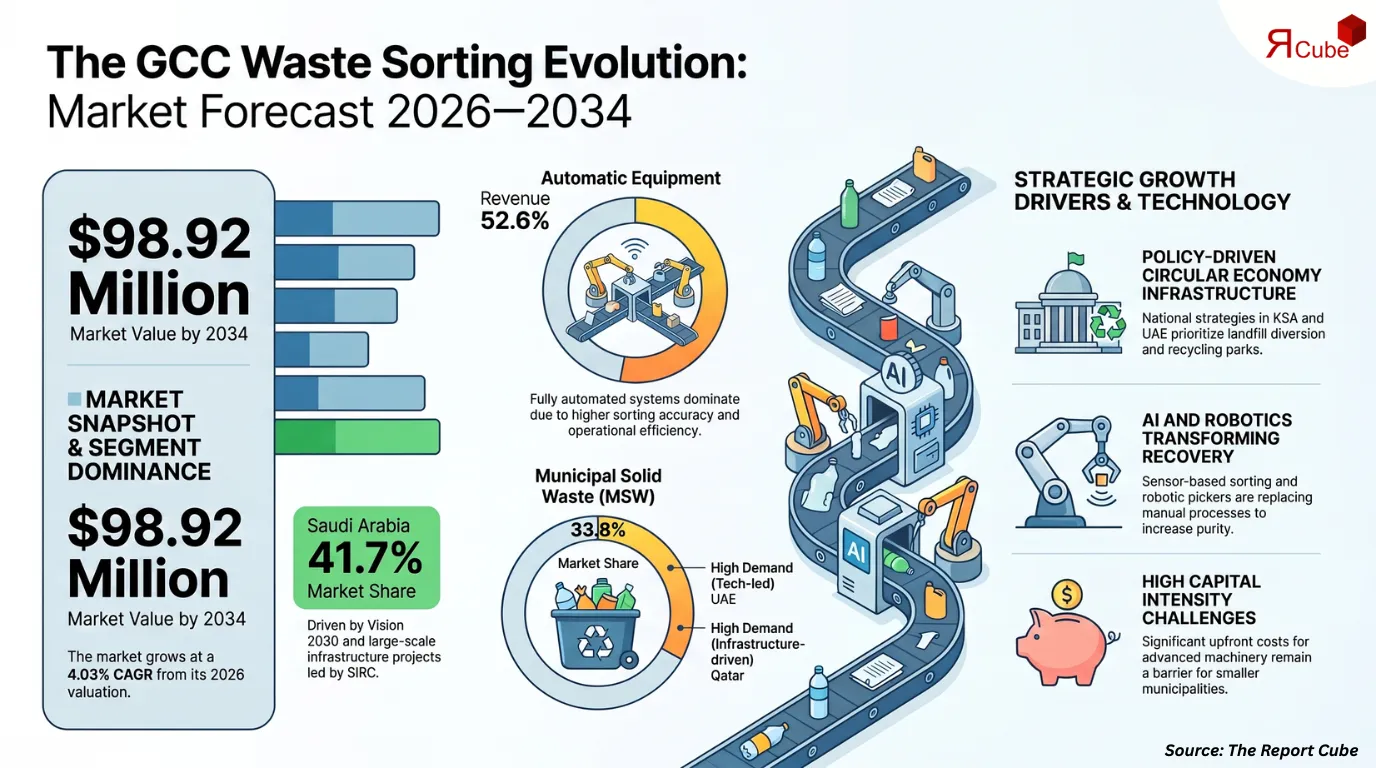
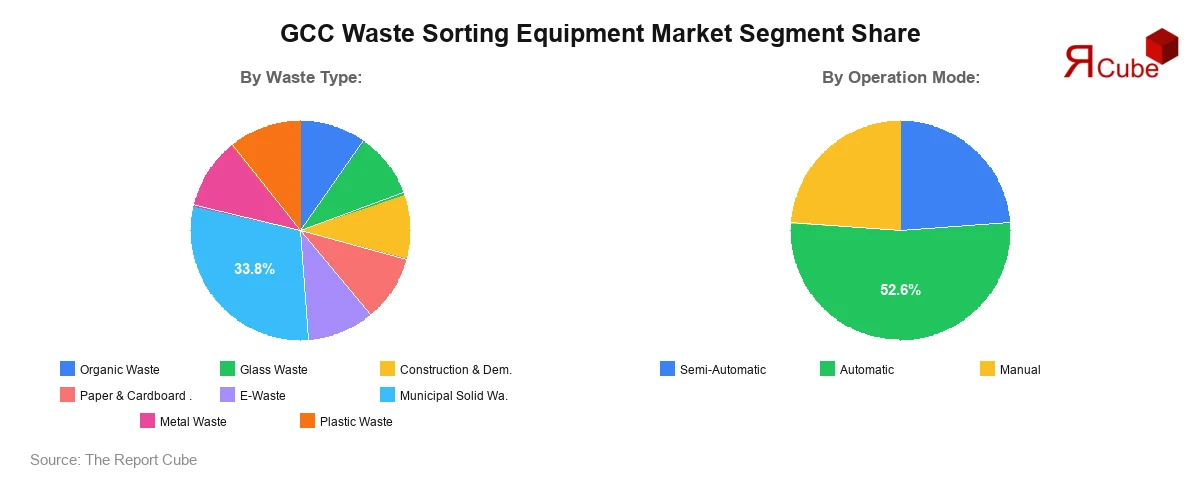
Municipal Solid Waste segment leads the market with an estimated 33.8% market share.
By Operation Mode:
Automatic equipment dominates the market with nearly 52.6% of total revenue.
Regional Outlook:
Saudi Arabia dominates the GCC Waste Sorting Equipment Market with approximately 41.7% market share.
GCC Waste Sorting Equipment Market Insights & Analysis
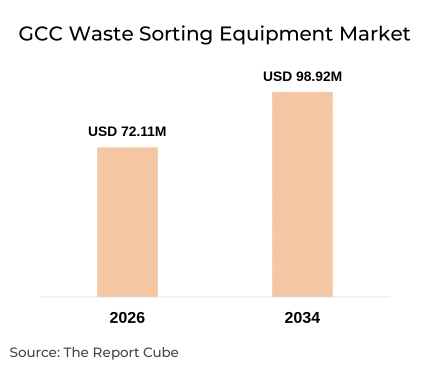
The GCC Waste Sorting Equipment Market is anticipated to register a CAGR of around 4.03% during the forecast period 2026-2034. The market size is valued at USD 72.11 million in 2026 and is projected to reach USD 98.92 million by 2034. Rising municipal solid waste generation, stricter environmental regulations, and sustained investments in recycling infrastructure are creating steady demand for advanced waste sorting equipment throughout the Gulf region. Governments are replacing landfill-dependent waste management practices with integrated recycling systems capable of recovering plastics, metals, paper, glass, and construction materials before final disposal. This structural transition has accelerated investments in optical sorting systems, magnetic separators, ballistic separators, robotic sorting units, and intelligent conveyor solutions across municipal and industrial recycling facilities. Increasing industrial diversification and rapid urban development continue to generate larger and more complex waste streams, reinforcing the need for efficient material separation technologies that improve resource recovery while reducing landfill dependence.
National sustainability programs across Saudi Arabia, the United Arab Emirates, Qatar, Kuwait, Oman, and Bahrain continue to reshape regional waste management infrastructure. Public authorities are expanding material recovery facilities, waste-to-energy projects, and integrated recycling parks to achieve ambitious landfill diversion and resource recovery targets. Large infrastructure developments increasingly specify sensor-based sorting technologies, AI-guided robotic systems, and automated quality control solutions to improve processing efficiency and produce higher-purity recyclable materials. Equipment manufacturers are also introducing digital monitoring platforms that optimize throughput, reduce maintenance requirements, and improve plant productivity. Recent investments in large-scale municipal recycling facilities across Abu Dhabi and Saudi Arabia demonstrate the region's long-term commitment to developing modern circular economy infrastructure. These projects are expected to generate sustained procurement opportunities for suppliers of advanced waste sorting equipment over the forecast period.
GCC Waste Sorting Equipment Market Impact Analysis
| Factor | Type | Specific Impact on Market | Magnitude | Business Implication |
|---|---|---|---|---|
| Rising Municipal Solid Waste Volumes | Market | Higher daily waste generation pushes demand for sorting lines | High | Supports capacity additions across city material recovery facilities |
| GCC Sustainability And Circular Policies | Regulatory | National recycling targets accelerate adoption of advanced equipment | High | Drives project pipelines funded by state backed green programs |
| Automation Using Robotics And Sensors | Technological | AI and robotic pickers raise sorting accuracy and plant throughput | High | Encourages investment in premium automated systems and upgrades |
| Capital Intensity Of Large Sorting Plants | Market | High upfront cost slows adoption for smaller municipalities | Medium | Creates need for PPP models and vendor financed project structures |
| Growth Of Recycling And Reuse Industries | Market | Expanding recyclers require cleaner feedstock from sorting facilities | High | Strengthens demand for equipment with better material recovery rates |
| Presence Of Global Technology Suppliers | Competitive | International OEMs introduce advanced solutions and pricing pressure | Medium | Local players must differentiate via service and tailored designs |
| Public Awareness On Waste Segregation | Consumer | Improved source sorting enhances equipment efficiency and uptime | Medium | Supports campaigns and consulting services tied to equipment sales |
GCC Waste Sorting Equipment Market Dynamics
Key Driver: Accelerating Investments in Circular Economy Infrastructure Across the GCC
Governments throughout the Gulf region are significantly increasing investment in recycling infrastructure to reduce landfill dependency and improve resource efficiency. National sustainability strategies now prioritize material recovery facilities, waste processing centers, and waste-to-energy projects capable of recovering valuable recyclable materials before final disposal. These initiatives are creating consistent demand for automated waste sorting equipment that can efficiently process municipal solid waste, industrial waste, construction debris, plastics, metals, and electronic waste. Population growth, expanding urban communities, and higher commercial activity continue to increase waste volumes, requiring more sophisticated sorting systems with greater processing capacity and higher recovery accuracy.
Long-term infrastructure programs supported by public-private partnerships are further strengthening equipment procurement across the GCC. Municipal authorities increasingly seek high-capacity optical sorters, magnetic separation systems, robotic picking technologies, and sensor-based sorting equipment to improve recycling performance while lowering operating costs. Modern facilities are designed to maximize material recovery, reduce contamination, and produce higher-quality recyclable feedstock that supports downstream manufacturing industries. Continuous investment in integrated waste management infrastructure is expected to remain a fundamental contributor to market expansion throughout the forecast period.
Industry Trend: Intelligent Automation is Transforming Material Recovery Operations
Automation has become a defining feature of newly commissioned recycling facilities across GCC countries. Modern waste sorting plants increasingly integrate artificial intelligence, near-infrared sensors, hyperspectral imaging, machine vision, and robotic sorting technologies to identify and separate recyclable materials with greater precision than conventional manual processes. These intelligent systems improve recovery rates for plastics, metals, paper, and glass while minimizing contamination that can reduce the commercial value of recycled materials. As recycling targets become more ambitious, operators are prioritizing technologies capable of delivering consistent sorting accuracy at higher processing speeds.
Digitalization is also improving operational performance across waste processing facilities. Remote equipment monitoring, predictive maintenance software, and automated process optimization allow operators to reduce downtime and improve equipment utilization. Smart control systems provide real-time performance data that enables faster operational decisions while lowering maintenance costs over the equipment lifecycle. The growing preference for intelligent sorting technologies reflects the region's broader investment in smart infrastructure and industrial automation, creating favorable conditions for suppliers offering advanced waste sorting solutions.
Book your FREE 30-minute expert consultation today
Contact UsMajor Challenge: High Capital Requirements Continue to Influence Investment Decisions
Advanced waste sorting facilities require substantial financial investment before commercial operations begin. Installation of optical sorting equipment, robotic separation systems, screening machinery, magnetic separators, conveyors, compressed air systems, and integrated software platforms significantly increases initial project costs. Additional expenditure is required for civil infrastructure, commissioning, workforce training, and ongoing technical support. These financial considerations often extend procurement timelines, particularly for municipalities with phased infrastructure budgets and smaller private recycling operators.
Operational complexity presents another important consideration for facility owners. Automated sorting systems require experienced technical personnel, preventive maintenance programs, and reliable access to replacement components to maintain peak performance. Variations in municipal waste composition across GCC countries may also require customized equipment configurations that increase engineering requirements and implementation costs. Although long-term operational savings remain attractive, these initial investment barriers continue to influence purchasing decisions across several developing waste management projects.
Opportunity: Expansion of Material Recovery Facilities Creates Long-Term Equipment Demand
Large-scale material recovery facilities under development across the GCC are creating substantial opportunities for manufacturers of advanced waste sorting equipment. Governments continue to expand integrated recycling infrastructure that combines material recovery, waste-to-energy generation, and resource recycling within unified waste management ecosystems. Every new facility requires a combination of mechanical sorting systems, optical sorters, magnetic separators, eddy current separators, ballistic screens, and robotic picking technologies capable of processing high waste volumes efficiently. Rising investments in construction waste recycling, plastic recovery, and electronic waste management further broaden equipment demand across specialized recycling applications.
Growing participation from international engineering companies, technology providers, and regional waste management operators is accelerating technology transfer throughout the Gulf region. Collaborative infrastructure projects increasingly prioritize equipment capable of achieving higher recovery efficiency, lower operating costs, and greater energy efficiency while supporting national sustainability objectives. As governments continue expanding recycling capacity to meet long-term landfill diversion targets, procurement activity for advanced waste sorting equipment is expected to remain strong across Saudi Arabia, the United Arab Emirates, Qatar, Kuwait, Oman, and Bahrain throughout the forecast period.
GCC Waste Sorting Equipment Market Segment-wise Analysis
By Waste Type:
- Organic Waste
- Glass Waste
- Construction & Demolition Waste
- Paper & Cardboard Waste
- E-Waste
- Municipal Solid Waste
- Metal Waste
- Plastic Waste
Municipal Solid Waste (MSW) accounted for the largest share of the GCC Waste Sorting Equipment Market, contributing an estimated 33.8% of total revenue in 2026. Rapid urbanization, population growth, and higher consumption levels have significantly increased household and commercial waste generation across Saudi Arabia, the United Arab Emirates, Qatar, Kuwait, Oman, and Bahrain. Municipal authorities are expanding waste segregation and recycling programs to reduce landfill dependency while improving resource recovery rates. This shift has accelerated investments in automated waste sorting equipment capable of efficiently separating plastics, paper, metals, glass, and organic materials from mixed municipal waste streams.
The construction of advanced Material Recovery Facilities (MRFs) across the GCC continues to strengthen demand for municipal waste sorting equipment. Modern facilities increasingly incorporate optical sorters, magnetic separators, ballistic screens, and AI-assisted robotic sorting systems to improve processing efficiency and material purity. Government policies promoting circular economy development and landfill diversion targets are encouraging municipalities to replace conventional manual sorting operations with automated systems. As urban waste volumes continue to rise, Municipal Solid Waste is expected to remain the largest waste type segment throughout the forecast period.
By Operation Mode:
- Semi-Automatic
- Automatic
- Manual
Automatic waste sorting equipment held the largest market share of approximately 52.6% in 2026, reflecting the GCC region's increasing focus on operational efficiency and advanced recycling infrastructure. Fully automated systems enable continuous processing of large waste volumes while delivering higher sorting accuracy than conventional manual operations. Municipal recycling facilities and industrial waste processing plants are increasingly adopting sensor-based sorting technologies, optical recognition systems, robotic pickers, and automated conveyor networks to maximize recyclable material recovery and reduce contamination levels.
The growing deployment of smart recycling facilities is further accelerating demand for automated sorting solutions. Automated equipment reduces labor dependency, lowers long-term operating costs, and improves workplace safety by minimizing direct handling of hazardous waste materials. Equipment manufacturers are also integrating predictive maintenance software, machine vision technology, and real-time monitoring platforms to enhance operational reliability and throughput. As governments continue investing in digital infrastructure and intelligent waste management systems, automatic operation is expected to maintain its dominant position across new recycling projects throughout the GCC.
Regional Projection of GCC Waste Sorting Equipment Industry
- Saudi Arabia
- United Arab Emirates
- Kuwait
- Oman
- Qatar
- Bahrain
Saudi Arabia represented the largest regional market, accounting for approximately 41.7% of the GCC Waste Sorting Equipment Market in 2026. The country's leadership is supported by extensive investments in waste management infrastructure under Saudi Vision 2030, along with rising demand for sustainable waste treatment solutions. Rapid urban expansion, industrial development, and population growth have substantially increased municipal, industrial, and construction waste generation, creating strong demand for high-capacity waste sorting equipment. Government-backed organizations continue to invest in modern recycling facilities designed to improve resource recovery while reducing landfill disposal.
Large-scale projects led by the Saudi Investment Recycling Company (SIRC) and other public-private partnerships are accelerating the deployment of advanced material recovery facilities across major cities. New recycling plants increasingly specify optical sorting systems, magnetic separation equipment, eddy current separators, and AI-enabled robotic sorting technologies to improve operational performance and produce higher-quality recyclable materials. Continued investment in circular economy initiatives, combined with expanding waste-to-energy infrastructure and stricter environmental regulations, is expected to reinforce Saudi Arabia's position as the leading market for waste sorting equipment across the GCC during the forecast period.
Need insights for a specific region within this market?
Request Regional DataCountries Analysis of GCC Waste Sorting Equipment Market
The GCC waste sorting equipment market varies by country due to differing policy ambition, waste volumes, and technology adoption.
| Cluster | Demand Level | Key Areas | System Dominance | Core Demand Logic | Growth Nature |
|---|---|---|---|---|---|
| Saudi Arabia | Very High | Riyadh, Jeddah, Dammam | Optical sorters & robotics | Vision 2030 landfill diversion push | Policy-led, large scale expansion |
| United Arab Emirates | High | Dubai, Abu Dhabi, Sharjah | AI-driven smart sorting lines | Tech-led recycling and WTE targets | Fastest regional technology adoption |
| Kuwait | Medium | Kuwait City, Shuaiba area | Mechanical sorting and conveyors | Modernization of legacy landfills | Gradual upgrade, project based |
| Oman | Medium | Muscat, Sohar industrial belt | Mixed automated sorting lines | Centralized hubs for scattered waste | Steady growth via PPP concessions |
| Qatar | High | Doha, Ras Laffan zone | Automated MRF and optical sorters | National sustainability and WTE focus | Infrastructure driven capacity build |
| Bahrain | Low to Medium | Manama, Hidd industrial area | Basic mechanical sorting systems | Small volume, selective upgrades | Niche, incremental modernization |
Government Initiatives & Policies
- Saudi Arabia National Waste Management Strategy (2025): Saudi Arabia continues expanding recycling infrastructure under Vision 2030 through the National Center for Waste Management and the Saudi Investment Recycling Company. The strategy promotes landfill diversion, private investment, advanced sorting technologies, and circular economy development across municipal and industrial waste streams.
- UAE Circular Economy Policy and Integrated Waste Management Programs (2025): The United Arab Emirates continues implementing national circular economy initiatives that encourage material recovery facilities, advanced recycling infrastructure, AI-enabled waste management, and private sector participation to significantly reduce landfill disposal while increasing recycling rates across all emirates.
GCC Waste Sorting Equipment Industry Recent Developments
- 2024: Tadweer Group announced the development of Abu Dhabi's first greenfield Material Recovery Facility (MRF) at Al Mafraq Industrial Area. The facility will process up to 1.3 million tonnes of municipal solid waste annually using advanced optical sorting systems, AI-guided robotic sorting technologies, and automated material separation equipment. Scheduled for commissioning by the end of 2026, the project is expected to significantly strengthen the UAE's recycling infrastructure while supporting the country's landfill diversion objectives.
- 2024: SUEZ and the Saudi Investment Recycling Company (SIRC) signed a strategic framework partnership to accelerate the development of waste treatment and circular economy infrastructure across Saudi Arabia. The collaboration covers municipal, medical, industrial, and hazardous waste processing facilities, creating additional demand for high-capacity sorting equipment, intelligent material separation technologies, and integrated recycling systems supporting the Kingdom's long-term sustainability goals.
Why Choose This Report?
- Provides a comprehensive overview of the overall market analysis, encompassing key trends, consumer behavior analysis, and risk assessment to support strategic decision-making.
- Provides accurate, up-to-date insights into market size, segmentation, and emerging opportunities, helping to minimize risk while capitalizing on growth.
- Gives deep understanding of target audience preferences, investment habits, and communication channels for enhanced product development and marketing effectiveness.
- Delivers competitive analysis and benchmarking, uncovering the strengths and weaknesses of market competitors to guide strategic planning.
- Consolidates comprehensive market intelligence, reducing research efforts while improving business decision-making efficiency.
- Facilitates customized market segmentation and risk mitigation strategies tailored to business objectives and investment priorities.
- Helps identify both market challenges and untapped opportunities within the industry to support sustainable long-term business growth.
- Provides valuable insights based on actual customer behavior, industry developments, regulatory trends, and evolving market demand.
Table of Contents
- Introduction
- Objective of the Study
- Product and Category Definition
- Market Segmentation
- Study Variables
- Research Methodology
- Secondary Data Points
- Breakdown of Secondary Sources
- Primary Data Points
- Breakdown of Primary Interviews
- Secondary Data Points
- Executive Summary
- Market Dynamics
- Emerging Opportunities
- Adoption Trends
- Demand Drivers
- Disruption Analysis (Challenges)
- Industry Analysis & Strategic Insights
- Supply/Value Chain Analysis
- Pricing Analysis
- Go-To-Market (GTM) Strategy
- BCG Matrix
- Recent Trends and Developments
- Import and Export Analysis
- Regulatory and Policy Landscape
- Country-wise Policies
- Government Initiatives
- GCC Waste Sorting Equipment Market Overview and Forecast Analysis (2021-2034)
- Market Size, By Value, By Growth Rate (CAGR/USD Million)
- Market Share, By Waste Type
- Organic Waste
- Glass Waste
- Construction & Demolition Waste
- Paper & Cardboard Waste
- E-Waste
- Municipal Solid Waste
- Metal Waste
- Plastic Waste
- Market Share, By Operation Mode
- Semi-Automatic
- Automatic
- Manual
- Market Share, By Technology
- Mechanical Sorting
- Sensor-Based Sorting
- Robotic Sorting
- Magnetic Separation
- Others
- Market Share, By End User
- Industrial
- E-Waste Recycling
- Municipal
- Construction & Demolition
- Recycling Facilities/MRFs
- Market Share, By Country
- Saudi Arabia
- United Arab Emirates
- Kuwait
- Oman
- Qatar
- Bahrain
- Market Share, By Company
- Revenue Shares & Analysis
- Competitive Landscape
- Saudi Arabia Waste Sorting Equipment Market Overview and Forecast Analysis (2021-2034)
- Market Size, By Value, By Growth Rate (CAGR/USD Million)
- Market Share, By Waste Type
- Market Share, By Operation Mode
- Market Share, By Technology
- Market Share, By End User
- United Arab Emirates Waste Sorting Equipment Market Overview and Forecast Analysis (2021-2034)
- Market Size, By Value, By Growth Rate (CAGR/USD Million)
- Market Share, By Waste Type
- Market Share, By Operation Mode
- Market Share, By Technology
- Market Share, By End User
- Kuwait Waste Sorting Equipment Market Overview and Forecast Analysis (2021-2034)
- Market Size, By Value, By Growth Rate (CAGR/USD Million)
- Market Share, By Waste Type
- Market Share, By Operation Mode
- Market Share, By Technology
- Market Share, By End User
- Oman Waste Sorting Equipment Market Overview and Forecast Analysis (2021-2034)
- Market Size, By Value, By Growth Rate (CAGR/USD Million)
- Market Share, By Waste Type
- Market Share, By Operation Mode
- Market Share, By Technology
- Market Share, By End User
- Qatar Waste Sorting Equipment Market Overview and Forecast Analysis (2021-2034)
- Market Size, By Value, By Growth Rate (CAGR/USD Million)
- Market Share, By Waste Type
- Market Share, By Operation Mode
- Market Share, By Technology
- Market Share, By End User
- Bahrain Waste Sorting Equipment Market Overview and Forecast Analysis (2021-2034)
- Market Size, By Value, By Growth Rate (CAGR/USD Million)
- Market Share, By Waste Type
- Market Share, By Operation Mode
- Market Share, By Technology
- Market Share, By End User
- Competitive Analysis, 2026
- Market Share of Key Players
- Competitive Mapping for Each Segment and Companies Operating Countryally
- Saudi Arabia Waste Sorting Equipment Companies Share & Competitive Analysis, 2026
- United Arab Emirates Waste Sorting Equipment Companies Share & Competitive Analysis, 2026
- Kuwait Waste Sorting Equipment Companies Share & Competitive Analysis, 2026
- Oman Waste Sorting Equipment Companies Share & Competitive Analysis, 2026
- Qatar Waste Sorting Equipment Companies Share & Competitive Analysis, 2026
- Bahrain Waste Sorting Equipment Companies Share & Competitive Analysis, 2026
- Company Profile (Partial List)
- Envirotec International Co. Ltd.
- Company Overview
- Product Portfolio
- Strategic Alliances/Partnerships
- Recent Developments
- Excel Industry Co. L.L.C.
- Company Overview
- Product Portfolio
- Strategic Alliances/Partnerships
- Recent Developments
- Pellenc ST SAS
- Company Overview
- Product Portfolio
- Strategic Alliances/Partnerships
- Recent Developments
- ZenRobotics Ltd. (Terex Corporation)
- Company Overview
- Product Portfolio
- Strategic Alliances/Partnerships
- Recent Developments
- AMP Robotics Corp.
- Company Overview
- Product Portfolio
- Strategic Alliances/Partnerships
- Recent Developments
- Mil-tek Middle East FZCO
- Company Overview
- Product Portfolio
- Strategic Alliances/Partnerships
- Recent Developments
- BHS-Sonthofen GmbH
- Company Overview
- Product Portfolio
- Strategic Alliances/Partnerships
- Recent Developments
- Wastech Saudi Arabia
- Company Overview
- Product Portfolio
- Strategic Alliances/Partnerships
- Recent Developments
- Al Shirawi Equipment Co. L.L.C.
- Company Overview
- Product Portfolio
- Strategic Alliances/Partnerships
- Recent Developments
- Solwearth Ecotech Pvt. Ltd.
- Company Overview
- Product Portfolio
- Strategic Alliances/Partnerships
- Recent Developments
- Envac AB
- Company Overview
- Product Portfolio
- Strategic Alliances/Partnerships
- Recent Developments
- CP Manufacturing, Inc.
- Company Overview
- Product Portfolio
- Strategic Alliances/Partnerships
- Recent Developments
- TOMRA Systems ASA
- Company Overview
- Product Portfolio
- Strategic Alliances/Partnerships
- Recent Developments
- Bühler AG
- Company Overview
- Product Portfolio
- Strategic Alliances/Partnerships
- Recent Developments
- Wealth Industry Company Ltd.
- Company Overview
- Product Portfolio
- Strategic Alliances/Partnerships
- Recent Developments
- Others (Partial List)
- Envirotec International Co. Ltd.
- Contact Us and Disclaimer
Top Key Players & Market Share Outlook
- Envirotec International Co. Ltd.
- Excel Industry Co. L.L.C.
- Pellenc ST SAS
- ZenRobotics Ltd. (Terex Corporation)
- AMP Robotics Corp.
- Mil-tek Middle East FZCO
- BHS-Sonthofen GmbH
- Wastech Saudi Arabia
- Al Shirawi Equipment Co. L.L.C.
- Solwearth Ecotech Pvt. Ltd.
- Envac AB
- CP Manufacturing, Inc.
- TOMRA Systems ASA
- Bühler AG
- Wealth Industry Company Ltd.
- Others
Frequently Asked Questions






