



Build Your Custom Market Intelligence Report
Customize Your ReportUS Waste Sorting Equipment Market Key Highlights
By Waste Type:
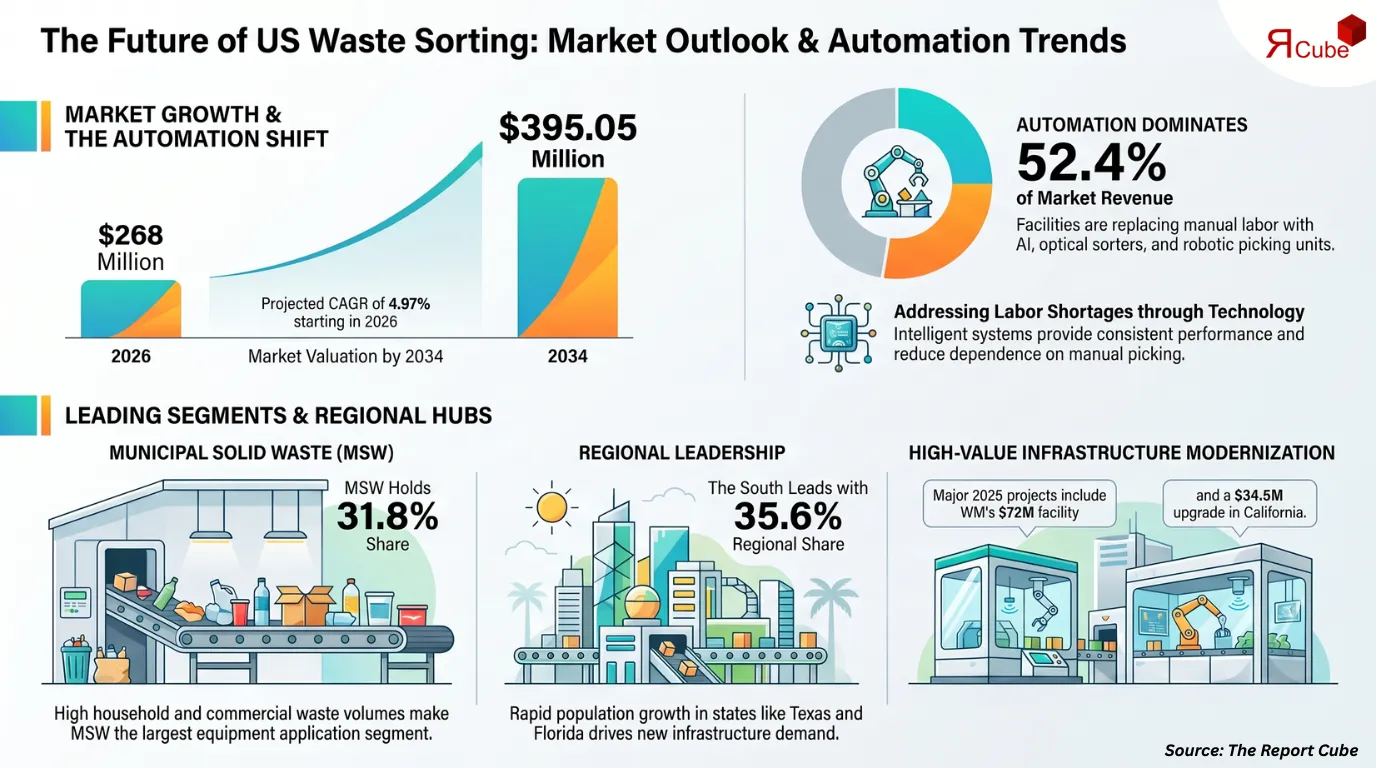
Municipal Solid Waste segment leads the market with approximately 31.8% share.
By Operation Mode:
Automatic segment dominates the market with nearly 52.4% of total revenue.
Regional Outlook:
The South region dominates the US Waste Sorting Equipment Market with around 35.6% market share.
US Waste Sorting Equipment Market Insights & Analysis
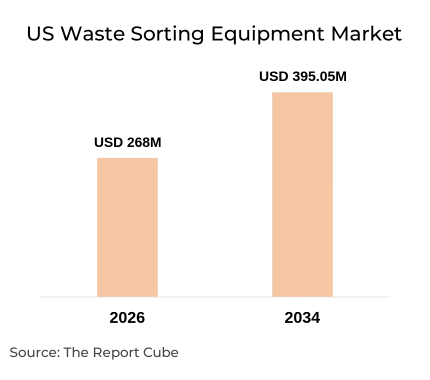
The US Waste Sorting Equipment Market is anticipated to register a CAGR of around 4.97% during the forecast period 2026-2034. The market size is valued at USD 268 million in 2026 and is projected to reach USD 395.05 million by 2034. Demand for advanced waste sorting machines in the United States continues to strengthen as municipalities, recycling operators, and industrial facilities upgrade aging processing infrastructure to improve material recovery efficiency. Modern material recovery facilities are increasingly replacing conventional manual sorting lines with automated optical sorters, magnetic separation systems, robotic picking units, and sensor-based technologies capable of processing mixed waste streams with greater speed and accuracy. Higher recycling targets, stricter contamination standards, and rising disposal costs are encouraging facility operators to invest in equipment that improves operational productivity while maximizing the recovery of valuable recyclable materials such as plastics, paper, metals, glass, and electronic components.
Capital investment across the domestic recycling sector remains robust as public agencies and private waste management companies expand processing capacity to accommodate increasing waste generation. Multiple large-scale projects announced during 2025 demonstrate a clear shift toward fully integrated sorting systems that combine artificial intelligence, machine vision, optical recognition, and automated quality control into a single processing line. States with mature recycling programs continue allocating funding for facility modernization, while manufacturers are introducing energy-efficient equipment designed to reduce maintenance requirements and operating costs. At the same time, corporate sustainability commitments and growing demand for recycled feedstock from packaging, automotive, and consumer goods manufacturers are reinforcing long-term procurement opportunities for waste sorting equipment suppliers throughout the United States.
US Waste Sorting Equipment Market Impact Analysis
| Factor | Type | Specific Impact on Market | Magnitude | Business Implication |
|---|---|---|---|---|
| Stricter Federal and State Recycling Rules | Regulatory | Mandated diversion targets increase demand for sorting lines | High | Drives long term orders from MRFs and municipal operators |
| Rising Municipal Solid Waste Volumes | Market | Higher waste generation requires scalable automated separation | High | Supports capacity expansion investments across large US cities |
| Adoption of AI and Sensor Based Sorting | Technological | Advanced systems improve recovery rates and plant throughput | High | Encourages upgrades from legacy conveyors to smart lines |
| Labor Shortages and Rising Wage Levels | Environmental | Operators seek automation to cut manual picking dependence | Medium | Strengthens payback case for robotics and optical sorters |
| Volatile Prices for Recyclable Commodities | Market | Fluctuating revenues affect timing of capital purchases | Medium | Favors modular lines and service contracts over large one offs |
| Competition Among Global OEMs and Integrators | Competitive | Multiple suppliers intensify pricing and service differentiation | Medium | Requires stronger after sales support and lifecycle offerings |
| ESG and Corporate Sustainability Commitments | Consumer | Brands push for higher recycling rates in supply chains | Medium | Creates private sector demand for dedicated sorting capacity |
US Waste Sorting Equipment Market Dynamics
Key Driver: Modernization of Material Recovery Facilities Across the United States
Investment in modern material recovery facilities has become a primary growth catalyst for the US Waste Sorting Equipment Market. Numerous municipalities and private recycling operators are replacing legacy processing systems with advanced waste sorting machines to improve recovery efficiency, reduce contamination, and increase throughput. Aging infrastructure built decades ago is no longer capable of efficiently processing today's complex waste stream, which includes multilayer plastics, flexible packaging, electronic waste, and mixed recyclables. As a result, procurement of automated sorting equipment has accelerated across municipal recycling centers, commercial waste facilities, and industrial recycling plants seeking higher operational performance and improved resource recovery.
Equipment suppliers are responding by developing integrated processing solutions that combine optical sorting, magnetic separation, ballistic separation, robotic picking, and intelligent software into scalable platforms. These systems reduce manual intervention while delivering greater sorting precision and lower operating costs over the equipment lifecycle. Continued investment from both public and private sectors is expected to sustain replacement demand, particularly as recycling infrastructure expands in fast-growing metropolitan areas where waste volumes continue to increase each year.
Industry Trend: Intelligent Automation is Transforming Waste Processing Operations
Automation is reshaping recycling operations as operators prioritize productivity, material purity, and workforce efficiency. Advanced waste sorting machines now incorporate high-speed cameras, near-infrared sensors, laser scanners, hyperspectral imaging, and artificial intelligence algorithms capable of identifying materials within milliseconds. These technologies enable facilities to recover a greater percentage of recyclable commodities while minimizing contamination that can reduce the commercial value of recovered materials. Automated systems also maintain consistent performance during continuous operation, making them well suited for high-capacity material recovery facilities.
Digital technologies are becoming equally important across modern sorting facilities. Remote equipment monitoring, predictive maintenance software, and real-time operational analytics allow plant managers to optimize throughput while reducing unexpected downtime. Equipment manufacturers are increasingly designing modular systems that can be expanded as processing requirements evolve, allowing operators to modernize facilities without replacing complete production lines. This combination of intelligent automation and flexible system architecture is expected to remain a defining trend throughout the forecast period.
Book your FREE 30-minute expert consultation today
Contact UsMajor Challenge: Capital-Intensive Equipment Deployment and Project Integration
Although advanced sorting technologies deliver measurable improvements in operational efficiency, the financial commitment required for large-scale installations remains a significant challenge for many recycling operators. A complete automated sorting line often requires substantial investment in optical sorters, robotic systems, conveyors, magnetic separators, control software, civil modifications, and electrical infrastructure. These costs can be difficult to justify for smaller municipalities and independently operated recycling facilities working within limited capital budgets.
Project execution also requires careful coordination to ensure compatibility between multiple equipment technologies and existing processing infrastructure. Installation schedules, operator training, software integration, and routine maintenance planning can temporarily affect plant productivity during modernization. Volatility in recycled commodity prices further influences investment decisions because fluctuations in recovered material values directly affect project payback periods. These financial and operational considerations continue to moderate equipment adoption among cost-sensitive market participants.
Opportunity: Expansion of High-Capacity Recycling Infrastructure in Fast-Growing States
Rapid population growth across several US states is creating sustained demand for new recycling infrastructure capable of processing larger waste volumes with greater efficiency. Metropolitan areas throughout Texas, Florida, Georgia, Arizona, and the Carolinas are experiencing increased investment in material recovery facilities designed around fully automated waste sorting equipment rather than conventional manual operations. These greenfield projects typically specify complete processing systems, creating significant contract opportunities for manufacturers offering integrated sorting technologies.
Additional growth opportunities are emerging from specialized recycling applications involving electronic waste, construction debris, lithium-ion batteries, plastics recovery, and industrial waste streams. Manufacturers introducing equipment with higher sorting accuracy, lower energy consumption, and greater operational flexibility are expected to strengthen their competitive position as recycling requirements continue to evolve. Ongoing investment in circular resource management and domestic recycling capacity is likely to support stable demand for advanced waste sorting machines across the United States over the coming decade.
US Waste Sorting Equipment Market Segment-wise Analysis
By Waste Type:
- Organic Waste
- Glass Waste
- Construction & Demolition Waste
- Paper & Cardboard Waste
- E-Waste
- Municipal Solid Waste
- Metal Waste
- Plastic Waste
Municipal Solid Waste (MSW) accounted for approximately 31.8% of the US Waste Sorting Equipment Market in 2026, making it the largest waste type segment. The dominance of MSW is primarily attributed to the steady increase in household, commercial, and institutional waste generation across the United States. According to federal environmental estimates, municipal solid waste generation continues to exceed 290 million tons annually, prompting municipalities to strengthen recycling infrastructure and improve landfill diversion rates. This has accelerated investments in advanced waste sorting machines capable of efficiently separating paper, plastics, metals, glass, and organic materials from mixed waste streams. Modern material recovery facilities increasingly rely on optical sorters, ballistic separators, magnetic systems, and AI-assisted robotic sorters to enhance recovery efficiency while minimizing contamination.
State recycling mandates, extended producer responsibility (EPR) programs, and local sustainability targets continue to support procurement of automated sorting equipment for municipal applications. Public-private partnerships are expanding the number of high-capacity material recovery facilities, particularly in rapidly growing metropolitan regions where waste volumes continue to rise. In addition, municipalities are prioritizing investments that improve recycling rates while lowering operational costs and reducing landfill dependency. As urban populations expand and recycling standards become more stringent, municipal solid waste is expected to remain the leading application for advanced waste sorting equipment throughout the forecast period.
By Operation Mode:
- Semi-Automatic
- Automatic
- Manual
The Automatic segment represented nearly 52.4% of the total US Waste Sorting Equipment Market revenue in 2026, reflecting the industry's transition toward highly automated recycling operations. Recycling facilities are increasingly replacing labor-intensive sorting processes with intelligent waste sorting machines equipped with optical sensors, artificial intelligence, robotic arms, near-infrared scanners, and machine vision technologies. These systems enable faster material identification, greater sorting precision, and higher throughput while significantly reducing contamination levels. Automatic equipment also helps operators address labor shortages and improve workplace safety by minimizing manual handling of mixed waste streams.
Investment in automated sorting technology continues to accelerate as operators seek higher productivity and lower lifecycle operating costs. Large-scale material recovery facilities increasingly prefer fully integrated systems that combine conveyors, optical sorters, robotic picking units, magnetic separators, and centralized control software into a single processing line. These technologies improve recovery rates for high-value recyclable materials while supporting continuous plant operation and predictive maintenance. As municipalities and private recycling companies continue expanding domestic recycling capacity, automatic waste sorting equipment is expected to maintain its leading position across the US market.
Regional Projection of US Waste Sorting Equipment Industry
- West
- East
- South
- Midwest
- Others
The South accounted for the largest regional share of approximately 35.6% in the US Waste Sorting Equipment Market, supported by rapid population growth, expanding industrial activity, and continuous investment in modern recycling infrastructure. States including Texas, Florida, Georgia, Tennessee, and North Carolina have witnessed significant growth in municipal solid waste generation, creating sustained demand for new material recovery facilities and advanced waste sorting machines. Several large-scale recycling projects announced during 2025 incorporated AI-enabled optical sorters, robotic sorting systems, and high-capacity automated processing lines designed to improve recycling efficiency and recover higher-value materials.
The region also benefits from strong investment by both public authorities and private waste management companies seeking to expand local recycling capacity and reduce transportation costs associated with long-distance waste processing. Continued residential development, commercial construction, and manufacturing expansion are generating larger waste volumes that require modern sorting technologies capable of handling diverse recyclable materials. Furthermore, increasing corporate sustainability commitments and state-led recycling initiatives are encouraging long-term infrastructure upgrades, positioning the South as the primary growth center for waste sorting equipment manufacturers operating in the United States.
Need insights for a specific region within this market?
Request Regional DataUS Waste Sorting Equipment Market Regional Analysis
The US waste sorting equipment market shows distinct regional patterns driven by policy, infrastructure, and industrial activity.
| Cluster | Demand Level | Key Areas | System Dominance | Core Demand Logic | Growth Nature |
|---|---|---|---|---|---|
| West | Very High | California, Washington | Sensor & optical sorters | SB 1383 & zero waste laws | Policy-led rapid upgrades |
| East | High | New York, Massachusetts | Smart MRF lines | Dense cities & landfill limits | Steady modernization |
| South | Medium | Texas, Florida, Georgia | Mixed waste sorters | Growing MSW volumes | Volume-driven expansion |
| Midwest | Medium | Illinois, Ohio, Michigan | Automated recycling lines | Industrial scrap recovery | Replacement-led growth |
| Others | Low to Medium | Mountain & rural states | Compact sorting systems | Emerging regional mandates | Gradual infrastructure build |
Government Initiatives & Policies
- EPA Solid Waste Infrastructure for Recycling (SWIFR) Grants: In 2025, the U.S. Environmental Protection Agency continued funding grants that support improvements to recycling systems, material recovery facilities, collection infrastructure, and waste diversion projects across states and local governments.
- EPA National Strategy to Prevent Plastic Pollution: The U.S. Environmental Protection Agency continued implementing initiatives during 2025 to improve recycling systems, reduce plastic waste generation, strengthen circular economy practices, and increase domestic recycling capacity through coordinated federal actions.
US Waste Sorting Equipment Industry Recent Developments
- 2025: Bulk Handling Systems, Inc. secured a USD 34.5 million contract to modernize the Sunnyvale Materials Recovery and Transfer (SMaRT) Station in California. The project includes the installation of the company's NextGen Integrated Processing System, capable of processing 100 tons per hour of municipal solid waste and 20 tons per hour of source-separated recyclables. The deployment of advanced screening, density separation, and material classification technologies establishes a new benchmark for integrated municipal recycling infrastructure in the United States.
- 2025: WM inaugurated its USD 72 million Mesquite Creek Recycling Facility in New Braunfels, Texas. The 110,000-square-foot material recovery facility incorporates more than 16 AI-powered optical sorters equipped with advanced cameras and laser technology, enabling annual processing capacity of approximately 144,000 tons. The investment reflects increasing demand for intelligent sorting systems in rapidly growing metropolitan areas and expands regional recycling capacity.
- 2025: Republic Services announced plans to construct a 105,000-square-foot recycling center in Bridgeton, Missouri, scheduled for completion in 2027. The facility will feature at least 10 optical sorters, AI-enabled process optimization, and advanced screening technologies capable of processing 45 tons of single-stream recyclables per hour. The project highlights the growing adoption of optical sorting equipment across new-build material recovery facilities.
- 2025: Casella Waste Systems completed a nearly USD 20 million modernization of its Willimantic, Connecticut material recovery facility. The project introduced more than a dozen advanced sorting components, including Samurai robotic sorting systems, upgraded fire suppression infrastructure, and expanded processing capacity from approximately 60,000 to 120,000 tons annually, strengthening the market for robotic waste sorting technologies.
Why Choose This Report?
- Provides a comprehensive overview of the overall market analysis, encompassing key trends, consumer behavior analysis, and risk assessment to support strategic decision-making.
- Provides accurate, up-to-date insights into market size, segmentation, and emerging opportunities, helping to minimize risk while capitalizing on growth opportunities.
- Gives a deep understanding of target customer preferences, investment trends, purchasing patterns, and technology adoption for enhanced product development and marketing effectiveness.
- Delivers competitive analysis and benchmarking, uncovering the strengths and strategic positioning of leading market participants to support informed business decisions.
- Consolidates comprehensive market intelligence, reducing research time while providing actionable insights across the entire value chain.
- Facilitates customized market segmentation, investment planning, and risk mitigation strategies aligned with organizational objectives.
- Helps identify both existing market challenges and emerging growth opportunities across the US Waste Sorting Equipment Market to support long-term expansion strategies.
- Provides valuable information based on actual industry developments, customer demand trends, regulatory landscape, and market intelligence.
Table of Contents
- Introduction
- Objective of the Study
- Product and Category Definition
- Market Segmentation
- Study Variables
- Research Methodology
- Secondary Data Points
- Breakdown of Secondary Sources
- Primary Data Points
- Breakdown of Primary Interviews
- Secondary Data Points
- Executive Summary
- Market Dynamics
- Emerging Opportunities
- Adoption Trends
- Demand Drivers
- Disruption Analysis (Challenges)
- Industry Analysis & Strategic Insights
- Supply/Value Chain Analysis
- Pricing Analysis
- Go-To-Market (GTM) Strategy
- BCG Matrix
- Recent Trends and Developments
- Import and Export Analysis
- Regulatory and Policy Landscape
- Region-wise Policies
- Government Initiatives
- US Waste Sorting Equipment Market Overview and Forecast Analysis (2021-2034)
- Market Size, By Value, By Growth Rate (CAGR/USD Billion)
- Market Share, By Waste Type
- Organic Waste
- Glass Waste
- Construction & Demolition Waste
- Paper & Cardboard Waste
- E-Waste
- Municipal Solid Waste
- Metal Waste
- Plastic Waste
- Market Share, By Operation Mode
- Semi-Automatic
- Automatic
- Manual
- Market Share, By Technology
- Mechanical Sorting
- Sensor-Based Sorting
- Robotic Sorting
- Magnetic Separation
- Others
- Market Share, By End User
- Industrial
- E-Waste Recycling
- Municipal
- Construction & Demolition
- Recycling Facilities/MRFs
- Market Share, By Region
- West
- East
- South
- Midwest
- Others
- Market Share, By Company
- Revenue Shares & Analysis
- Competitive Landscape
- West US Waste Sorting Equipment Market Overview and Forecast Analysis (2021-2034)
- Market Size, By Value, By Growth Rate (CAGR/USD Billion/Million)
- Market Share, By Waste Type
- Market Share, By Operation Mode
- Market Share, By Technology
- Market Share, By End User
- East US Waste Sorting Equipment Market Overview and Forecast Analysis (2021-2034)
- Market Size, By Value, By Growth Rate (CAGR/USD Billion/Million)
- Market Share, By Waste Type
- Market Share, By Operation Mode
- Market Share, By Technology
- Market Share, By End User
- South US Waste Sorting Equipment Market Overview and Forecast Analysis (2021-2034)
- Market Size, By Value, By Growth Rate (CAGR/USD Billion/Million)
- Market Share, By Waste Type
- Market Share, By Operation Mode
- Market Share, By Technology
- Market Share, By End User
- Midwest US Waste Sorting Equipment Market Overview and Forecast Analysis (2021-2034)
- Market Size, By Value, By Growth Rate (CAGR/USD Billion/Million)
- Market Share, By Waste Type
- Market Share, By Operation Mode
- Market Share, By Technology
- Market Share, By End User
- Competitive Analysis, 2026
- Market Share of Key Players
- Competitive Mapping for Each Segment and Companies Operating Regionally
- West US Waste Sorting Equipment Companies Share & Competitive Analysis, 2026
- East US Waste Sorting Equipment Companies Share & Competitive Analysis, 2026
- South US Waste Sorting Equipment Companies Share & Competitive Analysis, 2026
- Midwest US Waste Sorting Equipment Companies Share & Competitive Analysis, 2026
- Company Profile (Partial List)
- AMP Robotics Corporation
- Company Overview
- Product Portfolio
- Strategic Alliances/Partnerships
- Recent Developments
- STEINERT The US, Inc.
- Company Overview
- Product Portfolio
- Strategic Alliances/Partnerships
- Recent Developments
- Bulk Handling Systems, Inc.
- Company Overview
- Product Portfolio
- Strategic Alliances/Partnerships
- Recent Developments
- Van Dyk Recycling Solutions, LLC
- Company Overview
- Product Portfolio
- Strategic Alliances/Partnerships
- Recent Developments
- CP Manufacturing, Inc.
- Company Overview
- Product Portfolio
- Strategic Alliances/Partnerships
- Recent Developments
- Green Machine Sales LLC
- Company Overview
- Product Portfolio
- Strategic Alliances/Partnerships
- Recent Developments
- Hustler Conveyor Company
- Company Overview
- Product Portfolio
- Strategic Alliances/Partnerships
- Recent Developments
- Sherbrooke OEM Ltd.
- Company Overview
- Product Portfolio
- Strategic Alliances/Partnerships
- Recent Developments
- MSS, Inc.
- Company Overview
- Product Portfolio
- Strategic Alliances/Partnerships
- Recent Developments
- TOMRA Systems ASA
- Company Overview
- Product Portfolio
- Strategic Alliances/Partnerships
- Recent Developments
- Others (Partial List)
- AMP Robotics Corporation
- Contact Us and Disclaimer
Top Key Players & Market Share Outlook
- AMP Robotics Corporation
- STEINERT The US, Inc.
- Bulk Handling Systems, Inc.
- Van Dyk Recycling Solutions, LLC
- CP Manufacturing, Inc.
- Green Machine Sales LLC
- Hustler Conveyor Company
- Sherbrooke OEM Ltd.
- MSS, Inc.
- TOMRA Systems ASA
- Others
Frequently Asked Questions






