



Build Your Custom Market Intelligence Report
Customize Your ReportIndia Water Taxi Market Key Takeaways
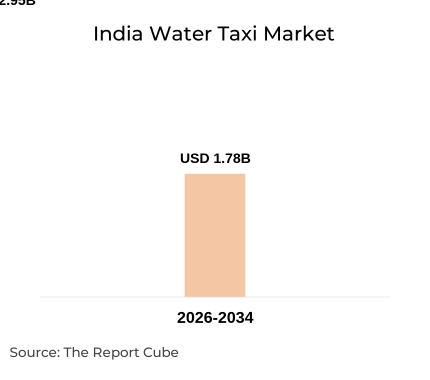
- India Water Taxi Market valued at USD 1.78 billion in 2026, reflecting growing urban waterway investments.
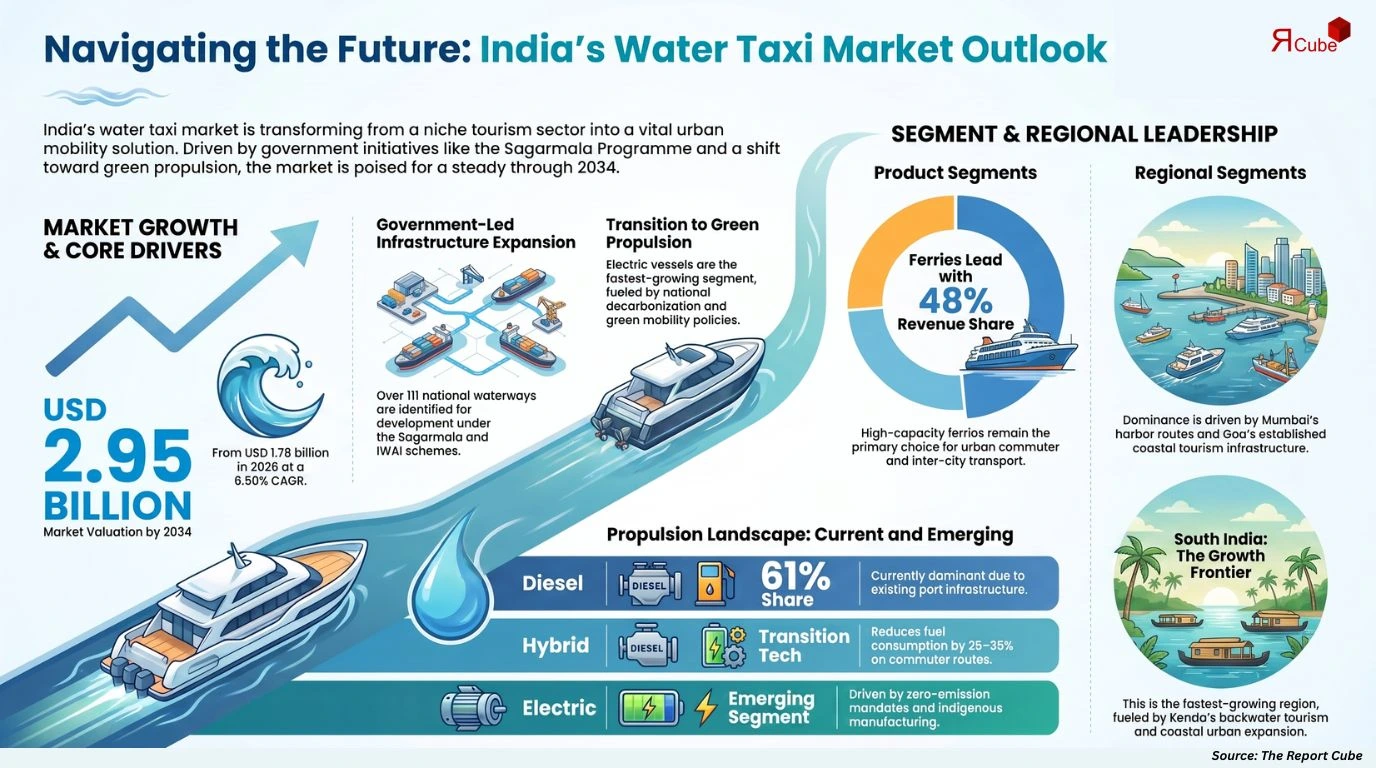
- Market projected to reach USD 2.95 billion by 2034, expanding at a steady 6.50% CAGR.
- Ferries dominate the By Product segment owing to high-capacity commuter and inter-city water transport demand.
- Electric propulsion is emerging as the fastest-growing segment driven by India's green mobility policy push.
- West India leads regional revenue generation through Mumbai and Goa waterway infrastructure and tourism activity.
- South India represents the fastest-growing region fueled by Kerala backwater tourism and coastal urban expansion.
- Leading companies include Princess Cruises, Austal, Azimut Benetti S.p.A, Ferretti Group, and Royal Caribbean Group.
- Rising urban congestion, port modernization, and government-backed waterway schemes continue accelerating market expansion.
India Water Taxi Market Insights & Analysis
The India Water Taxi Market is anticipated to register a 6.50% CAGR during 2026–2034. The market size was valued at USD 1.78 billion in 2026 and is projected to reach USD 2.95 billion by 2034. India's Inland Waterways Authority (IWAI) has identified over 111 national waterways for commercial development, with the government allocating approximately INR 4,000 crore under the Sagarmala Programme to boost river ferry services, water taxi corridors, and passenger jetty infrastructure. Increasing urban traffic congestion along coastal cities, combined with rising investments in green marine vessels, continues reinforcing long-term market growth.
India's water taxi ecosystem is further supported by state-level initiatives in Maharashtra, Kerala, Goa, West Bengal, and Andaman & Nicobar Islands that have formalized public-private partnerships for waterway passenger transport. The operationalization of the Mumbai Water Transport project, connecting key commuter nodes including Gateway of India, Belapur, and Mandwa, demonstrates growing institutional commitment to expanding water-based urban mobility networks. Increasing tourist arrivals in coastal and backwater destinations continue driving demand for leisure cruise and sailboat-based water taxi services alongside daily commuter operations.
India Water Taxi Market Dynamics
India's water taxi sector continues gathering momentum as municipalities, port trusts, and private operators jointly develop river and coastal passenger transport infrastructure. Government incentives for hybrid and electric vessel procurement, combined with rising demand for alternative urban mobility in congested coastal cities, are elevating water taxis from niche tourism assets to strategic public transport solutions. Supportive regulatory reforms by India's Ministry of Ports, Shipping, and Waterways continue broadening commercial deployment across key waterway corridors.
|
Factor |
Type |
Specific Impact on Market |
Magnitude |
|---|---|---|---|
|
Urban congestion and port modernization |
Driver |
Accelerates waterway commuter service deployment across coastal metros |
Very High |
|
Government Sagarmala and IWAI investments |
Driver |
Boosts vessel procurement and jetty infrastructure development |
High |
|
Electric and hybrid vessel mandates |
Opportunity |
Increases adoption of zero-emission water taxis on priority routes |
High |
|
Tourism growth in coastal and backwater zones |
Driver |
Expands leisure cruise and sailboat water taxi demand |
High |
|
Regulatory harmonization across states |
Trend |
Improves licensing, safety, and operational standardization for operators |
Moderate |
Key Market Driver: Government-Led Waterway Infrastructure Expansion
India's central and state governments have significantly accelerated investments in inland and coastal waterway passenger infrastructure under the Sagarmala Programme and IWAI's National Waterway development plan. The operationalization of National Waterway-1 connecting Varanasi and Haldia, alongside ferry route expansions in Kerala, Goa, and Mumbai, has created substantial procurement demand for ferries, water taxis, and hybrid vessels. These government-backed inland waterway development programs continue enabling private operators to launch commercially viable water taxi services with subsidized jetty access and route licensing support across priority urban corridors.
Major Industry Challenge: Aging Vessel Fleet and Safety Compliance Gaps
A significant portion of India's operational water taxi and ferry fleet comprises aging diesel-powered vessels that lack modern safety systems, passenger amenities, and navigation technologies. Retrofitting or replacing these vessels to comply with updated Directorate General of Shipping safety norms and inland waterway regulations requires substantial capital expenditure that smaller regional operators struggle to mobilize. Fragmented state-level regulatory frameworks further complicate fleet modernization timelines, creating operational inconsistencies and safety risks that discourage passenger adoption on emerging water taxi routes beyond established tourist corridors.
Emerging Trend Shaping Outlook: Electric and Solar-Hybrid Vessel Adoption
Indian operators and government bodies are increasingly procuring electric and solar-hybrid water taxis to reduce fuel costs, cut emissions, and align with national decarbonization targets. Cochin Shipyard's indigenous electric ferry Aditya, operational in Kerala, demonstrated that zero-emission vessel economics are commercially viable on short-distance routes. Multiple state governments have issued tenders for electric and hybrid water taxis as part of Smart City and green port initiatives, with vessel manufacturers responding by developing India-specific designs optimized for tropical waterway conditions, shallow draft navigation, and solar-assisted battery recharging systems.
Need Specific Data, Let’s Customize the Report for You
Request CustomizationIndia Water Taxi Market Segment-wise Analysis
India's water taxi sector encompasses a diverse range of vessel categories deployed across commuter, tourism, and leisure applications. Investment priorities differ significantly across urban river corridors, coastal ferry routes, and inland backwater tourism circuits, with vessel type and propulsion technology influencing both operational economics and regulatory classification for each deployment environment.
By Product
- Yachts
- Ferries
- Cruise
- Sail Boats
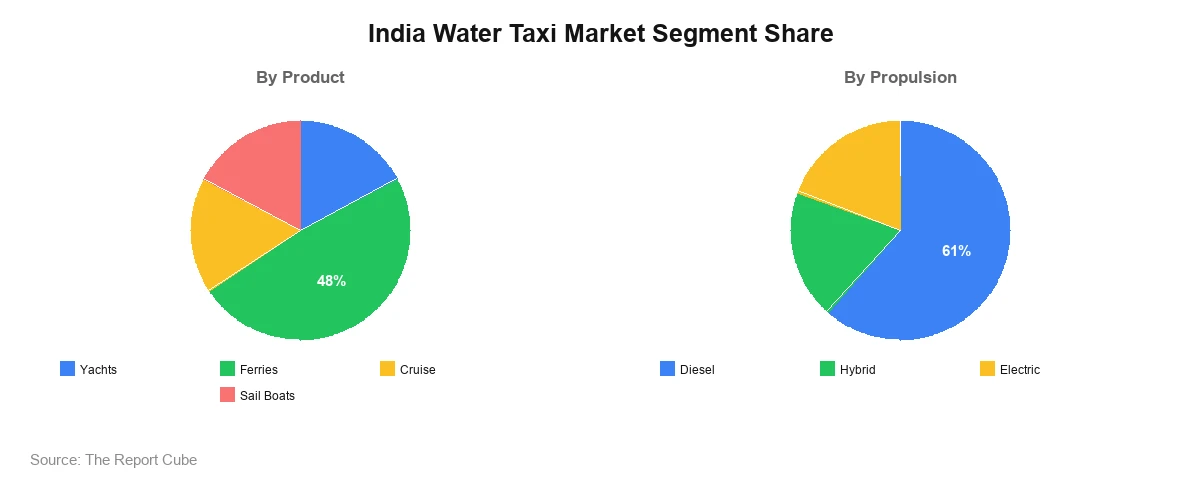
Ferries dominate the By Product segment with an estimated 48% revenue share, driven by their central role in daily urban commuter services across Mumbai harbor routes, the Brahmaputra river in Assam, and Godavari delta crossings in Andhra Pradesh. High passenger capacity, operational cost efficiency, and compatibility with existing government jetty infrastructure make ferries the default vessel category for newly sanctioned IWAI waterway projects. State transport corporations continue procuring hybrid-diesel ferries to replace aging fleets on high-frequency commuter corridors, reinforcing segment dominance through the forecast period.
Yachts and cruise vessels collectively account for a growing share of leisure-oriented water taxi revenue, particularly across Goa, Andaman & Nicobar Islands, Lakshadweep, and Kerala's Vembanad Lake tourism circuit. The luxury yacht and leisure vessel charter segment is expanding as domestic tourism rebounds and premium hospitality operators launch curated waterway experiences. Sail boats represent the smallest but fastest-growing product sub-segment, driven by adventure tourism operators and sailing academies along Maharashtra, Karnataka, and Tamil Nadu coastlines that are investing in modern fiberglass sailboat fleets to serve weekend leisure markets.
By Propulsion
- Diesel
- Hybrid
- Electric
Diesel propulsion retains the largest share at approximately 61% of the India Water Taxi Market by propulsion type, reflecting the widespread availability of marine diesel infrastructure across India's ports, river terminals, and coastal jetties. Diesel-powered ferries and water taxis continue to dominate high-frequency, long-distance routes where electric battery range remains insufficient and hybrid vessel procurement costs remain prohibitive for smaller state transport operators. However, tightening emission norms under India's National Clean Air Programme and port-level fuel regulations are beginning to erode diesel's dominance on urban short-haul routes.
Hybrid propulsion is gaining significant traction as a transitional technology, combining diesel generators with lithium-ion battery banks to reduce fuel consumption by 25–35% on stop-start commuter routes. Electric vessels represent the fastest-growing propulsion sub-segment, supported by Cochin Shipyard's manufacturing scale-up, KPIT Technologies' maritime electrification solutions, and growing state-level electric ferry tenders. The broader electric marine vessel adoption across South Asia is further reinforcing India's procurement pipeline, with central government subsidies under the FAME India extension under consideration for commercial electric water taxis deployed on national waterways.
Regional Projection of India Water Taxi Market
India's water taxi market demonstrates pronounced regional variation shaped by waterway infrastructure maturity, state government investment priorities, tourism activity, and urban density along major river and coastal corridors. West India currently leads revenue contribution while South India represents the most dynamic growth frontier.
|
Region |
Estimated Market Share |
Key Growth Factors |
Consumer Trends |
|---|---|---|---|
|
West India |
38.5% |
Mumbai harbor routes, Goa tourism, Maharashtra government waterway expansion |
High demand for commuter and leisure water taxis |
|
South India |
27.4% |
Kerala backwater tourism, Cochin harbor ferry, Tamil Nadu coastal expansion |
Rising electric ferry and eco-tourism vessel adoption |
|
East India |
19.8% |
Kolkata Hooghly River ferry, Brahmaputra NW-2 services, West Bengal port investments |
Growth in daily commuter ferry services |
|
North India |
14.3% |
Varanasi NW-1 corridor, Yamuna riverfront development, government pilot projects |
Emerging tourism and pilgrimage water taxi adoption |
- West India: West India commands approximately 38.5% of the India Water Taxi Market, anchored by Mumbai's busy harbor routes connecting the mainland to Elephanta Island, Alibaug, and Mandwa, alongside Goa's thriving coastal leisure and tourism water transport ecosystem that serves both domestic and international visitors year-round.
- South India: South India is the fastest-growing regional market, propelled by Kerala's internationally recognized backwater tourism circuit, expanding Cochin harbor ferry services, and Tamil Nadu's investments in Pamban and Rameswaram coastal water transport linking pilgrimage destinations and island communities with growing passenger volumes.
- East India: East India contributes a stable revenue share driven by Kolkata's longstanding Hooghly River ferry network, Assam's Brahmaputra National Waterway-2 passenger services, and West Bengal's ongoing port modernization investments that are progressively upgrading aging diesel ferry fleets with higher-capacity modern vessels.
- North India: North India represents an emerging market centered on the Varanasi-Haldia National Waterway-1 corridor and Yamuna riverfront development projects in Agra and Delhi, where government pilot programs are testing tourist-oriented water taxi operations with increasing stakeholder interest from hospitality and urban planning authorities.
India Water Taxi Market: Recent Development (2025)
- Austal secured a contract to deliver hybrid water taxis for India's western coastal ferry network.
- Cochin Shipyard launched its second-generation electric ferry for Kerala's Vembanad Lake route operations.
- Ferretti Group announced a strategic partnership with an Indian port operator for luxury yacht deployment.
- Maharashtra Maritime Board expanded Mumbai harbor water taxi routes adding three new commuter vessel corridors.
India Water Taxi Market Future Outlook (2034)
The India Water Taxi Market is projected to expand at a 6.50% CAGR, reaching approximately USD 2.95 billion by 2034. Continued government investment under the Sagarmala Programme, the operationalization of new national waterway segments, and growing private operator participation will sustain market momentum across commuter, tourism, and leisure segments. The accelerating shift toward electric and solar-hybrid vessel fleets will progressively reduce operational costs and attract new passenger demographics to water-based transit in India's congested coastal and riverine urban centers.
Long-term expansion will be reinforced by advances in vessel automation, real-time passenger management systems, integrated ticketing platforms, and smart jetty infrastructure. The future of India's inland and coastal marine passenger transport will increasingly depend on multi-modal connectivity where water taxis seamlessly integrate with metro rail, bus rapid transit, and last-mile mobility networks. Rising demand from Smart City missions, state tourism boards, and urban development authorities will create sustained procurement pipelines for modern ferry, cruise, and hybrid vessel categories through 2034.
India Water Taxi Market Report Coverage
|
Report Attribute |
Details |
|---|---|
|
Market Name |
India Water Taxi Market |
|
Market Size (2026) |
USD 1.78 Billion |
|
Market Size (2034) |
USD 2.95 Billion |
|
Forecast Period |
2026–2034 |
|
CAGR |
6.50% |
|
Base Year |
2026 |
|
Historical Years |
2021–2025 |
|
Forecast Years |
2026–2034 |
|
Segments Covered |
By Product, By Propulsion |
|
Regions Covered |
North India, South India, East India, West India |
|
Key Companies |
Princess Cruises, Austal, Azimut Benetti S.p.A, Catalina Yachts, Ferretti Group, Disney Cruise Line, Royal Caribbean Group, Carnival Corp, Bavaria Yachtbau GmbH, Others |
|
Report Format |
PDF, Excel, PPT |
|
Customization |
Available as per client requirements |
Why Choose This Report?
- Comprehensive analysis covering India's evolving waterway passenger transport landscape.
- Accurate market sizing with a reliable forecast through 2034 for strategic planning.
- Detailed segmentation by product type and propulsion technology driving revenue opportunities.
- Regional insights across North, South, East, and West India with growth projections.
- Competitive profiling of leading domestic and international water taxi vessel manufacturers.
- In-depth coverage of electric and hybrid propulsion adoption trends across key routes.
- Strategic insights aligned with India's Sagarmala and IWAI waterway investment programs.
- Data-driven research following EEAT principles and current maritime industry best practices.
Table of Contents
- Introduction
- Objective of the Study
- Product Definition
- Market Segmentation
- Study Variables
- Research Methodology
- Secondary Data Points
- Companies Interviewed
- Primary Data Points
- Breakdown of Primary Interviews
- Secondary Data Points
- Executive Summary
- Market Dynamics
- Drivers
- Challenges
- Opportunity Assessment
- Recent Trends and Developments
- Policy and Regulatory Landscape
- India Water Taxi Market Overview and Forecast Analysis (2021-2034)
- Market Size, By Value, By Growth Rate (CAGR/USD Billions)
- Demand – Supply Trends
- Market Share, By Product
- Yachts
- Ferries
- Cruise
- Sail Boats
- Market Share, By Propulsion
- Diesel
- Hybird
- Electric
- Market Share, By Region
- North India
- South India
- East India
- West India
- Market Share, By Competitors
- Competition Characteristics
- Revenue Shares
- Yachts India Water Taxi Market Overview, 2021-2034F
- By Value (USD Million)
- By Propulsion – Market Size & Forecast 2021-2034, USD Million
- Diesel
- Hybird
- Electric
- Ferries India Water Taxi Market Overview, 2021-2034F
- By Value (USD Million)
- By Propulsion – Market Size & Forecast 2021-2034, USD Million
- Diesel
- Hybird
- Electric
- Cruise India Water Taxi Market Overview, 2021-2034F
- By Value (USD Million)
- By Propulsion – Market Size & Forecast 2021-2034, USD Million
- Diesel
- Hybird
- Electric
- Sail Boats India Water Taxi Market Overview, 2021-2034F
- By Value (USD Million)
- By Propulsion – Market Size & Forecast 2021-2034, USD Million
- Diesel
- Hybird
- Electric
- Competitive Outlook (Company Profile – Partial List)
- Princess Cruises
- Company Overview
- Business Segments
- Strategic Alliances/Partnerships
- Recent Developments
- Austal
- Company Overview
- Business Segments
- Strategic Alliances/Partnerships
- Recent Developments
- Azimut Benetti S.p.A
- Company Overview
- Business Segments
- Strategic Alliances/Partnerships
- Recent Developments
- Catalina Yachts
- Company Overview
- Business Segments
- Strategic Alliances/Partnerships
- Recent Developments
- Ferretti Group
- Company Overview
- Business Segments
- Strategic Alliances/Partnerships
- Recent Developments
- Disney Cruise Line
- Company Overview
- Business Segments
- Strategic Alliances/Partnerships
- Recent Developments
- Royal Caribbean Grou
- Company Overview
- Business Segments
- Strategic Alliances/Partnerships
- Recent Developments
- Carnival Corp
- Company Overview
- Business Segments
- Strategic Alliances/Partnerships
- Recent Developments
- Bavaria Yachtbau GmbH
- Company Overview
- Business Segments
- Strategic Alliances/Partnerships
- Recent Developments
- Others
- Princess Cruises
- Contact Us & Disclaimer
Top Key Players & Market Share Outlook
- Princess Cruises
- Austal
- Azimut Benetti S.p.A
- Catalina Yachts
- Ferretti Group
- Disney Cruise Line
- Royal Caribbean Grou
- Carnival Corp
- Bavaria Yachtbau GmbH
- Others
Frequently Asked Questions






