



Build Your Custom Market Intelligence Report
Customize Your ReportUS Wind Turbine Market Insights & Analysis
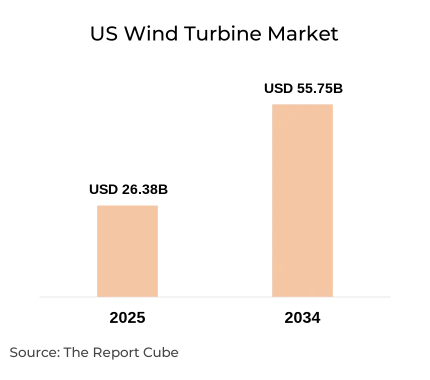
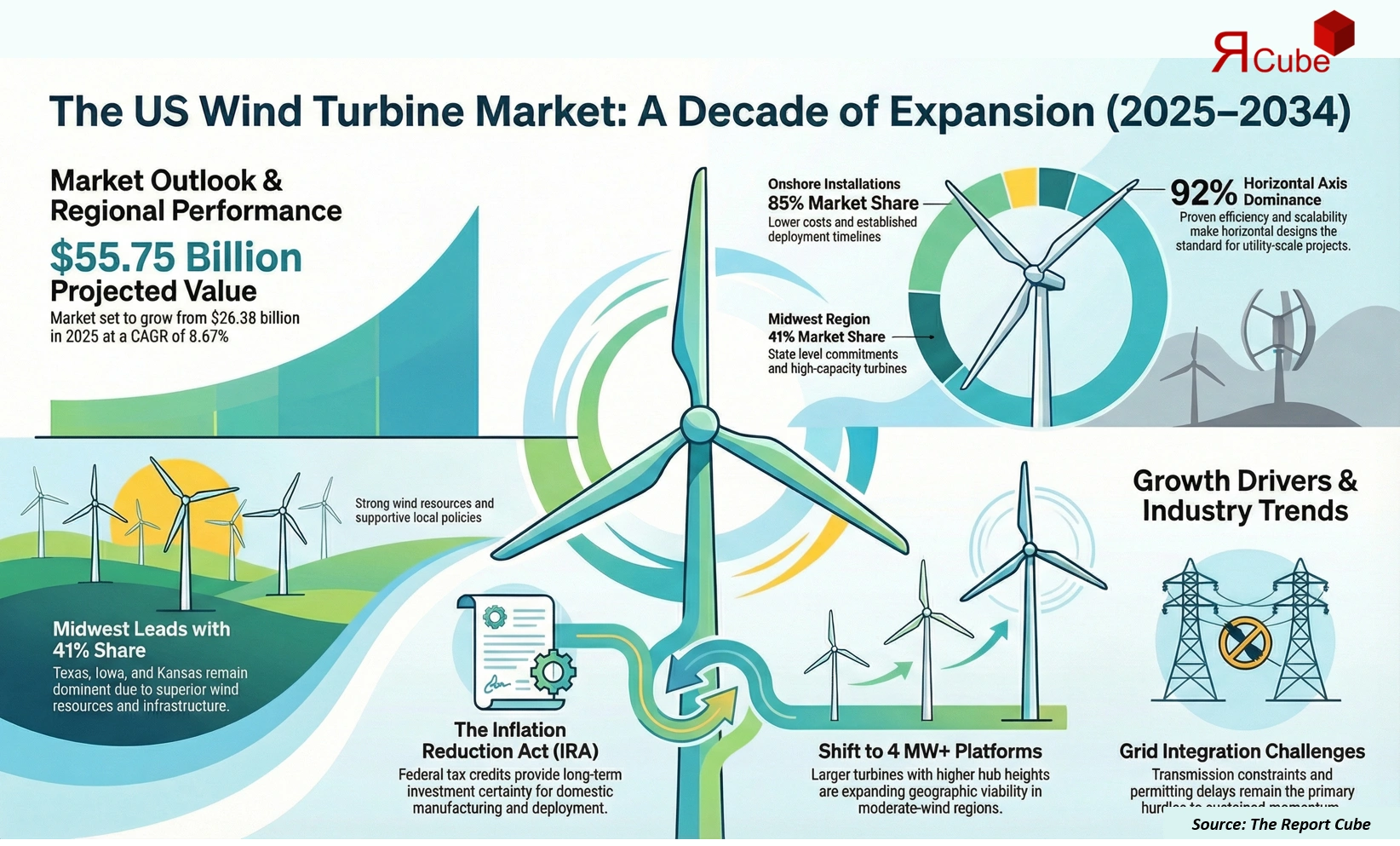
The US Wind Turbine Market is anticipated to register a CAGR of 8.67% during the forecast period 2026-2034. The market size was valued at USD 26.38 billion in 2025 and is projected to reach USD 55.75 billion by 2034. This strong growth trajectory reflects the accelerating transition toward renewable energy, rising electricity demand, and sustained policy support for decarbonization across the United States.
The US power generation mix is undergoing a structural shift as utilities, corporations, and state governments increasingly prioritize wind energy to meet clean energy targets. Wind power has emerged as one of the most cost-competitive sources of new electricity generation, particularly in regions with high wind resources such as the Midwest and parts of the West. Declining turbine costs, technological advancements in blade design, and improved capacity factors have significantly enhanced project economics, encouraging large-scale deployment.
Furthermore, the growing emphasis on energy security and domestic manufacturing is strengthening the wind turbine supply chain. Federal incentives, grid modernization investments, and rising corporate power purchase agreements are reinforcing long-term demand visibility. Together, these factors position the US Wind Turbine Market as a cornerstone of the nation’s renewable energy expansion through 2034.
US Wind Turbine Market Recent Developments
- 2025: GE Vernova expanded its US onshore turbine manufacturing capacity to support rising utility-scale project demand.
- 2025: Vestas secured multiple long-term service agreements for large wind farms across the Midwest.
Government Initiatives & Policies
- Inflation Reduction Act (IRA): Provides long-term tax credits for wind energy deployment and domestic manufacturing.
- DOE Wind Energy Technologies Office: Supports innovation, grid integration, and offshore wind development.
US Wind Turbine Market Dynamics
Key Driver: Strong Federal and State-Level Renewable Energy Targets
The primary driver of the US Wind Turbine Market is the expansion of renewable energy targets at both federal and state levels. More than 30 US states have implemented renewable portfolio standards or clean energy mandates, requiring utilities to source a growing share of electricity from renewables. Wind energy plays a central role in meeting these targets due to its scalability and cost efficiency. Federal incentives under long-term tax credit frameworks have reduced investment uncertainty, enabling developers to plan multi-gigawatt project pipelines. As utilities retire coal and aging gas assets, wind turbines are increasingly deployed as replacement capacity, ensuring consistent market growth through the forecast period.
Book your FREE 30-minute expert consultation today
Contact UsIndustry Trends: Shift Toward Larger, More Efficient Turbines
A key trend shaping the market is the rapid shift toward larger turbine platforms with higher hub heights and longer blades. Modern wind turbines installed in the US now regularly exceed 4 MW capacity for onshore projects, significantly improving energy output per installation. These advancements allow developers to maximize generation even in moderate wind speed regions, expanding the geographic viability of wind projects. Offshore wind is also emerging as a long-term growth segment, with coastal states advancing large-scale projects. Additionally, digital monitoring, predictive maintenance, and advanced control systems are improving turbine reliability and reducing operating costs, further enhancing market attractiveness.
Major Challenge: Grid Integration and Transmission Constraints
Despite robust demand, grid integration and transmission infrastructure limitations remain a major challenge for the US Wind Turbine Market. Many high-quality wind resources are located far from population centers, requiring substantial investment in transmission lines. Project delays caused by permitting complexities, interconnection queues, and local opposition can extend development timelines and increase costs. Grid congestion in key regions has also led to curtailment risks, affecting project revenues. Addressing these challenges will require coordinated policy action, infrastructure investment, and streamlined regulatory processes to sustain long-term market momentum.
Opportunity: Rapid Expansion of Offshore Wind Projects
The accelerating development of offshore wind presents a significant growth opportunity for the market. The US offshore wind pipeline now exceeds 30 GW, driven by strong policy support from coastal states and rising demand for clean energy near urban load centers. Offshore wind turbines offer higher capacity factors and consistent generation profiles compared to onshore installations. Investments in port infrastructure, domestic vessel construction, and supply chain localization are creating new economic opportunities while reducing project risk. As early projects move into construction, offshore wind is expected to become a major contributor to overall market value by 2034.
US Wind Turbine Market Segment-wise Analysis
By Axis Type:
- Horizontal Axis
- Vertical Axis
Horizontal Axis Wind Turbines dominate the US Wind Turbine Market, accounting for approximately 92% of total installations in 2025. Their high efficiency, scalability, and proven performance make them the preferred choice for utility-scale projects. Horizontal axis designs benefit from continuous innovation in blade aerodynamics and tower height, enabling higher energy capture. Vertical axis turbines hold a niche share, primarily used in small-scale or urban applications where space constraints exist. However, their limited capacity and lower efficiency restrict widespread adoption. As utility-scale projects continue to expand, horizontal axis turbines are expected to maintain their leadership throughout the forecast period.
By Installation:
- Onshore
- Offshore
Onshore wind installations currently lead the market, representing nearly 85% of total capacity due to lower costs and faster deployment timelines. The Midwest and West regions are key contributors to onshore growth, supported by abundant wind resources and established infrastructure. Offshore wind, while accounting for a smaller share today, is the fastest-growing segment. With several gigawatts under development, offshore installations are projected to increase their market share steadily, driven by higher capacity turbines and strong state-level commitments. This dual growth pattern underscores a balanced expansion across installation types.
Regional Projection of US Wind Turbine Industry
- Northeast
- Midwest
- South
- West
The Midwest leads the US Wind Turbine Market, accounting for approximately 41% of total installed capacity. States such as Texas, Iowa, and Kansas benefit from strong wind resources, supportive policies, and established transmission networks. The region’s dominance is reinforced by large-scale utility investments and long-term power purchase agreements. The West follows, driven by decarbonization goals and corporate renewable procurement. The Northeast is emerging as a hub for offshore wind development, while the South is gradually increasing adoption through hybrid renewable projects. Together, these regions support diversified and resilient market growth.
Need insights for a specific region within this market?
Request Regional DataWhy Choose This Report?
- Provides a comprehensive overview of the overall market analysis, encompassing key trends, consumer behavior analysis, and risk assessment to support strategic decision-making.
- Provides accurate, up-to-date insights into market size, segmentation, and emerging opportunities, helping to minimize risk & capitalizing on growth.
- Gives deep understanding of target audience preferences, investment habits, and communication channels for enhanced product development & marketing effectiveness.
- Delivers competitive analysis & benchmarking, uncovering the strengths & weaknesses of market competitors to guide strategies.
- Consolidate comprehensive market intelligence, reducing reasoning & streamlining research efforts.
- Facilitates customized market segmentation & risk mitigation strategies, fine-tuned to the business objectives.
- Aids in identifying both market challenges & untapped opportunities within the industry to drive long-term business growth.
- Provides valuable information based on actual customer data & search trends.
Table of Contents
- Introduction
- Objective of the Study
- Product and Category Definition
- Market Segmentation
- Study Variables
- Research Methodology
- Secondary Data Points
- Breakdown of Secondary Sources
- Primary Data Points
- Breakdown of Primary Interviews
- Secondary Data Points
- Executive Summary
- Market Dynamics
- Drivers
- Challenges
- Opportunity Assessment
- Recent Trends and Developments
- Regulatory and Policy Landscape
- United States Wind Turbine Market Overview (2021-2034)
- Market Size, By Value (USD Billion)
- Market Share, By Axis Type
- Horizontal Axis
- Vertical Axis
- Market Share, By Installation
- Onshore
- Offshore
- Market Share, By Connectivity
- Grid Connected
- Stand Alone
- Market Share, By Rating
- Up to 1 MW
- 1-2.5 MW
- 2.5-5 MW
- 5-10 MW
- Above 10 MW
- Market Share, By Application
- Utility
- Industrial
- Commercial
- Residential
- Others
- Market Share, By Region
- Northeast
- Midwest
- South
- West
- Market Share, By Company
- Competition Characteristics
- Revenue Shares & Analysis
- Northeast U.S. Wind Turbine Market
- Market Size, By Value (USD Billion)
- Market Share, By Axis Type
- Market Share, By Installation
- Market Share, By Connectivity
- Market Share, By Rating
- Market Share, By Application
- Market Share, By State
- New York
- Massachusetts
- New Jersey
- Others (Northeast)
- Midwest U.S. Wind Turbine Market
- Market Size, By Value (USD Billion)
- Market Share, By Axis Type
- Market Share, By Installation
- Market Share, By Connectivity
- Market Share, By Rating
- Market Share, By Application
- Market Share, By State
- Iowa
- Illinois
- Kansas
- Others (Midwest)
- South U.S. Wind Turbine Market
- Market Size, By Value (USD Billion)
- Market Share, By Axis Type
- Market Share, By Installation
- Market Share, By Connectivity
- Market Share, By Rating
- Market Share, By Application
- Market Share, By State
- Texas
- Oklahoma
- New Mexico
- Others (South)
- West U.S. Wind Turbine Market
- Market Size, By Value (USD Billion)
- Market Share, By Axis Type
- Market Share, By Installation
- Market Share, By Connectivity
- Market Share, By Rating
- Market Share, By Application
- Market Share, By State
- California
- Washington
- Oregon
- Others (West)
- Competitive Outlook and Company Profiles
- GE Vernova
- Company Overview
- Product Portfolio
- Strategic Alliances/Partnerships
- Recent Developments
- Vestas
- Company Overview
- Product Portfolio
- Strategic Alliances/Partnerships
- Recent Developments
- Siemens Gamesa
- Company Overview
- Product Portfolio
- Strategic Alliances/Partnerships
- Recent Developments
- Nordex Group
- Company Overview
- Product Portfolio
- Strategic Alliances/Partnerships
- Recent Developments
- Enercon
- Company Overview
- Product Portfolio
- Strategic Alliances/Partnerships
- Recent Developments
- Goldwind
- Company Overview
- Product Portfolio
- Strategic Alliances/Partnerships
- Recent Developments
- Mingyang
- Company Overview
- Product Portfolio
- Strategic Alliances/Partnerships
- Recent Developments
- Envision Energy
- Company Overview
- Product Portfolio
- Strategic Alliances/Partnerships
- Recent Developments
- ACCIONA
- Company Overview
- Product Portfolio
- Strategic Alliances/Partnerships
- Recent Developments
- Siemens Energy
- Company Overview
- Product Portfolio
- Strategic Alliances/Partnerships
- Recent Developments
- Others
- GE Vernova
- Contact Us and Disclaimer
Top Key Players & Market Share Outlook
- GE Vernova
- Vestas
- Siemens Gamesa
- Nordex Group
- Enercon
- Goldwind
- Mingyang
- Envision Energy
- ACCIONA
- Siemens Energy
- Others
Frequently Asked Questions






