




Build Your Custom Market Intelligence Report
Customize Your ReportItaly Wine Market Insights & Analysis
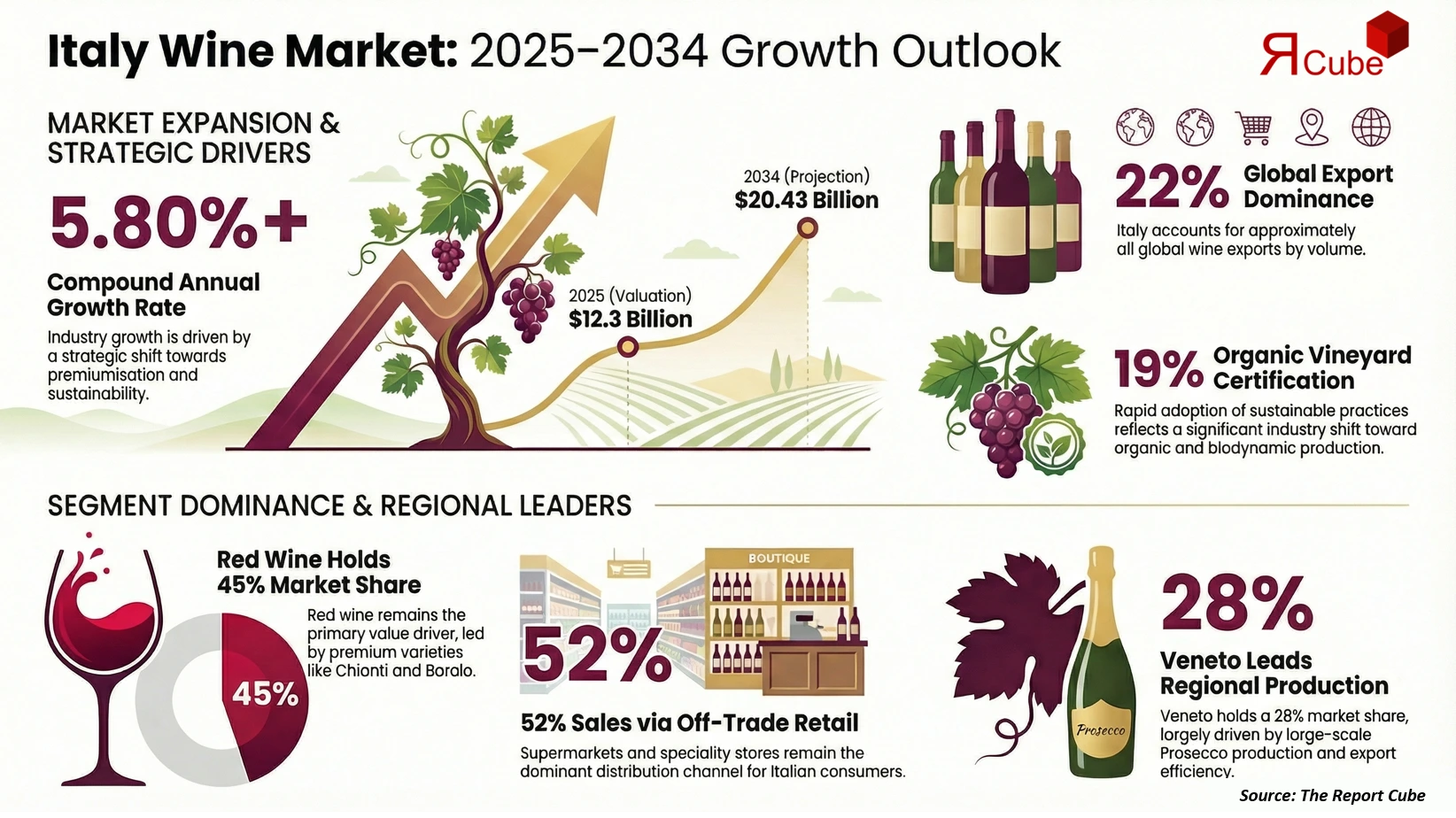
The Italy Wine Market is anticipated to register a CAGR of 5.80% during 2034. The market size was valued at USD 12.3 Billion in 2025 and is projected to reach USD 20.43 Billion by the end of the forecast period. Italy remains one of the world’s largest wine producers and exporters, supported by strong domestic consumption, premium wine exports, and deep-rooted cultural integration of wine into daily life.
Italy’s wine industry benefits from a diverse portfolio including red, white, sparkling, and fortified wines, with growing demand for DOC/DOCG-certified and organic variants. Export-oriented growth continues to accelerate, particularly across North America and Northern Europe, where Italian wines are perceived as high-quality yet competitively priced. Rising wine tourism, premiumization trends, and sustainable vineyard practices are further strengthening market value.
Additionally, evolving consumer preferences toward low-alcohol, organic, and region-specific wines are reshaping production strategies. Digital wine retail platforms and direct-to-consumer winery sales are improving accessibility and margins. With strong branding around regional appellations such as Tuscany, Piedmont, and Veneto, the Italy Wine Market is positioned for consistent long-term expansion.
Italy Wine Market Recent Developments
- 2025: Antinori expanded organic-certified vineyard acreage in Tuscany to support premium export demand.
- 2025: Caviro Group launched low-alcohol sparkling wine variants targeting younger consumers.
Government Initiatives & Policies
- Italian National Wine Sector Plan: Supports vineyard restructuring and export promotion programs.
- EU Common Agricultural Policy (CAP): Provides subsidies for sustainable viticulture and rural development.
Italy Wine Market Dynamics
Key Driver: Strong Export Demand for Premium Italian Wines
Rising international demand for Italian wines remains a primary growth driver. Italy accounts for nearly 22% of global wine exports by volume, with strong traction in the U.S., Germany, and the U.K. Premium DOC and DOCG wines command higher margins, while Prosecco continues to dominate the global sparkling wine category. Export revenues benefit from favorable brand perception, geographical indication protection, and competitive pricing compared to French counterparts. Additionally, Italy’s extensive varietal diversity allows producers to cater to multiple price tiers, enhancing resilience against market volatility.
Industry Trends: Premiumization and Sustainable Wine Production
The Italian wine industry is experiencing rapid premiumization, with consumers favoring terroir-driven, organic, and biodynamic wines. Over 19% of Italy’s vineyards are now organically certified, reflecting a strong shift toward sustainability. Eco-friendly packaging, carbon-neutral wineries, and traceability technologies are gaining prominence. Wine tourism is also expanding, contributing over USD 3.5 billion annually, reinforcing brand loyalty and direct sales channels.
Major Challenge: Climate Variability Impacting Grape Yields
Climate change poses a structural challenge for Italian wine producers. Rising temperatures, irregular rainfall, and extreme weather events have increased production costs and yield variability. Southern regions face drought stress, while northern regions experience harvest timing shifts. Small and mid-sized wineries face higher adaptation costs related to irrigation systems, vineyard relocation, and grape varietal changes, which may pressure profitability.
Book your FREE 30-minute expert consultation today
Contact UsOpportunity: Growth of Organic, Low-Alcohol, and Functional Wines
Changing consumer lifestyles present strong opportunities for innovation. Demand for organic, vegan-certified, and low-alcohol wines is growing at over 8% annually in Italy. Health-conscious consumers and younger demographics favor clean-label and responsibly produced wines. Producers investing in alcohol-reduction technologies, natural fermentation, and functional wine variants are well-positioned to capture emerging demand and expand export footprints.
Italy Wine Market Segment-wise Analysis
By Product Type:
- Red Wine
- White Wine
- Sparkling Wine
- Fortified Wine
Red Wine remains the leading product segment in the Italy Wine Market, accounting for approximately 45% of the total market value in 2025. This leadership is primarily driven by Italy’s deep-rooted wine culture, where red wine is traditionally consumed with meals and is widely regarded as a symbol of heritage and quality. Prominent red wine varieties such as Chianti, Barolo, Brunello di Montalcino, and Amarone enjoy strong domestic demand while also representing Italy’s most valuable wine exports.
From an economic perspective, red wines generate higher average revenue per bottle compared to white and table wines, largely due to extended aging potential, premium positioning, and strong brand recognition in international markets. Regions such as Tuscany, Piedmont, and Veneto collectively contribute a significant share of red wine production, supported by favorable terroir and protected designation systems such as DOC and DOCG. Export markets, particularly the United States, Germany, and the United Kingdom, continue to favor Italian red wines for their balance of quality, authenticity, and pricing.
Although sparkling wines are experiencing faster growth, red wine maintains its dominance due to stable year-round consumption, premiumization trends, and strong collector and restaurant demand. Rising interest in organic and single-vineyard red wines is further expected to strengthen this segment’s leadership through the forecast period.
By Distribution Channel:
- On-Trade (Hotels, Restaurants, Cafés)
- Off-Trade Retail
- Online & Direct-to-Consumer
- Wine Tourism Sales
Off-Trade Retail is the dominant distribution channel in the Italy Wine Market, holding an estimated 52% market share in 2025. Supermarkets, hypermarkets, and specialty wine retailers play a central role in wine sales due to their wide geographic presence, competitive pricing, and extensive product portfolios. Italian consumers strongly prefer retail purchases for everyday wine consumption, driven by convenience, promotional offers, and private-label availability.
Off-trade channels also provide greater visibility for regional and locally produced wines, enabling small and medium-sized wineries to reach a broader consumer base. Large retail chains increasingly stock premium DOC and DOCG wines, narrowing the gap between mass-market and premium offerings. This has strengthened retail’s position as the primary volume-driven channel across both urban and rural areas.
While online and direct-to-consumer sales are expanding rapidly, off-trade retail continues to lead due to higher sales volumes, well-established supply chains, and strong consumer trust. The integration of digital tools such as click-and-collect and in-store wine advisory services is expected to further reinforce the dominance of this channel over the forecast period.
Regional Projection of Italy Wine Industry
- Tuscany
- Piedmont
- Veneto
- Rest of Italy
Veneto leads the Italy Wine Market with an estimated 28% regional market share, driven by large-scale Prosecco production and export efficiency. Tuscany follows closely, benefiting from premium red wine exports and strong wine tourism inflows. Northern regions dominate volume, while central regions lead in value-driven premium wines.
Need insights for a specific region within this market?
Request Regional DataWhy Choose This Report?
- Provides a comprehensive overview of the overall market analysis, encompassing key trends, consumer behavior analysis, and risk assessment.
- Delivers accurate insights into market size, segmentation, and emerging opportunities.
- Offers deep understanding of target audience preferences and purchasing behavior.
- Includes competitive benchmarking to guide strategic positioning.
- Reduces research complexity through consolidated market intelligence.
- Supports customized segmentation and risk mitigation strategies.
- Identifies market challenges and untapped growth opportunities.
- Leverages real consumer data and search trends.
Table of Contents
- Introduction
- Objective of the Study
- Wine Product Definition
- Market Segmentation
- Study Variables
- Research Methodology
- Secondary Data Points
- Breakdown of Secondary Sources
- Primary Data Points
- Breakdown of Primary Interviews
- Secondary Data Points
- Executive Summary
- Market Dynamics
- Drivers
- Challenges
- Opportunity Assessment
- Recent Trends and Developments
- Regulatory and Policy Landscape
- Italy Wine Market Overview
- Market Size, By Value (USD Billion)
- Market Share, By Wine Type
- Red Wine
- White Wine
- Sparkling Wine
- Rosé Wine
- Dessert Wine
- Market Share, By Production Type
- Conventional Wine
- Organic Wine
- Biodynamic Wine
- Market Share, By Quality Classification
- DOCG
- DOC
- IGT
- Table Wine
- Market Share, By Distribution Channel
- Supermarkets
- Specialty Stores
- Online Retail
- On-Trade
- Market Share, By Price Range
- Economy
- Mid-Range
- Premium
- Market Share, By Company
- Competition Characteristics
- Revenue Shares & Analysis
- Market Share, By Region
- Piedmont Wine Market
- Market Size, By Volume & Value
- Market Share, By Wine Type
- Market Share, By Price Tier
- Market Share, By Distribution Channel
- Tuscany Wine Market
- Market Size, By Volume & Value
- Market Share, By Wine Type
- Market Share, By Price Tier
- Market Share, By Distribution Channel
- Veneto Wine Market
- Market Size, By Volume & Value
- Market Share, By Wine Type
- Market Share, By Price Tier
- Market Share, By Distribution Channel
- Sicily Wine Market
- Market Size, By Volume & Value
- Market Share, By Wine Type
- Market Share, By Price Tier
- Market Share, By Distribution Channel
- Piedmont Wine Market
- Competitive Outlook and Company Profiles
- Marchesi Antinori
- Company Overview
- Product Portfolio
- Strategic Alliances/Partnerships
- Recent Developments
- Gaja Winery
- Company Overview
- Product Portfolio
- Strategic Alliances/Partnerships
- Recent Developments
- Gruppo Italiano Vini
- Company Overview
- Product Portfolio
- Strategic Alliances/Partnerships
- Recent Developments
- Caviro Group
- Company Overview
- Product Portfolio
- Strategic Alliances/Partnerships
- Recent Developments
- Zonin Group
- Company Overview
- Product Portfolio
- Strategic Alliances/Partnerships
- Recent Developments
- Others
- Company Overview
- Business Segments
- Strategic Alliances/Partnerships
- Recent Developments
- Marchesi Antinori
- Contact Us / Disclaimer
Top Key Players & Market Share Outlook
- Marchesi Antinori
- Gaja Winery
- Gruppo Italiano Vini
- Caviro Group
- Zonin Group
- Others
Frequently Asked Questions






