



Build Your Custom Market Intelligence Report
Customize Your ReportSaudi Arabia 3D Printing Market Insights & Analysis
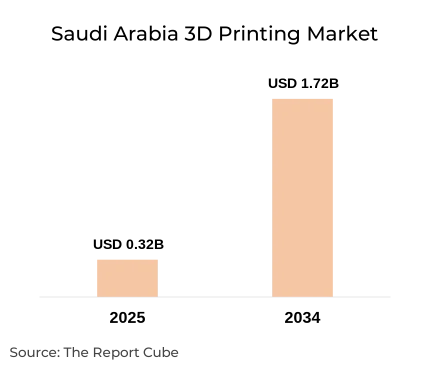
The Saudi Arabia 3D Printing Market is projected to grow at a 20.52% CAGR during 2026-2034. The market stood at USD 0.32 billion in 2025 and is expected to reach USD 1.72 billion by 2034. Growth is driven by strong national digital transformation initiatives, increasing industrial diversification under Vision 2030, and rapid adoption of advanced manufacturing technologies across automotive, aerospace, defense, construction, medical devices, and energy sectors. Saudi Arabia’s expanding innovation ecosystem including research centers, universities, and industrial zones continues to adopt 3D printing to accelerate prototyping, reduce lead times, optimize part performance, and localize production. As giga-projects such as NEOM and various industrial cities deploy additive manufacturing for construction elements, architectural modeling, and specialized components, market momentum continues to build. Local service bureaus and global OEMs are expanding their presence to provide materials, printing services, training, and certification programs.
The market is also benefitting from increased availability of high-performance materials including metal powders, engineering polymers, resins, and composites tailored for specific industrial applications. Sectors such as oil & gas increasingly use 3D printing for complex, lightweight components and spare parts, reducing supply-chain dependency and downtime. Healthcare providers adopt additive manufacturing for patient-specific implants, dental applications, and surgical models. Meanwhile, education and R&D institutions are integrating 3D printing into engineering curricula to strengthen national talent pipelines. As more organizations seek localized, cost-effective, and customizable production methods, additive manufacturing continues transitioning from prototyping to full-scale production within the Kingdom.
Saudi Arabia 3D Printing Market Recent Developments
- 2025: New metal additive manufacturing centers were announced in Riyadh and Dammam to support aerospace, defense, and oil & gas component production.
- 2025: Construction-focused 3D printing pilots expanded across NEOM and Red Sea developments, accelerating adoption of large-format printers and advanced concrete-printing materials.
Government Initiatives & Policies
- Vision 2030 Advanced Manufacturing Programs: National strategies support innovation, localization, and industrial diversification through incentives for additive manufacturing, R&D, and technology transfer.
- Digital & Industrial Development Authority Initiatives: Programs promoting digital factories, industrial automation, and certification frameworks help accelerate 3D printing adoption across private and public sectors.
Saudi Arabia 3D Printing Market Dynamics
Driver: Industrial Diversification, Localization Needs & Advanced Material Adoption
A primary driver of Saudi Arabia’s 3D printing market is the national drive to localize manufacturing, enhance supply-chain resilience, and accelerate industrial diversification. Additive manufacturing significantly reduces dependency on imported spare parts and enables rapid prototyping for industries such as defense, aerospace, oil & gas, and automotive. As the Kingdom invests in engineering innovation, high-performance materials such as metal alloys, engineering polymers, and composite resins are increasingly used to manufacture lightweight, durable, and geometrically complex components. Major industrial players leverage additive manufacturing for tooling optimization, customized components, and on-demand part production—delivering cost efficiencies, reduced downtime, and enhanced technological competitiveness.
Challenge: High Capex, Talent Gaps & Material Certification Barriers
Despite strong policy support, market growth faces challenges including the high upfront cost of industrial-grade 3D printers, metal systems, and specialized post-processing equipment. Limited local expertise in design-for-additive-manufacturing (DfAM) and insufficient workforce training hinder widespread adoption. Material certification for critical applications—particularly in aerospace, energy, and healthcare—requires rigorous testing, specialized infrastructure, and international accreditation, slowing commercialization timelines. The lack of standardized guidelines for industrial use and limited regional distribution networks for high-spec materials also add complexity for manufacturers. Overcoming these barriers requires coordinated investment in skills development, R&D infrastructure, and certification frameworks.
Opportunity: Large-Scale Construction Printing, Oil & Gas Components & Custom Medical Devices
Significant opportunity exists in large-format 3D printing for construction, where giga-projects increasingly adopt additive methods to accelerate building timelines, reduce waste, and create geometrically advanced components. The oil & gas sector presents another major opportunity, using additive manufacturing to produce lightweight, corrosion-resistant parts, complex geometries, and on-demand spares for remote facilities. Healthcare and dental sectors benefit from patient-specific implants, anatomical modeling, and orthodontic solutions. As service bureaus expand, offering on-demand printing, scanning, and design services, adoption among SMEs is expected to accelerate. The combination of cost reduction, customization, and rapid production will drive multi-sector growth moving forward.
Trend: Digital Factories, Cloud-Integrated Printing & Advanced Metal Additive Manufacturing
Saudi Arabia is seeing rising adoption of digital factories where additive manufacturing is integrated with automation, IoT sensors, cloud print management, and AI-driven optimization tools. Metal additive manufacturing—such as DMLS and electron-beam technologies—continues to expand for functional, high-performance components across industrial sectors. Cloud-based platforms allow centralized management of print farms, remote job scheduling, real-time monitoring, and predictive maintenance. Material innovation—particularly in high-strength alloys, bio-compatible materials, and reinforced composites—is creating new application horizons. These trends move the Kingdom toward smart, agile, and decentralized production environments aligned with Vision 2030 manufacturing goals.
Saudi Arabia 3D Printing Market Segment-wise Analysis
By Component:
- 3D Printers — Hardware
- Materials — Filaments/Resins/Metals
- Software & Services
- Others
3D Printers — Hardware lead the market with an estimated around 41% share. Industrial and professional-grade printers dominate demand due to large-scale adoption in aerospace, energy, automotive, construction, and research. Hardware investments are driven by the shift from rapid prototyping to end-use part manufacturing, requiring high reliability, precision, and compatibility with advanced materials. Expanding adoption of metal additive systems and large-format printers for construction and industrial design reinforces hardware’s dominance within total market revenue.
By Technology:
- FDM
- SLA
- SLS
- DMLS
- PolyJet & Others
DMLS (Direct Metal Laser Sintering) represents the leading technology segment with an estimated approximately 34% share. Demand for metal additive manufacturing is rising across defense, aerospace, oil & gas, and high-performance engineering applications requiring strong, lightweight, and intricately detailed components. DMLS supports the production of heat-resistant, structurally complex parts that cannot be easily produced through traditional methods, making it a strategic technology for Saudi Arabia’s industrial ambitions.
Regional Projection of Saudi Arabia 3D Printing Industry
By Region:
- Riyadh Region
- Eastern Province
- Makkah & Madinah Region
- NEOM/Tabuk Corridor
- Other Regions
Riyadh Region leads the market with an estimated about 43% share due to its concentration of research hubs, industrial zones, corporate headquarters, and technology investment programs. The region hosts advanced manufacturing centers partnering with global OEMs to develop additive solutions for aerospace, automotive, defense, and medical applications. Riyadh also benefits from strong government funding, innovation incentives, and the presence of training and certification facilities that accelerate skill development and commercialization of emerging technologies.
What Does Our Saudi Arabia 3D Printing Market Research Study Entail?
- Provides comprehensive market sizing and forecasting from 2026–2034, showing growth from USD 0.32 billion to USD 1.72 billion at a 20.52% CAGR with scenario insights across industrial and construction adoption.
- Delivers detailed segmentation across Components and Technologies, highlighting strong demand for hardware and metal additive systems.
- Offers regional analysis across Riyadh, Eastern Province, Makkah & Madinah, NEOM/Tabuk Corridor, and other areas for strategic investment and distribution planning.
- Profiles key industry players including Stratasys, 3D Systems, Desktop Metal, Markforged, HP, Ultimaker, Formlabs, Materialise, and leading Saudi service bureaus.
- Reviews major technology trends, material advancements, digital factory models, and strategic recommendations for OEMs, integrators, and industrial adopters.
Top Key Players
Stratasys Ltd., 3D Systems Corporation, Desktop Metal Inc., Markforged Holding Corporation, HP Inc. (3D Printing Division), Ultimaker B.V., Formlabs Inc., Materialise NV, Local Saudi 3D Printing Companies & Service Bureaus, and Others.
Table of Contents
- Introduction
- Objective of the Study
- Product/Technology Definition
- Market Segmentation
- Study Variables
- Research Methodology
- Secondary Data Points
- Breakdown of Secondary Sources
- Primary Data Points
- Breakdown of Primary Interviews
- Secondary Data Points
- Executive Summary
- Market Dynamics
- Drivers
- Challenges
- Opportunity Assessment
- Recent Trends and Developments
- Policy and Regulatory Landscape
- Saudi Arabia 3D Printing Market Overview (2020–2034)
- Market Size, By Volume (Units) & Value (USD Million)
- Market Share, By Component
- 3D Printers (Hardware)
- Materials (Filaments, Resins, Metals, etc.)
- Software & Services
- Others
- Market Share, By Technology
- Fused Deposition Modeling (FDM)
- Stereolithography (SLA)
- Selective Laser Sintering (SLS)
- Direct Metal Laser Sintering (DMLS)
- PolyJet & Others
- Market Share, By End-Use Industry
- Aerospace & Defense
- Automotive
- Healthcare & Medical Devices
- Construction
- Oil & Gas
- Consumer Products & Others
- Market Share, By Region
- Riyadh Region
- Eastern Province
- Makkah & Madinah Region
- NEOM/Tabuk Corridor
- Other Regions
- Market Share, By Company
- Revenue Shares
- Competitive Landscape
- Segment-wise & Industry-wise Market Forecast (2026–2034)
- By Component
- By Technology
- By End-Use Industry
- By Region
- Regional Analysis (2020–2034)
- Riyadh Region 3D Printing Market
- Market Size, By Volume & Value (USD Million)
- Market Share, By Component
- Market Share, By Technology
- Market Share, By Key Projects
- Eastern Province 3D Printing Market
- Market Size, By Volume & Value (USD Million)
- Market Share, By Component
- Market Share, By Technology
- Market Share, By Key Projects
- Makkah & Madinah Region 3D Printing Market
- Market Size, By Volume & Value (USD Million)
- Market Share, By Component
- Market Share, By Technology
- Market Share, By Key Projects
- NEOM/Tabuk Corridor 3D Printing Market
- Market Size, By Volume & Value (USD Million)
- Market Share, By Component
- Market Share, By Technology
- Market Share, By Key Projects
- Other Regions 3D Printing Market
- Market Size, By Volume & Value (USD Million)
- Market Share, By Component
- Market Share, By Technology
- Market Share, By Key Projects
- Competitive Outlook & Company Profiles
- Stratasys Ltd.
- Company Overview
- Business Segments
- Strategic Alliances/Partnerships
- Recent Developments
- 3D Systems Corporation
- Company Overview
- Business Segments
- Strategic Alliances/Partnerships
- Recent Developments
- Desktop Metal Inc.
- Company Overview
- Business Segments
- Strategic Alliances/Partnerships
- Recent Developments
- Markforged Holding Corporation
- Company Overview
- Business Segments
- Strategic Alliances/Partnerships
- Recent Developments
- HP Inc. (3D Printing Division)
- Company Overview
- Business Segments
- Strategic Alliances/Partnerships
- Recent Developments
- Ultimaker B.V.
- Company Overview
- Business Segments
- Strategic Alliances/Partnerships
- Recent Developments
- Formlabs Inc.
- Company Overview
- Business Segments
- Strategic Alliances/Partnerships
- Recent Developments
- Materialise NV
- Company Overview
- Business Segments
- Strategic Alliances/Partnerships
- Recent Developments
- Local Saudi 3D Printing Companies & Service Bureaus
- Company Overview
- Business Segments
- Strategic Alliances/Partnerships
- Recent Developments
- Stratasys Ltd.
- Contact Us / Disclaimer
Top Key Players & Market Share Outlook
- Stratasys Ltd.
- 3D Systems Corporation
- Desktop Metal Inc.
- Markforged Holding Corporation
- HP Inc. (3D Printing Division)
- Ultimaker B.V.
- Formlabs Inc.
- Materialise NV
- Local Saudi 3D Printing Companies & Service Bureaus
Frequently Asked Questions






