



Build Your Custom Market Intelligence Report
Customize Your ReportPhilippines 5G Deployment Market Key Highlights
By Component:
Hardware segment leads the market, with around 46% share.
By Network Architecture:
Non-Standalone 5G segment dominates the market, accounting for nearly 62% of total deployments.
Regional Outlook:
Luzon region dominates the Philippines 5g deployment market, with around 58% share.
Government Initiatives & Policies
- National Broadband Plan (Department of Information and Communications Technology): The Philippine government continues expanding nationwide broadband infrastructure to improve connectivity, support 5G deployment, and accelerate digital transformation across industries.
- Common Tower Policy Program: The Philippine government introduced a shared tower infrastructure framework to speed up mobile network expansion and reduce deployment costs for telecom operators developing 5G infrastructure.
Philippines 5G Deployment Market Insights & Analysis
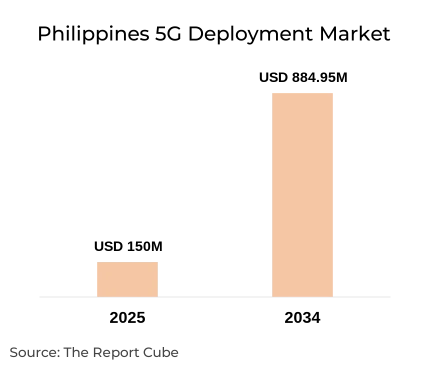
The Philippines 5G Deployment Market is anticipated to register a CAGR of 21.8% during 2026-2034. The market size was valued at USD 150 million in 2025 and is projected to reach USD 884.95 million by 2034. Rapid digital transformation, increasing mobile data consumption, and strong investment from telecom operators are shaping the country's next generation connectivity landscape.
The Philippines is experiencing a surge in mobile internet usage driven by video streaming, online gaming, and cloud-based services. Mobile data traffic in the country has increased significantly over the past few years as smartphone penetration continues to expand. With millions of users relying on mobile connectivity for work, education, and entertainment, telecom operators are under growing pressure to upgrade network capacity. As a result, 5G deployment has become a strategic priority for both private telecom companies and government agencies.
Telecommunication providers are investing heavily in network infrastructure upgrades to support higher bandwidth and lower latency services. Large operators are expanding fiber backhaul networks, modernizing tower infrastructure, and installing advanced radio access equipment capable of supporting high-speed connectivity. These infrastructure investments are not only improving mobile broadband speeds but also creating a foundation for future technologies such as smart cities, Internet of Things applications, and autonomous systems.
The development of digital infrastructure is also closely linked with national economic goals. The Philippine government continues promoting digitalization across sectors including finance, education, logistics, and manufacturing. Strong collaboration between government regulators and telecom companies is enabling faster approval processes for network installations, tower construction, and spectrum allocation. This supportive ecosystem is helping accelerate the rollout of 5G services across urban and semi-urban regions.
Another important driver is the rise of enterprise demand for advanced connectivity solutions. Businesses are increasingly adopting cloud computing platforms, real-time analytics systems, and automation technologies that require reliable high-speed networks. 5G networks provide the low latency and high reliability needed for these applications, making them essential for industries aiming to improve operational efficiency and digital capabilities.
Philippines 5G Deployment Market Dynamics
Key Driver: Rising Demand for High-Speed Mobile Connectivity and Digital Services
The Philippines has one of the fastest growing digital populations in Southeast Asia. Increasing smartphone adoption and growing reliance on digital platforms have created strong demand for high-speed mobile networks. Consumers are using mobile networks for video streaming, online gaming, digital payments, and remote work applications. These services require consistent high bandwidth and minimal network latency, creating a strong need for 5G infrastructure.
Telecom operators are responding to this demand by rapidly expanding their 5G coverage across major cities and commercial hubs. Investments in new base stations, fiber networks, and advanced radio technologies are improving network reliability and expanding coverage areas. This expansion is enabling telecom providers to deliver faster download speeds and improved network stability compared with earlier mobile network generations.
Beyond consumer demand, businesses are also accelerating their adoption of digital platforms that require high-performance connectivity. Industries such as logistics, manufacturing, and financial services rely on real-time data transmission and cloud-based applications. As these industries expand their digital operations, demand for advanced mobile networks continues to grow.
Book your FREE 30-minute expert consultation today
Contact UsIndustry Trends: Rapid Expansion of Fixed Wireless Access and Enterprise 5G Applications
One of the most prominent trends in the Philippine 5G market is the growing adoption of fixed wireless access solutions. FWA technology allows telecom operators to deliver high-speed broadband services without relying entirely on traditional fiber infrastructure. This approach is particularly valuable in regions where fiber deployment is challenging due to geographical or economic constraints.
Many telecom providers are introducing FWA solutions to provide reliable home and business broadband connectivity. These services allow users to access high-speed internet using 5G wireless networks, offering speeds comparable to fiber broadband. The growing popularity of remote work, online education, and digital entertainment has further accelerated demand for these services.
Enterprise applications are also becoming an important focus area for 5G deployment. Companies are exploring private 5G networks to support automation, industrial monitoring, and smart infrastructure projects. These networks allow organizations to maintain secure and reliable communication systems tailored to their operational needs.
Major Challenge: Infrastructure Investment and Spectrum Allocation Complexity
Although the Philippine 5G market shows strong growth potential, deploying nationwide infrastructure presents several operational challenges. Building thousands of base stations, expanding fiber backhaul networks, and upgrading existing telecom infrastructure require significant financial investment. Telecom companies must carefully balance these costs with long-term revenue expectations.
Geographic challenges also affect deployment speed. The Philippines consists of more than 7,000 islands, making network coverage expansion more complex compared with countries with contiguous landmass. Telecom providers must deploy additional infrastructure to ensure consistent coverage across multiple islands and remote regions.
Spectrum allocation and regulatory approvals can also influence deployment timelines. Telecom operators require access to sufficient spectrum resources to support high-capacity 5G networks. Coordinating spectrum usage while ensuring fair competition among providers requires careful regulatory management.
Opportunity: Smart Cities, Digital Economy Growth, and Industry 4.0 Adoption
The Philippines is entering a period of rapid digital transformation that creates strong opportunities for 5G deployment. Government initiatives promoting smart city development, digital public services, and advanced transport infrastructure are expected to increase demand for reliable high-speed connectivity.
5G networks enable technologies such as real-time traffic monitoring, connected surveillance systems, and intelligent energy management platforms. These solutions are becoming increasingly important as cities attempt to manage population growth and urban infrastructure demands.
Industry 4.0 technologies are also emerging as a major opportunity for telecom operators. Manufacturing companies are adopting automation systems, robotics, and real-time production monitoring platforms that require ultra-reliable network connectivity. By enabling these technologies, 5G networks can play a critical role in improving industrial productivity and economic competitiveness.
Philippines 5G Deployment Market Segment-wise Analysis
By Component:
- Hardware
- Radio Access Network (RAN)
- Core Network Equipment
- Transport and Backhaul
- Customer Premises Equipment (CPE)
- Software
- Network Management and Orchestration
- Network Performance and Analytics
- Security and Policy Management
- Operations Support Systems
- Services
- Planning and Consulting Services
- Integration and Deployment Services
- Managed Network Services
- Maintenance and Support Services
The hardware segment leads the Philippines 5G deployment market with nearly 46% share due to strong demand for network infrastructure equipment. Hardware components such as radio access network systems, core network equipment, transport networks, and customer premises equipment form the backbone of 5G connectivity.
Telecom operators are deploying thousands of new base stations and upgrading existing infrastructure to support advanced wireless technologies. These investments include high-capacity antennas, fiber transport networks, and edge computing infrastructure required for low-latency applications. As network coverage expands across urban centers and emerging cities, demand for hardware components continues to increase.
By Network Architecture:
- Non-Standalone 5G
- Standalone 5G
The non-standalone architecture segment dominates the Philippine 5G deployment market with approximately 62% share. Telecom providers initially deploy non-standalone networks because they allow operators to utilize existing LTE infrastructure while introducing 5G radio capabilities. This strategy enables faster rollout and reduces infrastructure costs during early deployment stages.
As networks mature and demand for ultra-low latency services increases, operators are expected to gradually transition toward standalone 5G architecture. Standalone networks provide advanced capabilities such as network slicing, improved latency performance, and support for massive IoT deployments.
Regional Projection of Philippines 5G Deployment Industry
- Luzon
- Visayas
- Mindanao
Luzon represents the leading regional market for 5G deployment in the Philippines due to its high concentration of population, businesses, and digital infrastructure. Metro Manila and surrounding urban areas host the majority of telecom network investments as they represent the country’s primary economic centers.
The region also benefits from strong fiber connectivity and a high density of mobile users. Telecom operators prioritize network upgrades in Luzon to meet the growing demand for mobile data services across residential, commercial, and enterprise sectors. As coverage expands, 5G networks are supporting emerging digital services such as cloud computing platforms, streaming services, and smart home technologies.
Philippines 5G Deployment Market Recent Developments
- 2025: Globe Telecom expanded its nationwide 5G network by deploying 235 new 5G sites and upgrading thousands of towers, extending coverage to more than 98% of Metro Manila and key cities across Visayas and Mindanao while supporting increasing demand for streaming, gaming, and smart home services.
- 2025: DITO Telecommunity announced plans to scale its fixed wireless access broadband services and target up to two million FWA subscribers by 2026, using the segment as a major revenue driver to accelerate nationwide 5G network expansion.
- 2025: PLDT Inc. / Smart continued expanding its 5G coverage by upgrading network infrastructure and deploying additional base stations to strengthen mobile broadband performance and support enterprise digital transformation initiatives.
- 2025: Ericsson Philippines partnered with local telecom operators to provide advanced 5G radio access solutions and network optimization technologies designed to improve network efficiency and coverage across major urban centers.
- 2025: Nokia Philippines introduced next-generation 5G core and transport network solutions aimed at supporting standalone 5G architecture and enabling advanced enterprise connectivity services.
Need insights for a specific region within this market?
Request Regional DataWhy Choose This Report?
- Provides a comprehensive overview of the overall market analysis, encompassing key trends, consumer behavior analysis, and risk assessment to support strategic decision-making.
- Provides accurate, up-to-date insights into market size, segmentation, and emerging opportunities, helping to minimize risk & capitalizing on growth.
- Gives deep understanding of target audience preferences, investment habits, and communication channels for enhanced product development & marketing effectiveness.
- Delivers competitive analysis & benchmarking, uncovering the strengths & weaknesses of market competitors to guide strategies.
- Consolidate comprehensive market intelligence, reducing reasoning & streamlining research efforts.
- Facilitates customized market segmentation & risk mitigation strategies, fine-tuned to the business objectives.
- Aids in identifying both market challenges & untapped opportunities within the industry to drive long-term business growth.
- Provides valuable information based on actual customer data & search trends.
Table of Contents
- Introduction
- Objective of the Study
- Product and Category Definition
- Market Segmentation
- Study Variables
- Research Methodology
- Secondary Data Points
- Breakdown of Secondary Sources
- Primary Data Points
- Breakdown of Primary Interviews
- Secondary Data Points
- Executive Summary
- Market Dynamics
- Drivers
- Challenges
- Opportunity Assessment
- Recent Trends and Developments
- Regulatory and Policy Landscape
- Philippines 5G Deployment Market Overview (2021-2034)
- Market Size, By Value (USD million)
- Market Share, By Component
- Hardware
- Radio Access Network (RAN)
- Core Network Equipment
- Transport and Backhaul
- Customer Premises Equipment (CPE)
- Software
- Network Management and Orchestration
- Network Performance and Analytics
- Security and Policy Management
- Operations Support Systems
- Services
- Planning and Consulting Services
- Integration and Deployment Services
- Managed Network Services
- Maintenance and Support Services
- Hardware
- Market Share, By Network Architecture
- Non-Standalone 5G
- Standalone 5G
- Market Share, By Spectrum Band
- Low-Band 5G
- Mid-Band 5G
- Millimeter-Wave 5G
- Market Share, By Deployment Mode
- Public 5G Network
- Private 5G Network
- Market Share, By Use Case
- Enhanced Mobile Broadband
- Fixed Wireless Access
- Massive Machine-Type Communications
- Ultra-Reliable Low-Latency Communications
- Market Share, By End User
- Consumer
- Enterprise
- Government and Public Sector
- Industrial and Manufacturing
- Transport and Logistics
- Smart Cities and Infrastructure
- Market Share, By Region
- Luzon
- Visayas
- Mindanao
- Market Share, By Company
- Revenue Shares and Analysis
- Competitive Landscape
- Luzon 5G Deployment Market
- Market Size, By Value (USD million)
- Market Share, By Component
- Market Share, By Network Architecture
- Market Share, By Spectrum Band
- Market Share, By Deployment Mode
- Market Share, By Use Case
- Market Share, By End User
- Visayas 5G Deployment Market
- Market Size, By Value (USD million)
- Market Share, By Component
- Market Share, By Network Architecture
- Market Share, By Spectrum Band
- Market Share, By Deployment Mode
- Market Share, By Use Case
- Market Share, By End User
- Mindanao 5G Deployment Market
- Market Size, By Value (USD million)
- Market Share, By Component
- Market Share, By Network Architecture
- Market Share, By Spectrum Band
- Market Share, By Deployment Mode
- Market Share, By Use Case
- Market Share, By End User
- Competitive Outlook and Company Profiles
- PLDT Inc. / Smart
- Company Overview
- Product Portfolio
- Strategic Alliances/Partnerships
- Recent Developments
- Globe Telecom
- Company Overview
- Product Portfolio
- Strategic Alliances/Partnerships
- Recent Developments
- DITO Telecommunity
- Company Overview
- Product Portfolio
- Strategic Alliances/Partnerships
- Recent Developments
- Converge ICT
- Company Overview
- Product Portfolio
- Strategic Alliances/Partnerships
- Recent Developments
- NOW Corporation
- Company Overview
- Product Portfolio
- Strategic Alliances/Partnerships
- Recent Developments
- Huawei Philippines
- Company Overview
- Product Portfolio
- Strategic Alliances/Partnerships
- Recent Developments
- Ericsson Philippines
- Company Overview
- Product Portfolio
- Strategic Alliances/Partnerships
- Recent Developments
- Nokia Philippines
- Company Overview
- Product Portfolio
- Strategic Alliances/Partnerships
- Recent Developments
- ZTE Philippines
- Company Overview
- Product Portfolio
- Strategic Alliances/Partnerships
- Recent Developments
- Radius Telecoms
- Company Overview
- Product Portfolio
- Strategic Alliances/Partnerships
- Recent Developments
- edotco Group
- Company Overview
- Product Portfolio
- Strategic Alliances/Partnerships
- Recent Developments
- PhilTower
- Company Overview
- Product Portfolio
- Strategic Alliances/Partnerships
- Recent Developments
- Unity Digital Infra
- Company Overview
- Product Portfolio
- Strategic Alliances/Partnerships
- Recent Developments
- EdgePoint Infra
- Company Overview
- Product Portfolio
- Strategic Alliances/Partnerships
- Recent Developments
- MEC Networks
- Company Overview
- Product Portfolio
- Strategic Alliances/Partnerships
- Recent Developments
- TP-Link Philippines
- Company Overview
- Product Portfolio
- Strategic Alliances/Partnerships
- Recent Developments
- Eastern Telecoms
- Company Overview
- Product Portfolio
- Strategic Alliances/Partnerships
- Recent Developments
- Others
- PLDT Inc. / Smart
- Contact Us and Disclaimer
Top Key Players & Market Share Outlook
- PLDT Inc. / Smart
- Globe Telecom
- DITO Telecommunity
- Converge ICT
- NOW Corporation
- Huawei Philippines
- Ericsson Philippines
- Nokia Philippines
- ZTE Philippines
- Radius Telecoms
- edotco Group
- PhilTower
- Unity Digital Infra
- EdgePoint Infra
- MEC Networks
- TP-Link Philippines
- Eastern Telecoms
Frequently Asked Questions






