



Build Your Custom Market Intelligence Report
Customize Your ReportPhilippines Telecommunications Infrastructure Market Key Highlights
By Network Type:
Wireless Access segment leads the market, with around 34% market share.
By Infrastructure Type:
Fiber Optic Cable segment dominates the market, accounting for nearly 38% of total revenue.
Regional Outlook:
Luzon dominates the Philippines telecommunications infrastructure market, with around 46% market share.
Government Initiatives & Policies
- National Broadband Plan (NBP) Expansion Program: The Philippine government continues expanding nationwide fiber connectivity through the National Broadband Plan to strengthen digital infrastructure and connect underserved provinces and municipalities.
- Common Tower Policy Program: The Department of Information and Communications Technology implemented the Common Tower Policy to accelerate telecom tower deployment by allowing independent tower companies to build shared infrastructure nationwide.
Philippines Telecommunications Infrastructure Market Insights & Analysis
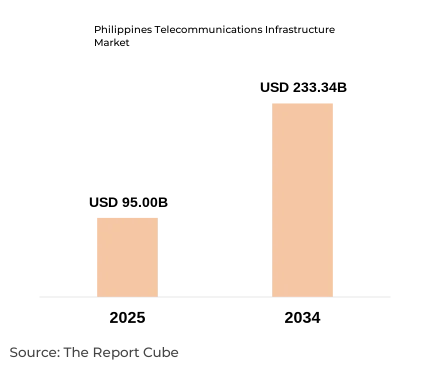
The Philippines Telecommunications Infrastructure Market is anticipated to register a CAGR of 10.5% during 2026-2034. the market size was valued at USD 95.0 billion in 2025 and is projected to reach USD 233.34 billion by 2034. The market is experiencing rapid transformation as the country accelerates digital connectivity, expands fiber broadband networks, and prepares for widespread 5G deployment. Telecommunications infrastructure has become one of the most critical pillars supporting the Philippines’ digital economy, especially as demand for high-speed internet, cloud services, and mobile connectivity continues to expand across both urban and rural areas.
Investment activity across the sector has intensified over the past few years. Major operators including PLDT Inc., Globe Telecom, and DITO Telecommunity are allocating billions of dollars toward fiber backbone networks, 5G infrastructure, and data center expansion. Fiber connectivity is particularly gaining momentum as operators gradually replace legacy copper networks with gigabit-capable fiber systems. In 2025 alone, fiber coverage reached millions of households, enabling reliable broadband access in areas that previously depended on slower DSL services.
Government initiatives are also playing an important role in strengthening telecommunications infrastructure nationwide. Programs such as the National Broadband Plan and the Common Tower Policy are designed to reduce infrastructure bottlenecks and encourage shared tower development. These initiatives help speed up network deployment while lowering operational costs for telecom providers. The government has also streamlined permitting processes for tower construction, significantly reducing approval timelines from several months to a few weeks.
Technology innovation continues to reshape the market landscape. The transition toward 5G networks is unlocking new opportunities for ultra-fast connectivity, low-latency applications, and smart city infrastructure. Telecommunications companies are also adopting software-driven technologies such as network virtualization and cloud-native network management. These developments are enabling operators to scale capacity efficiently while supporting emerging digital services including IoT networks, enterprise cloud connectivity, and high-definition video streaming. As digital adoption accelerates across industries and households, the Philippines telecommunications infrastructure market is positioned for sustained expansion throughout the forecast period.
Philippines Telecommunications Infrastructure Market Dynamics
Key Driver: Rapid Expansion of Digital Connectivity and Mobile Internet Usage
The increasing reliance on mobile internet services and digital platforms is one of the primary forces driving the Philippines telecommunications infrastructure market. Over the past decade, smartphone adoption across the country has expanded dramatically, reaching more than 75% of the population by 2025. This surge in mobile device usage has created unprecedented demand for reliable wireless networks, high-capacity fiber backbones, and advanced data infrastructure.
Filipino consumers are among the most active internet users globally, spending an average of nine hours online each day across social media, video streaming, online gaming, and e-commerce platforms. Such heavy digital engagement places significant pressure on telecommunications infrastructure. To address this demand, telecom operators are rapidly expanding base stations, fiber networks, and small cell deployments to improve network performance and reduce congestion.
The enterprise sector is also fueling infrastructure development. Businesses across banking, retail, healthcare, and logistics increasingly rely on cloud computing, digital payments, and remote collaboration tools. Reliable connectivity is no longer optional but essential for business operations. This shift is encouraging telecom operators to invest in advanced backbone networks and high-capacity transport systems capable of supporting large-scale data traffic. As digital adoption continues across both consumer and enterprise sectors, infrastructure investment is expected to remain a top priority.
Book your FREE 30-minute expert consultation today
Contact UsIndustry Trends: Fiberization and 5G Deployment Transform National Connectivity
The telecommunications industry in the Philippines is undergoing a structural shift toward fiber-based connectivity and next-generation wireless technologies. Fiber optic networks are rapidly replacing traditional copper lines, delivering significantly faster speeds and improved reliability for both residential and enterprise customers. Telecom operators are aggressively expanding fiber footprints in urban centers as well as in secondary cities and municipalities.
5G deployment represents another major industry trend. Since the launch of commercial 5G networks, telecom providers have expanded coverage to major metropolitan areas including Metro Manila, Cebu, and Davao. These networks deliver ultra-fast speeds and support advanced digital applications such as smart manufacturing, telemedicine, and immersive entertainment. As coverage expands, 5G is expected to become a key enabler of digital innovation across the country.
Infrastructure sharing has also emerged as a critical trend shaping the market. Independent tower companies are increasingly collaborating with telecom operators to build and manage shared towers. This model accelerates network expansion while lowering capital expenditure requirements for mobile network operators. In addition, operators are integrating cloud-based network architectures and software-defined networking technologies, allowing them to optimize traffic management and improve network efficiency.
Major Challenge: Infrastructure Deployment Barriers and Geographic Complexity
Although the telecommunications infrastructure market in the Philippines is expanding rapidly, several challenges continue to affect network deployment. One of the most significant barriers is the country’s geographic structure. The Philippines consists of more than 7,600 islands, making infrastructure rollout more complex and costly compared with mainland markets.
Building fiber backbones across islands requires extensive subsea cable networks and specialized engineering expertise. The cost of deploying telecommunications equipment in remote or mountainous regions can be significantly higher than in urban areas. In addition, limited access to power infrastructure in rural communities can complicate the installation of base stations and communication towers.
Another challenge involves right-of-way approvals and local permitting processes. While regulatory reforms have improved approval timelines, certain regions still face administrative delays that slow infrastructure construction. Telecom operators must coordinate with multiple government agencies and local authorities before installing towers or laying fiber cables. These complexities increase project timelines and operational costs.
Addressing these challenges will require continued collaboration between government agencies, infrastructure providers, and telecom operators. Simplified regulatory frameworks, improved logistical planning, and investment in resilient network design can help overcome deployment obstacles and support nationwide connectivity.
Opportunity: Emerging Digital Economy and Smart Infrastructure Development
The Philippines telecommunications infrastructure market holds strong growth potential as the country advances toward a fully digital economy. Rapid digitalization across industries is creating new demand for high-capacity communication networks and advanced digital infrastructure. Government initiatives supporting digital transformation, fintech development, and e-commerce expansion are accelerating connectivity requirements nationwide.
Smart city initiatives present another major opportunity. Urban areas are exploring smart transportation systems, digital surveillance networks, and connected public services that rely on robust telecommunications infrastructure. 5G connectivity combined with fiber backbones can support real-time data processing, enabling efficient traffic management and public safety monitoring.
The growth of data centers and cloud computing facilities is also expanding infrastructure requirements. Global technology companies and regional cloud providers are investing in data centers across Southeast Asia, and the Philippines is emerging as a strategic location due to its growing digital population and improving connectivity. Telecom operators are increasingly integrating fiber networks with data center ecosystems to support enterprise cloud services.
As digital technologies become embedded in everyday life, telecommunications infrastructure will serve as the backbone of economic development. With sustained investments, supportive regulatory frameworks, and expanding digital demand, the market is expected to witness significant growth opportunities throughout the forecast period.
Philippines Telecommunications Infrastructure Market Segment-wise Analysis
By Network Type:
- Wireless Access
- Fixed Broadband
- Transport Network
- Core Network
- Data Center
Wireless access represents the leading segment in the Philippines telecommunications infrastructure market, accounting for approximately 34% of total market share in 2025. The dominance of this segment reflects the country's heavy reliance on mobile connectivity as the primary gateway to internet access. Millions of Filipino users depend on smartphones for communication, entertainment, and financial services, making wireless infrastructure a central component of the telecom ecosystem.
Mobile network operators continue to invest heavily in expanding wireless coverage through the deployment of additional base stations and small cells. These upgrades help increase network capacity and improve data speeds in densely populated urban centers. The expansion of 4G LTE networks remains important for ensuring nationwide coverage, particularly in rural regions where 5G infrastructure is still developing.
At the same time, the rollout of 5G networks is accelerating across major metropolitan areas. Operators are deploying advanced antennas and spectrum technologies that enable faster speeds and lower latency compared with previous generations. These improvements support high-bandwidth applications such as video streaming, cloud gaming, and enterprise connectivity services. As smartphone penetration continues to rise, wireless access infrastructure will remain a crucial driver of telecommunications market growth.
By Infrastructure Type:
- Towers and Poles
- Fiber Optic Cable
- Base Stations
- Small Cells
- Backhaul Links
- Power Systems
Fiber optic cable infrastructure dominates the Philippines telecommunications infrastructure market with an estimated market share of 38%. Fiber technology provides significantly higher bandwidth capacity compared with traditional copper networks, enabling gigabit-speed internet services for both households and businesses. Telecom operators are aggressively investing in fiber expansion to meet growing demand for high-speed broadband connectivity.
Fiber networks serve as the backbone of modern telecommunications systems, connecting base stations, data centers, and international subsea cables. In recent years, operators have deployed thousands of kilometers of new fiber routes across Luzon, Visayas, and Mindanao to strengthen network resilience and support increasing data traffic. These investments help reduce network congestion while improving overall service reliability.
The growing popularity of fiber-to-the-home services is also driving segment growth. Consumers increasingly expect stable and high-speed internet connections for remote work, online education, and streaming services. Telecom companies are therefore prioritizing fiber infrastructure to deliver consistent performance and future-ready connectivity. As digital consumption continues to rise across the country, fiber networks will remain the cornerstone of telecommunications infrastructure development.
Regional Projection of Philippines Telecommunications Infrastructure Industry
- Luzon
- Visayas
- Mindanao
Luzon holds the largest share of the Philippines telecommunications infrastructure market, accounting for approximately 46% of national infrastructure investments. The region includes Metro Manila and several major economic centers, making it the primary hub for telecommunications activity. High population density, strong economic activity, and widespread digital adoption contribute to the region’s leading position.
Telecommunications providers have concentrated a significant portion of their network expansion efforts in Luzon to support the large base of residential and enterprise users. Major fiber backbones, international subsea cable landing stations, and data center facilities are located in this region, enabling high-capacity connectivity for businesses and consumers alike.
Metro Manila in particular serves as the focal point of telecom infrastructure development. The region hosts dense clusters of communication towers, fiber networks, and data exchange facilities that support millions of daily internet users. Telecom companies are also deploying advanced 5G infrastructure throughout urban centers to deliver enhanced mobile broadband services.
While Luzon continues to lead the market, infrastructure development is gradually expanding toward Visayas and Mindanao as operators aim to close the digital connectivity gap. Investments in subsea fiber links and rural tower deployment are improving access to reliable internet services in these regions. Over time, this expansion will help distribute digital opportunities more evenly across the Philippines.
Philippines Telecommunications Infrastructure Market Recent Developments
- 2025: Globe Telecom upgraded more than 600 towns across the Philippines to full fiber-optic internet infrastructure. The company eliminated copper-based connectivity in these locations, significantly improving broadband speeds while accelerating growth in fiber subscribers and residential broadband revenues during 2025.
- 2025: DITO Telecommunity highlighted rapid adoption of its 5G-powered fixed wireless access and WoWFi services. The company operates a full-scale standalone 5G network that delivers ultra-low latency and high-capacity connectivity for Filipino households and digital services.
- 2025: Converge ICT Solutions announced an ambitious plan to expand its nationwide fiber network to 11 million ports by 2027. The initiative includes large-scale fiber rollout in underserved municipalities and the construction of new data centers supported by subsea cable systems.
- 2025: PhilTower Consortium revealed plans to invest approximately USD 150 million in 2025 to deploy around 1,000 new telecommunications towers across the country, including major installations across Luzon, Visayas, and Mindanao to enhance nationwide mobile coverage.
Need insights for a specific region within this market?
Request Regional DataWhy Choose This Report?
- Provides a comprehensive overview of the overall market analysis, encompassing key trends, consumer behavior analysis, and risk assessment to support strategic decision-making.
- Provides accurate, up-to-date insights into market size, segmentation, and emerging opportunities, helping to minimize risk & capitalizing on growth.
- Gives deep understanding of target audience preferences, investment habits, and communication channels for enhanced product development & marketing effectiveness.
- Delivers competitive analysis & benchmarking, uncovering the strengths & weaknesses of market competitors to guide strategies.
- Consolidate comprehensive market intelligence, reducing reasoning & streamlining research efforts.
- Facilitates customized market segmentation & risk mitigation strategies, fine-tuned to the business objectives.
- Aids in identifying both market challenges & untapped opportunities within the industry to drive long-term business growth.
- Provides valuable information based on actual customer data & search trends.
Table of Contents
- Introduction
- Objective of the Study
- Product and Category Definition
- Market Segmentation
- Study Variables
- Research Methodology
- Secondary Data Points
- Breakdown of Secondary Sources
- Primary Data Points
- Breakdown of Primary Interviews
- Secondary Data Points
- Executive Summary
- Market Dynamics
- Drivers
- Challenges
- Opportunity Assessment
- Recent Trends and Developments
- Regulatory and Policy Landscape
- Philippines Telecommunications Infrastructure Market Overview (2021-2034)
- Market Size, By Value (USD Billion)
- Market Share, By Network Type
- Wireless Access
- Fixed Broadband
- Transport Network
- Core Network
- Data Center
- Market Share, By Infrastructure Type
- Towers and Poles
- Fiber Optic Cable
- Base Stations
- Small Cells
- Backhaul Links
- Power Systems
- Market Share, By Technology
- 2G and 3G
- 4G and LTE
- 5G
- IP and MPLS
- SDN and NFV
- Market Share, By Ownership
- Mobile Network Operators
- Tower Companies
- Neutral Hosts
- Infrastructure Funds
- Market Share, By End User
- Consumer Services
- Enterprise Services
- Public Sector
- Wholesale and Carrier
- Market Share, By Region
- Luzon
- Visayas
- Mindanao
- Market Share, By Company
- Revenue Shares and Analysis
- Competitive Landscape
- Luzon Telecommunications Infrastructure Market
- Market Size, By Value (USD Billion/Million)
- Market Share, By Network Type
- Market Share, By Infrastructure Type
- Market Share, By Technology
- Market Share, By Ownership
- Market Share, By End User
- Visayas Telecommunications Infrastructure Market
- Market Size, By Value (USD Billion/Million)
- Market Share, By Network Type
- Market Share, By Infrastructure Type
- Market Share, By Technology
- Market Share, By Ownership
- Market Share, By End User
- Mindanao Telecommunications Infrastructure Market
- Market Size, By Value (USD Billion/Million)
- Market Share, By Network Type
- Market Share, By Infrastructure Type
- Market Share, By Technology
- Market Share, By Ownership
- Market Share, By End User
- Competitive Outlook and Company Profiles
- PLDT Inc. / Smart
- Company Overview
- Product Portfolio
- Strategic Alliances/Partnerships
- Recent Developments
- Globe Telecom
- Company Overview
- Product Portfolio
- Strategic Alliances/Partnerships
- Recent Developments
- DITO Telecommunity
- Company Overview
- Product Portfolio
- Strategic Alliances/Partnerships
- Recent Developments
- Converge ICT Solutions
- Company Overview
- Product Portfolio
- Strategic Alliances/Partnerships
- Recent Developments
- edotco Philippines
- Company Overview
- Product Portfolio
- Strategic Alliances/Partnerships
- Recent Developments
- PhilTower Consortium
- Company Overview
- Product Portfolio
- Strategic Alliances/Partnerships
- Recent Developments
- Unity Digital Infra
- Company Overview
- Product Portfolio
- Strategic Alliances/Partnerships
- Recent Developments
- EdgePoint Towers PH
- Company Overview
- Product Portfolio
- Strategic Alliances/Partnerships
- Recent Developments
- MIESCOR Infra (MIDC)
- Company Overview
- Product Portfolio
- Strategic Alliances/Partnerships
- Recent Developments
- PFOCN
- Company Overview
- Product Portfolio
- Strategic Alliances/Partnerships
- Recent Developments
- American Tower (ATC)
- Company Overview
- Product Portfolio
- Strategic Alliances/Partnerships
- Recent Developments
- SBA Towers Philippines
- Company Overview
- Product Portfolio
- Strategic Alliances/Partnerships
- Recent Developments
- LBS Digital Infra
- Company Overview
- Product Portfolio
- Strategic Alliances/Partnerships
- Recent Developments
- PT&T Corp.
- Company Overview
- Product Portfolio
- Strategic Alliances/Partnerships
- Recent Developments
- Tiger Infrastructure
- Company Overview
- Product Portfolio
- Strategic Alliances/Partnerships
- Recent Developments
- Now Telecom
- Company Overview
- Product Portfolio
- Strategic Alliances/Partnerships
- Recent Developments
- Eastern Communications
- Company Overview
- Product Portfolio
- Strategic Alliances/Partnerships
- Recent Developments
- Others
- PLDT Inc. / Smart
- Contact Us and Disclaimer
Top Key Players & Market Share Outlook
- PLDT Inc. / Smart
- Globe Telecom
- DITO Telecommunity
- Converge ICT Solutions
- edotco Philippines
- PhilTower Consortium
- Unity Digital Infra
- EdgePoint Towers PH
- MIESCOR Infra (MIDC)
- PFOCN
- American Tower (ATC)
- SBA Towers Philippines
- LBS Digital Infra
- PT&T Corp.
- Tiger Infrastructure
- Now Telecom
- Eastern Communications
Frequently Asked Questions






