



Build Your Custom Market Intelligence Report
Customize Your ReportJapan Active Data Warehousing Market Key Takeaways
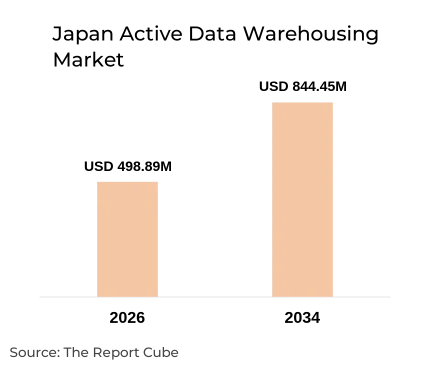
- Japan active data warehousing market valued at USD 498.89 million in 2026, reflecting robust enterprise adoption.
- Industry projected to reach USD 844.45 million by 2034 at a 6.80% CAGR.
- Market expanding at a consistent 6.80% CAGR across the 2026–2034 forecast period.
- Large enterprises lead the enterprise size segment driven by complex real-time analytics requirements.
- BFSI dominates Japan's end-user landscape through high-volume transaction data processing demand.
- IT and Telecommunication is the fastest-growing end-user segment across Japan's data infrastructure channels.
- Amazon Web Services, Microsoft, and IBM lead active data warehousing solution delivery in Japan.
- Cloud-native deployments and AI-integrated query processing are reshaping enterprise data architecture procurement decisions.
Japan Active Data Warehousing Market Overview
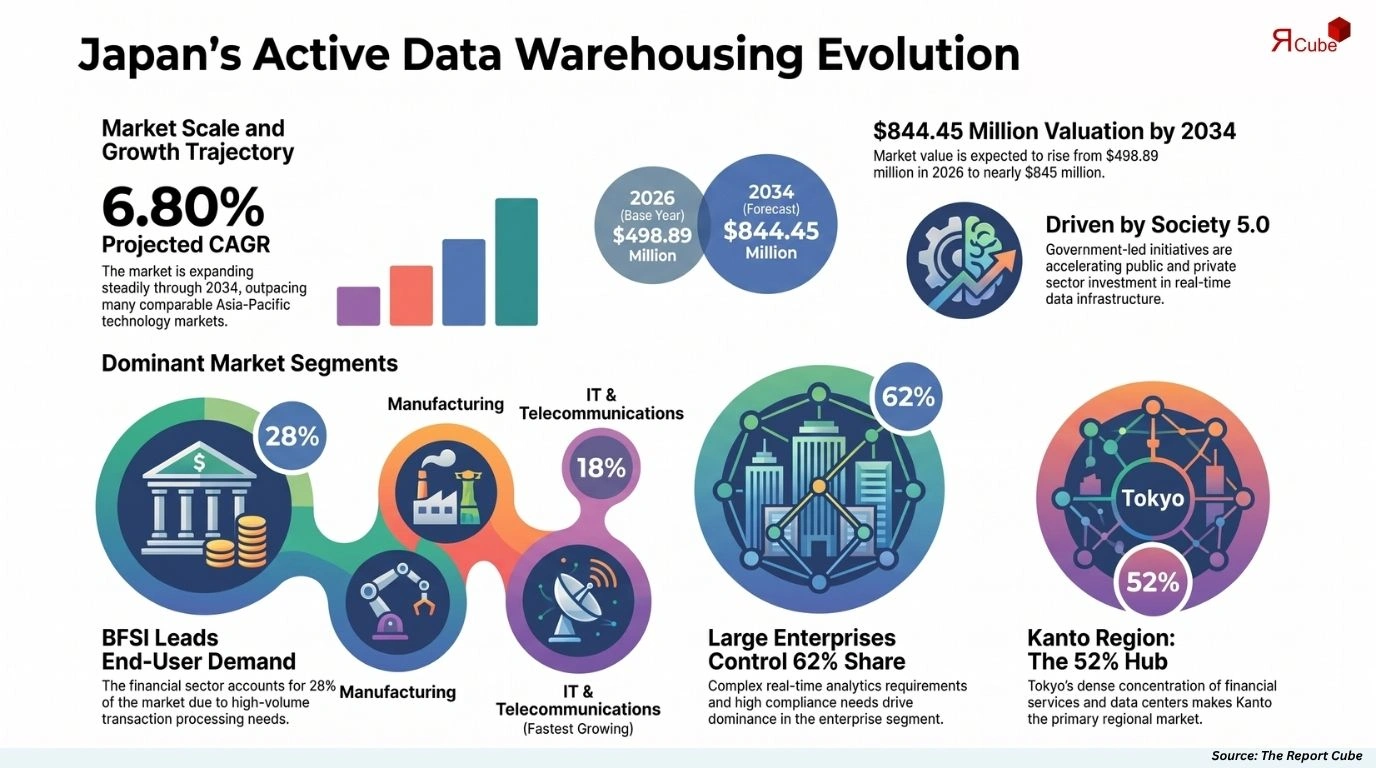
The Japan Active Data Warehousing Market is anticipated to register a 6.80% CAGR during 2026–2034. The market size was valued at USD 498.89 million in 2026 and is projected to reach USD 844.45 million by 2034. Japan active data warehousing market analysis reveals that enterprise demand is driven by accelerating digital transformation mandates, expanding cloud infrastructure investment, and government-led initiatives under Japan's Society 5.0 framework promoting data-driven public and private sector innovation. Amazon Web Services Inc., Microsoft Corporation, and IBM have strengthened their Japan-specific data platform offerings to address large enterprise and government procurement requirements.
Rising adoption of real-time analytics across BFSI, healthcare, and manufacturing verticals continues generating sustained demand for active warehousing solutions capable of supporting concurrent query workloads and live data ingestion pipelines. Japan's strategic focus on data sovereignty and domestic cloud infrastructure investment further accelerates enterprise migration toward hybrid and cloud-native active warehousing architectures. Cloudera Inc., Oracle Corporation, and Hewlett Packard Enterprise Development LP have intensified market engagement through localized professional services, Japanese-language support programs, and compliance-aligned data governance frameworks targeting regulated industry verticals.
Japan Active Data Warehousing Market Size & Forecast
|
Metric |
Details |
|---|---|
|
Market Size (2026) |
USD 498.89 Million |
|
Market Size (2034) |
USD 844.45 Million |
|
CAGR (2026–2034) |
6.80% |
|
Base Year |
2026 |
|
Historical Years |
2021–2025 |
|
Forecast Years |
2026–2034 |
The Japan Active Data Warehousing Market size was valued at USD 498.89 million in 2026 and is projected to reach USD 844.45 million by 2034, expanding at a 6.80% CAGR. This trajectory outpaces comparable Asia Pacific markets, driven primarily by Japan's advanced enterprise IT maturity, large-scale financial sector digitization, and accelerating government investments in data-centric public administration infrastructure through the forecast horizon.
Japan Active Data Warehousing Market Dynamics
Japan's active data warehousing sector is expanding steadily as enterprises across BFSI, manufacturing, and public sector verticals transition from traditional batch-processing architectures toward real-time, query-optimized data platforms. Increasing cloud adoption, AI-driven analytics integration, and government-backed digital infrastructure programs are collectively reinforcing procurement momentum for scalable active warehousing solutions across Japan's diversified enterprise landscape.
|
Factor |
Type |
Specific Impact on Market |
Magnitude |
|---|---|---|---|
|
Enterprise cloud migration acceleration |
Driver |
Increases deployment of cloud-native active warehousing platforms across large and mid-market enterprises |
High |
|
Government Society 5.0 digital initiatives |
Driver |
Expands public sector procurement of real-time data infrastructure and analytics capabilities |
High |
|
High legacy infrastructure replacement costs |
Challenge |
Slows migration timelines for mid-market enterprises with significant on-premise data architecture investments |
Medium |
|
AI and machine learning analytics integration |
Opportunity |
Enables advanced predictive analytics use cases that elevate active warehousing platform adoption and value |
High |
|
Hybrid cloud deployment architecture demand |
Trend |
Drives demand for interoperable warehousing solutions bridging on-premise and cloud data environments |
Medium |
- Growth Drivers - Growing enterprise cloud migration across Japan's BFSI and manufacturing sectors is accelerating active data warehousing market growth, as organizations require real-time query processing, concurrent workload support, and scalable data ingestion capabilities that traditional on-premise data warehouse architectures cannot efficiently deliver at enterprise scale.
- Market Opportunities - Japan's expanding AI and machine learning adoption across healthcare diagnostics, financial risk modeling, and smart manufacturing creates growing demand for active warehousing platforms that support real-time data pipelines. E-commerce sector growth and government open-data initiatives are additionally opening new enterprise and public sector procurement opportunities through 2034.
- Industry Challenges - Japan's stringent data residency and privacy regulations, including the Act on Protection of Personal Information (APPI) amendments, impose compliance complexity on cloud warehousing deployments. Vendor consolidation pressure, skill shortages in advanced data engineering disciplines, and evolving cross-border data transfer restrictions collectively increase total procurement and operational complexity for enterprise buyers.
Japan Active Data Warehousing Market Trends
- Emerging Trends - Japan active data warehousing market trends reflect accelerating enterprise interest in real-time analytics and data lakehouse architectures. Hybrid multi-cloud warehousing strategies are gaining traction as organizations seek to balance data sovereignty requirements with the scalability advantages offered by hyperscale cloud infrastructure deployments.
- Technology Trends - In-memory computing, columnar storage optimization, and massively parallel processing architectures are becoming foundational to enterprise active warehousing deployments in Japan. AI-assisted query optimization tools and automated data pipeline orchestration platforms are increasingly embedded within leading warehousing solutions offered by Microsoft, Amazon Web Services, and IBM.
- Consumer / Buyer Trends - Enterprise technology buyers across Japan's BFSI and manufacturing sectors increasingly prioritize active warehousing vendors offering Japanese-language support, domestic data center residency options, and compliance-ready governance frameworks. Procurement decisions increasingly favor platforms demonstrating measurable total cost of ownership reductions and certified integration with existing ERP and CRM environments.
Need Specific Data, Let’s Customize the Report for You
Request CustomizationJapan Active Data Warehousing Market Segment Analysis
Japan's active data warehousing market serves distinct enterprise size categories and end-user industry verticals, each characterized by unique deployment requirements, data complexity levels, and real-time analytics performance expectations. Understanding segment-level demand dynamics enables suppliers and enterprise buyers to align platform capabilities with operational and compliance-specific procurement priorities.
By Enterprise Size
|
Enterprise Size |
Estimated Share (2026) |
Key Characteristics |
|---|---|---|
|
Large Enterprise |
62% |
Complex multi-source data environments; real-time analytics at enterprise scale; high compliance requirements |
|
Small and Medium-Sized Enterprise |
38% |
Cloud-first deployments; cost-sensitive procurement; growing SaaS warehousing adoption |
Large enterprises hold an estimated 62% of the Japan Active Data Warehousing Market share in 2026, reflecting the segment's advanced data complexity and significant concurrent analytics workload requirements. Microsoft Corporation and Oracle Corporation serve large enterprise clients through comprehensive platform ecosystems and managed service frameworks. The SME segment, representing approximately 38%, is the faster-growing category as cloud-based SaaS warehousing offerings from Amazon Web Services Inc. and Cloudera Inc. reduce upfront infrastructure investment barriers and accelerate mid-market adoption across Japan's diversified technology landscape.
By End User
|
End User |
Estimated Share (2026) |
Growth Outlook |
|---|---|---|
|
BFSI |
28% |
Steady; driven by real-time transaction analytics, fraud detection, and regulatory reporting |
|
Healthcare |
14% |
Growing; supported by electronic health records integration and diagnostic data analytics demand |
|
Manufacturing |
18% |
Steady; smart factory IoT data integration and production analytics drive warehousing adoption |
|
IT and Telecommunication |
16% |
Fastest-growing; network analytics, customer intelligence, and service optimization fuel demand |
|
Government and Public Sector |
12% |
Growing; Society 5.0 initiatives and open-data mandates expand public procurement |
|
Retail |
8% |
Growing; inventory optimization and consumer behavior analytics accelerate platform adoption |
|
Media and Entertainment |
4% |
Emerging; content analytics and audience intelligence drive early-stage warehousing deployment |
BFSI remains the dominant end-user segment at an estimated 28% of market demand in 2026, supported by stringent regulatory reporting obligations, high-frequency transaction data processing requirements, and real-time fraud detection analytics needs. IBM and Oracle Corporation are primary active warehousing solution providers serving Japan's major financial institutions and insurance enterprises. IT and Telecommunication represents the fastest-growing end-user category, with Huawei Technologies Co. Ltd. and Amazon Web Services Inc. delivering network data analytics and customer intelligence platforms across Japan's leading telecom operators and technology service providers.
Japan Active Data Warehousing Market Regional Analysis
|
Region |
Estimated Market Share |
Key Growth Factors |
Consumer Trends |
|---|---|---|---|
|
Kanto |
52% |
Dense enterprise concentration, financial district digitization, major cloud data center presence |
High large enterprise and BFSI warehousing adoption; advanced analytics platform preference |
|
Kansai |
24% |
Manufacturing industry digitization, healthcare IT expansion, regional government data programs |
Smart manufacturing analytics, healthcare data integration, mid-market cloud warehousing growth |
|
Chubu |
14% |
Automotive and industrial IoT data growth, regional enterprise modernization investments |
Manufacturing analytics, supply chain data warehousing, on-premise to hybrid migration activity |
|
Others |
10% |
Growing regional digital transformation programs, SME cloud adoption, public sector data initiatives |
Emerging cloud-first warehousing deployments, government digitization procurement |
- Kanto - Accounting for approximately 52% of Japan's active data warehousing demand, the Kanto region encompasses Tokyo's dominant financial services district, major technology enterprise headquarters, and the highest concentration of hyperscale cloud data centers operated by Amazon Web Services, Microsoft Azure, and Google. BFSI and IT sector procurement anchors regional demand at scale.
- Kansai - Osaka and Kyoto's expanding manufacturing and healthcare sectors drive active warehousing adoption in Kansai, which holds an estimated 24% regional share. Regional manufacturers pursuing smart factory IoT analytics and healthcare networks modernizing patient data infrastructure represent the primary growth segments engaging IBM and Oracle platform deployments.
- Chubu - The Chubu region, centered on Nagoya's automotive and industrial manufacturing ecosystem, accounts for approximately 14% of national demand. Toyota group suppliers, precision manufacturers, and regional logistics operators are progressively adopting active warehousing platforms for supply chain data integration and production performance analytics.
- Others - Remaining regions including Tohoku, Kyushu, Shikoku, and Hokkaido collectively represent approximately 10% of market demand, with growth driven by expanding prefectural government digitization programs, regional SME cloud adoption, and national broadband infrastructure investment supporting distributed data architecture deployments.
Japan Active Data Warehousing Market Share & Competitive Landscape
The Japan active data warehousing competitive landscape is dominated by global hyperscale cloud platform providers and established enterprise software vendors, competing across deployment model flexibility, Japan-specific compliance support, managed services depth, and AI-integrated analytics capability. Vendors differentiating on data sovereignty, Japanese-language technical support, and regulatory-aligned governance frameworks maintain strongest competitive positioning across regulated enterprise verticals.
|
Company |
Competitive Strength |
Primary Segment Served |
|---|---|---|
|
Amazon Web Services Inc. |
Scalable cloud warehousing (Redshift), extensive Japan data center footprint |
Large Enterprise, IT and Telecommunication, Retail |
|
Cloudera Inc. |
Hybrid and multi-cloud data platform, enterprise analytics |
Large Enterprise, Manufacturing, Government |
|
Hewlett Packard Enterprise Development LP |
Hybrid IT infrastructure, on-premise warehousing integration |
Large Enterprise, Manufacturing, Government |
|
Huawei Technologies Co. Ltd. |
Telecom-grade data infrastructure, edge analytics capabilities |
IT and Telecommunication, Manufacturing |
|
IBM |
Deep enterprise integration, AI-powered analytics, financial sector expertise |
BFSI, Healthcare, Government and Public Sector |
|
Microsoft Corporation |
Azure Synapse Analytics, broad enterprise ecosystem integration |
All segments; Large Enterprise and BFSI focus |
|
Oracle Corporation |
Autonomous Database, ERP-integrated warehousing, compliance frameworks |
BFSI, Healthcare, Large Enterprise |
|
Others |
Specialized niche and regional platform providers |
SME, Media and Entertainment, Emerging Verticals |
Key Companies in the Japan Active Data Warehousing Market
Amazon Web Services Inc.
Amazon Web Services Inc., headquartered in Seattle, USA, operates as the world's largest cloud infrastructure provider and delivers Amazon Redshift as its primary active data warehousing platform. In 2025, AWS expanded its Japan data center presence with additional Availability Zones in the Tokyo and Osaka regions, enhancing data residency compliance capability for Japanese enterprise and government clients. Its serverless warehousing architecture and deep AI integration through Amazon Bedrock represent core competitive differentiators across Japan's enterprise analytics market.
Microsoft Corporation
Microsoft Corporation, headquartered in Redmond, USA, serves Japan's active data warehousing market through Azure Synapse Analytics, combining data integration, warehousing, and AI-powered analytics within a unified enterprise platform. In 2025, Microsoft announced expanded Azure data center investment in Japan supporting data sovereignty requirements for regulated financial and healthcare sector clients. Its deep integration with existing Microsoft 365 and Dynamics 365 enterprise environments provides a structural adoption advantage across Japan's large enterprise customer base.
Japan Active Data Warehousing Market Recent Developments
|
Year |
Company |
Development |
|---|---|---|
|
2025 |
Amazon Web Services Inc. |
Announced additional Availability Zone expansions in Tokyo and Osaka regions, strengthening enterprise data residency and warehousing compliance capability for Japanese clients |
|
2025 |
Microsoft Corporation |
Expanded Azure data center investment in Japan to support data sovereignty mandates for financial services and healthcare enterprise clients |
|
2025 |
Oracle Corporation |
Launched Oracle Autonomous Database enhancements with Japan-specific compliance certifications targeting BFSI and government sector active warehousing deployments |
Japan Active Data Warehousing Market Future Outlook
The Japan Active Data Warehousing Market forecast projects growth from USD 498.89 million in 2026 to USD 844.45 million by 2034, advancing at a 6.80% CAGR. BFSI and manufacturing verticals will sustain procurement momentum as real-time fraud analytics, supply chain intelligence, and regulatory reporting requirements continue intensifying. Amazon Web Services, Microsoft, and Oracle are expected to deepen Japan-specific platform investment through localized managed services, compliance-aligned governance tools, and AI-enhanced analytics capabilities through 2034.
Technological advancement in active warehousing - encompassing serverless query architecture, automated workload management, and AI-driven data pipeline optimization - will progressively become accessible to Japan's mid-market enterprise segment. Expanding data sovereignty regulations, APPI compliance updates, and Ministry of Economy digital transformation guidelines will collectively drive enterprise preference toward vendors offering domestic data residency, transparent governance frameworks, and certified security standards across Japan's regulated industry verticals through the forecast horizon.
Japan Active Data Warehousing Market Report Coverage
The Japan Active Data Warehousing Market report provides comprehensive coverage of market sizing, competitive dynamics, segmentation analysis, and regional demand across the 2026–2034 forecast period.
|
Report Attribute |
Details |
|---|---|
|
Market Name |
Japan Active Data Warehousing Market |
|
Market Size (2026) |
USD 498.89 Million |
|
Market Size (2034) |
USD 844.45 Million |
|
Forecast Period |
2026–2034 |
|
CAGR |
6.80% |
|
Base Year |
2026 |
|
Historical Years |
2021–2025 |
|
Forecast Years |
2026–2034 |
|
Segments Covered |
By Deployment Type, By Enterprise Size, By End User |
|
Regions Covered |
Kanto, Kansai, Chubu, Others |
|
Key Companies |
Amazon Web Services Inc., Cloudera Inc., Hewlett Packard Enterprise Development LP, Huawei Technologies Co. Ltd., IBM, Microsoft Corporation, Oracle Corporation, Others |
|
Report Format |
PDF, Excel, PPT |
|
Customization |
Available as per client requirements |
Why Choose This Japan Active Data Warehousing Market Report?
- Comprehensive coverage of Japan's growing enterprise active data warehousing platform market across all key verticals.
- Accurate market sizing from USD 498.89 million in 2026 through the 2034 forecast horizon.
- Detailed segmentation by enterprise size (Large Enterprise vs. SME) and eight end-user industry categories.
- Regional insights covering Kanto, Kansai, Chubu, and Others with estimated demand share analysis.
- Competitive profiling of seven leading global active warehousing solution providers operating in Japan.
- Analysis of cloud-native, hybrid, and on-premise deployment trends reshaping enterprise data architecture procurement.
- Forecast data supporting strategic investment, partnership planning, and market entry decision-making.
- Research aligned with Japan's Society 5.0 digital transformation objectives and APPI regulatory compliance landscape.
Table of Contents
- Introduction
- Objective of the Study
- Product Definition
- Market Segmentation
- Study Variables
- Research Methodology
- Secondary Data Points
- Companies Interviewed
- Primary Data Points
- Breakdown of Primary Interviews
- Secondary Data Points
- Executive Summary
- Market Dynamics
- Drivers
- Challenges
- Opportunity Assessment
- Recent Trends and Developments
- Policy and Regulatory Landscape
- Japan Active Data Warehousing Market Overview and Forecast Analysis (2021-2034)
- Market Size, By Value, By Growth Rate (CAGR/USD Millions)
- Demand – Supply Trends
- Market Share, By Deployment Type
- On-Premise
- Cloud
- Market Share, By Enterprise Size
- Large Enterprise
- Small and Medium-Sized Enterprise
- Market Share, By End User
- BFSI
- Healthcare
- Manufacturing
- IT and Telecommunication
- Government and Public Sector
- Retail
- Media and Entertainment
- Others
- Market Share, By Region
- Kanto
- Kansai
- Chubu
- Others
- Market Share, By Competitors
- Competition Characteristics
- Revenue Shares
- On-Premise Japan Active Data Warehousing Market Overview, 2021-2034F
- By Value (USD Million)
- By Enterprise Size – Market Size & Forecast 2021-2034, USD Million
- Large Enterprise
- Small and Medium-Sized Enterprise
- Cloud Japan Active Data Warehousing Market Overview, 2021-2034F
- By Value (USD Million)
- By Enterprise Size – Market Size & Forecast 2021-2034, USD Million
- Large Enterprise
- Small and Medium-Sized Enterprise
- Competitive Outlook (Company Profile - Partial List)
- Amazon Web Services Inc.
- Company Overview
- Business Segments
- Strategic Alliances/Partnerships
- Recent Developments
- Cloudera Inc.
- Company Overview
- Business Segments
- Strategic Alliances/Partnerships
- Recent Developments
- Hewlett Packard Enterprise Development LP
- Company Overview
- Business Segments
- Strategic Alliances/Partnerships
- Recent Developments
- Huawei Technologies Co. Ltd.
- Company Overview
- Business Segments
- Strategic Alliances/Partnerships
- Recent Developments
- IBM
- Company Overview
- Business Segments
- Strategic Alliances/Partnerships
- Recent Developments
- Microsoft Corporation
- Company Overview
- Business Segments
- Strategic Alliances/Partnerships
- Recent Developments
- Oracle Corporation
- Company Overview
- Business Segments
- Strategic Alliances/Partnerships
- Recent Developments
- Others
- Amazon Web Services Inc.
- Contact Us & Disclaimer
Top Key Players & Market Share Outlook
- Amazon Web Services Inc.
- Cloudera Inc.
- Hewlett Packard Enterprise Development LP
- Huawei Technologies Co. Ltd.
- IBM
- Microsoft Corporation
- Oracle Corporation
- Others
Frequently Asked Questions






