



Build Your Custom Market Intelligence Report
Customize Your ReportGlobal Agricultural Pheromones Market Key Highlights
By Pheromone Type:
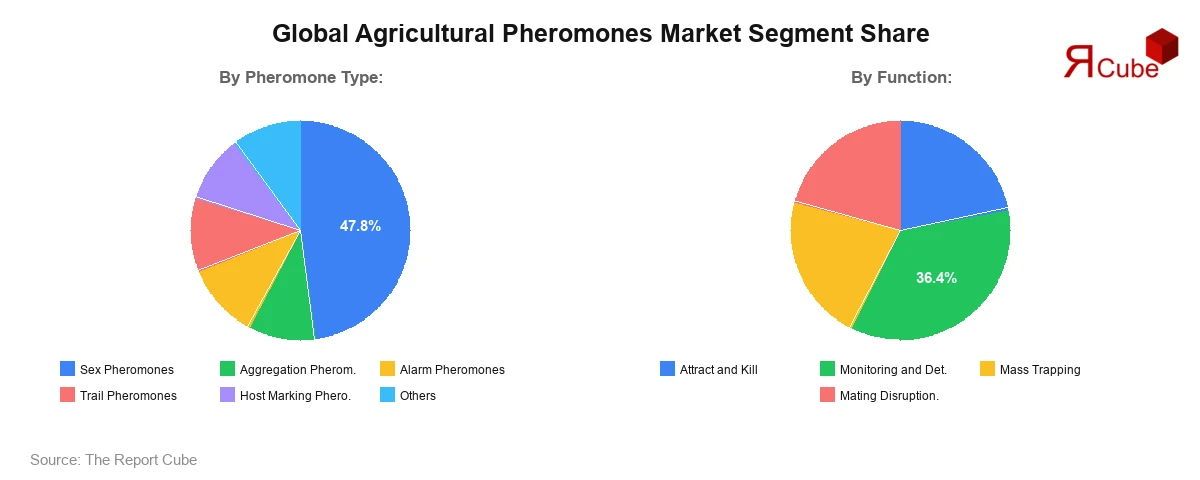
Sex Pheromones segment leads the market with approximately 47.8% share.
By Function:
Monitoring and Detection dominates the market with nearly 36.4% of total revenue.
Regional Outlook:
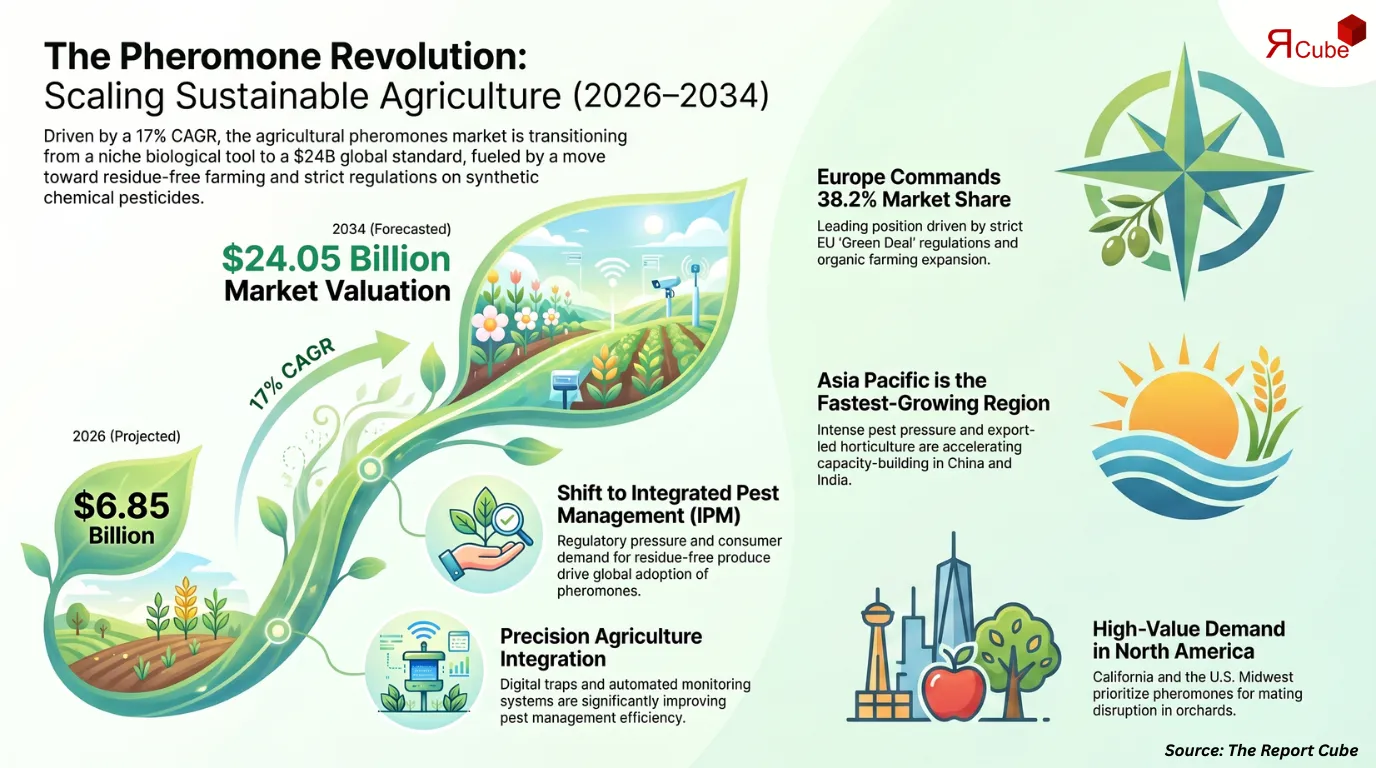
Europe dominates the Global Agricultural Pheromones Market with around 38.2% market share.
Global Agricultural Pheromones Market Insights & Analysis
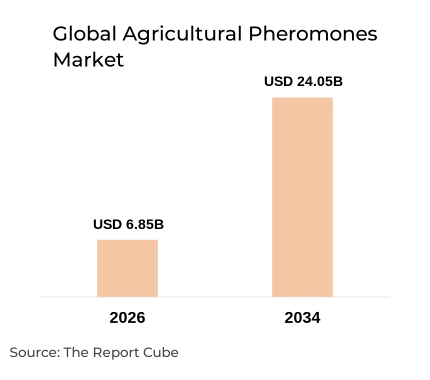
The Global Agricultural Pheromones Market is anticipated to register a CAGR of around 17.00% during the forecast period 2026-2034. The market size is valued at USD 6.85 Billion in 2026 and is projected to reach approximately USD 24.05 Billion by 2034. Market growth is supported by increasing demand for sustainable crop protection, rising adoption of biological pest management technologies, and growing restrictions on synthetic chemical pesticides worldwide. Farmers are increasingly integrating pheromone-based monitoring, mass trapping, and mating disruption techniques into Integrated Pest Management (IPM) programs to improve crop productivity while minimizing environmental impact. The rapid expansion of high-value horticultural crops, vineyards, orchards, and greenhouse cultivation continues to strengthen demand for agricultural pheromone products across developed and emerging agricultural economies.
Significant investments in precision agriculture, controlled-release formulations, microencapsulation technologies, and digital pest monitoring platforms are transforming the agricultural pheromones industry. Governments across Europe, North America, and Asia Pacific continue promoting biological crop protection through regulatory incentives and sustainable farming initiatives, encouraging wider commercialization of pheromone-based pest control products. Companies are expanding production capacity, forming strategic partnerships, and introducing crop-specific pheromone solutions for fruit flies, codling moths, fall armyworms, beetles, and weevils. Increasing consumer preference for residue-free food products, expansion of organic farming acreage, and advancements in smart dispensers and automated monitoring systems are expected to create long-term growth opportunities while strengthening the agricultural pheromones market throughout the forecast period.
Global Agricultural Pheromones Market Impact Analysis
| Factor | Type | Specific Impact on Market | Magnitude | Business Implication |
|---|---|---|---|---|
| Shift to Integrated Pest Management | Market | Broader IPM adoption raises demand for pheromone tools | High | Supports scale up of mating disruption and mass trapping |
| Stringent Regulations on Chemical Pesticides | Regulatory | Restrictions on toxic sprays favor low residue solutions | High | Accelerates farmer interest in pheromone based control |
| Growth in High Value Crop Cultivation | Market | Fruit and vegetable acreage increases need for precise control | Medium | Creates premium demand for crop specific pheromone blends |
| Advances in Formulation and Dispenser Technology | Technological | Improved release systems enhance field life and efficacy | Medium | Enables differentiated products with higher performance |
| Rising Awareness of Residue Free Produce | Consumer | End users increasingly value low residue food and safety | Medium | Strengthens brand positioning around safe crop protection |
| High Initial Cost versus Conventional Sprays | Competitive | Upfront expense slows adoption among small scale farmers | Medium | Requires bundled advisory and flexible pricing programs |
| Expansion of Supportive Subsidy and Grant Programs | Regulatory | Public schemes lower net cost of biological solutions | Medium | Helps vendors push pheromones in emerging farming regions |
Global Agricultural Pheromones Market Dynamics
Key Driver: Strong Transition Toward Sustainable Pest Management Practices
Regulatory pressure to reduce synthetic pesticide usage has encouraged growers to adopt safer and more targeted crop protection methods. Agricultural pheromones have emerged as a reliable biological alternative because they interrupt insect behavior without contaminating soil, water, or harvested crops. Their ability to selectively manage pest populations while preserving beneficial insects makes them highly valuable for integrated pest management and certified organic production systems. As export markets continue enforcing stricter residue limits, growers are increasingly incorporating pheromone technologies into routine crop protection programs to maintain product quality and comply with international food safety standards.
Commercial fruit, vegetable, vineyard, and plantation producers are also recognizing the economic benefits of pheromone-based monitoring and mating disruption. Early detection of pest outbreaks allows growers to optimize treatment schedules, reduce unnecessary insecticide applications, and improve overall farm profitability. Continuous improvements in dispenser technology, formulation stability, and field longevity are further increasing grower confidence, resulting in higher adoption rates across both high-value horticultural crops and broad-acre farming systems.
Industry Trend: Precision Agriculture is Reshaping Biological Crop Protection
Rapid adoption of precision farming technologies is transforming the way pheromone products are deployed and monitored in commercial agriculture. Digital pheromone traps equipped with wireless communication, automated insect counting, and cloud-based reporting systems enable growers to monitor pest populations with greater accuracy than traditional scouting methods. These technologies support timely interventions, reduce unnecessary pesticide applications, and improve overall crop management efficiency. Integration with farm management software further allows producers to make informed decisions based on localized pest pressure and seasonal trends.
Manufacturers are simultaneously investing in advanced formulation technologies that extend pheromone release periods and improve stability under diverse environmental conditions. Microencapsulation, biodegradable polymer matrices, and controlled-release gel technologies are reducing labor requirements while enhancing field performance. Strategic collaborations between biological crop protection companies and agricultural technology providers are accelerating commercialization of these innovations, supporting broader adoption across commercial farming operations worldwide.
Book your FREE 30-minute expert consultation today
Contact UsMajor Challenge: Cost Sensitivity and Technical Adoption Remain Key Barriers
Although agricultural pheromones deliver long-term agronomic and environmental advantages, initial implementation costs remain higher than many conventional pest control alternatives. Growers often need to invest in specialized traps, dispensers, or application systems before realizing economic returns. Smallholder farmers, particularly in developing regions, may hesitate to adopt these technologies because of budget constraints and limited access to technical guidance. Product effectiveness also depends on proper installation, pest population density, and field management practices, making technical support essential during adoption.
Commercial expansion is further influenced by regulatory approval timelines and the need to develop pest-specific formulations for different geographic regions. Climatic variability, cropping patterns, and insect behavior require extensive field validation before products reach large-scale commercialization. Continued investment in farmer education, extension services, and cost-efficient manufacturing processes will be important to improve accessibility and accelerate market penetration across emerging agricultural economies.
Opportunity: Expanding Biological Agriculture Creates Long-Term Growth Potential
Growing investment in sustainable food production is creating favorable conditions for wider adoption of agricultural pheromones. Organic farming continues to expand across Europe, North America, Asia Pacific, and Latin America as consumers increasingly prefer food produced with minimal chemical inputs. Since pheromone products are compatible with organic certification standards and integrated pest management programs, they are becoming a preferred solution for protecting high-value crops while maintaining environmental sustainability. Increasing exports of fresh fruits, vegetables, nuts, and plantation crops are further encouraging growers to adopt residue-free pest management technologies.
Future growth is also expected to benefit from continued innovation targeting row crops, including maize, soybean, rice, and cotton, where biological pest management has historically experienced lower adoption than horticultural production. Investments in large-scale manufacturing, strategic licensing agreements, and public-private research collaborations are expanding product availability across new agricultural markets. These developments position agricultural pheromones as an increasingly important component of next-generation crop protection strategies throughout the forecast period.
Global Agricultural Pheromones Market Segment-wise Analysis
By Pheromone Type:
- Sex Pheromones
- Oriental Fruit Moth Pheromones
- Diamondback Moth Pheromones
- Codling Moth Pheromones
- Pink Bollworm Pheromones
- Grape Berry Moth Pheromones
- Spotted Bollworm Pheromones
- Aggregation Pheromones
- Fruit Fly Aggregation Pheromones
- Bark Beetle Pheromones
- Scarab Beetle Pheromones
- Palm Weevil Pheromones
- Stored Product Beetle Pheromones
- Alarm Pheromones
- Thrips Alarm Pheromones
- Whitefly Alarm Pheromones
- Aphid Alarm Pheromones
- Trail Pheromones
- Termite Trail Pheromones
- Ant Trail Pheromones
- Host Marking Pheromones
- Fruit Fly Host Marking Pheromones
- Weevil Host Marking Pheromones
- Others
Sex Pheromones dominated the Global Agricultural Pheromones Market, accounting for approximately 47.8% of total revenue in 2026. Their leading position is supported by extensive use in mating disruption programs that target destructive insect species, including codling moths, oriental fruit moths, pink bollworms, diamondback moths, and grape berry moths. These pheromones interfere with insect reproduction by disrupting mate-finding behavior, significantly reducing pest populations without harming beneficial insects or pollinators. Their high target specificity has made them an important biological alternative to conventional insecticides, particularly in fruit orchards, vineyards, and vegetable production systems where crop quality directly affects market value.
Continued investment in controlled-release dispensers, biodegradable formulations, and microencapsulation technologies has further strengthened the commercial adoption of sex pheromones across developed and emerging agricultural markets. Growers increasingly prefer these solutions because they support resistance management strategies while helping farms comply with stringent pesticide residue regulations imposed by export markets. Rising cultivation of high-value horticultural crops, combined with government support for sustainable farming practices, is expected to sustain demand for sex pheromone products throughout the forecast period.
By Function:
- Attract and Kill
- Monitoring and Detection
- Mass Trapping
- Mating Disruption
Monitoring and Detection represented the largest functional segment, contributing nearly 36.4% of the global market in 2026. Early pest identification has become a critical component of modern crop management because it enables growers to respond before pest populations reach economically damaging levels. Pheromone-based monitoring systems provide accurate information on insect activity, seasonal emergence, and population density, allowing producers to optimize intervention timing while reducing unnecessary pesticide applications. Their widespread use across integrated pest management programs has significantly improved pest surveillance efficiency in commercial agriculture.
The increasing adoption of precision agriculture is creating additional opportunities for monitoring and detection applications. Smart pheromone traps integrated with wireless communication, remote sensing, and automated insect recognition technologies allow growers to monitor pest activity in real time and make informed management decisions. These digital innovations improve operational efficiency while lowering labor requirements and production costs. As commercial farming operations continue adopting data-driven crop management practices, monitoring and detection are expected to remain the largest functional application within the agricultural pheromones industry
Regional Projection of Global Agricultural Pheromones Industry
- North America
- Europe
- Asia Pacific
- Middle East and Africa
- South America
Europe accounted for approximately 38.2% of the Global Agricultural Pheromones Market in 2026, making it the leading regional market. The region has established a strong foundation for biological crop protection through strict regulations governing synthetic pesticide use, widespread implementation of integrated pest management programs, and continuous expansion of organic farming. Countries including Spain, Italy, France, Germany, and the Netherlands have adopted pheromone-based pest control across vineyards, orchards, greenhouse vegetables, and specialty crops where maintaining product quality and meeting export standards are essential. The region also benefits from a well-developed agricultural research ecosystem that supports innovation in pheromone formulations and delivery technologies.
Steady public and private investment in sustainable agriculture continues to reinforce Europe's market leadership. Agricultural producers are increasingly incorporating pheromone monitoring, mating disruption, and mass trapping techniques to reduce chemical pesticide dependence while preserving beneficial insects and biodiversity. Collaboration between research institutes, biological crop protection companies, and farming organizations has accelerated commercialization of next-generation pheromone products with improved field stability and application efficiency. Growing consumer demand for residue-free food products and supportive environmental policies are expected to maintain Europe's dominant position in the Agricultural Pheromones Market over the coming years.
Need insights for a specific region within this market?
Request Regional DataRegional Analysis of Global Agricultural Pheromones Market
The global agricultural pheromones market shows varied growth across regions, shaped by IPM adoption, crop patterns, and sustainability mandates.
| Region | Demand Level | Key Areas | System Dominance | Core Demand Logic | Growth Nature |
|---|---|---|---|---|---|
| North America | Very High | U.S. Midwest, California belt | Mating disruption, mass trapping | Strong IPM policies and high-value crops | Regulation-led, rapid scale-up |
| Europe | High | Spain, France, Italy, Germany belts | Mating disruption in orchards | Green Deal and pesticide reduction | Policy-driven, steady expansion |
| Asia Pacific | Very High | China, India, Japan intensive belts | Mating disruption and lure traps | High pest pressure and export crops | Fastest-growing, capacity-building |
| Middle East and Africa | Medium | GCC, South Africa, North Africa | Monitoring lures and traps | Export horticulture and water stress | Project-led, gradual adoption |
| South America | High | Brazil, Chile, Argentina belts | Mating disruption in fruit crops | Large farms seeking residue cuts | High-potential, price-sensitive |
Government Initiatives & Policies
- European Union Sustainable Use of Plant Protection Products Regulation (2025): The European Union continues expanding Integrated Pest Management requirements and promotes biological crop protection technologies, including pheromone-based pest control, to reduce dependence on conventional pesticides and support sustainable agriculture.
- United States Department of Agriculture Integrated Pest Management Program (2025): USDA continues funding research, extension services, and commercialization initiatives that encourage adoption of biological pest management tools, including pheromone monitoring and mating disruption technologies across specialty and field crops.
Global Agricultural Pheromones Industry Recent Developments
- 2025: Syngenta and Provivi, Inc. entered a strategic partnership to commercialize a pheromone-based biological solution for fall armyworm control in Brazil. The collaboration expands sustainable crop protection options for corn and row-crop growers while supporting integrated pest management practices through species-specific pest control technologies.
- 2025: Provivi, Inc. announced its global expansion through new commercial partnerships and sustainable crop protection initiatives. The company strengthened deployment of its pheromone platform across major agricultural regions, increasing support for row-crop pest management and reinforcing its long-term international market presence.
- 2025: Bayer AG expanded its collaboration with M2i Group through a development and distribution agreement covering pheromone gel technologies across Asia Pacific, Latin America, and the United States. The agreement broadens access to biological crop protection solutions beyond Europe and Africa while accelerating commercialization of innovative pheromone products.
- 2025: Semios continued expanding its precision agriculture platform by integrating advanced pest monitoring capabilities with digital farm management solutions. The development enhances real-time insect surveillance, improves pest forecasting accuracy, and supports data-driven decision-making for commercial orchard and vineyard operators.
Why Choose This Report?
- Provides a comprehensive overview of the overall market analysis, encompassing key trends, consumer behavior analysis, and risk assessment to support strategic decision-making.
- Provides accurate, up-to-date insights into market size, segmentation, and emerging opportunities, helping to minimize risk while capitalizing on growth.
- Gives deep understanding of target audience preferences, investment habits, and communication channels for enhanced product development and marketing effectiveness.
- Delivers competitive analysis and benchmarking, uncovering the strengths and weaknesses of market competitors to guide business strategies.
- Consolidates comprehensive market intelligence, reducing research time and streamlining strategic planning efforts.
- Facilitates customized market segmentation and risk mitigation strategies that are aligned with specific business objectives.
- Aids in identifying both market challenges and untapped opportunities within the industry to support long-term business growth.
- Provides valuable information based on actual customer demand patterns, industry developments, and market trends.
Table of Contents
- Introduction
- Objective of the Study
- Product and Category Definition
- Market Segmentation
- Study Variables
- Research Methodology
- Secondary Data Points
- Breakdown of Secondary Sources
- Primary Data Points
- Breakdown of Primary Interviews
- Secondary Data Points
- Executive Summary
- Market Dynamics
- Emerging Opportunities
- Adoption Trends
- Demand Drivers
- Disruption Analysis (Challenges)
- Industry Analysis & Strategic Insights
- Supply/Value Chain Analysis
- Pricing Analysis
- Go-To-Market (GTM) Strategy
- BCG Matrix
- Recent Trends and Developments
- Import and Export Analysis
- Regulatory and Policy Landscape
- Region-wise policies
- Government Initiatives
- Global Agricultural Pheromones Market Overview and Forecast Analysis (2021-2034)
- Market Size, By Value, By Growth Rate (CAGR/USD Billion)
- Market Share, By Pheromone Type
- Host Marking Pheromones
- Fruit Fly Host Marking Pheromones
- Weevil Host Marking Pheromones
- Trail Pheromones
- Termite Trail Pheromones
- Ant Trail Pheromones
- Sex Pheromones
- Oriental Fruit Moth Pheromones
- Diamondback Moth Pheromones
- Codling Moth Pheromones
- Pink Bollworm Pheromones
- Grape Berry Moth Pheromones
- Spotted Bollworm Pheromones
- Alarm Pheromones
- Thrips Alarm Pheromones
- Whitefly Alarm Pheromones
- Aphid Alarm Pheromones
- Aggregation Pheromones
- Fruit Fly Aggregation Pheromones
- Bark Beetle Pheromones
- Scarab Beetle Pheromones
- Palm Weevil Pheromones
- Stored Product Beetle Pheromones
- Others
- Host Marking Pheromones
- Market Share, By Function
- Attract And Kill
- Monitoring And Detection
- Mass Trapping
- Mating Disruption
- Market Share, By Crop Type
- Floriculture Crops
- Nursery Ornamentals
- Ornamental Plants
- Cut Flowers
- Potted Plants
- Vegetables
- Root Vegetables
- Brassicas
- Peppers
- Leafy Vegetables
- Cucurbits
- Tomatoes
- Leguminous Vegetables
- Field Crops
- Rice
- Oilseeds
- Soybean
- Maize
- Cotton
- Wheat
- Pulses
- Plantation Crops
- Coconut
- Tea
- Rubber
- Coffee
- Banana
- Oil Palm
- Cocoa
- Fruits And Nuts
- Berries
- Grapes
- Walnuts
- Apples
- Almonds
- Stone Fruits
- Pistachios
- Citrus Fruits
- Hazelnuts
- Others
- Floriculture Crops
- Market Share, By Pest Type
- Leafminers
- Borers
- Fruit Flies
- Weevils
- Aphids And Whiteflies
- Beetles
- Moths
- Others
- Market Share, By Delivery Format
- Traps
- Aerosol Puffers
- Microencapsulated Delivery Systems
- Sprayable Pheromones
- Lures
- Dispensers
- Market Share, By Formulation
- Solid Formulations
- Controlled Release Formulations
- Microencapsulated Formulations
- Gel Formulations
- Liquid Formulations
- Market Share, By Farming System
- Organic Farming
- Protected Cultivation
- Conventional Farming
- Integrated Pest Management Farming
- Market Share, By End User
- Greenhouse Growers
- Plantation Growers
- Research And Extension Institutes
- Commercial Farmers
- Pest Management Service Providers
- Horticulture Producers
- Market Share, By Distribution Channel
- Online Sales Channels
- Specialty Crop Input Retailers
- Agricultural Cooperatives
- Direct Sales
- Agrochemical Distributors
- Market Share, By Region
- North America
- Europe
- Asia Pacific
- Middle East and Africa
- South America
- Market Share, By Company
- Revenue Shares & Analysis
- Competitive Landscape
- North America Agricultural Pheromones Market Overview and Forecast Analysis (2021-2034)
- Market Size, By Value, By Growth Rate (CAGR/USD Billion/Million)
- Market Share, By Pheromone Type
- Market Share, By Function
- Market Share, By Crop Type
- Market Share, By Pest Type
- Market Share, By Delivery Format
- Market Share, By Formulation
- Market Share, By Farming System
- Market Share, By End User
- Market Share, By Distribution Channel
- Market Share, By Country
- The U.S.
- Canada
- Mexico
- Rest of North America
- Europe Agricultural Pheromones Market Overview and Forecast Analysis (2021-2034)
- Market Size, By Value, By Growth Rate (CAGR/USD Billion/Million)
- Market Share, By Pheromone Type
- Market Share, By Function
- Market Share, By Crop Type
- Market Share, By Pest Type
- Market Share, By Delivery Format
- Market Share, By Formulation
- Market Share, By Farming System
- Market Share, By End User
- Market Share, By Distribution Channel
- Market Share, By Country
- Germany
- The U.K.
- France
- Italy
- Spain
- Netherlands
- Russia
- Poland
- Belgium
- Sweden
- Rest of Europe
- Asia Pacific Agricultural Pheromones Market Overview and Forecast Analysis (2021-2034)
- Market Size, By Value, By Growth Rate (CAGR/USD Billion/Million)
- Market Share, By Pheromone Type
- Market Share, By Function
- Market Share, By Crop Type
- Market Share, By Pest Type
- Market Share, By Delivery Format
- Market Share, By Formulation
- Market Share, By Farming System
- Market Share, By End User
- Market Share, By Distribution Channel
- Market Share, By Country
- China
- India
- Japan
- South Korea
- Australia
- Indonesia
- Thailand
- Malaysia
- Vietnam
- Philippines
- Singapore
- New Zealand
- Rest of Asia-Pacific
- Middle East and Africa Agricultural Pheromones Market Overview and Forecast Analysis (2021-2034)
- Market Size, By Value, By Growth Rate (CAGR/USD Billion/Million)
- Market Share, By Pheromone Type
- Market Share, By Function
- Market Share, By Crop Type
- Market Share, By Pest Type
- Market Share, By Delivery Format
- Market Share, By Formulation
- Market Share, By Farming System
- Market Share, By End User
- Market Share, By Distribution Channel
- Market Share, By Country
- Saudi Arabia
- The UAE
- South Africa
- Egypt
- Nigeria
- Morocco
- Turkey
- Rest of the Middle East & Africa
- South America Agricultural Pheromones Market Overview and Forecast Analysis (2021-2034)
- Market Size, By Value, By Growth Rate (CAGR/USD Billion/Million)
- Market Share, By Pheromone Type
- Market Share, By Function
- Market Share, By Crop Type
- Market Share, By Pest Type
- Market Share, By Delivery Format
- Market Share, By Formulation
- Market Share, By Farming System
- Market Share, By End User
- Market Share, By Distribution Channel
- Market Share, By Country
- Brazil
- Argentina
- Chile
- Colombia
- Peru
- Rest of South America
- Competitive Analysis, 2026
- Market Share of Key Players
- Competitive Mapping for Each Segment and Companies Operating Regionally
- North America Agricultural Pheromones Companies Share & Competitive Analysis, 2026
- Europe Agricultural Pheromones Companies Share & Competitive Analysis, 2026
- Asia Pacific Agricultural Pheromones Companies Share & Competitive Analysis, 2026
- Middle East and Africa Agricultural Pheromones Companies Share & Competitive Analysis, 2026
- South America Agricultural Pheromones Companies Share & Competitive Analysis, 2026
- Company Profile (Partial List)
- Pherobank B.V.
- Company Overview
- Product Portfolio
- Strategic Alliances/Partnerships
- Recent Developments
- Russell IPM Ltd.
- Company Overview
- Product Portfolio
- Strategic Alliances/Partnerships
- Recent Developments
- International Pheromone Systems Ltd.
- Company Overview
- Product Portfolio
- Strategic Alliances/Partnerships
- Recent Developments
- Biobest Group NV
- Company Overview
- Product Portfolio
- Strategic Alliances/Partnerships
- Recent Developments
- Scentry Biologicals, Inc.
- Company Overview
- Product Portfolio
- Strategic Alliances/Partnerships
- Recent Developments
- Semios
- Company Overview
- Product Portfolio
- Strategic Alliances/Partnerships
- Recent Developments
- Suterra LLC
- Company Overview
- Product Portfolio
- Strategic Alliances/Partnerships
- Recent Developments
- Pherobio Technology Co., Ltd.
- Company Overview
- Product Portfolio
- Strategic Alliances/Partnerships
- Recent Developments
- Koppert B.V.
- Company Overview
- Product Portfolio
- Strategic Alliances/Partnerships
- Recent Developments
- BedoukianBio
- Company Overview
- Product Portfolio
- Strategic Alliances/Partnerships
- Recent Developments
- Shin-Etsu Chemical Co., Ltd.
- Company Overview
- Product Portfolio
- Strategic Alliances/Partnerships
- Recent Developments
- M2i Group
- Company Overview
- Product Portfolio
- Strategic Alliances/Partnerships
- Recent Developments
- Provivi, Inc.
- Company Overview
- Product Portfolio
- Strategic Alliances/Partnerships
- Recent Developments
- ISCA Inc.
- Company Overview
- Product Portfolio
- Strategic Alliances/Partnerships
- Recent Developments
- CBC Group
- Company Overview
- Product Portfolio
- Strategic Alliances/Partnerships
- Recent Developments
- Trécé Inc.
- Company Overview
- Product Portfolio
- Strategic Alliances/Partnerships
- Recent Developments
- Others (Partial List)
- Pherobank B.V.
- Contact Us and Disclaimer
Top Key Players & Market Share Outlook
- Pherobank B.V.
- Russell IPM Ltd.
- International Pheromone Systems Ltd.
- Biobest Group NV
- Scentry Biologicals, Inc.
- Semios
- Suterra LLC
- Pherobio Technology Co., Ltd.
- Koppert B.V.
- BedoukianBio
- Shin-Etsu Chemical Co., Ltd.
- M2i Group
- Provivi, Inc.
- ISCA Inc.
- CBC Group
- Trécé Inc.
- Others
Frequently Asked Questions






