



Build Your Custom Market Intelligence Report
Customize Your ReportGlobal AI in Food & Beverage Manufacturing Market Key Takeaways
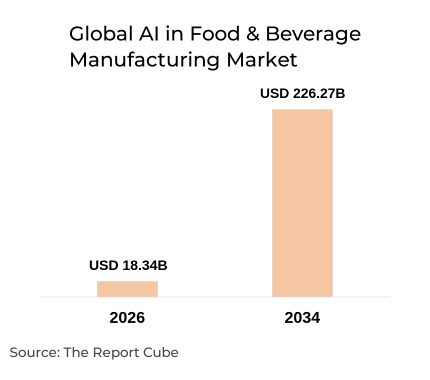
- Global AI in Food & Beverage Manufacturing Market was valued at USD 18.34 billion in 2026.
- Market is projected to reach USD 226.27 billion by 2034, expanding rapidly.
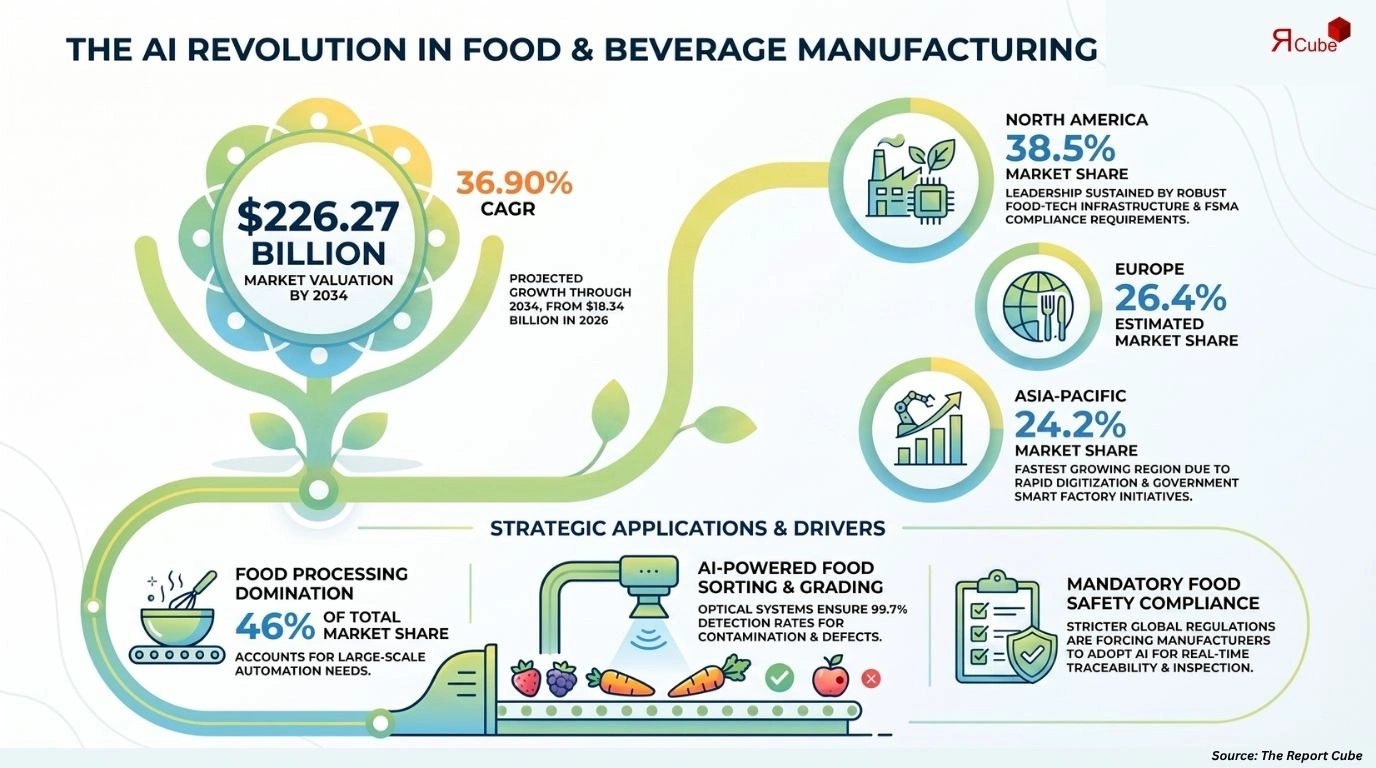
- Industry is anticipated to register a 36.90% CAGR during the 2026–2034 forecast period.
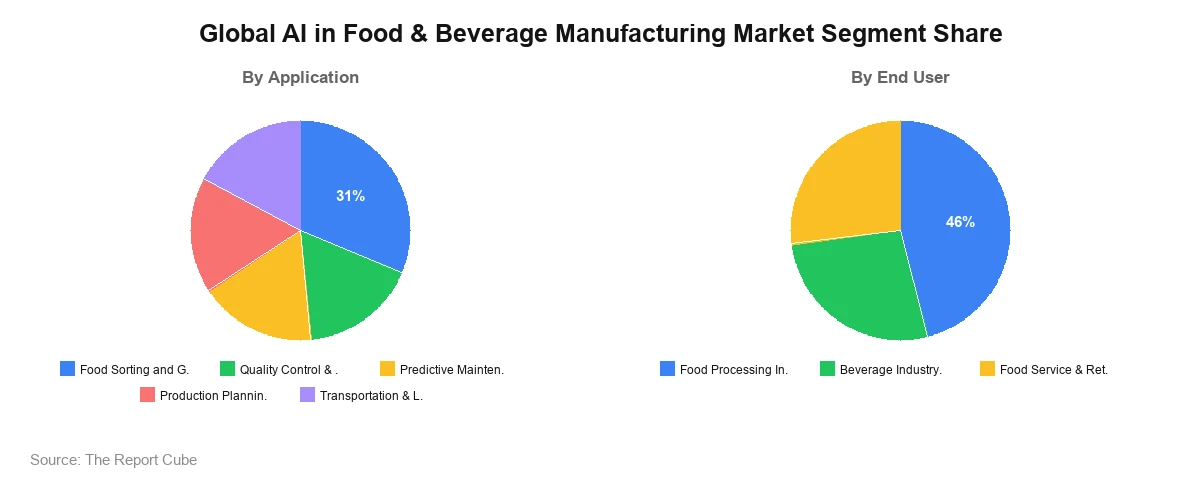
- Food sorting and grading leads application segments, driven by precision-processing demand.
- Food processing industry dominates end-use owing to large-scale automation investments globally.
- North America maintains regional leadership through robust food-tech infrastructure and regulations.
- Asia-Pacific emerges as the fastest-growing region, driven by rapid food industry digitization.
- Leading players include ABB Ltd., Rockwell Automation, Siemens AG, and Honeywell International.
Global AI in Food & Beverage Manufacturing Market Insights & Analysis
The Global AI in Food & Beverage Manufacturing Market is anticipated to register a 36.90% CAGR during 2026–2034. The market size was valued at USD 18.34 billion in 2026 and is projected to reach USD 226.27 billion by 2034. The industry is benefiting from accelerating factory automation programs, widespread integration of machine vision and predictive analytics platforms, and growing regulatory pressure to strengthen food safety and traceability across global supply chains. Governments across North America, Europe, and Asia-Pacific are channeling investments into smart manufacturing infrastructure, with the U.S. Department of Agriculture allocating over USD 300 million toward food supply chain modernization initiatives in fiscal 2025, directly benefiting AI-driven processing technologies.
Manufacturing operators are deploying AI-powered systems to address persistent challenges - labor shortages, quality inconsistency, and supply chain volatility - that traditional automation cannot resolve at scale. Computer vision platforms integrated with AI-powered food inspection and defect detection systems are enabling real-time quality assurance at processing speeds exceeding 200,000 units per hour, replacing manual inspection at a fraction of the cost. Strategic alliances between industrial automation majors and cloud hyperscalers - including Siemens' expanded NVIDIA partnership at CES 2026 for an Industrial AI Operating System - are further accelerating deployment velocity across food and beverage production environments worldwide.
Global AI in Food & Beverage Manufacturing Market Dynamics
AI adoption in food and beverage manufacturing is accelerating as producers contend with rising operational complexity, stricter food safety mandates, and the need to optimize throughput without proportional headcount growth. Enterprise-level investments in robotics, edge computing, and intelligent process control are reshaping production economics across the entire value chain - from raw material intake through logistics and distribution.
|
Factor |
Type |
Specific Impact on Market |
Magnitude |
|---|---|---|---|
|
Rising food safety compliance requirements |
Driver |
Accelerates AI quality control adoption across processing lines |
Very High |
|
Labor shortages in food manufacturing |
Driver |
Drives deployment of AI robotics and automated inspection systems |
High |
|
Predictive maintenance for processing equipment |
Opportunity |
Reduces unplanned downtime and extends equipment lifecycle |
High |
|
Smart factory and Industry 4.0 initiatives |
Trend |
Integrates AI platforms with existing PLC and SCADA infrastructure |
Very High |
|
Supply chain volatility and demand uncertainty |
Driver |
Increases investment in AI-driven demand forecasting and logistics |
High |
Key Market Driver: Escalating Food Safety Compliance Mandates
Global food safety regulations are tightening significantly, with the U.S. Food Safety Modernization Act enforcement expansions and the EU's updated General Food Law Regulation compelling manufacturers to establish real-time contamination detection and batch traceability systems. AI-powered vision platforms from Cognex Corporation and TOMRA Food enable manufacturers to achieve foreign object detection rates exceeding 99.7%, satisfying audit requirements that manual inspection lines cannot consistently meet. These compliance obligations are converting AI quality control from an operational upgrade into a non-negotiable manufacturing standard, driving sustained capital allocation toward intelligent inspection and food traceability and compliance management platforms across both large processors and mid-tier contract manufacturers.
Major Industry Challenge: Integration Complexity Across Brownfield Facilities
A significant share of global food and beverage manufacturing infrastructure consists of brownfield facilities operating legacy programmable logic controllers, aging SCADA systems, and siloed operational technology environments. Retrofitting these facilities with AI analytics platforms requires extensive edge computing hardware, protocol bridging, and data normalization work before machine learning models can function reliably. ABB and Honeywell have responded by embedding edge AI chips directly into legacy PLC portfolios to reduce migration friction, but integration timelines for complex multi-line facilities still average 18 to 24 months. This complexity slows adoption velocity particularly among small and mid-sized food processors who lack dedicated OT engineering teams to manage AI deployment projects.
Emerging Trend Shaping Outlook: Digital Twin-Enabled Production Optimization
Food and beverage manufacturers are increasingly deploying digital twin technology alongside AI analytics to simulate production scenarios, optimize line configurations, and validate process changes before physical implementation. Siemens' Digital Twin Composer - integrated with NVIDIA Omniverse at CES 2026 - has already been deployed by PepsiCo across U.S. manufacturing facilities, delivering a 20% improvement in throughput and 10–15% reduction in capital expenditure through virtual capacity discovery. This convergence of digital twin modeling with real-time AI production planning and scheduling platforms represents a structural shift in how food manufacturers approach capacity planning, reducing costly physical trials and accelerating new product introduction timelines.
Need Specific Data, Let’s Customize the Report for You
Request CustomizationGlobal AI in Food & Beverage Manufacturing Market Segment-wise Analysis
AI-powered solutions are being adopted across a broad range of manufacturing applications, from optical sorting lines and quality inspection stations to enterprise demand planning systems and logistics optimization platforms. Deployment is expanding beyond large-scale processors into mid-market food manufacturers as solution costs decline and cloud-native deployment models reduce infrastructure barriers.
By Application
- Food Sorting and Grading
- Quality Control & Safety Compliance
- Predictive Maintenance
- Production Planning & Demand Forecasting
- Transportation & Logistics
Food sorting and grading leads the application segment with an estimated 31% market share, reflecting the critical role of AI-powered optical systems in maintaining product consistency, minimizing false reject rates, and ensuring compliance with export-grade quality standards. TOMRA Food's expanded TOMRA 5X platform - deployed across nine new European food processing installations in 2025 - demonstrates the scale at which sensor-based AI sorting is being standardized across regional processing networks. Cognex machine vision systems are similarly being integrated into high-speed packaging and inspection lines, classifying defects by shape, color, texture, and completeness at throughput levels that displace multiple manual quality inspection stations per line.
Quality control and safety compliance is the second-largest application category, accelerating rapidly as food manufacturers face tightened audit requirements under FSMA and EU Food Law reforms. Predictive maintenance is advancing at the highest growth trajectory within the segment, with adoption fueled by Rockwell Automation's Fiix MAX - an AI-driven maintenance assistance platform launched in partnership with Augury in 2025 - enabling food processors to identify machine health anomalies and optimize predictive maintenance scheduling for processing equipment before costly production stoppages occur. Production planning and demand forecasting applications are gaining traction as AI systems analyzing historical sales data, seasonal signals, and regional consumer behavior patterns improve short-term forecast accuracy by up to 40%, directly reducing overstock and spoilage costs.
By End User
- Food Processing Industry
- Beverage Industry
- Food Service & Retail
The food processing industry dominates the end-user segment with an estimated 46% market share, driven by the sector's capital-intensive production infrastructure, high throughput volumes, and stringent food safety compliance obligations that create compelling business cases for AI-powered quality assurance and process automation. Processors handling fruits, vegetables, proteins, grains, and packaged goods are investing heavily in computer vision inspection, robotic pick-and-place systems, and AI-driven energy optimization platforms to reduce per-unit processing costs and meet retailer quality specifications.
The beverage industry represents the second-largest end-user category, with breweries, soft drink manufacturers, and dairy processors deploying AI for real-time fermentation monitoring, fill-level inspection, and demand-signal-driven production scheduling. Siemens' Xcelerator platform is supporting Heineken's global decarbonization program across 15 breweries, integrating AI-powered energy optimization with production scheduling to reduce CO₂ emissions alongside operating costs. Food service and retail operators - including quick-service restaurant chains and large grocery retailers - are increasingly deploying AI demand forecasting and intelligent beverage production and inventory optimization systems to minimize food waste and synchronize procurement with granular point-of-sale demand signals at the store level.
Regional Projection of Global AI in Food & Beverage Manufacturing Market
The global AI in Food & Beverage Manufacturing Market reflects pronounced regional variation driven by differences in food industry digitization maturity, regulatory frameworks, labor market conditions, and infrastructure investment capacity. North America maintains a dominant revenue position while Asia-Pacific is accelerating at the highest growth rate, underpinned by large-scale food industry modernization programs across China, India, Japan, and Southeast Asia.
|
Region |
Estimated Market Share |
Key Growth Factors |
Consumer Trends |
|---|---|---|---|
|
North America |
38.5% |
FSMA compliance, advanced food-tech adoption, strong VC investment in AgriTech |
High uptake of predictive maintenance and AI quality platforms |
|
Europe |
26.4% |
EU Farm to Fork strategy, food waste reduction mandates, Industry 4.0 programs |
Growing AI demand forecasting and traceability adoption |
|
Asia-Pacific |
24.2% |
Rapid food industry expansion, government smart factory initiatives, labor cost pressures |
Rising computer vision and robotic sorting deployments |
|
Latin America |
6.5% |
Expanding food export capacity, agri-processing modernization |
Increased AI quality control adoption in protein processing |
|
Middle East & Africa |
4.4% |
Smart food manufacturing investments, import substitution programs |
Growing AI deployment in packaged food production |
- North America: North America dominates the global market with approximately 38.5% revenue share, reflecting widespread AI adoption across food processing, beverage manufacturing, and food retail logistics. The U.S. leads regional investment, with food and beverage manufacturers channeling capital into machine vision inspection, AI-powered ERP integrations, and North American food manufacturing automation and robotics platforms to meet FSMA traceability requirements and address acute labor shortages on processing lines.
- Europe: Europe is expanding AI adoption significantly under the EU Farm to Fork Strategy, which mandates a 50% reduction in food waste by 2030 and is pushing processors in Germany, France, and the Netherlands to deploy AI demand forecasting and spoilage prediction tools. TOMRA Food's 2025 European expansion and Schneider Electric's USD 3.1 billion acquisition of Cognite - which deepens industrial AI and data contextualization capabilities - are reinforcing Europe's position as a key deployment hub for intelligent food manufacturing platforms.
- Asia-Pacific: Asia-Pacific is the fastest-growing regional market, expanding rapidly as food manufacturers in China, India, South Korea, and Southeast Asia invest in automated sorting, AI quality inspection, and smart factory infrastructure to serve growing urban middle-class consumer bases. Government-backed smart manufacturing programs in China and India are providing direct subsidies for AI adoption in agri-food processing, compressing adoption timelines and expanding the addressable market for platform vendors.
- Latin America: Latin America is accelerating AI adoption in protein processing - particularly in Brazil and Argentina - as major beef, poultry, and soybean processors upgrade sorting and quality inspection infrastructure to meet European and North American export-grade compliance requirements. AI-powered grading systems are increasingly being deployed at large export-oriented processing facilities.
- Middle East & Africa: The Middle East and Africa region is investing in AI-powered packaged food and beverage production as governments pursue food security and import substitution objectives. GCC nations are integrating AI quality control and demand planning systems into newly established food processing zones as part of broader economic diversification strategies under Vision 2030 frameworks.
Global AI in Food & Beverage Manufacturing Market: Recent Development (2025)
- TOMRA Food launched the TOMRA 4C with LUCAi deep learning models for expanded nut and citrus sorting.
- Siemens announced advanced AI agents for industrial automation at the Automate 2025 Detroit exhibition event.
- Rockwell Automation launched Fiix MAX AI-driven maintenance platform in partnership with Augury for factories.
- Schneider Electric announced intent to acquire Cognite for USD 3.1 billion to strengthen industrial AI capabilities.
Global AI in Food & Beverage Manufacturing Market Future Outlook (2034)
The Global AI in Food & Beverage Manufacturing Market is projected to expand at a 36.90% CAGR, reaching approximately USD 226.27 billion by 2034. Sustained growth will be driven by the universal adoption of smart factory frameworks, where AI platforms operate continuously across sorting, inspection, maintenance, planning, and logistics functions within a unified data architecture. As edge computing costs decline and 5G connectivity expands across industrial facilities, AI inference at the line level will become standard infrastructure - enabling real-time adaptive process control that responds to incoming raw material variability, environmental conditions, and downstream demand signals simultaneously, without human intervention.
Technology advancement will center on the convergence of digital twin modeling, generative AI, and autonomous robotics - creating self-optimizing food manufacturing environments capable of reconfiguring production sequences, ingredient formulations, and packaging specifications dynamically. The accelerating deployment of Asia Pacific AI-powered agri-food processing and smart factory solutions will create substantial demand for platform vendors offering cloud-native AI tools compatible with diverse legacy equipment ecosystems. Organizations that invest now in interoperable AI infrastructure, clean data pipelines, and workforce AI literacy programs will be best positioned to sustain competitive cost structures and regulatory compliance as global food safety and sustainability mandates continue tightening through 2034 and beyond.
Global AI in Food & Beverage Manufacturing Market Report Coverage
|
Report Attribute |
Details |
|---|---|
|
Market Name |
Global AI in Food & Beverage Manufacturing Market |
|
Market Size (2026) |
USD 18.34 Billion |
|
Market Size (2034) |
USD 226.27 Billion |
|
Forecast Period |
2026–2034 |
|
CAGR |
36.90% |
|
Base Year |
2026 |
|
Historical Years |
2021–2025 |
|
Forecast Years |
2026–2034 |
|
Segments Covered |
By Application, By End User, By Technology, By Component |
|
Regions Covered |
North America, Europe, Asia-Pacific, Latin America, Middle East & Africa |
|
Key Companies |
ABB Ltd., Rockwell Automation Inc., Siemens AG, Honeywell International Inc., Schneider Electric SE, TOMRA Food, Cognex Corporation, Others |
|
Report Format |
PDF, Excel, PPT |
|
Customization |
Available as per client requirements |
Why Choose This Report?
- Comprehensive analysis of AI adoption trends across food and beverage manufacturing applications.
- Accurate market sizing with reliable data-backed forecast through 2034.
- Detailed segmentation covering application, end-user, and regional revenue opportunities.
- Regional insights informed by current regulatory and infrastructure investment developments.
- Competitive profiling of leading industrial automation and AI platform vendors.
- Analysis of digital twin, predictive maintenance, and computer vision adoption trajectories.
- Strategic insights supporting capital allocation, partnership, and market entry decisions.
- Research aligned with EEAT standards and current industry best practices.
Table of Contents
- Introduction
- Objective of the Study
- Product Definition
- Market Segmentation
- Study Variables
- Research Methodology
- Secondary Data Points
- Companies Interviewed
- Primary Data Points
- Breakdown of Primary Interviews
- Secondary Data Points
- Executive Summary
- Market Dynamics
- Drivers
- Challenges
- Opportunity Assessment
- Recent Trends and Developments
- Policy and Regulatory Landscape
- Global AI in Food & Beverage Manufacturing Market Overview and Forecast Analysis (2021-2034)
- Market Size, By Value, By Growth Rate (CAGR/USD Billions)
- Demand – Supply Trends
- Market Share, By Component
- Software Solutions
- Hardware
- Services
- Market Share, By Technology
- Computer Vision
- Machine Learning & Deep Learning
- Robotics & Process Automation
- Natural Language Processing (NLP)
- Market Share, By Application
- Food Sorting and Grading
- Quality Control & Safety Compliance
- Predictive Maintenance
- Production Planning & Demand Forecasting
- Transportation & Logistics
- Market Share, By End User
- Food Processing Industry
- Beverage Industry
- Food Service & Retail
- Market Share, By Region
- North America
- Europe
- Asia Pacific
- Latin America
- Middle East & Africa
- Market Share, By Competitors
- Competition Characteristics
- Revenue Shares
- Software Solutions Global AI in Food & Beverage Manufacturing Market Overview, 2021-2034F
- By Value (USD Million)
- By Technology – Market Size & Forecast 2021-2034, USD Million
- Computer Vision
- Machine Learning & Deep Learning
- Robotics & Process Automation
- Natural Language Processing (NLP)
- Hardware Global AI in Food & Beverage Manufacturing Market Overview, 2021-2034F
- By Value (USD Million)
- By Technology – Market Size & Forecast 2021-2034, USD Million
- Computer Vision
- Machine Learning & Deep Learning
- Robotics & Process Automation
- Natural Language Processing (NLP)
- Services Global AI in Food & Beverage Manufacturing Market Overview, 2021-2034F
- By Value (USD Million)
- By Technology – Market Size & Forecast 2021-2034, USD Million
- Computer Vision
- Machine Learning & Deep Learning
- Robotics & Process Automation
- Natural Language Processing (NLP)
- Competitive Outlook (Company Profile – Partial List)
- ABB Ltd.
- Company Overview
- Business Segments
- Strategic Alliances/Partnerships
- Recent Developments
- Rockwell Automation Inc.
- Company Overview
- Business Segments
- Strategic Alliances/Partnerships
- Recent Developments
- Siemens AG
- Company Overview
- Business Segments
- Strategic Alliances/Partnerships
- Recent Developments
- Honeywell International Inc.
- Company Overview
- Business Segments
- Strategic Alliances/Partnerships
- Recent Developments
- Schneider Electric SE
- Company Overview
- Business Segments
- Strategic Alliances/Partnerships
- Recent Developments
- TOMRA Food
- Company Overview
- Business Segments
- Strategic Alliances/Partnerships
- Recent Developments
- Cognex Corporation
- Company Overview
- Business Segments
- Strategic Alliances/Partnerships
- Recent Developments
- Others
- ABB Ltd.
- Contact Us & Disclaimer
Top Key Players & Market Share Outlook
- ABB Ltd.
- Rockwell Automation Inc.
- Siemens AG
- Honeywell International Inc.
- Schneider Electric SE
- TOMRA Food
- Cognex Corporation
- Others
Frequently Asked Questions






