



Build Your Custom Market Intelligence Report
Customize Your ReportAfrica Air Conditioners Market Key Highlights
By Product Type:
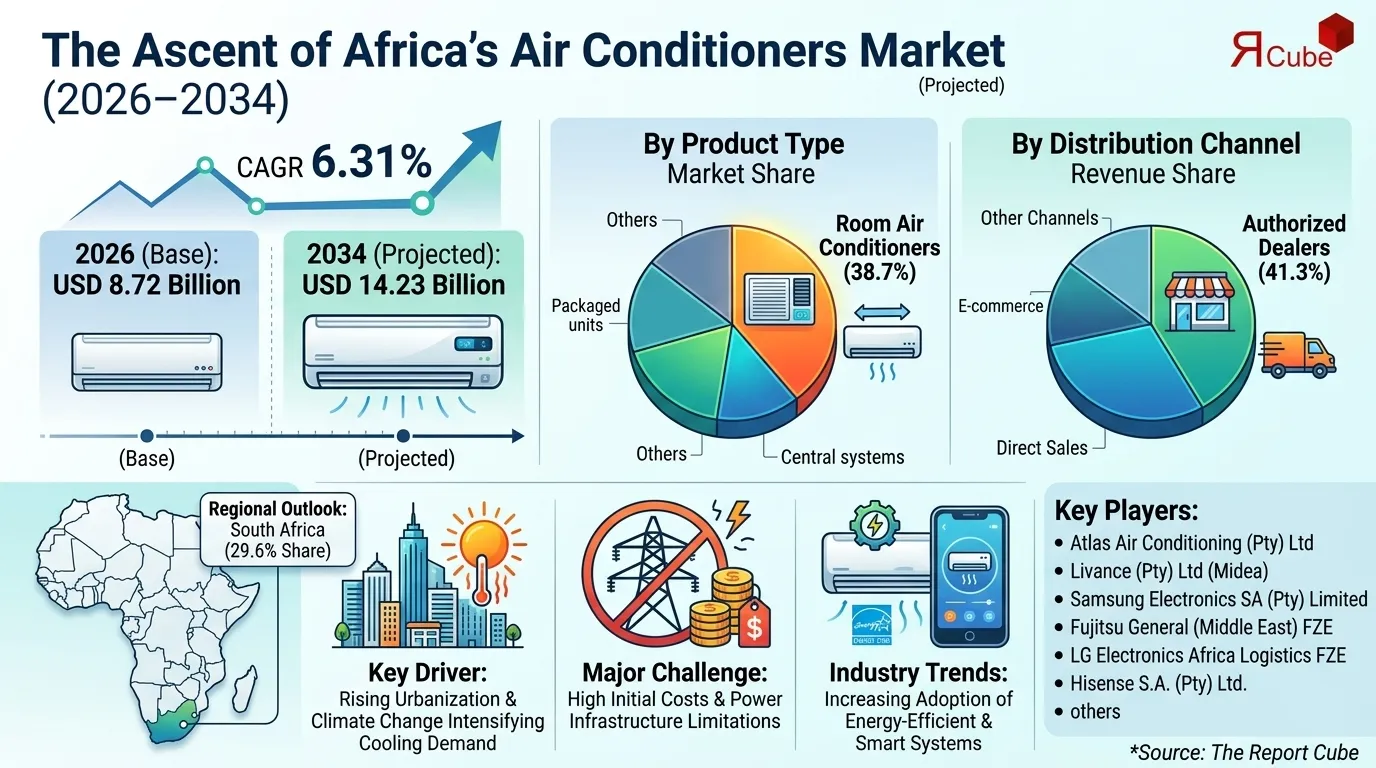
Room air conditioners segment leads the market with 38.7% share.
By Distribution Channel:
Authorized dealers and distributors segment dominates the market with 41.3% of revenue.
Regional Outlook:
South Africa region dominates the Africa Air Conditioners market with 29.6% share.
Africa Air Conditioners Market Insights & Analysis
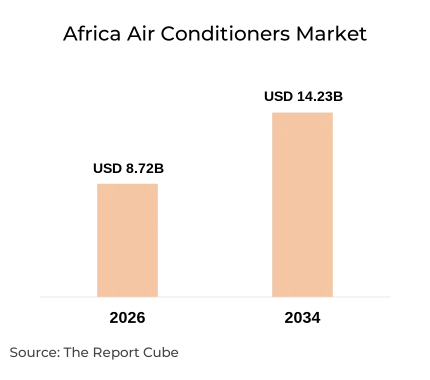
The Africa Air Conditioners Market is anticipated to register a CAGR of around 6.31% during the forecast period 2026-2034. The market size is valued at USD 8.72 billion in 2026 and is projected to reach USD 14.23 billion by 2034. Growing urbanization across African economies is shaping demand for cooling solutions, particularly in rapidly expanding cities such as Lagos, Nairobi, and Cairo. Increasing disposable income levels combined with rising temperatures have pushed household penetration of room air conditioners beyond 32% in urban households by 2025. Additionally, commercial infrastructure projects such as shopping malls, data centers, and hospitality spaces are boosting demand for packaged and ducted split systems.
Investment activity continues to expand across industrial and energy sectors, creating strong demand for large-scale HVAC systems including chillers and VRF systems. Governments are also promoting energy-efficient cooling technologies through building regulations and green construction initiatives. For instance, energy codes introduced in South Africa and Egypt are accelerating the shift toward inverter-based air conditioners. Leading companies are focusing on localized manufacturing and distribution expansion to reduce import dependency. Furthermore, the growth of e-commerce platforms and multi-brand retail networks is improving product accessibility, supporting overall Africa air conditioners market growth, share expansion, and long-term demand trends.
Africa Air Conditioners Market Impact Analysis
| Factor | Type | Specific Impact on Market | Magnitude | Business Implication |
|---|---|---|---|---|
| Rapid Urbanization & Infrastructure Growth | Market | Urban population exceeds 50% by 2030; construction boom | High | Expand in urban hubs; target smart city projects |
| Rising Temperatures & Climate Change (1.5°C) | Environmental | Average temps rise 1.5°C; AC shifts to health necessity | High | Position as essential health products; boost service |
| Growing Middle-Class & Disposable Income | Consumer | Home ownership in SA, Kenya, Nigeria drives AC adoption | High | Develop mid-range models for emerging buyers |
| MEPS & Energy Labelling (EAC/SADC Standards) | Regulatory | EAC/SADC Class B minimum; two-phase rollout (2025/2027) | High | Ensure Class B+ compliance; leverage energy labels |
| Hospitality & Commercial Sector Expansion | Market | Hotels, offices, malls fuel commercial cooling demand | Medium | Strengthen commercial AC portfolio; VRF systems |
| High Electricity Costs & Power Grid Issues | Market | Consumers prioritize low-consumption models; grid limits | High | Promote inverter ACs; highlight long-term savings |
| R22 Refrigerant Phase-Out (2.5% Quota 2026) | Regulatory | HCFC import quota drops to 2.5%; forces refrigerant shift | High | Transition to eco-friendly refrigerants immediately |
| Imported Used AC Units & Market Dumping | Market | Used units flood market; undermine efficiency standards | Medium | Advocate import regulations; educate on efficiency |
| Split AC Dominance in Residential Segment | Market | Split systems preferred; limited product diversification | Medium | Diversify product portfolio beyond split systems |
| Low AC Penetration Rate (<5% Households) | Market | Huge untapped market potential; growth from low base | High | Build distribution networks; lower entry barriers |
| Government Energy Efficiency Programs | Regulatory | African Energy Efficiency Program targets regional MEPS | Medium | Align with regional programs; access incentives |
| Price Sensitivity & Affordability Barriers | Consumer | High upfront costs limit mass adoption in rural areas | High | Offer financing; develop budget-friendly models |
| Regional MEPS Harmonization (Phase 2 2027) | Regulatory | Stricter Phase 2 standards by 2027; compliance transition | High | Prepare for Phase 2 now; avoid compliance rush |
| Solar-Powered & Off-Grid AC Solutions | Technological | Off-grid solutions address unreliable power infrastructure | Medium | Invest in solar AC R&D; partner with off-grid firms |
Africa Air Conditioners Market Dynamics
Key Driver: Rising Urbanization and Climate Change Intensifying Cooling Demand
Rapid urban expansion across Africa is significantly increasing the need for residential and commercial cooling systems. Urban population growth is expected to exceed 50% of the total population by 2030, creating strong demand for room air conditioners and ducted systems. At the same time, climate patterns are shifting, with average temperatures rising by nearly 1.5°C in several African regions over the past decade. This change is directly influencing consumer preference toward reliable cooling solutions, strengthening Africa air conditioners market size and demand outlook.
Commercial construction is another strong driver supporting the Africa air conditioners market growth. Retail developments, office complexes, and hospitality projects require centralized cooling systems such as chillers and VRF units. In countries like Nigeria and South Africa, over 45% of new commercial buildings now integrate advanced HVAC systems. These factors collectively drive sustained growth across both residential and industrial segments, reinforcing long-term market expansion.
Book your FREE 30-minute expert consultation today
Contact UsIndustry Trends: Increasing Adoption of Energy-Efficient and Smart Air Conditioning Systems
The shift toward energy-efficient technologies is reshaping the Africa air conditioners market trends. Consumers and businesses are actively adopting inverter-based systems and eco-friendly refrigerants to reduce electricity consumption. Energy-efficient air conditioners can lower power usage by nearly 30%, making them attractive in regions with high electricity costs. Governments are also encouraging adoption through labeling programs and energy standards.
Smart air conditioning systems are gaining traction as digital connectivity expands across Africa. Features such as remote control via mobile apps, automated temperature adjustments, and AI-based energy optimization are becoming more common. This trend is particularly visible in premium residential and commercial segments. As a result, manufacturers are investing in product innovation, enhancing market competitiveness and strengthening Africa air conditioners market share.
Major Challenge: High Initial Costs and Power Infrastructure Limitations
The high upfront cost of air conditioning systems remains a key barrier to widespread adoption in several African countries. Entry-level split air conditioners can cost between USD 300 and USD 700, which limits affordability for middle- and lower-income households. Installation and maintenance expenses further increase total ownership costs, impacting market penetration in rural and semi-urban areas.
Electricity infrastructure challenges also restrict market growth. Many regions experience frequent power outages and unstable supply, making consistent air conditioner usage difficult. In countries such as Ethiopia and Tanzania, electricity access rates remain below 60% in some areas. These constraints hinder Africa air conditioners market growth and slow down adoption across residential and commercial segments.
Opportunity: Expansion of Renewable Energy and Off-Grid Cooling Solutions
The rise of renewable energy solutions is opening new growth avenues for the Africa air conditioners market. Solar-powered air conditioning systems are gaining popularity, especially in regions with abundant sunlight. These systems reduce dependency on grid electricity and offer cost savings over time. Solar HVAC installations have increased by nearly 18% annually across Africa since 2023, indicating strong future potential.
Off-grid cooling solutions are also emerging as a viable alternative in underserved regions. Hybrid systems combining solar and battery storage enable consistent cooling performance even in areas with unreliable electricity. Companies are introducing compact, energy-efficient units tailored for rural markets. This trend is expected to significantly boost Africa air conditioners market demand, particularly in remote and developing regions.
Africa Air Conditioners Market Segment-wise Analysis
By Product Type:
- Chillers
- Room Air Conditioners
- Cassette Air Conditioners
- Packaged Air Conditioners
- Ducted Split Systems
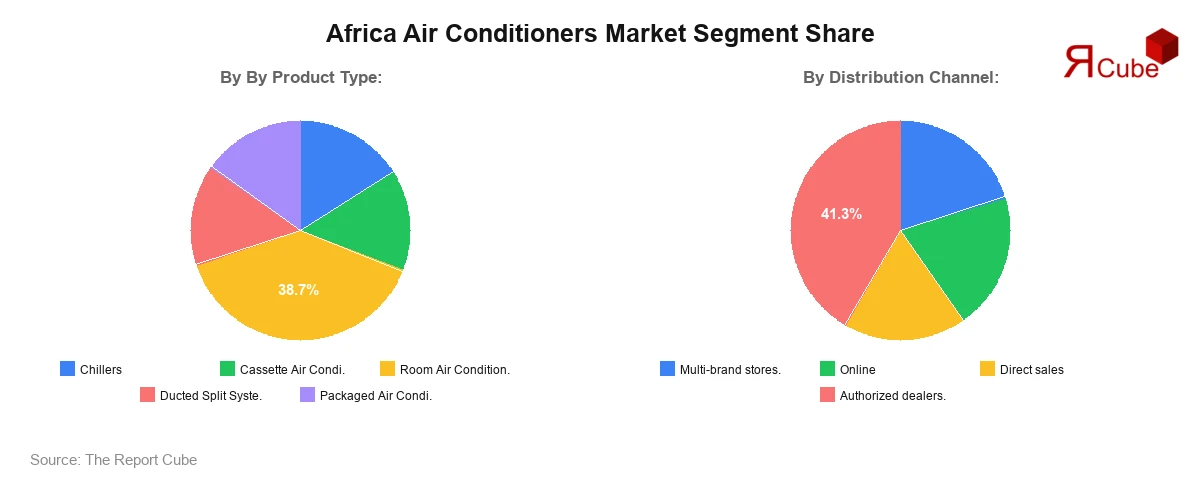
Room air conditioners dominate the Africa air conditioners market, accounting for approximately 38.7% of total market share in 2026. Strong residential demand, especially in urban areas, continues to drive this segment. Split AC units are particularly popular due to their energy efficiency and flexibility in installation.
Over 65% of households purchasing air conditioners prefer split systems within the 1 to 1.5 ton capacity range. Increasing affordability and availability through retail networks have further accelerated adoption. Additionally, rising temperatures and improved living standards are encouraging consumers to invest in cooling appliances. This segment is expected to maintain its leadership position due to continuous product innovation and expanding distribution reach.
By Distribution Channel:
- Multi-brand stores
- Online
- Direct sales
- Authorized dealers and distributors
Authorized dealers and distributors lead the Africa air conditioners market distribution landscape, contributing around 41.3% of total revenue. Customers often prefer these channels due to trust, after-sales support, and installation services. In many African countries, structured dealer networks provide warranties and maintenance services, which are critical for high-value products like air conditioners.
Direct engagement with distributors also ensures access to genuine products and technical assistance. Meanwhile, online channels are growing steadily, particularly in urban markets, driven by increasing internet penetration. However, the need for installation and service support continues to keep authorized distribution networks at the forefront of market growth.
Regional Projection of Africa Air Conditioners Industry
- Algeria
- Ethiopia
- Tanzania
- Egypt
- South Africa
- Morocco
- Nigeria
- Others
South Africa leads the Africa air conditioners market with an estimated 29.6% share, driven by strong industrial infrastructure and high urbanization levels. The country has a well-established commercial sector, including retail, healthcare, and energy industries, all of which require advanced HVAC systems.
Demand for chillers and ducted systems is particularly high in industrial and energy projects. Additionally, increasing adoption of energy-efficient technologies is boosting sales of inverter-based air conditioners. Government regulations promoting green buildings further support market growth. With a stable electricity network compared to other regions, South Africa continues to dominate the regional market landscape.
Africa Air Conditioners Market Countries Analysis
The Africa air conditioners market varies significantly across regions due to diverse climatic conditions, urban concentration, and economic activity.
| Cluster | Demand Level | Key Areas | System Dominance | Core Demand Logic | Growth Nature |
|---|---|---|---|---|---|
| Algeria | High | Algiers, Oran, Constantine | Room splits, basic commercial splits | Hot summers, rising urban comfort need | Steady, helped by local assembly push |
| Ethiopia | Medium | Addis Ababa, industrial parks | Splits, light commercial units | Urbanisation and new factories, mild climate | Emerging, constrained by power and FX |
| Tanzania | Medium–High | Dar es Salaam, Arusha, ports | Splits, small VRF in premium sites | Hot coastal belt, tourism and services | Fast, led by tourism and construction |
| Egypt | Very High | Cairo, Alexandria, new capital | Splits, multi‑splits, VRF, central | Dry heat, big urban base, real estate | Strong, one of the largest in Africa |
| South Africa | High | Johannesburg, Pretoria, Cape Town | Commercial splits, VRF, central HVAC | Developed services, malls, offices | Stable, upgrade and retrofit led |
| Morocco | Medium–High | Casablanca, Rabat, Marrakech | Residential splits, hotel VRF | Warm climate, tourism and retail | Growing, helped by tourism spend |
| Nigeria | Very High | Lagos, Abuja, Port Harcourt | Splits, inverter splits, light VRF | Hot humid south, big middle class | Fastest, despite grid and FX issues |
Need insights for a specific region within this market?
Request Regional DataGovernment Initiatives & Policies
- South Africa Energy Efficiency Strategy 2025: Focuses on reducing national energy consumption by promoting efficient appliances including HVAC systems.
- Egypt Green Building Code 2026: Encourages adoption of energy-efficient cooling systems in commercial and residential construction projects.
Africa Air Conditioners Industry Recent Developments
- 2025: AHI Carrier South Africa (Pty) Ltd secured critical chiller servicing contracts for Eskom Holdings SOC Ltd through 2026. This agreement supports maintenance of large-scale cooling systems in power plants, ensuring operational reliability and reinforcing demand for industrial HVAC services.
Why Choose This Report?
- Provides a comprehensive overview of the overall market analysis, encompassing key trends, consumer behavior analysis, and risk assessment to support strategic decision-making.
- Provides accurate, up-to-date insights into market size, segmentation, and emerging opportunities, helping to minimize risk & capitalizing on growth.
- Gives deep understanding of target audience preferences, investment habits, and communication channels for enhanced product development & marketing effectiveness.
- Delivers competitive analysis & benchmarking, uncovering the strengths & weaknesses of market competitors to guide strategies.
- Consolidate comprehensive market intelligence, reducing reasoning & streamlining research efforts.
- Facilitates customized market segmentation & risk mitigation strategies, fine-tuned to the business objectives.
- Aids in identifying both market challenges & untapped opportunities within the industry to drive long-term business growth.
- Provides valuable information based on actual customer data & search trends.
Table of Contents
- Introduction
- Objective of the Study
- Product and Category Definition
- Market Segmentation
- Study Variables
- Research Methodology
- Secondary Data Points
- Breakdown of Secondary Sources
- Primary Data Points
- Breakdown of Primary Interviews
- Secondary Data Points
- Executive Summary
- Market Dynamics
- Emerging Opportunities
- Adoption Trends
- Demand Drivers
- Disruption Analysis (Challenges)
- Industry Analysis and Strategic Insights
- Supply and Value Chain Analysis
- Pricing Analysis
- Go-To-Market (GTM) Strategy
- BCG Matrix
- Recent Trends and Developments
- Import and Export Analysis
- Regulatory and Policy Landscape
- Region-wise Policies
- Government Initiatives
- Africa Air Conditioners Market Overview and Forecast Analysis (2021-2034)
- Market Size, By Value, By Growth Rate (CAGR/USD Billion)
- Market Share, By Product Type
- Chillers
- Water-cooled Chillers
- Air-cooled Chillers
- Other Chillers
- Room Air Conditioners
- Split AC
- Up to 1 Ton
- 1 Ton to 1.5 Ton
- Above 1.6 to 2 Ton
- Above 2 Ton
- Window AC
- Up to 1 Ton
- 1 Ton to 2 Ton
- Above 2 Ton
- Split AC
- Cassette Air Conditioners
- Up to 2 Tons
- 2.1 to 4 Tons
- 4.1 to 5 Tons
- Above 5 Tons
- Packaged Air Conditioners
- Up to 5 Tons
- 6 to 10 Tons
- 11 to 20 Tons
- Above 20 Tons
- Ducted Split Systems
- VRF Systems
- Up to 5 Tons
- 6 to 10 Tons
- 11 to 20 Tons
- Above 20 Tons
- Others (Air Handling Units / Fan Coil Units, etc.)
- Chillers
- Market Share, By Refrigerant Type
- R290
- R410A
- R32
- R1234ze / R1234yf
- R134a
- Other refrigerants
- Market Share, By Distribution Channel
- Multi-brand stores
- Online
- Direct sales
- Authorized dealers and distributors
- Market Share, By End User
- Retail and malls
- Pharmaceuticals
- Food and beverage
- Hotels and hospitality
- Data centers
- Offices
- Manufacturing
- Residential
- Educational institutions
- Hospitals and healthcare
- Other
- Market Share, By Country
- Algeria
- Ethiopia
- Tanzania
- Egypt
- South Africa
- Morocco
- Nigeria
- Market Share, By Company
- Revenue Share and Analysis
- Competitive Landscape
- Algeria Air Conditioners Market Overview and Forecast Analysis (2021-2034)
- Market Size, By Value, By Growth Rate (CAGR/USD Billion/Million)
- Market Share, By Product Type
- Market Share, By Refrigerant Type
- Market Share, By Distribution Channel
- Market Share, By End User
- Ethiopia Air Conditioners Market Overview and Forecast Analysis (2021-2034)
- Market Size, By Value, By Growth Rate (CAGR/USD Billion/Million)
- Market Share, By Product Type
- Market Share, By Refrigerant Type
- Market Share, By Distribution Channel
- Market Share, By End User
- Tanzania Air Conditioners Market Overview and Forecast Analysis (2021-2034)
- Market Size, By Value, By Growth Rate (CAGR/USD Billion/Million)
- Market Share, By Product Type
- Market Share, By Refrigerant Type
- Market Share, By Distribution Channel
- Market Share, By End User
- Egypt Air Conditioners Market Overview and Forecast Analysis (2021-2034)
- Market Size, By Value, By Growth Rate (CAGR/USD Billion/Million)
- Market Share, By Product Type
- Market Share, By Refrigerant Type
- Market Share, By Distribution Channel
- Market Share, By End User
- South Africa Air Conditioners Market Overview and Forecast Analysis (2021-2034)
- Market Size, By Value, By Growth Rate (CAGR/USD Billion/Million)
- Market Share, By Product Type
- Market Share, By Refrigerant Type
- Market Share, By Distribution Channel
- Market Share, By End User
- Morocco Air Conditioners Market Overview and Forecast Analysis (2021-2034)
- Market Size, By Value, By Growth Rate (CAGR/USD Billion/Million)
- Market Share, By Product Type
- Market Share, By Refrigerant Type
- Market Share, By Distribution Channel
- Market Share, By End User
- Nigeria Air Conditioners Market Overview and Forecast Analysis (2021-2034)
- Market Size, By Value, By Growth Rate (CAGR/USD Billion/Million)
- Market Share, By Product Type
- Market Share, By Refrigerant Type
- Market Share, By Distribution Channel
- Market Share, By End User
- Competitive Analysis, 2026
- Market Share of Key Players
- Competitive Mapping for Each Segment and Companies Operating By Country
- Algeria Air Conditioners Companies/Brands Share and Competitive Analysis, 2026
- Ethiopia Air Conditioners Companies/Brands Share and Competitive Analysis, 2026
- Tanzania Air Conditioners Companies/Brands Share and Competitive Analysis, 2026
- Egypt Air Conditioners Companies/Brands Share and Competitive Analysis, 2026
- South Africa Air Conditioners Companies/Brands Share and Competitive Analysis, 2026
- Morocco Air Conditioners Companies/Brands Share and Competitive Analysis, 2026
- Nigeria Air Conditioners Companies/Brands Share and Competitive Analysis, 2026
- Company Profile (Partial List)
- Atlas Air Conditioning (Pty) Ltd
- Company Overview
- Product Portfolio
- Strategic Alliances/Partnerships
- Recent Developments
- Livance (Pty) Ltd (Midea)
- Company Overview
- Product Portfolio
- Strategic Alliances/Partnerships
- Recent Developments
- Samsung Electronics SA (Pty) Limited
- Company Overview
- Product Portfolio
- Strategic Alliances/Partnerships
- Recent Developments
- Fujitsu General (Middle East) FZE
- Company Overview
- Product Portfolio
- Strategic Alliances/Partnerships
- Recent Developments
- LG Electronics Africa Logistics FZE
- Company Overview
- Product Portfolio
- Strategic Alliances/Partnerships
- Recent Developments
- Hisense S.A. (Pty) Ltd.
- Company Overview
- Product Portfolio
- Strategic Alliances/Partnerships
- Recent Developments
- Daikin Airconditioning South Africa (Pty) Ltd
- Company Overview
- Product Portfolio
- Strategic Alliances/Partnerships
- Recent Developments
- MS Airconditioning Distributors (Pty) Ltd
- Company Overview
- Product Portfolio
- Strategic Alliances/Partnerships
- Recent Developments
- Robert Bosch (Pty) Ltd
- Company Overview
- Product Portfolio
- Strategic Alliances/Partnerships
- Recent Developments
- AHI Carrier South Africa (Pty) Ltd
- Company Overview
- Product Portfolio
- Strategic Alliances/Partnerships
- Recent Developments
- Others (Partial List)
- Atlas Air Conditioning (Pty) Ltd
- Contact Us and Disclaimer
Top Key Players & Market Share Outlook
- Atlas Air Conditioning (Pty) Ltd
- Livance (Pty) Ltd (Midea)
- Samsung Electronics SA (Pty) Limited
- Fujitsu General (Middle East) FZE
- LG Electronics Africa Logistics FZE
- Hisense S.A. (Pty) Ltd.
- Daikin Airconditioning South Africa (Pty) Ltd
- MS Airconditioning Distributors (Pty) Ltd
- Robert Bosch (Pty) Ltd
- AHI Carrier South Africa (Pty) Ltd
Frequently Asked Questions






