



Build Your Custom Market Intelligence Report
Customize Your ReportSouth Africa Air Conditioners Market Key Highlights
By Product Type:
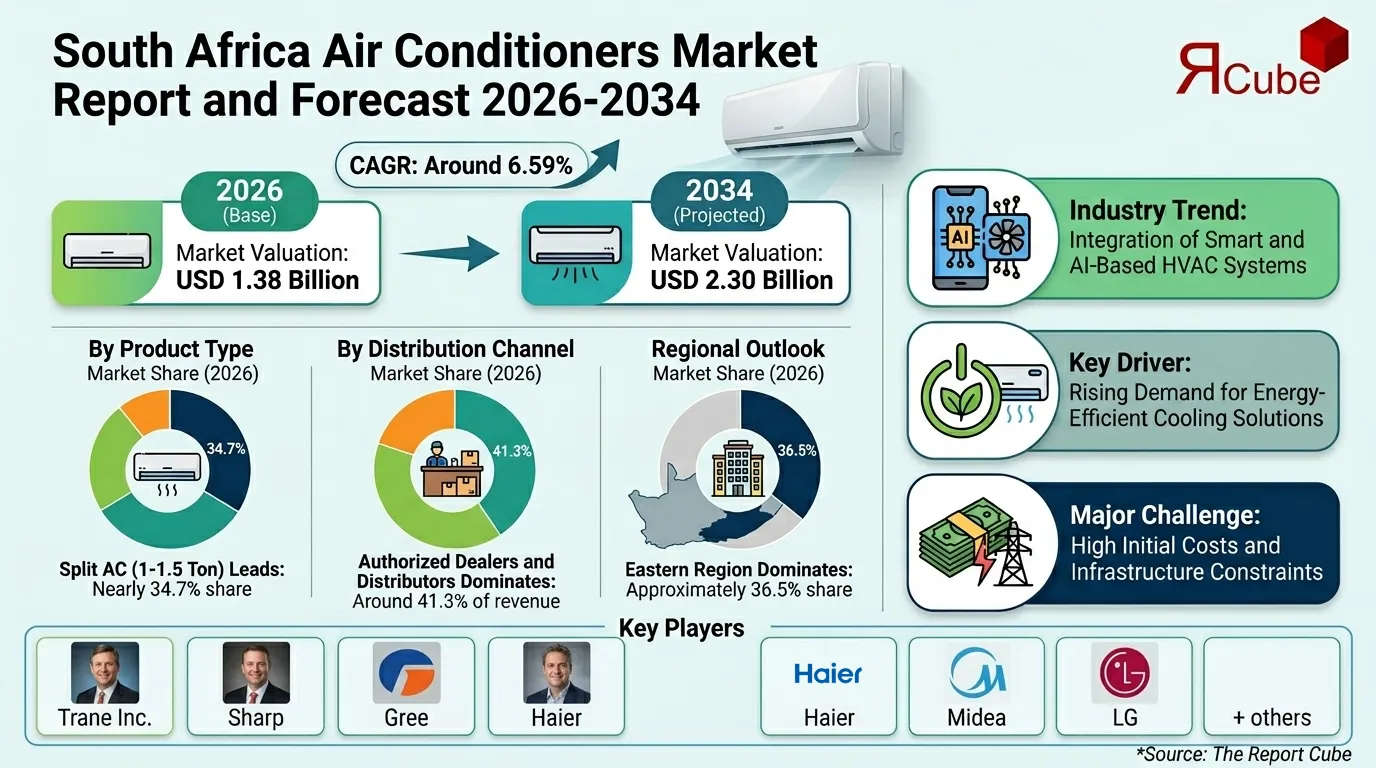
Split AC (1 Ton to 1.5 Ton) segment leads the market with nearly 34.7% share.
By Distribution Channel:
Authorized Dealers and Distributors segment dominates the market with around 41.3% of revenue.
Regional Outlook:
Eastern region dominates the South Africa Air Conditioners market with approximately 36.5% share.
South Africa Air Conditioners Market Insights & Analysis
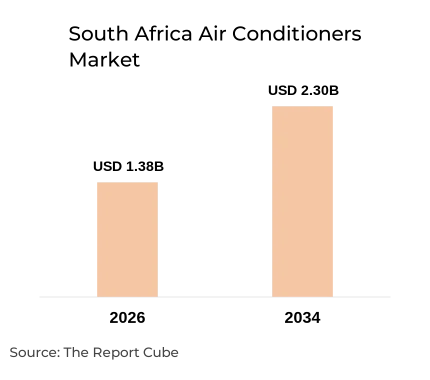
The South Africa Air Conditioners Market is anticipated to register a CAGR of around 6.59% during the forecast period 2026-2034. The market size is valued at USD 1.38 billion in 2026 and is projected to reach USD 2.30 billion by 2034. Growing urban density, rising middle-class purchasing power, and increasing temperature variability are shaping the demand curve for air conditioning systems across residential and commercial sectors. Market trends show that more than 58% of new urban housing projects in South Africa now include integrated cooling systems, reflecting changing lifestyle expectations and climate adaptation needs.
Investment momentum is accelerating as global HVAC leaders expand their footprint through localized innovation and distribution strategies. The entry of new manufacturers and the rollout of energy-efficient systems are influencing the South Africa air conditioners market size and share. Technological integration such as AI-driven energy optimization and smart climate control is gaining traction, especially in commercial buildings and smart homes. Government-backed energy efficiency initiatives and the shift toward low-GWP refrigerants are also reshaping product development. These combined factors are strengthening market growth while aligning with sustainability goals and evolving consumer demand.
South Africa Air Conditioners Market Impact Analysis
| Factor | Type | Specific Impact on Market | Magnitude | Business Implication |
|---|---|---|---|---|
| Rising temperatures and heatwaves | Environmental | Hotter summers make cooling a necessity nationwide | High | Plan higher peak season stock and service coverage |
| Urbanisation and infrastructure growth | Market | City housing and offices drive AC penetration up | High | Prioritise Gauteng and major metros for roll‑outs |
| Overall AC market growth outlook | Market | Steady demand growth across sectors to 2030s | High | Expand capacity and add SKUs for key segments |
| Shift to split and room AC systems | Consumer | Splits and portables outpace window units in sales | High | Focus pipeline on split and portable product lines |
| Energy efficiency rules and labels | Regulatory | Efficiency standards push demand to efficient units | Medium | Upgrade designs and market star ratings actively |
| High electricity tariffs for users | Consumer | Running cost concern boosts efficient model appeal | Medium | Highlight life‑cycle savings and inverter benefits |
| Competition from imports and brands | Competitive | Imported and regional brands intensify price play | Medium | Differentiate via reliability, service and features |
| Household income and employment shifts | Market | Income pressure delays first and replacement buys | Medium | Strengthen value lines and flexible consumer credit |
| Growth in commercial and retail spaces | Market | New malls, offices and hotels raise AC demand | Medium | Develop light commercial and VRF based offerings |
| Smart and connected AC adoption | Technological | Urban users show interest in Wi‑Fi and app control | Low | Introduce entry smart SKUs for premium segments |
| Environmental focus and refrigerants | Environmental | Policy shift toward lower GWP cooling solutions | Medium | Move to low GWP gases and promote green branding |
| E‑commerce and digital search usage | Consumer | Online research and reviews shape final AC choice | Medium | Invest in content, ratings and omni‑channel reach |
South Africa Air Conditioners Market Dynamics
Key Driver: Rising Demand for Energy-Efficient Cooling Solutions
Growing concerns around electricity costs and power reliability are pushing consumers and businesses toward energy-efficient air conditioning systems. South Africa has experienced recurring load-shedding, which has significantly influenced purchasing behavior. As a result, nearly 62% of commercial buyers now prioritize systems with energy-saving certifications and inverter technology. This shift is driving the South Africa air conditioners market growth, especially in urban hubs where energy costs are higher.
Additionally, increasing awareness about environmental sustainability is encouraging the adoption of eco-friendly refrigerants and advanced cooling systems. Manufacturers are responding by introducing products that reduce energy consumption by up to 30%, improving both operational efficiency and long-term savings. This evolving demand pattern continues to expand the market size while strengthening consumer confidence in modern HVAC technologies.
Book your FREE 30-minute expert consultation today
Contact UsIndustry Trends: Integration of Smart and AI-Based HVAC Systems
Smart HVAC systems are gaining popularity across residential and commercial applications. Consumers are increasingly opting for air conditioners that offer remote control, automated temperature adjustments, and predictive maintenance features. Recent data indicates that smart-enabled air conditioners account for nearly 28% of new installations in metropolitan areas. This trend is shaping the South Africa air conditioners market trends by enhancing user convenience and system efficiency.
Furthermore, artificial intelligence is playing a key role in optimizing performance. AI-driven systems can analyze usage patterns and external weather conditions to deliver precise cooling. This not only improves comfort but also reduces energy waste. As smart home adoption grows, the demand for connected air conditioning systems is expected to rise steadily, reinforcing long-term market expansion.
Major Challenge: High Initial Costs and Infrastructure Constraints
The upfront cost of advanced air conditioning systems remains a barrier for many consumers, particularly in lower-income segments. High installation expenses, coupled with maintenance costs, limit adoption rates in certain regions. Around 37% of potential buyers delay purchases due to budget constraints, affecting the overall South Africa air conditioners market demand.
Infrastructure limitations also pose challenges, especially in rural and semi-urban areas. Inconsistent power supply and limited access to skilled technicians restrict the deployment of complex HVAC systems. These factors create a gap between demand and actual installation, slowing market penetration in underserved regions.
Opportunity: Growth in Commercial Infrastructure and Data Centers
The expansion of commercial infrastructure, including shopping malls, office spaces, and data centers, is creating new growth opportunities. South Africa’s digital economy is driving the need for advanced cooling systems in data centers, where temperature control is critical. This segment is expected to grow at over 8% annually, boosting the South Africa air conditioners market share.
At the same time, green building initiatives and sustainable construction practices are encouraging the use of high-efficiency HVAC systems. Developers are increasingly integrating centralized cooling solutions into new projects, creating a strong pipeline for future demand. These developments are opening new revenue streams for manufacturers and suppliers across the value chain.
South Africa Air Conditioners Market Segment-wise Analysis
By Product Type:
- Chillers
- Room Air Conditioners
- Cassette Air Conditioners
- Packaged Air Conditioners
- Ducted Split Systems
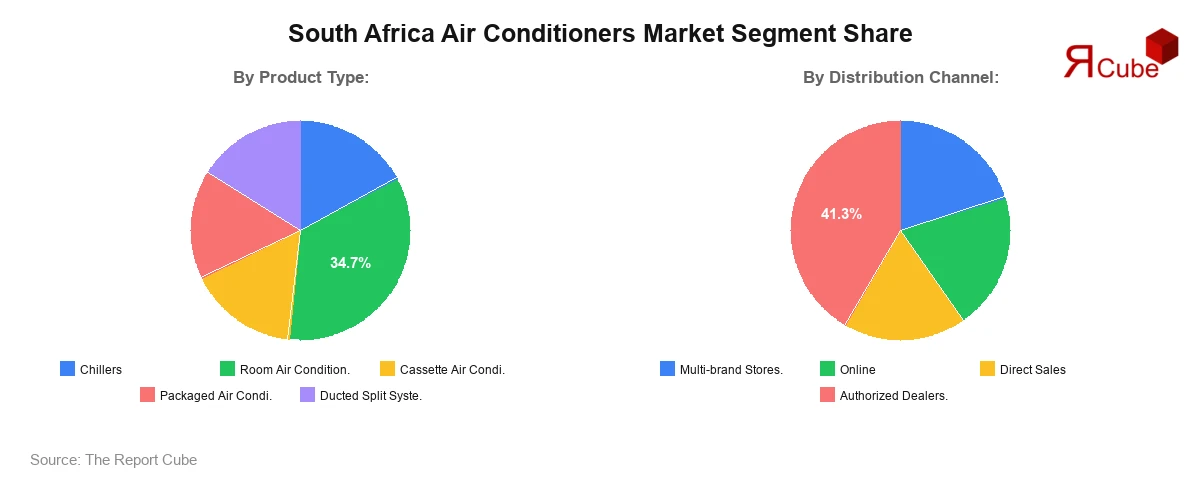
Split air conditioners within the room air conditioners category hold the dominant position, contributing approximately 34.7% of the overall market share. Their popularity is driven by ease of installation, affordability, and energy-efficient operation. Among these, units ranging from 1 ton to 1.5 ton are widely preferred for residential use due to optimal performance in medium-sized rooms.
Demand for split AC systems has grown by nearly 11% year-on-year, supported by increasing urban housing developments and rising disposable incomes. The segment continues to lead the South Africa air conditioners market size as consumers shift toward quieter and more efficient cooling solutions.
By Distribution Channel:
- Multi-brand Stores
- Online
- Direct Sales
- Authorized Dealers and Distributors
Authorized dealers and distributors dominate the distribution landscape, accounting for around 41.3% of total revenue. These channels offer reliable after-sales service, warranty support, and professional installation, which are critical factors for buyers. Customers often prefer these outlets for high-value purchases due to trust and technical assistance.
Sales through authorized networks have increased by nearly 9% annually, reflecting strong consumer preference. While online channels are expanding rapidly, especially among younger buyers, the need for installation services keeps offline channels at the forefront of the South Africa air conditioners market share.
Regional Projection of South Africa Air Conditioners Industry
- Eastern
- Western
- Northwest
- Northern
- Others
The Eastern region leads the South Africa air conditioners market with an estimated share of 36.5%. This dominance is supported by high urbanization rates, strong commercial activity, and increasing infrastructure development. Cities in this region are experiencing rapid growth in residential complexes and commercial buildings, driving demand for efficient cooling systems.
The region also benefits from better access to distribution networks and service providers, ensuring higher adoption rates. Annual growth in this region is projected to exceed 7%, supported by rising temperatures and increasing consumer awareness about indoor climate control solutions.
South Africa Air Conditioners Market Regional Analysis
The South Africa air conditioners market varies significantly across regions due to diverse climatic conditions, urban concentration, and economic activity.
| Cluster | Demand Level | Key Areas | System Dominance | Core Demand Logic | Growth Nature |
|---|---|---|---|---|---|
| Eastern | High | Durban, Richards Bay belt | Split and ducted split AC | Humid coastal heat, tourism pull | Weather led but structurally rising |
| Western | Medium | Cape Town, Paarl, industrial | Split, VRF in premium sites | Seasonal heat, offices and retail | Retrofit and efficiency upgrade led |
| Northwest | Medium | Mining and logistics corridors | Rugged split and packaged units | Process and worker cooling need | Project driven, cyclical with mining |
| Northern | Very High | Hot inland, cross border trade | Split, multisplit and light VRF | Intense summer heat, urbanising | Fastest expansion from low base |
Need insights for a specific region within this market?
Request Regional DataGovernment Initiatives & Policies
- National Energy Efficiency Strategy 2025 Update: Focuses on reducing energy consumption in buildings by promoting high-efficiency HVAC systems.
- Green Building Incentive Program 2026: Encourages adoption of sustainable cooling technologies through tax incentives and compliance standards.
South Africa Air Conditioners Industry Recent Developments
- 2025: LG Electronics launched its AI-powered Multi VI HVAC system in Johannesburg, featuring SmartCare technology that adjusts cooling based on environmental data. The system delivers high energy efficiency and faster ROI, especially in major cities.
- 2026: Haier Electronics Group Co., Ltd. entered the South African market with solar-powered air conditioners and announced plans for local manufacturing, strengthening regional supply chains and addressing power challenges.
- 2026: Samsung Electronics Co. Ltd. expanded its HVAC portfolio with AI-enabled systems using R32 refrigerant, achieving up to 30% energy savings and supporting eco-friendly cooling demand.
- 2025: Daikin Middle East and Africa FZE introduced advanced cooling solutions for data centers, aligning with increasing demand for energy-efficient industrial cooling systems in the region.
Why Choose This Report?
- Provides a comprehensive overview of the overall market analysis, encompassing key trends, consumer behavior analysis, and risk assessment to support strategic decision-making.
- Provides accurate, up-to-date insights into market size, segmentation, and emerging opportunities, helping to minimize risk & capitalizing on growth.
- Gives deep understanding of target audience preferences, investment habits, and communication channels for enhanced product development & marketing effectiveness.
- Delivers competitive analysis & benchmarking, uncovering the strengths & weaknesses of market competitors to guide strategies.
- Consolidate comprehensive market intelligence, reducing reasoning & streamlining research efforts.
- Facilitates customized market segmentation & risk mitigation strategies, fine-tuned to the business objectives.
- Aids in identifying both market challenges & untapped opportunities within the industry to drive long-term business growth.
- Provides valuable information based on actual customer data & search trends.
Table of Contents
- Introduction
- Objective of the Study
- Product and Category Definition
- Market Segmentation
- Study Variables
- Research Methodology
- Secondary Data Points
- Breakdown of Secondary Sources
- Primary Data Points
- Breakdown of Primary Interviews
- Secondary Data Points
- Executive Summary
- Market Dynamics
- Emerging Opportunities
- Adoption Trends
- Demand Drivers
- Disruption Analysis (Challenges)
- Industry Analysis and Strategic Insights
- Supply and Value Chain Analysis
- Pricing Analysis
- Go-to-Market (GTM) Strategy
- BCG Matrix
- Recent Trends and Developments
- Import and Export Analysis
- Regulatory and Policy Landscape
- Region-wise Policies
- Government Initiatives
- South Africa Air Conditioners Market Overview and Forecast Analysis (2021-2034)
- Market Size, By Value, By Growth Rate (CAGR/USD Billion)
- Market Share, By Product Type
- Chillers
- Water-cooled Chillers
- Air-cooled Chillers
- Other Chillers
- Room Air Conditioners
- Split AC
- Up to 1 Ton
- 1 Ton to 1.5 Ton
- Above 1.6 to 2 Ton
- Above 2 Ton
- Window AC
- Up to 1 Ton
- 1 Ton to 2 Ton
- Above 2 Ton
- Split AC
- Cassette Air Conditioners
- Up to 2 Tons
- 2.1 to 4 Tons
- 4.1 to 5 Tons
- Above 5 Tons
- Packaged Air Conditioners
- Up to 5 Tons
- 6 to 10 Tons
- 11 to 20 Tons
- Above 20 Tons
- Ducted Split Systems
- VRF Systems
- Up to 5 Tons
- 6 to 10 Tons
- 11 to 20 Tons
- Above 20 Tons
- Others (Air Handling Units / Fan Coil Units, etc.)
- Chillers
- Market Share, By Refrigerant Type
- R290
- R410A
- R32
- R1234ze / R1234yf
- R134a
- Other Refrigerants
- Market Share, By Distribution Channel
- Multi-brand Stores
- Online
- Direct Sales
- Authorized Dealers and Distributors
- Market Share, By End User
- Retail and Malls
- Pharmaceuticals
- Food and Beverage
- Hotels and Hospitality
- Data Centers
- Offices
- Manufacturing
- Residential
- Educational Institutions
- Hospitals and Healthcare
- Other
- Market Share, By Region
- Eastern
- Western
- Northwest
- Northern
- Others
- Market Share, By Company
- Revenue Shares and Analysis
- Competitive Landscape
- Eastern South Africa Air Conditioners Market Overview and Forecast (2021-2034)
- Market Size, By Value, By Growth Rate (CAGR/USD Billion/Million)
- Market Share, By Product Type
- Market Share, By Refrigerant Type
- Market Share, By Distribution Channel
- Market Share, By End User
- Western South Africa Air Conditioners Market Overview and Forecast (2021-2034)
- Market Size, By Value, By Growth Rate (CAGR/USD Billion/Million)
- Market Share, By Product Type
- Market Share, By Refrigerant Type
- Market Share, By Distribution Channel
- Market Share, By End User
- Northwest South Africa Air Conditioners Market Overview and Forecast (2021-2034)
- Market Size, By Value, By Growth Rate (CAGR/USD Billion/Million)
- Market Share, By Product Type
- Market Share, By Refrigerant Type
- Market Share, By Distribution Channel
- Market Share, By End User
- Northern South Africa Air Conditioners Market Overview and Forecast (2021-2034)
- Market Size, By Value, By Growth Rate (CAGR/USD Billion/Million)
- Market Share, By Product Type
- Market Share, By Refrigerant Type
- Market Share, By Distribution Channel
- Market Share, By End User
- Other Regions in South Africa Air Conditioners Market Overview and Forecast (2021-2034)
- Market Size, By Value, By Growth Rate (CAGR/USD Billion/Million)
- Market Share, By Product Type
- Market Share, By Refrigerant Type
- Market Share, By Distribution Channel
- Market Share, By End User
- Competitive Analysis, 2026
- Market Share of Key Players
- Competitive Mapping for Each Product Type, Refrigerant Type, Distribution Channel, End User, and Regions
- Eastern South Africa Air Conditioners Companies/Brands Share and Competitive Analysis, 2026
- Western South Africa Air Conditioners Companies/Brands Share and Competitive Analysis, 2026
- Northwest South Africa Air Conditioners Companies/Brands Share and Competitive Analysis, 2026
- Northern South Africa Air Conditioners Companies/Brands Share and Competitive Analysis, 2026
- Other Regions in South Africa Air Conditioners Companies/Brands Share and Competitive Analysis, 2026
- Company Profiles (Partial List)
- Trane Inc.
- Company Overview
- Product Portfolio
- Strategic Alliances/Partnerships
- Recent Developments
- Sharp Middle East FZE
- Company Overview
- Product Portfolio
- Strategic Alliances/Partnerships
- Recent Developments
- Gree Electric Appliances, Inc. of Zhuhai
- Company Overview
- Product Portfolio
- Strategic Alliances/Partnerships
- Recent Developments
- Haier Electronics Group Co., Ltd.
- Company Overview
- Product Portfolio
- Strategic Alliances/Partnerships
- Recent Developments
- Midea Middle East
- Company Overview
- Product Portfolio
- Strategic Alliances/Partnerships
- Recent Developments
- LG Electronics
- Company Overview
- Product Portfolio
- Strategic Alliances/Partnerships
- Recent Developments
- Airconditioning and Heating International Carrier FZC
- Company Overview
- Product Portfolio
- Strategic Alliances/Partnerships
- Recent Developments
- Daikin Middle East and Africa FZE
- Company Overview
- Product Portfolio
- Strategic Alliances/Partnerships
- Recent Developments
- Dunham-Bush International (Africa) (Pty) Ltd
- Company Overview
- Product Portfolio
- Strategic Alliances/Partnerships
- Recent Developments
- Samsung Electronics Co. Ltd.
- Company Overview
- Product Portfolio
- Strategic Alliances/Partnerships
- Recent Developments
- Others (Partial List)
- Trane Inc.
- Contact Us and Disclaimer
Top Key Players & Market Share Outlook
- Trane Inc.
- Sharp Middle East FZE
- Gree Electric Appliances, Inc. of Zhuhai
- Haier Electronics Group Co., Ltd.
- Midea Middle East
- LG Electronics
- Airconditioning & Heating International Carrier FZC
- Daikin Middle East and Africa FZE
- Dunham-Bush International (Africa) (Pty) Ltd
- Samsung Electronics Co. Ltd.
Frequently Asked Questions






