



Build Your Custom Market Intelligence Report
Customize Your ReportNigeria Air Conditioners Market Key Highlights
By Product Type:
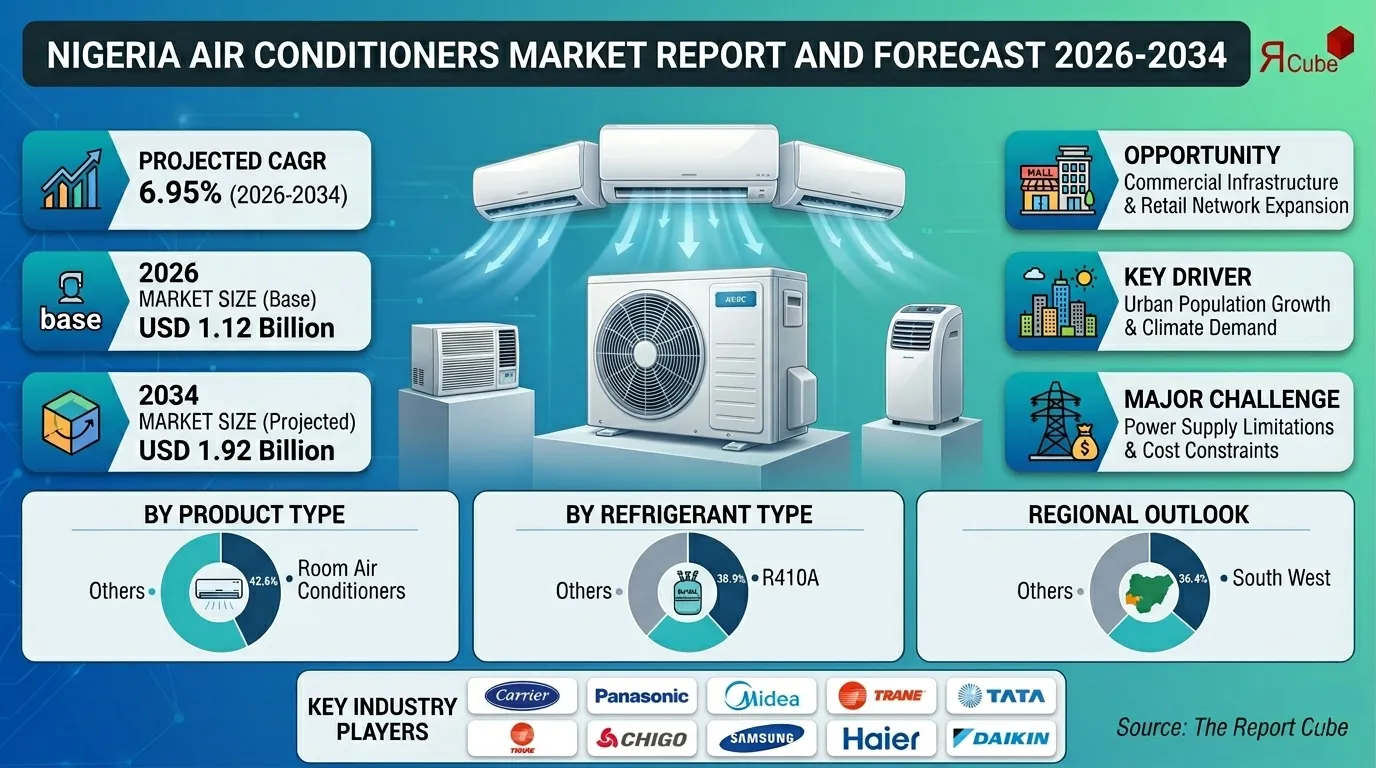
Room Air Conditioners segment leads the market with 42.6%.
By Refrigerant Type:
R410A segment dominates the market with 38.9% of revenue.
Regional Outlook:
South West region dominates the Nigeria Air Conditioners market with 36.4% share.
Nigeria Air Conditioners Market Insights & Analysis
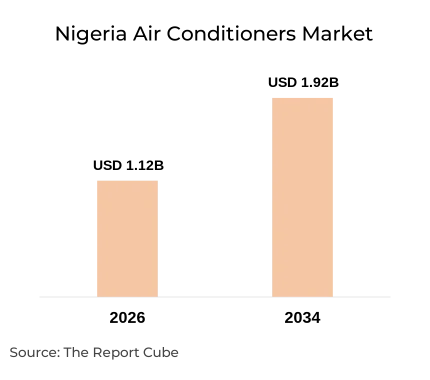
The Nigeria Air Conditioners Market is anticipated to register a CAGR of around 6.95% during the forecast period 2026-2034. The market size is valued at USD 1.12 billion and is projected to reach USD 1.92 billion by 2034. Nigeria’s air conditioner market is gaining steady traction due to rising urbanization, population expansion, and changing climate conditions. Increasing average temperatures across major cities such as Lagos and Abuja are pushing both residential and commercial consumers toward cooling solutions. Investments in real estate projects, especially mixed-use developments and commercial complexes, are supporting sustained demand for split AC systems and ducted solutions.
Government-backed infrastructure development and improved electrification initiatives are encouraging appliance adoption. Companies are introducing inverter-based systems designed for energy savings in regions with inconsistent power supply. Smart air conditioners with IoT capabilities are entering urban markets, targeting premium consumers. International brands are expanding distribution networks through local partnerships, while affordable models from Asian manufacturers are improving accessibility. These combined factors are shaping market size, share, and demand patterns across Nigeria.
Nigeria Air Conditioners Market Impact Analysis
| Factor | Type | Specific Impact on Market | Magnitude | Business Implication |
|---|---|---|---|---|
| Rising Temperatures and Extreme Heat Events | Environmental | Pushes AC adoption as key climate adaptation need | High | Position ACs as essential resilience and comfort tool |
| Urbanisation in Lagos, Abuja and Key Cities | Market | Concentrates demand in dense urban and peri-urban hubs | High | Prioritise distribution and service density in core cities |
| Infrastructure Growth in Hospitality and Offices | Market | Boosts demand from hotels, malls, offices and clinics | High | Develop B2B project sales and key account partnerships |
| Unreliable Grid Power and Generator Dependence | Environmental | Limits daily usage hours and raises running expenses | High | Design ACs optimised for low power and generator use |
| Growing Middle Class but High Price Sensitivity | Consumer | Creates volume potential but strong upfront cost concern | Medium | Offer flexible pricing, entry SKUs and instalment finance |
| Weak Enforcement of Efficiency and Refrigerant Rules | Regulatory | Allows inefficient and second-hand units to circulate | Medium | Compete on quality while lobbying for stronger standards |
| Competition from Imports and Used AC Shipments | Competitive | Exerts downwards pressure on prices and replacement | Medium | Differentiate on warranty, reliability and energy saving |
| Shift Toward Split and Inverter-Based AC Systems | Technological | Increases demand for efficient, quiet and compact units | High | Scale split inverter portfolio tuned to Nigerian usage |
| Limited Technician Skills and Service Quality Gaps | Consumer | Can cause failures, leaks and poor lifetime performance | Medium | Invest in training networks and certified installer base |
| Macroeconomic Volatility and Currency Depreciation | Market | Raises import costs and creates frequent price resets | High | Localise sourcing where viable and hedge FX exposures |
Nigeria Air Conditioners Market Dynamics
Key Driver: Rising Urban Population and Climate Demand
Urban centers in Nigeria are experiencing rapid expansion, creating consistent demand for cooling systems in residential and commercial buildings. Cities such as Lagos are witnessing increasing apartment developments, which require compact and efficient air conditioning units. Higher temperatures and humidity levels are pushing households toward split AC systems, driving steady market growth.
Commercial spaces including malls, offices, and healthcare facilities are adopting advanced HVAC systems to maintain indoor comfort. The Nigeria Air Conditioners Market benefits from increased consumer awareness regarding indoor air quality and productivity benefits. Demand for inverter AC units is rising as users aim to reduce electricity consumption, which strengthens long-term adoption across urban areas.
Book your FREE 30-minute expert consultation today
Contact UsIndustry Trends: Shift Toward Energy-Efficient and Smart Systems
Energy-efficient air conditioners are gaining strong traction as electricity costs remain a concern across Nigeria. Consumers are opting for inverter technology and eco-friendly refrigerants such as R32 to reduce power consumption. Manufacturers are focusing on launching models tailored for high ambient temperatures, ensuring reliability under extreme conditions.
Smart features such as remote control through mobile apps and automated temperature adjustment are becoming popular in premium segments. The Nigeria Air Conditioners Market is witnessing increasing integration of IoT-enabled cooling systems in commercial buildings. This trend is expected to expand further as connectivity infrastructure improves, boosting adoption of intelligent HVAC solutions.
Major Challenge: Power Supply Limitations and Cost Constraints
Irregular electricity supply remains a significant challenge for air conditioner adoption in Nigeria. Many households rely on generators, increasing the total cost of ownership for cooling systems. This limits penetration in lower-income segments, restricting overall market expansion.
High upfront costs of advanced air conditioners further slow adoption in rural and semi-urban regions. The Nigeria Air Conditioners Market faces pricing pressure as consumers prefer affordable models over premium energy-efficient units. Import dependency and fluctuating exchange rates also affect product pricing, creating barriers for consistent market growth.
Opportunity: Expansion of Commercial Infrastructure and Retail Networks
Growing investments in commercial infrastructure such as shopping centers, hotels, and office complexes are creating new opportunities for HVAC system deployment. Large-scale projects require centralized cooling systems, boosting demand for chillers and ducted solutions.
Retail expansion and improved distribution channels are increasing product availability across regions. The Nigeria Air Conditioners Market is benefiting from e-commerce platforms and dealer networks that make products accessible beyond major cities. Companies focusing on localized assembly and after-sales service are likely to gain competitive advantage in the coming years.
Nigeria Air Conditioners Market Segment-wise Analysis
By Product Type:
- Chillers
- Room Air Conditioners
- Cassette Air Conditioners
- Packaged Air Conditioners
- Ducted Split Systems
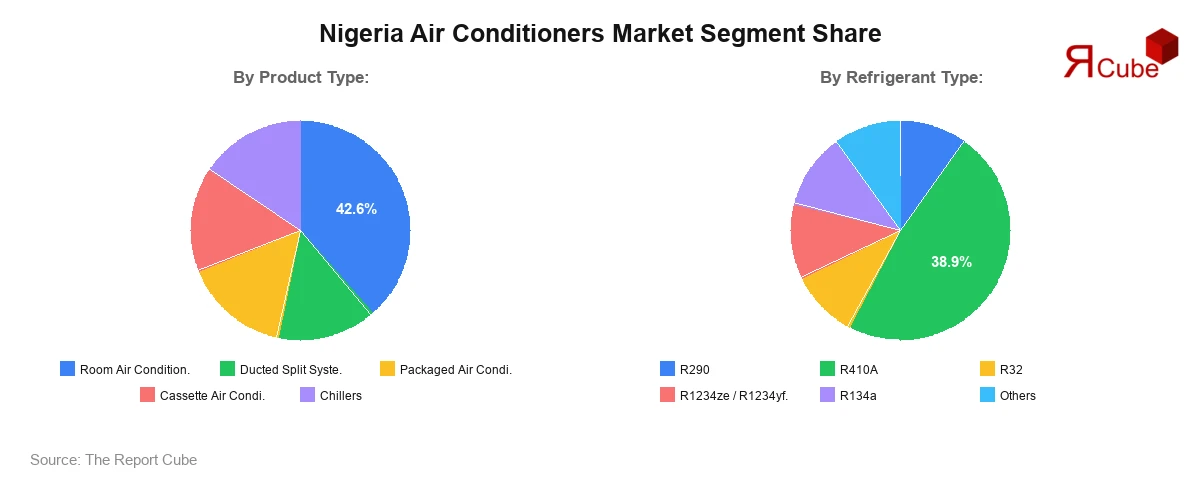
Room Air Conditioners hold the leading share of 42.6% in the Nigeria Air Conditioners Market. Split AC units dominate within this segment due to their energy efficiency, compact design, and suitability for residential spaces. Increasing middle-class households and rising urban housing demand are key contributors to segment dominance. Split ACs in the 1 ton to 1.5 ton category are particularly popular, accounting for 47.3% of room AC demand due to their balance between cost and cooling capacity.
Window AC units continue to serve budget-conscious consumers, though their share is gradually declining due to noise and installation limitations. Commercial adoption of cassette and ducted systems is growing in offices and retail spaces, yet room ACs remain the preferred choice due to affordability and ease of maintenance. This segment continues to shape overall market share and demand trends.
By Refrigerant Type:
- R290
- R410A
- R32
- R1234ze / R1234yf
- R134a
- Other Refrigerants
R410A dominates the refrigerant segment with a 38.9% market share due to its wide adoption in residential and commercial AC systems. It offers reliable cooling performance and compatibility with existing infrastructure, making it a preferred choice among manufacturers and consumers. However, the shift toward environmentally friendly alternatives is gradually influencing this segment.
R32 is gaining traction with a share of 21.7% as it offers lower global warming potential and improved energy efficiency. Manufacturers are increasingly introducing R32-based systems to align with global environmental standards. The Nigeria Air Conditioners Market is expected to see gradual transition toward sustainable refrigerants, driven by regulatory focus and consumer awareness.
Regional Projection of Nigeria Air Conditioners Industry
- South West
- South South
- South East
- North Central
- North West
- North East
The South West region leads the Nigeria Air Conditioners Market with a 36.4% share, driven by high urban density and strong economic activity. Lagos, being the commercial hub, contributes significantly to regional demand due to its concentration of residential complexes, offices, and retail centers. Rising disposable income levels and lifestyle changes are further boosting adoption of air conditioning systems.
Commercial infrastructure development in the South West continues to attract investments in HVAC systems, particularly in hospitality and corporate sectors. The presence of major distributors and service providers enhances product availability and maintenance support. While other regions are witnessing gradual adoption, the South West remains the dominant contributor to market size and revenue generation.
Nigeria Air Conditioners Market Regional Analysis
The Nigeria air conditioners market varies significantly across regions due to diverse climatic conditions, urban concentration, and economic activity.
| Cluster | Demand Level | Key Areas | System Dominance | Core Demand Logic | Growth Nature |
|---|---|---|---|---|---|
| South West | Very High | Lagos, Ibadan, Akure belt | Split & inverter AC | Urban heat, dense commercial corridors | Mix of new installs and upgrades |
| South South | Very High | Port Harcourt, Warri, Calabar | Split & light commercial systems | Hot humid climate, oil and port activity | Network expansion and replacements |
| South East | High | Enugu, Onitsha, Aba clusters | Split AC & multi‑split | Trading hubs, rising home comfort needs | SME‑led, steady volume growth |
| North Central | High | Abuja, Jos, Ilorin axis | Split, VRF in offices | Administrative hub and service growth | Project‑driven commercial expansion |
| North West | Medium | Kano, Kaduna, Sokoto zone | Split & basic commercial units | Very hot summers, emerging urban demand | Climate‑driven but grid constrained |
| North East | Low to Medium | Maiduguri, Yola corridor | Split and window units | Extreme heat, limited formal projects | Slow, from low base with risks |
Need insights for a specific region within this market?
Request Regional DataGovernment Initiatives & Policies
- Energy Efficiency Program: Nigeria introduced updated appliance efficiency standards in 2025 promoting low-energy cooling systems.
- National Cooling Action Plan: In 2026, the government advanced sustainable cooling strategies focusing on eco-friendly refrigerants and energy-saving technologies.
Nigeria Air Conditioners Industry Recent Developments
- 2026: Panasonic Corporation expanded its smart AC portfolio with energy-efficient inverter systems targeting high-temperature markets. The initiative includes scaling production to 2000000 units and introducing IoT-enabled VRF solutions tailored for commercial applications.
Why Choose This Report? {{UNCHANGED template}}
- Provides a comprehensive overview of the overall market analysis, encompassing key trends, consumer behavior analysis, and risk assessment to support strategic decision-making.
- Provides accurate, up-to-date insights into market size, segmentation, and emerging opportunities, helping to minimize risk & capitalizing on growth.
- Gives deep understanding of target audience preferences, investment habits, and communication channels for enhanced product development & marketing effectiveness.
- Delivers competitive analysis & benchmarking, uncovering the strengths & weaknesses of market competitors to guide strategies.
- Consolidate comprehensive market intelligence, reducing reasoning & streamlining research efforts.
- Facilitates customized market segmentation & risk mitigation strategies, fine-tuned to the business objectives.
- Aids in identifying both market challenges & untapped opportunities within the industry to drive long-term business growth.
- Provides valuable information based on actual customer data & search trends.
Table of Contents
- Introduction
- Objective of the Study
- Product and Category Definition
- Market Segmentation
- Study Variables
- Research Methodology
- Secondary Data Points
- Breakdown of Secondary Sources
- Primary Data Points
- Breakdown of Primary Interviews
- Secondary Data Points
- Executive Summary
- Market Dynamics
- Emerging Opportunities
- Adoption Trends
- Demand Drivers
- Disruption Analysis (Challenges)
- Industry Analysis & Strategic Insights
- Supply/Value Chain Analysis
- Pricing Analysis
- Go-To-Market (GTM) Strategy
- BCG Matrix
- Recent Trends and Developments
- Import and Export Analysis
- Regulatory and Policy Landscape
- Region-wise Policies
- Government Initiatives
- Nigeria Air Conditioners Market Overview and Forecast Analysis (2021-2034)
- Market Size, By Value, By Growth Rate (CAGR/USD Billion)
- Market Share, By Product Type
- Chillers
- Water-cooled Chillers
- Air-cooled Chillers
- Other Chillers
- Room Air Conditioners
- Split AC
- Up to 1 Ton
- 1 Ton to 1.5 Ton
- Above 1.6 to 2 Ton
- Above 2 Ton
- Window AC
- Up to 1 Ton
- 1 Ton to 2 Ton
- Above 2 Ton
- Split AC
- Cassette Air Conditioners
- Up to 2 Tons
- 2.1 to 4 Tons
- 4.1 to 5 Tons
- Above 5 Tons
- Packaged Air Conditioners
- Up to 5 Tons
- 6 to 10 Tons
- 11 to 20 Tons
- Above 20 Tons
- Ducted Split Systems
- VRF Systems
- Up to 5 Tons
- 6 to 10 Tons
- 11 to 20 Tons
- Above 20 Tons
- Others (Air Handling Units / Fan Coil Units, etc.)
- Chillers
- Market Share, By Refrigerant Type
- R290
- R410A
- R32
- R1234ze / R1234yf
- R134a
- Other Refrigerants
- Market Share, By Distribution Channel
- Multi-brand Stores
- Online
- Direct Sales
- Authorized Dealers and Distributors
- Market Share, By End User
- Retail and Malls
- Pharmaceuticals
- Food and Beverage
- Hotels and Hospitality
- Data Centers
- Offices
- Manufacturing
- Residential
- Educational Institutions
- Hospitals and Healthcare
- Other
- Market Share, By Region
- South West
- South South
- South East
- North Central
- North West
- North East
- Market Share, By Company
- Revenue Shares and Analysis
- Competitive Landscape
- South West Nigeria Air Conditioners Market Overview and Forecast Analysis (2021-2034)
- Market Size, By Value, By Growth Rate (CAGR/USD Billion/Million)
- Market Share, By Product Type
- Market Share, By Refrigerant Type
- Market Share, By Distribution Channel
- Market Share, By End User
- South South Nigeria Air Conditioners Market Overview and Forecast Analysis (2021-2034)
- Market Size, By Value, By Growth Rate (CAGR/USD Billion/Million)
- Market Share, By Product Type
- Market Share, By Refrigerant Type
- Market Share, By Distribution Channel
- Market Share, By End User
- South East Nigeria Air Conditioners Market Overview and Forecast Analysis (2021-2034)
- Market Size, By Value, By Growth Rate (CAGR/USD Billion/Million)
- Market Share, By Product Type
- Market Share, By Refrigerant Type
- Market Share, By Distribution Channel
- Market Share, By End User
- North Central Nigeria Air Conditioners Market Overview and Forecast Analysis (2021-2034)
- Market Size, By Value, By Growth Rate (CAGR/USD Billion/Million)
- Market Share, By Product Type
- Market Share, By Refrigerant Type
- Market Share, By Distribution Channel
- Market Share, By End User
- North West Nigeria Air Conditioners Market Overview and Forecast Analysis (2021-2034)
- Market Size, By Value, By Growth Rate (CAGR/USD Billion/Million)
- Market Share, By Product Type
- Market Share, By Refrigerant Type
- Market Share, By Distribution Channel
- Market Share, By End User
- North East Nigeria Air Conditioners Market Overview and Forecast Analysis (2021-2034)
- Market Size, By Value, By Growth Rate (CAGR/USD Billion/Million)
- Market Share, By Product Type
- Market Share, By Refrigerant Type
- Market Share, By Distribution Channel
- Market Share, By End User
- Competitive Analysis, 2026
- Market Share of Key Players
- Competitive Mapping for Each Segment and Companies Operating Regionally
- South West Nigeria Air Conditioners Companies/Brands Share and Competitive Analysis, 2026
- South South Nigeria Air Conditioners Companies/Brands Share and Competitive Analysis, 2026
- South East Nigeria Air Conditioners Companies/Brands Share and Competitive Analysis, 2026
- North Central Nigeria Air Conditioners Companies/Brands Share and Competitive Analysis, 2026
- North West Nigeria Air Conditioners Companies/Brands Share and Competitive Analysis, 2026
- North East Nigeria Air Conditioners Companies/Brands Share and Competitive Analysis, 2026
- Company Profile (Partial List)
- Carrier Corporation
- Company Overview
- Product Portfolio
- Strategic Alliances/Partnerships
- Recent Developments
- Panasonic Corporation
- Company Overview
- Product Portfolio
- Strategic Alliances/Partnerships
- Recent Developments
- Midea Group Co., Ltd.
- Company Overview
- Product Portfolio
- Strategic Alliances/Partnerships
- Recent Developments
- Trane Inc.
- Company Overview
- Product Portfolio
- Strategic Alliances/Partnerships
- Recent Developments
- Chigo Holding Limited
- Company Overview
- Product Portfolio
- Strategic Alliances/Partnerships
- Recent Developments
- Samsung Electronics Co., Ltd.
- Company Overview
- Product Portfolio
- Strategic Alliances/Partnerships
- Recent Developments
- Qingdao Haier Co., Ltd.
- Company Overview
- Product Portfolio
- Strategic Alliances/Partnerships
- Recent Developments
- Daikin Industries, Ltd.
- Company Overview
- Product Portfolio
- Strategic Alliances/Partnerships
- Recent Developments
- LG Electronics, Inc.
- Company Overview
- Product Portfolio
- Strategic Alliances/Partnerships
- Recent Developments
- Mitsubishi Electric Corporation
- Company Overview
- Product Portfolio
- Strategic Alliances/Partnerships
- Recent Developments
- Johnson Controls, Inc. (York)
- Company Overview
- Product Portfolio
- Strategic Alliances/Partnerships
- Recent Developments
- Others (Partial List)
- Carrier Corporation
- Contact Us and Disclaimer
Top Key Players & Market Share Outlook
- Carrier Corporation
- Panasonic Corporation
- Midea Group Co., Ltd.
- Trane Inc.
- Chigo Holding Limited
- Samsung Electronics Co., Ltd.
- Qingdao Haier Co., Ltd.
- Daikin Industries, Ltd.
- LG Electronics, Inc.
- Mitsubishi Electric Corporation
- Johnson Controls, Inc. (York)
Frequently Asked Questions






