




Build Your Custom Market Intelligence Report
Customize Your ReportJapan Air Freight Market Insights & Analysis
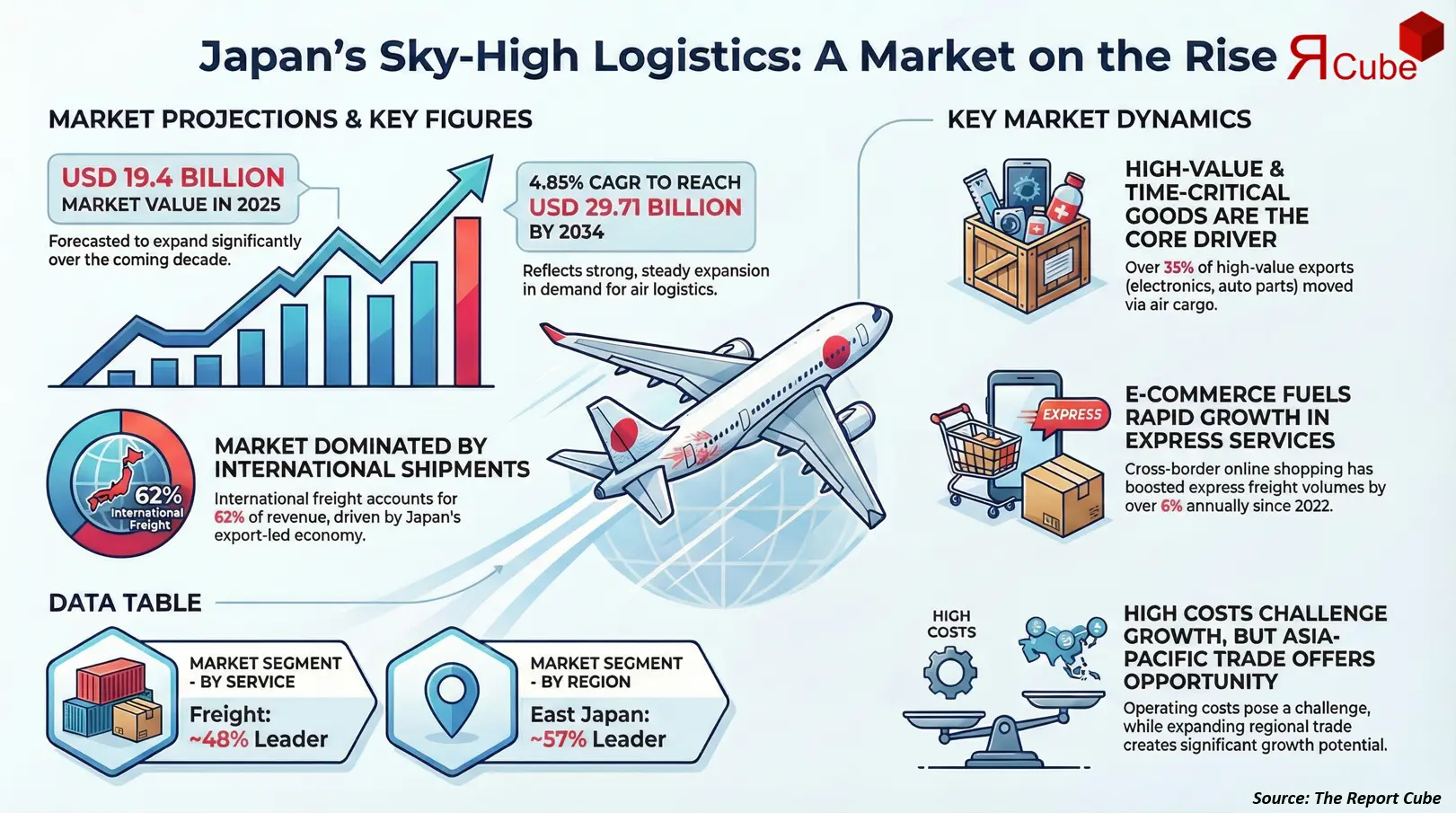
The Japan Air Freight Market is anticipated to register a CAGR of 4.85% during the forecast period 2026-2034. The market size was valued at USD 19.4 billion in 2025 and is projected to reach USD 29.71 billion by 2034. This steady expansion reflects Japan’s strong position in global manufacturing, electronics exports, pharmaceuticals, and high-value automotive components that rely heavily on time-sensitive air logistics.
The market’s growth is closely tied to Japan’s role as a regional trade hub in Asia-Pacific, supported by advanced airport infrastructure, efficient customs processes, and strong connectivity with North America and Europe. Rising cross-border e-commerce volumes, particularly in electronics, precision machinery, and healthcare products, continue to elevate demand for reliable air freight services. At the same time, Japanese manufacturers increasingly prefer air cargo to reduce inventory cycles and improve supply chain resilience.
Furthermore, structural changes in global supply chains are favoring diversified sourcing strategies, which benefit Japan’s air freight sector. Airlines and logistics providers are expanding dedicated cargo capacity and investing in digital freight management systems to enhance transparency and speed. These interconnected factors collectively strengthen the long-term outlook of the Japan Air Freight Market through 2034.
Japan Air Freight Market Recent Developments
- 2025: ANA Holdings expanded international cargo routes to support rising semiconductor and pharmaceutical exports.
- 2025: Yamato Transport enhanced express air cargo solutions for cross-border e-commerce shipments.
Government Initiatives & Policies
- Japan Logistics Policy Outline: Focuses on strengthening air cargo efficiency and international trade facilitation.
- Digital Trade and Customs Modernization Program: Aims to accelerate cargo clearance through digitalization.
Japan Air Freight Market Dynamics
Key Driver: Rising Demand for Time-Critical and High-Value Shipments
The primary driver of the Japan Air Freight Market is the increasing demand for time-critical and high-value shipments. Japan’s export profile is dominated by electronics, automotive components, medical devices, and precision machinery, all of which require fast and reliable transportation. Air freight significantly reduces transit times compared to sea transport, enabling manufacturers to meet strict delivery schedules and minimize inventory holding costs. In 2024, over 35% of Japan’s high-value exports by value moved via air cargo, highlighting its strategic importance. Additionally, pharmaceutical exports requiring temperature-controlled logistics have expanded rapidly, reinforcing the role of air freight. As global customers prioritize speed and reliability, air cargo continues to serve as a critical enabler of Japan’s export competitiveness.
Book your FREE 30-minute expert consultation today
Contact UsIndustry Trends: Expansion of Express and E-commerce Air Cargo Services
A key trend shaping the market is the rapid expansion of express and e-commerce-driven air cargo services. Growth in cross-border online shopping has increased demand for faster delivery options, particularly for consumer electronics and specialty goods. Logistics providers are responding by strengthening partnerships with airlines, expanding overnight and next-day delivery services, and integrating digital tracking platforms. Express air freight volumes in Japan have grown at an estimated annual rate of over 6% since 2022, outpacing traditional freight services. This shift is also encouraging investments in automated cargo handling and data-driven route optimization. As e-commerce penetration deepens across Asia-Pacific, express air freight is expected to remain a high-growth segment.
Major Challenge: High Operating Costs and Capacity Constraints
High operating costs present a significant challenge for the Japan Air Freight Market. Air cargo operations are sensitive to fuel price volatility, labor expenses, and aircraft maintenance costs, all of which directly affect profitability. Additionally, limited availability of dedicated freighter aircraft and congestion at major airports can restrict capacity during peak periods. Smaller logistics providers face margin pressure as they compete with global integrators offering integrated end-to-end services. These cost and capacity constraints may limit short-term expansion, particularly for price-sensitive shippers, even as demand remains robust.
Opportunity: Growth in International Trade and Asia-Pacific Connectivity
Expanding international trade and stronger Asia-Pacific connectivity present a major opportunity for the market. Japan’s trade agreements with regional partners and its strategic location enable efficient air cargo connections across Asia, North America, and Europe. Airlines are adding new international cargo routes and increasing belly-hold capacity on passenger flights as travel recovers. International air freight volumes are expected to grow faster than domestic shipments, driven by export-oriented industries. This international focus allows logistics providers to diversify revenue streams and capitalize on global trade growth, supporting long-term market expansion.
Japan Air Freight Market Segment-wise Analysis
By Service:
- Freight
- Express
- Others
The Freight segment dominates the Japan Air Freight Market, accounting for approximately 48% of total market share in 2025. This leadership is supported by strong demand from manufacturing, automotive, and electronics exporters requiring bulk and scheduled cargo services. The Express segment follows closely with nearly 32% share, driven by rapid e-commerce growth and demand for time-definite deliveries. Mail and other specialized services collectively account for the remaining share, serving niche requirements. The growing overlap between freight and express services highlights the market’s shift toward faster and more flexible logistics solutions.
By Destination:
- Domestic
- International
International air freight leads this segment, representing around 62% of total market revenue. Japan’s export-driven economy and strong trade links with the United States, China, and Europe underpin this dominance. International shipments benefit from higher value per ton and greater reliance on speed. Domestic air freight, accounting for about 38%, supports inter-island connectivity and urgent deliveries within Japan. While domestic growth remains steady, international air freight is expected to grow faster due to expanding global trade and supply chain diversification.
Regional Projection of Japan Air Freight Industry
- East Japan
- West Japan
East Japan leads the Japan Air Freight Market with an estimated 57% market share, driven by major economic centers such as Tokyo and surrounding industrial hubs. The region benefits from high cargo throughput at key international airports and a dense concentration of manufacturing and technology companies. West Japan follows with strong contributions from Osaka and surrounding regions, particularly in automotive and industrial exports. East Japan’s superior connectivity, higher export volumes, and advanced logistics infrastructure position it as the dominant region throughout the forecast period.
Need insights for a specific region within this market?
Request Regional DataWhy Choose This Report?
- Provides a comprehensive overview of the overall market analysis, encompassing key trends, consumer behavior analysis, and risk assessment to support strategic decision-making.
- Provides accurate, up-to-date insights into market size, segmentation, and emerging opportunities, helping to minimize risk & capitalizing on growth.
- Gives deep understanding of target audience preferences, investment habits, and communication channels for enhanced product development & marketing effectiveness.
- Delivers competitive analysis & benchmarking, uncovering the strengths & weaknesses of market competitors to guide strategies.
- Consolidate comprehensive market intelligence, reducing reasoning & streamlining research efforts.
- Facilitates customized market segmentation & risk mitigation strategies, fine-tuned to the business objectives.
- Aids in identifying both market challenges & untapped opportunities within the industry to drive long-term business growth.
- Provides valuable information based on actual customer data & search trends.
Table of Contents
- Introduction
- Objective of the Study
- Product and Category Definition
- Market Segmentation
- Study Variables
- Research Methodology
- Secondary Data Points
- Breakdown of Secondary Sources
- Primary Data Points
- Breakdown of Primary Interviews
- Secondary Data Points
- Executive Summary
- Market Dynamics
- Drivers
- Challenges
- Opportunity Assessment
- Recent Trends and Developments
- Regulatory and Policy Landscape
- Japan Air Freight Market Overview (2020-2034)
- Market Size, By Value (USD Billion)
- Market Share, By Service
- Freight
- Express
- Others
- Market Share, By Destination
- Domestic
- International
- Market Share, By Carrier Type
- Dedicated Cargo
- Belly Cargo
- Market Share, By End User
- Private
- Commercial
- Market Share, By Region
- East
- West
- Market Share, By Company
- Competition Characteristics
- Revenue Shares & Analysis
- East Japan Air Freight Market
- Market Size, By Value (USD Billion)
- Market Share, By Service
- Market Share, By Destination
- Market Share, By Carrier Type
- Market Share, By End User
- Market Share, By Region/Country Group
- Market Share, By Prefecture
- Kanto
- Tohoku
- Hokkaido
- West Japan Air Freight Market
- Market Size, By Value (USD Billion)
- Market Share, By Service
- Market Share, By Destination
- Market Share, By Carrier Type
- Market Share, By End User
- Market Share, By Region/Country Group
- Market Share, By Prefecture
- Kansai
- Chubu
- Chugoku
- Shikoku
- Kyushu-Okinawa
- Competitive Outlook and Company Profiles
- ANA Holdings Inc.
- Company Overview
- Service Portfolio
- Strategic Alliances/Partnerships
- Recent Developments
- Japan Airlines Co. Ltd.
- Company Overview
- Service Portfolio
- Strategic Alliances/Partnerships
- Recent Developments
- Nippon Express Co. Ltd.
- Company Overview
- Service Portfolio
- Strategic Alliances/Partnerships
- Recent Developments
- Yamato Transport Co. Ltd.
- Company Overview
- Service Portfolio
- Strategic Alliances/Partnerships
- Recent Developments
- Sagawa Express Co. Ltd.
- Company Overview
- Service Portfolio
- Strategic Alliances/Partnerships
- Recent Developments
- DHL Japan Inc.
- Company Overview
- Service Portfolio
- Strategic Alliances/Partnerships
- Recent Developments
- FedEx Japan G.K.
- Company Overview
- Service Portfolio
- Strategic Alliances/Partnerships
- Recent Developments
- UPS Japan Co. Ltd.
- Company Overview
- Service Portfolio
- Strategic Alliances/Partnerships
- Recent Developments
- Kuehne + Nagel Ltd.
- Company Overview
- Service Portfolio
- Strategic Alliances/Partnerships
- Recent Developments
- Schenker-Seino Co. Ltd.
- Company Overview
- Service Portfolio
- Strategic Alliances/Partnerships
- Recent Developments
- Others
- ANA Holdings Inc.
- Contact Us and Disclaimer
Top Key Players & Market Share Outlook
- ANA Holdings Inc.
- Japan Airlines Co. Ltd.
- Nippon Express Co. Ltd.
- Yamato Transport Co. Ltd.
- Sagawa Express Co. Ltd.
- DHL Japan Inc.
- FedEx Japan G.K.
- UPS Japan Co. Ltd.
- Kuehne + Nagel Ltd.
- Schenker-Seino Co. Ltd.
- Others
Frequently Asked Questions






