



Build Your Custom Market Intelligence Report
Customize Your ReportIndia Air Taxi Market Key Takeaways
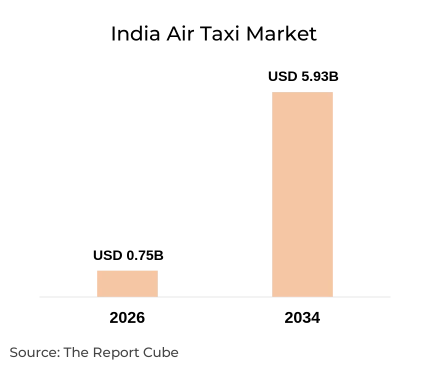
- India Air Taxi Market was valued at USD 0.75 billion in 2026.
- Market is projected to reach USD 5.93 billion by 2034.
- Industry is expected to expand at a 29.50% CAGR through 2034.
- Piloted air taxis lead the type segment due to current regulatory frameworks.
- Intercity range dominates demand, driven by inter-metropolitan mobility needs.
- West India holds the leading regional position owing to Mumbai's infrastructure push.
- South India is the fastest-growing region with expanding urban air mobility corridors.
- Key players include IndiGo, Boeing, Airbus SE, Uber Technologies, and EHang.
India Air Taxi Market Insights & Analysis
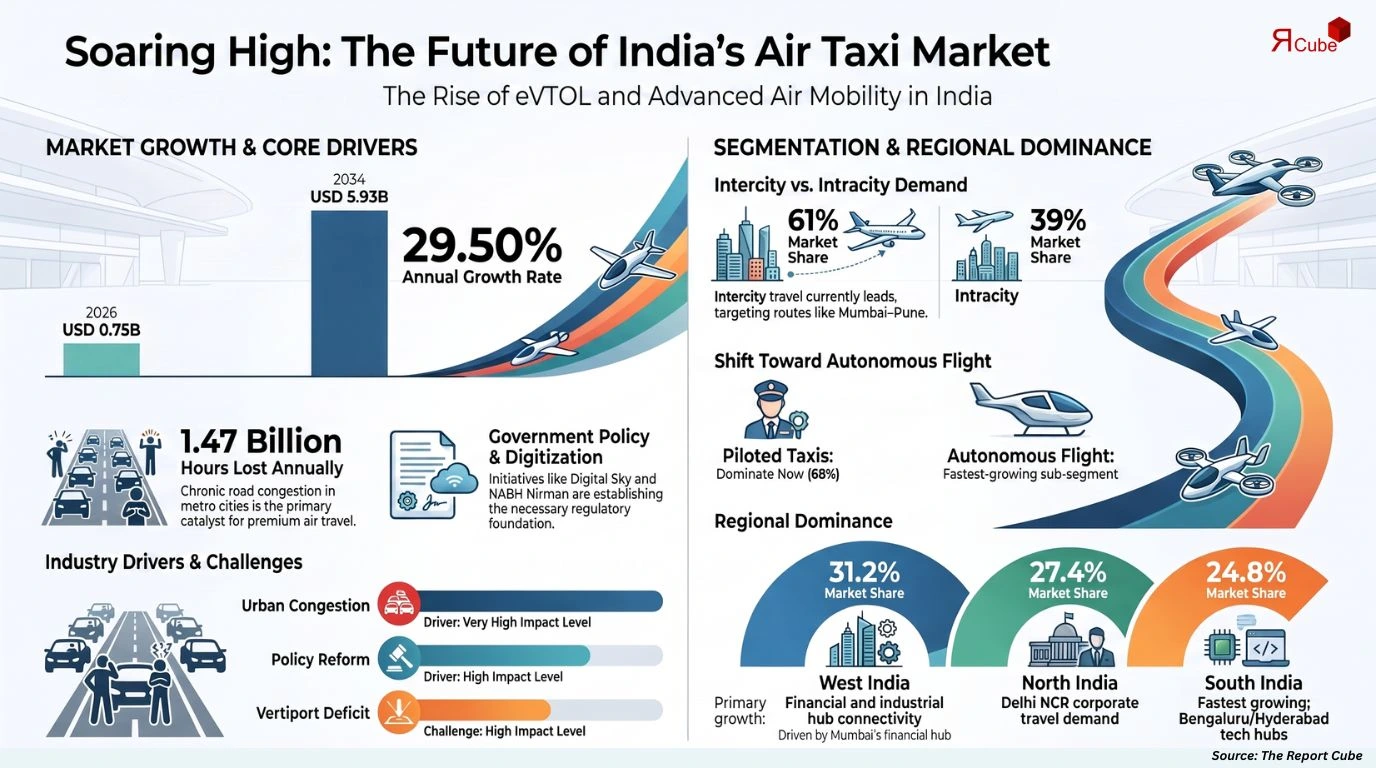
The India Air Taxi Market is anticipated to register a 29.50% CAGR during 2026–2034. The market size was valued at USD 0.75 billion in 2026 and is projected to reach USD 5.93 billion by 2034. India's urban air mobility ecosystem is being catalyzed by the Ministry of Civil Aviation's drone and advanced air mobility policy frameworks, growing congestion in tier-1 cities, and rising investments from domestic and international aviation conglomerates. The Drone Rules 2021 amendments and the National Urban Air Mobility Policy consultation paper have created a structured regulatory foundation, accelerating the commercial deployment timeline for eVTOL-based passenger services across metropolitan corridors.
Government-backed initiatives such as NABH Nirman and Digital Sky Platform integration are enabling vertiport planning and airspace digitization in cities like Bengaluru, Hyderabad, and Pune. Private capital inflows have exceeded USD 120 million in collaborative feasibility studies and infrastructure commitments since 2023, with Airbus SE and IndiGo exploring dedicated air corridor development. The growing emphasis on sustainable urban transport and India's net-zero aviation commitments further reinforce long-term urban air mobility infrastructure development, creating substantial commercial and regulatory tailwinds through 2034.
India Air Taxi Market Dynamics
India's air taxi market is gaining structural momentum as urban traffic congestion, airport connectivity deficits, and government-led aviation modernization converge to create a commercially viable ecosystem. Increasing collaboration between global eVTOL manufacturers, Indian aviation operators, and smart city planners is systematically transforming the market from pilot demonstration to pre-commercial rollout, with demand building across intercity premium routes and time-sensitive business travel segments.
|
Factor |
Type |
Specific Impact on Market |
Magnitude |
|---|---|---|---|
|
Rising urban traffic congestion |
Driver |
Accelerates intercity premium air corridor demand |
Very High |
|
Ministry of Civil Aviation policy reform |
Driver |
Establishes regulatory clarity for eVTOL certification |
High |
|
Vertiport infrastructure deficit |
Challenge |
Constrains commercial deployment timelines in metro cities |
High |
|
Autonomous air taxi development |
Trend |
Reduces per-seat operating costs and pilot dependency |
Very High |
|
Sustainable aviation fuel mandates |
Opportunity |
Strengthens eVTOL value proposition over fossil-fuel aviation |
High |
Key Market Driver: Urban Congestion Fueling Premium Air Corridors
India's top eight metropolitan regions collectively lose an estimated 1.47 billion productive hours annually to road congestion, with Mumbai and Delhi recording peak traffic indices exceeding 65 on the TomTom Congestion Index. This systemic mobility deficit is compelling corporate enterprises, logistics operators, and premium commuters to explore time-efficient aerial alternatives. Air taxi services on the Mumbai–Pune and Delhi–NCR corridors are projected to achieve journey time reductions of 75–80%, positioning the India air taxi ecosystem as a viable intercity transport solution that attracts corporate travel budgets previously allocated to helicopter charter and first-class rail travel.
Major Industry Challenge: Vertiport and Ground Infrastructure Scarcity
Despite strong policy intent, India's vertiport development pipeline remains critically underfunded, with fewer than 14 viable landing infrastructure sites identified across the top six cities as of early 2025. Land acquisition constraints, municipal zoning conflicts, and the absence of standardized vertiport building codes delay commercial launch timelines by an estimated 18–24 months in most metro areas. The Airports Authority of India is coordinating with state urban development authorities to fast-track rooftop vertiport approvals on commercial towers and transit hubs, but execution gaps continue to represent the most material near-term constraint for operators planning initial route launches.
Emerging Trend Shaping Outlook: Autonomous eVTOL Certification Pipeline
The Directorate General of Civil Aviation (DGCA) is actively developing a Type Certification framework for autonomous and remotely piloted air vehicles under its Advanced Air Mobility roadmap, with draft guidelines expected to incorporate EASA and FAA standards for cross-border aircraft compatibility. EHang's EH216-S autonomous air taxi received landmark certification progress in multiple jurisdictions in 2024, and its India-specific regulatory engagement signals a potential pre-2027 autonomous commercial debut. Hyundai's S-A2 eVTOL and Embraer's Eve platform are similarly advancing DGCA engagement, indicating that autonomous aerial vehicle certification timelines will materially shape competitive positioning across the India market through 2030.
Need Specific Data, Let’s Customize the Report for You
Request CustomizationIndia Air Taxi Market Segment-wise Analysis
The India Air Taxi Market demonstrates distinct segmentation dynamics across vehicle type and operational range, with each sub-segment reflecting unique regulatory, commercial, and infrastructure readiness profiles. Understanding segment-level demand drivers is essential for identifying near-term revenue opportunities and long-term scalability pathways across India's diverse urban geographies.
By Type
- Autonomous
- Piloted
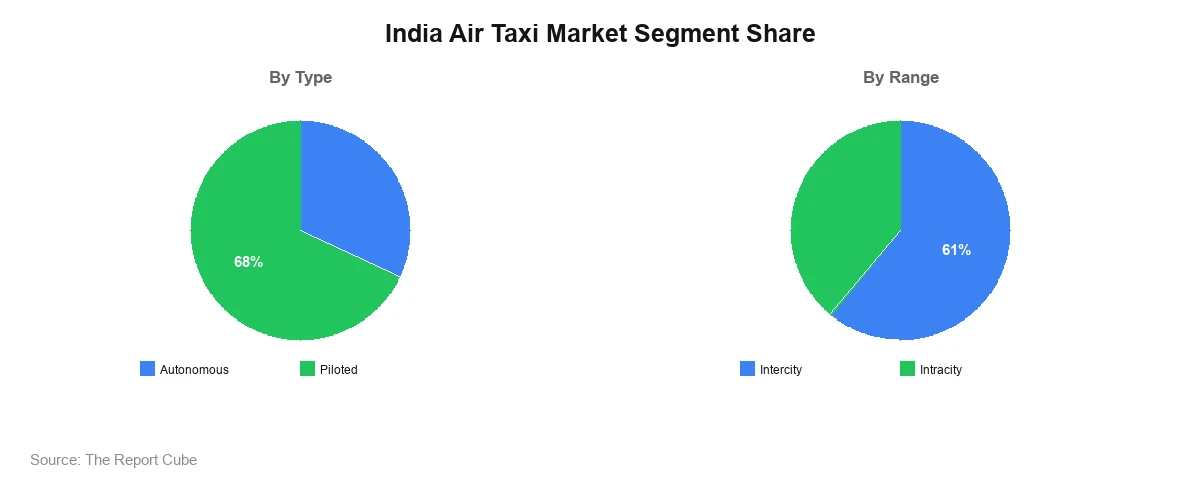
Piloted air taxis dominate the By Type segment with an estimated 68% market share in 2026, driven by the DGCA's current regulatory requirement for certified pilots aboard commercial passenger air vehicles. Piloted configurations reduce certification risk, improve public trust during early adoption phases, and align with existing aviation insurance frameworks. IndiGo and Airbus SE are both advancing piloted eVTOL service concepts on premium intercity corridors, with pilot training programs and route feasibility studies already underway on the Bengaluru–Mysuru and Mumbai–Pune axes.
Autonomous air taxis represent the fastest-growing sub-segment, projected to capture approximately 32% market share by 2034 as DGCA's certification pathway matures. EHang's autonomous platform and Hyundai's planned S-A2 deployment are driving pre-commercial trials, while electric vertical take-off and landing aircraft technology maturity increasingly supports the economic case for removing pilot overhead from per-seat pricing structures. Regulatory convergence with EASA standards and Digital Sky Platform integration are expected to accelerate autonomous commercial approvals post-2028.
By Range
- Intercity
- Intracity
Intercity air taxis account for approximately 61% of the India Air Taxi Market in 2026, underpinned by demand for premium time-efficient travel between major metropolitan pairs separated by 150–400 km. Routes such as Mumbai–Pune, Delhi–Chandigarh, and Hyderabad–Vijayawada present the strongest near-term commercial viability due to high corporate travel density, existing premium mobility spend, and airport infrastructure that can support interim vertiport buildouts. Ticket price modeling at INR 4,000–8,000 per seat on these corridors indicates meaningful adoption from business travelers currently reliant on helicopter charters.
Intracity air taxis, covering distances of 15–80 km within metropolitan boundaries, currently represent 39% market share but are poised for accelerated growth as vertiport density increases. Airport-to-CBD routes in Mumbai, Bengaluru, and Hyderabad are the initial priority corridors, with Uber Technologies' advanced air mobility division actively mapping demand density using its existing ride-hailing dataset. Urban air mobility corridor feasibility studies indicate that intracity routes will achieve operational cost parity with premium ground transport by 2030 as battery energy density and autonomous flight efficiencies improve.
Regional Projection of India Air Taxi Market
India's air taxi market exhibits significant regional variation shaped by metropolitan density, state government aviation policy, infrastructure investment levels, and the concentration of corporate travel demand. Each region presents a distinct demand and readiness profile that operators and investors must assess independently when prioritizing route development and vertiport placement strategies.
|
Region |
Estimated Market Share |
Key Growth Factors |
Consumer Trends |
|---|---|---|---|
|
North India |
27.4% |
Delhi NCR corporate demand, Chandigarh connectivity |
Premium business traveler adoption |
|
South India |
24.8% |
Bengaluru tech sector, Hyderabad aerospace hub |
Fastest-growing; startup ecosystem participation |
|
West India |
31.2% |
Mumbai financial hub, Pune industrial corridor |
Highest corporate charter conversion potential |
|
East India |
16.6% |
Kolkata port logistics, Bhubaneswar smart city |
Early-stage; airport intermodal connectivity focus |
- North India: North India captures approximately 27.4% market share, anchored by the Delhi–NCR corporate travel belt and the strong Chandigarh–Amritsar premium mobility corridor supporting business and leisure demand.
- South India: South India is the fastest-growing region, fueled by Bengaluru's globally integrated technology sector and Hyderabad's aerospace manufacturing concentration, which collectively drive advanced air mobility adoption among high-frequency business travelers.
- West India: West India leads regional revenue contribution with an estimated 31.2% market share, driven by Mumbai's status as India's financial capital and Pune's dense industrial and IT corridor, which together represent the highest per-capita corporate travel expenditure in the country.
- East India: East India holds approximately 16.6% share at early-stage commercialization, with Kolkata's port logistics ecosystem and Bhubaneswar's smart city program forming the initial institutional demand base for air taxi connectivity.
India Air Taxi Market: Recent Development (2025)
- IndiGo signed a strategic MoU with Airbus SE to explore urban air mobility corridors across India.
- EHang received DGCA engagement approval to begin autonomous air taxi trials in Hyderabad corridors.
- Hyundai unveiled India-specific S-A2 eVTOL deployment roadmap targeting Bengaluru airport connectivity.
- Boeing partnered with Airports Authority of India to assess vertiport infrastructure at six metro airports.
India Air Taxi Market Future Outlook (2034)
The India Air Taxi Market is projected to expand at a 29.50% CAGR, reaching USD 5.93 billion by 2034, supported by the progressive maturation of eVTOL certification, vertiport infrastructure deployment, and the commercialization of autonomous aerial vehicle platforms. Corporate travel monetization on intercity premium corridors will drive initial revenue scaling, while intracity last-mile connectivity services expand the addressable market to include high-frequency commuters, healthcare logistics, and emergency response applications. Strategic alignment between state smart city programs and central aviation policy will accelerate the integration of aerial mobility into multimodal urban transport networks.
Continued technology advancement in battery energy density, autonomous flight management, and predictive maintenance will reduce per-seat operating costs by an estimated 35–40% between 2026 and 2034, enabling broader consumer price accessibility. AI-driven air traffic management systems, digital twin-based route optimization, and vehicle health monitoring platforms will further improve fleet utilization and operational safety. The convergence of sustainable electric aviation and urban decarbonization targets will reinforce eVTOL adoption as India pursues its net-zero aviation commitment, ensuring that air taxi infrastructure investment receives both policy prioritization and long-term institutional capital support through the forecast horizon.
India Air Taxi Market Report Coverage
|
Report Attribute |
Details |
|---|---|
|
Market Name |
India Air Taxi Market |
|
Market Size (2026) |
USD 0.75 Billion |
|
Market Size (2034) |
USD 5.93 Billion |
|
Forecast Period |
2026–2034 |
|
CAGR |
29.50% |
|
Base Year |
2026 |
|
Historical Years |
2021–2025 |
|
Forecast Years |
2026–2034 |
|
Segments Covered |
By Type (Autonomous, Piloted), By Range (Intercity, Intracity) |
|
Regions Covered |
North India, South India, East India, West India |
|
Key Companies |
IndiGo, Boeing, Airbus SE, Uber Technologies, Embraer, EHang, Hyundai, and Others |
|
Report Format |
PDF, Excel, PPT |
|
Customization |
Available as per client requirements |
Why Choose This Report?
- Comprehensive coverage of India's emerging urban air mobility regulatory landscape.
- Accurate market sizing with reliable 29.50% CAGR forecast through 2034.
- Detailed segmentation analysis covering vehicle type and operational range dimensions.
- Region-level insights across all four Indian geographic zones with market share data.
- Competitive profiling of global eVTOL manufacturers active in India's market.
- Analysis of autonomous certification pathways and DGCA policy development timelines.
- Infrastructure gap assessment covering vertiport development and airspace digitization.
- Strategic insights supporting investment decisions and partnership planning through 2034.
Table of Contents
- Introduction
- Objective of the Study
- Product Definition
- Market Segmentation
- Study Variables
- Research Methodology
- Secondary Data Points
- Companies Interviewed
- Primary Data Points
- Breakdown of Primary Interviews
- Secondary Data Points
- Executive Summary
- Market Dynamics
- Drivers
- Challenges
- Opportunity Assessment
- Recent Trends and Developments
- Policy and Regulatory Landscape
- India Air Taxi Market Overview and Forecast Analysis (2021-2034)
- Market Size, By Value, By Growth Rate (CAGR/USD Billions)
- Demand – Supply Trends
- Market Share, By Type
- Autonomous
- Piloted
- Market Share, By Range
- Intercity
- Intracity
- Market Share, By Region
- North India
- South India
- East India
- West India
- Market Share, By Competitors
- Competition Characteristics
- Revenue Shares
- Autonomous India Air Taxi Market Overview, 2021-2034F
- By Value (USD Million)
- By Range – Market Size & Forecast 2021-2034, USD Million
- Intercity
- Intracity
- Piloted India Air Taxi Market Overview, 2021-2034F
- By Value (USD Million)
- By Range – Market Size & Forecast 2021-2034, USD Million
- Intercity
- Intracity
- Competitive Outlook (Company Profile – Partial List)
- IndiGo
- Company Overview
- Business Segments
- Strategic Alliances/Partnerships
- Recent Developments
- Boeing
- Company Overview
- Business Segments
- Strategic Alliances/Partnerships
- Recent Developments
- Airbus SE
- Company Overview
- Business Segments
- Strategic Alliances/Partnerships
- Recent Developments
- Uber Technologies
- Company Overview
- Business Segments
- Strategic Alliances/Partnerships
- Recent Developments
- Embraer
- Company Overview
- Business Segments
- Strategic Alliances/Partnerships
- Recent Developments
- EHANG
- Company Overview
- Business Segments
- Strategic Alliances/Partnerships
- Recent Developments
- Hyundai
- Company Overview
- Business Segments
- Strategic Alliances/Partnerships
- Recent Developments
- Others
- IndiGo
- Contact Us & Disclaimer
Top Key Players & Market Share Outlook
- IndiGo
- Boeing
- Airbus SE
- Uber Technologies
- Embraer
- EHANG
- Hyundai
- Others
Frequently Asked Questions






