



Build Your Custom Market Intelligence Report
Customize Your ReportKey Highlights
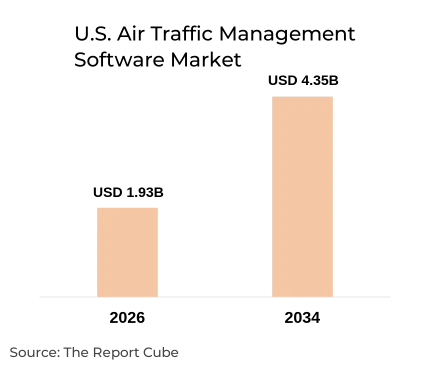
- The U.S. Air Traffic Management Software Market was valued at USD 1.93 billion in 2026.
- Market size is forecast to reach USD 4.35 billion by 2034.
- The market is expanding at a CAGR of 10.70% during 2026-2034.
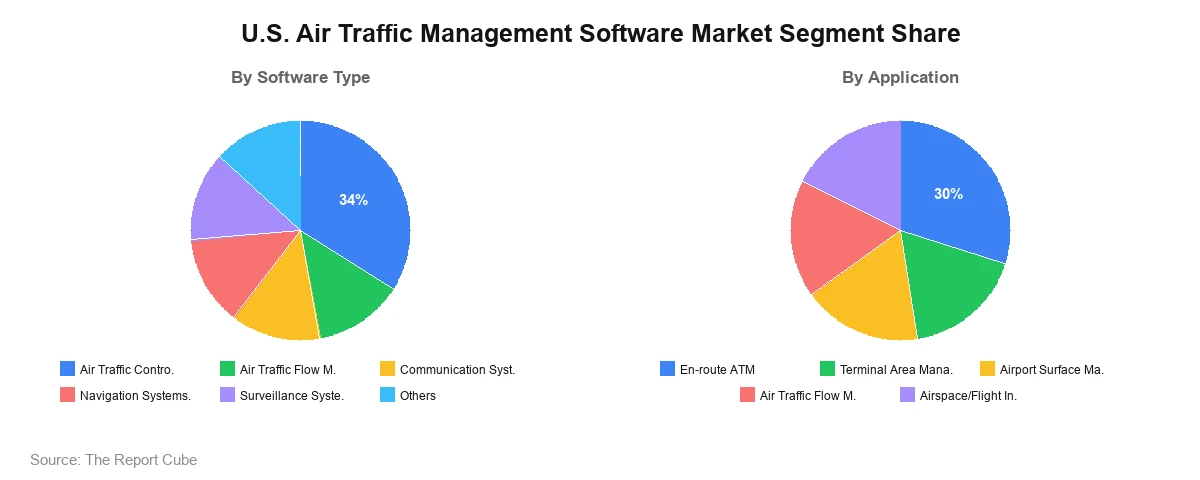
- By software type, Air Traffic Control led with approx 34% share in 2026.
- By end user, the FAA and federal air traffic management organizations led with approx 55% share in 2026.
- The FAA’s modernization programmes, including BNATCS, ERAM, TBFM and FMDS, are the major growth driver.
- Peraton’s role as prime systems integrator for BNATCS Phase 1 is a significant development in the competitive landscape.
Market Outlook
The U.S. Air Traffic Management Software Market covers platforms that manage, monitor and coordinate aircraft movements across the National Airspace System. Its software supports flight-data processing, controller automation, traffic-flow management, surveillance integration and decision support, which makes it central to aviation safety and operational efficiency.
Demand comes mainly from federal air traffic organizations, airport operators and commercial airlines. Rising traffic complexity, aging infrastructure and the need for real-time information exchange are pushing adoption of automated and integrated platforms. On-premises systems still dominate safety-critical environments, while modular and cloud-enabled architectures are gaining attention.
The market is valued at USD 1.93 billion in 2026 and is forecast to reach USD 4,35 billion by 2034, growing at a CAGR of 10.70%. Growth rests on legacy system replacement, automated traffic-flow tools and federal modernization funding. Competition centres on reliability, interoperability, cybersecurity and the ability to deliver complex government contracts, with software suppliers, defense contractors and integrators all participating.
Government Regulations
The Federal Aviation Administration is the primary authority for civil aviation and air traffic control in the United States, and it directs the modernization of the National Airspace System through NextGen and the Brand New Air Traffic Control System (BNATCS) initiative. The U.S. Government Accountability Office has reported that 51 of the FAA’s 138 air traffic control systems were unsustainable in its September 2024 assessment, which has raised the priority of system replacement. Software supplied to air traffic environments must meet strict safety, reliability and cybersecurity requirements, and federal procurement rules govern contract awards and integration. These requirements lengthen qualification and implementation cycles, which favours suppliers with proven certification records and the capability to work within large, multi-phase government programmes.
U.S. Air Traffic Management Software Market Dynamics
Demand is shaped by the modernization of aging infrastructure, rising airspace complexity and federal investment in digital aviation systems. Procurement timing, integration requirements and safety certification influence how quickly suppliers can convert programmes into revenue, supporting U.S. Air Traffic Management Software Market growth while creating execution demands.
|
Factor |
Type |
Specific Impact on Market |
Magnitude |
|---|---|---|---|
|
Aging air traffic control infrastructure |
Driver |
Sustains replacement and upgrade demand for ATC software |
High |
|
FAA modernization programmes (BNATCS, ERAM, TBFM, FMDS) |
Driver |
Create procurement and integration opportunities for suppliers |
High |
|
Emerging aviation technologies (UAS, advanced air mobility) |
Opportunity |
Add airspace coordination and information-exchange requirements |
Medium |
|
Legacy system integration |
Challenge |
Increases complexity, cost and timelines of software deployment |
Medium–High |
|
Long government procurement cycles |
Challenge |
Delay revenue recognition and raise supplier risk |
Medium |
|
Cloud-based and modular architectures |
Trend |
Support scalability and interoperability in flow management |
Medium–High |
Growth Drivers: Modernization of Aging Air Traffic Control Infrastructure
The condition of existing air traffic control systems is a major driver of the market. The U.S. Government Accountability Office’s September 2024 assessment identified 51 of the FAA’s 138 systems as unsustainable, underscoring the need for replacement and software modernization. Requirements for reliable flight-data processing, automated control functions and surveillance integration are expected to sustain demand for next-generation platforms, while the BNATCS initiative adds further opportunities for developers and integrators throughout the forecast period.
Market Opportunities: Development of Next-Generation Air Traffic Management Platforms
BNATCS creates opportunities for software providers, integrators and aviation technology suppliers. The programme is intended to replace aging infrastructure and introduce modern automation, communications, surveillance and information-management capabilities. Common automation platforms, modular software and integrated traffic-management solutions are expected to support demand for development, migration, integration and long-term maintenance, giving suppliers with proven government delivery experience a durable pipeline across the forecast period.
Industry Challenges: Integration with Legacy Aviation Infrastructure
Integrating advanced software with existing infrastructure remains a major challenge. Air traffic systems are interconnected and safety-critical, so upgrades must maintain uninterrupted operations. Legacy platforms may use different communication protocols, data structures and operating architectures, which increases integration complexity. Suppliers must ensure compatibility, reliability and interoperability while supporting the transition to modern digital systems, and long testing and certification cycles can add cost and delay deployment timelines.
Need Specific Data, Let’s Customize the Report for You
Request CustomizationMarket Trends: Transition Towards Cloud-Based and Modular ATM Software
The sector is exploring modular architectures and cloud-based infrastructure to improve scalability, flexibility and system integration. The FAA’s planned Flow Management Data and Services programme reflects this direction toward modernized, modular and cloud-enabled traffic-flow management. The shift is expected to encourage suppliers to develop flexible solutions supporting information exchange, operational analytics and integration with existing platforms, although adoption will depend on cybersecurity, reliability and regulatory acceptance.
U.S. Air Traffic Management Software Market Segment Analysis
The U.S. Air Traffic Management Software Market is segmented by software type, application, end user and deployment mode, reflecting differences in operational function, user requirements and technology architecture. Leading-segment shares are approximate 2026 estimates.
By Software Type
- Air Traffic Control
- Air Traffic Flow Management
- Communication Systems
- Navigation Systems
- Surveillance Systems
- Others
Air Traffic Control leads the software type segment with approx 34% share in 2026. It supports flight-data processing, controller automation, conflict detection and monitoring across en-route centers, terminal facilities and towers, and FAA automation upgrades sustain demand. Air Traffic Flow Management is the second analysed segment, supporting demand and capacity balancing, arrival sequencing and delay reduction, with rising airspace complexity creating opportunities. Communication, navigation and surveillance software, along with aeronautical information and analytics tools in Others, support information exchange, route management and monitoring.
By Application
- En-route ATM
- Terminal Area Management
- Airport Surface Management
- Air Traffic Flow Management
- Airspace/Flight Information Management
En-route ATM leads the application segment with approx 30% share in 2026. These systems manage aircraft across controlled airspace through flight-data processing, route management and conflict detection, and en-route automation modernization sustains demand. Terminal Area Management is the second analysed segment, supporting approach control, departure sequencing and terminal traffic coordination around airports, where efficiency requirements drive adoption. Airport surface management, air traffic flow management and airspace and flight information management serve runway and ground coordination, capacity balancing and information distribution.
U.S. Air Traffic Management Software Market Regional Analysis
The market is analysed across four U.S. regions that differ in airport concentration, airspace complexity and modernization activity. Regional share data has not been supplied or verified from approved sources, so no regional shares are displayed.
|
Region |
Key Growth Factors |
Industry Trends |
|---|---|---|
|
Northeast |
High-traffic airports and complex airspace operations |
Demand for terminal automation and flow management |
|
Midwest |
Commercial hubs and extensive en-route airspace |
Flight-data processing and surveillance integration |
|
South |
Substantial airport, commercial and military activity |
Infrastructure modernization at airports |
|
West |
Major international airports and emerging aviation technologies |
Digital airspace management and advanced surveillance |
Competitive Landscape
The U.S. Air Traffic Management Software Market includes defense contractors, aviation technology companies, software developers and systems integrators. Competition is based on reliability, automation capability, interoperability, cybersecurity and the ability to execute complex government modernization contracts. The table lists relevant participants and does not represent a ranking by revenue or market share.
|
Company |
Competitive Strength |
Primary Segment Served |
|---|---|---|
|
Leidos |
ATM systems and government technology integration |
FAA and federal organizations |
|
RTX Corporation |
Aviation surveillance and integrated aerospace technology |
Surveillance and communication systems |
|
Thales |
ATM automation and digital airspace management |
Air traffic control |
|
Indra Sistemas |
ATC automation and surveillance systems |
Air traffic control and surveillance |
|
Frequentis |
Safety-critical communication and control systems |
Communication systems |
|
Adacel Technologies |
ATC automation and simulation |
Air traffic control and training |
|
Saab |
Remote towers and surveillance |
Airport and airspace operations |
|
Peraton |
Government systems integration |
FAA modernization programmes |
|
L3Harris Technologies |
Aviation communications and surveillance |
Communication and surveillance systems |
Peraton: Peraton provides government technology, systems integration and mission-critical infrastructure solutions. It was awarded the FAA’s BNATCS Phase 1 prime systems integrator contract in December 2025, with a ceiling of approximately USD 1.5 billion. This role places it at the centre of U.S. air traffic control modernization and strengthens its position among integrators.
Leidos: Leidos is a U.S. technology and defense solutions provider with capabilities in aviation systems, air traffic management, mission-critical software and systems integration. Its long presence in federal technology programmes supports its competitive position in the aviation modernization ecosystem, particularly for integration-heavy contracts.
Recent Developments and Updates
- September 2026: The U.S. Government Accountability Office assessed the BNATCS programme, reporting an estimated USD 10.6 billion Phase 1 implementation cost as of June 2026 and approximately USD 10.2 billion in additional Phase 2 funding needs. These are programme costs, not software market revenue.
- 2025-2026: The FAA continues to advance the Flow Management Data and Services programme, a modular, cloud-enabled approach to traffic-flow management that is expected to create opportunities for software development, platform integration and ongoing support.
U.S. Air Traffic Management Software Market Future Outlook
The U.S. Air Traffic Management Software Market Forecast indicates growth from USD 1,927.4 million in 2026 to USD 4,346.7 million by 2034 at a CAGR of 10.70%. Near-term demand should come from procurement tied to modernization programmes, followed by software migration and integration, then wider use of digital flight-data exchange, cloud-enabled traffic management and decision-support analytics. Unmanned aircraft and advanced air mobility may add further requirements for airspace coordination software.
Competition is likely to centre on integrated, interoperable and cybersecurity-hardened platforms, with large integrators and specialist suppliers partnering on federal programmes. Risks include legacy integration complexity, long procurement cycles, funding timing and implementation delays. Actual outcomes will depend on federal procurement schedules, programme execution, technology acceptance and supplier delivery.
U.S. Air Traffic Management Software Market Report Coverage
This U.S. Air Traffic Management Software Market Report summarizes the valuation, forecast, segmentation, regional framework and competitive ecosystem for the 2026-2034 period.
|
Parameter |
Details |
|---|---|
|
Market Name |
U.S. Air Traffic Management Software Market |
|
Market Size (Base Year) |
USD 1.93 billion |
|
Market Size (Forecast Year) |
USD 4.35 billion |
|
CAGR |
10.70% |
|
Base Year |
2026 |
|
Historical Period |
2021-2025 |
|
Forecast Period |
2026-2034 |
|
Geographic Scope |
United States |
|
Segmentation |
By Software Type, By Application, By End User, By Deployment Mode |
|
Regions Covered |
Northeast, Midwest, South, West |
|
Key Companies |
Leidos, RTX Corporation, Thales, Indra Sistemas, Frequentis, Adacel Technologies, Saab, Peraton, L3Harris Technologies |
|
Customization |
Available as per requirement |
Why Choose This U.S. Air Traffic Management Software Market Report?
- Presents market sizing and the 2026-2034 forecast with a 10.70% CAGR.
- Segments the market by software type, application, end user and deployment mode.
- Reviews drivers, opportunities, challenges and trends shaping demand.
- Provides regional context across the Northeast, Midwest, South and West.
- Profiles nine participants by competitive strength and primary segment served.
- Highlights FAA modernization, cloud-based architectures and emerging aviation technologies.
- Supports strategic planning for software developers, integrators and aviation technology suppliers.
Table of Contents
- Introduction
- Objective of the Study
- Product Definition
- Market Segmentation
- Study Variables
- Research Methodology
- Secondary Data Points
- Companies Interviewed
- Primary Data Points
- Breakdown of Primary Interviews
- Secondary Data Points
- Executive Summary
- Market Dynamics
- Drivers
- Challenges
- Opportunity Assessment
- Recent Trends and Developments
- Policy and Regulatory Landscape
- United States Air Traffic Management Software Market Overview and Forecast Analysis (2021-2034)
- Market Size, By Value, By Growth Rate (CAGR/USD Billions)
- Demand – Supply Trends
- Market Share, By Software Type
- Air Traffic Control
- Air Traffic Flow Management
- Communication Systems
- Navigation Systems
- Surveillance Systems
- Others
- Market Share, By Application
- En-route Air Traffic Management
- Terminal Area Management
- Airport Surface Management
- Air Traffic Flow Management
- Airspace / Flight Information Management
- Market Share, By End User
- FAA / Federal ATM and ANSPs
- Airport Operators
- Airlines / Commercial Operators
- Market Share, By Deployment Mode
- On-premises
- Cloud-based
- Market Share, By Region
- Northeast
- Midwest
- South
- West
- Central
- Market Share, By Competitors
- Competition Characteristics
- Revenue Shares
- Air Traffic Control United States Air Traffic Management Software Market Overview, 2021-2034F
- By Value (USD Million)
- By Application – Market Size & Forecast 2021-2034, USD Million
- En-route Air Traffic Management
- Terminal Area Management
- Airport Surface Management
- Air Traffic Flow Management
- Airspace / Flight Information Management
- Air Traffic Flow Management United States Air Traffic Management Software Market Overview, 2021-2034F
- By Value (USD Million)
- By Application – Market Size & Forecast 2021-2034, USD Million
- En-route Air Traffic Management
- Terminal Area Management
- Airport Surface Management
- Air Traffic Flow Management
- Airspace / Flight Information Management
- Communication Systems United States Air Traffic Management Software Market Overview, 2021-2034F
- By Value (USD Million)
- By Application – Market Size & Forecast 2021-2034, USD Million
- En-route Air Traffic Management
- Terminal Area Management
- Airport Surface Management
- Air Traffic Flow Management
- Airspace / Flight Information Management
- Navigation Systems United States Air Traffic Management Software Market Overview, 2021-2034F
- By Value (USD Million)
- By Application – Market Size & Forecast 2021-2034, USD Million
- En-route Air Traffic Management
- Terminal Area Management
- Airport Surface Management
- Air Traffic Flow Management
- Airspace / Flight Information Management
- Surveillance Systems United States Air Traffic Management Software Market Overview, 2021-2034F
- By Value (USD Million)
- By Application – Market Size & Forecast 2021-2034, USD Million
- En-route Air Traffic Management
- Terminal Area Management
- Airport Surface Management
- Air Traffic Flow Management
- Airspace / Flight Information Management
- Others United States Air Traffic Management Software Market Overview, 2021-2034F
- By Value (USD Million)
- By Application – Market Size & Forecast 2021-2034, USD Million
- En-route Air Traffic Management
- Terminal Area Management
- Airport Surface Management
- Air Traffic Flow Management
- Airspace / Flight Information Management
- Competitive Outlook (Company Profile – Partial List)
- Leidos
- Company Overview
- Business Segments
- Strategic Alliances/Partnerships
- Recent Developments
- RTX Corporation
- Company Overview
- Business Segments
- Strategic Alliances/Partnerships
- Recent Developments
- Thales
- Company Overview
- Business Segments
- Strategic Alliances/Partnerships
- Recent Developments
- Indra Sistemas
- Company Overview
- Business Segments
- Strategic Alliances/Partnerships
- Recent Developments
- Frequentis
- Company Overview
- Business Segments
- Strategic Alliances/Partnerships
- Recent Developments
- Adacel Technologies
- Company Overview
- Business Segments
- Strategic Alliances/Partnerships
- Recent Developments
- Saab
- Company Overview
- Business Segments
- Strategic Alliances/Partnerships
- Recent Developments
- Peraton
- Company Overview
- Business Segments
- Strategic Alliances/Partnerships
- Recent Developments
- L3Harris Technologies
- Company Overview
- Business Segments
- Strategic Alliances/Partnerships
- Recent Developments
- Leidos
- Contact Us & Disclaimer
Top Key Players & Market Share Outlook
- Leidos
- RTX Corporation
- Thales
- Indra Sistemas
- Frequentis
- Adacel Technologies
- Saab
- Peraton
- L3Harris Technologies
Frequently Asked Questions