




Build Your Custom Market Intelligence Report
Customize Your ReportJapan Anime Market Key Takeaways
- Japan Anime Market valued at USD 14.27 billion in 2026, reflecting sustained global content monetization growth.
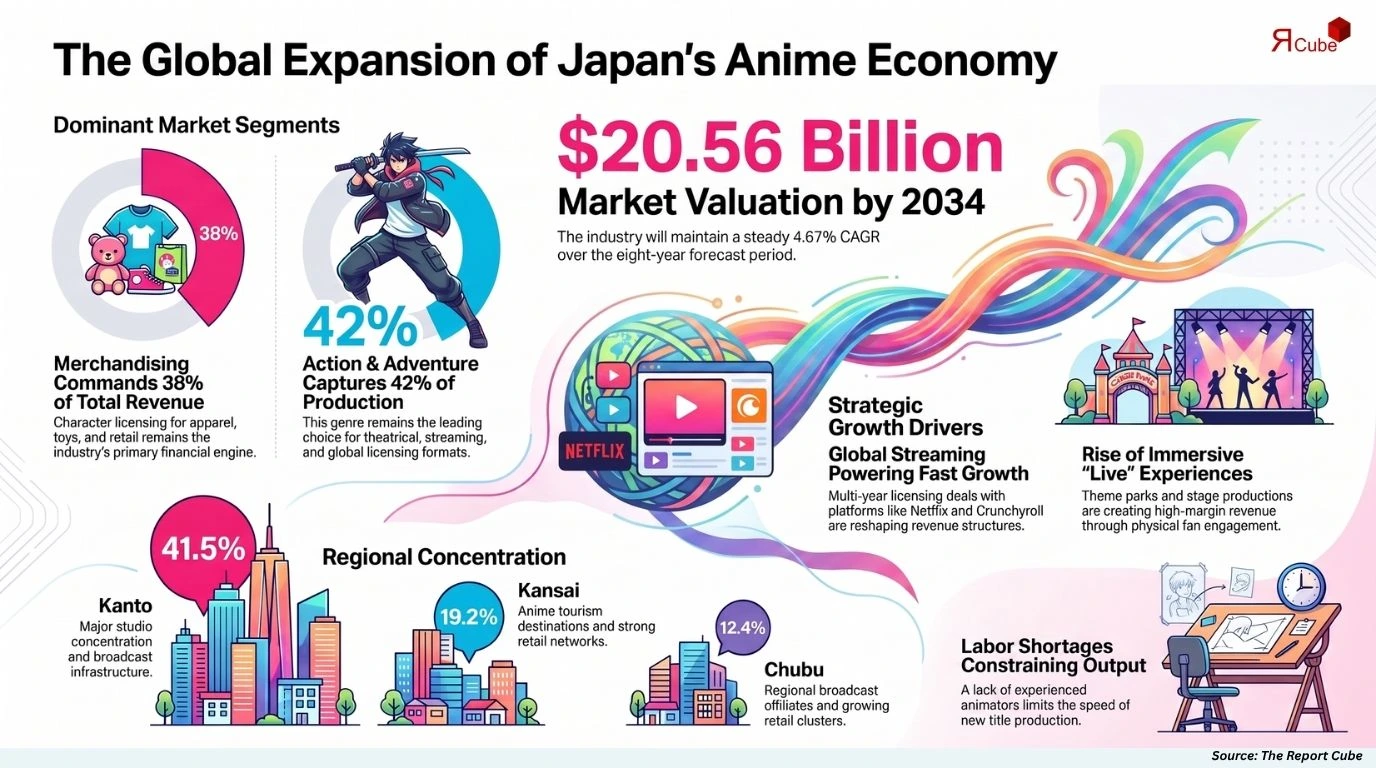
- Industry projected to reach USD 20.56 billion by 2034, expanding at a steady 4.67% CAGR.
- Merchandising remains the dominant revenue type, driven by robust character licensing and retail sales.
- Kanto region leads domestic market share, anchored by major studio concentrations and broadcast infrastructure.
- Internet distribution is the fastest-growing type, fueled by global streaming platform investments.
- Action and Adventure retains the leading genre position across theatrical, streaming, and home video formats.
- Key players include Toei Animation, Studio Ghibli, MAPPA, Aniplex, Kadokawa, and Production I.G.
- Cross-media IP expansion, global co-production deals, and webtoon adaptations continue reshaping anime monetization.
Japan Anime Market Insights & Analysis
The Japan Anime Market is anticipated to register a 4.67% CAGR during 2026–2034. The market size was valued at USD 14.27 billion in 2026 and is projected to reach USD 20.56 billion by 2034. The industry is benefiting from accelerating global demand for Japanese animated content, deepening streaming platform partnerships, and expanding cross-media IP strategies that convert popular series into merchandise, live entertainment, and music ecosystems. Government-backed cultural export initiatives and continued studio investment in production technology further underpin long-term revenue visibility.
Japan's anime industry continues diversifying beyond traditional television broadcast revenue as global anime streaming and licensing revenue from platforms such as Netflix, Crunchyroll, and Disney+ substantially expand overseas monetization. The Association of Japanese Animations reported overseas anime market revenue surpassing USD 13.6 billion in 2023, reinforcing the outward demand trajectory. Studios are increasingly co-producing titles with international partners and adopting digital production workflows, both of which reduce costs and accelerate release cycles, supporting sustained CAGR expansion through 2034.
Japan Anime Market Dynamics
Demand across the Japan Anime Market continues strengthening as production studios, streaming services, music labels, pachinko operators, and live entertainment promoters deepen their integration with anime intellectual property. The convergence of digital distribution, character merchandise licensing, and global fan communities is transforming anime from a domestic broadcast product into a globally managed franchise asset. Rising production budgets and studio talent investments reinforce output quality across all distribution channels.
|
Factor |
Type |
Specific Impact on Market |
Magnitude |
|---|---|---|---|
|
Global streaming platform expansion |
Driver |
Accelerates licensing revenue and co-production deal volumes |
Very High |
|
Cross-media IP monetization |
Opportunity |
Increases merchandise, music, and live entertainment revenues |
High |
|
Domestic broadcast decline |
Challenge |
Pressures traditional TV advertising revenue for studios |
Medium |
|
Webtoon and manga adaptation pipeline |
Driver |
Expands production slate and franchise diversification |
High |
|
Immersive fan experience formats |
Trend |
Drives live entertainment and themed venue revenue growth |
High |
Key Market Driver: Global Streaming Demand Accelerating Licensing Revenue
International streaming platforms are committing multi-year, multi-title licensing agreements with major Japanese studios, fundamentally reshaping revenue structure across the industry. Netflix allocated over USD 2.5 billion globally toward anime and Asian content through 2025, with a significant share directed at Japanese original productions. These agreements provide studios with stable upfront production financing, reduce dependence on domestic broadcast slots, and enable simultaneous global release strategies that amplify Japan's anime IP export potential, substantially supporting revenue growth through the forecast period.
Major Industry Challenge: Production Workforce Shortages Constraining Output
Japan's anime production ecosystem faces structural labor shortages as experienced animators, directors, and in-between artists remain in limited supply relative to the volume of commissions generated by streaming platform demand. Average entry-level animator salaries have historically lagged other creative industries, creating retention challenges despite rising studio revenues. While digital production tools and offshore subcontracting with South Korean and Southeast Asian studios partially offset this bottleneck, workforce capacity constraints continue limiting the speed at which new titles can be greenlit and completed without quality compromise.
Emerging Trend Shaping Outlook: Immersive Live Entertainment and Theme Park Integration
Japan's anime studios and rights holders are increasingly monetizing intellectual property through immersive physical experiences, including dedicated theme parks, touring stage productions, and augmented reality fan events. Universal Studios Japan's continued expansion of its anime-branded attractions, combined with MAPPA and Aniplex investments in concert and stage performance formats, reflects a strategic pivot toward experiential revenue that complements digital and merchandise streams. These formats generate high per-capita consumer spending and strengthen long-term franchise loyalty across both domestic and international fan bases.
Need Specific Data, Let’s Customize the Report for You
Request CustomizationJapan Anime Market Segment-wise Analysis
Japan's anime ecosystem encompasses a broad and interlocking set of revenue-generating formats, from broadcast and theatrical distribution to music, merchandise, and pachinko licensing. Each type and genre category contributes meaningfully to overall market revenue, with digital and physical channels increasingly reinforcing one another through franchise management strategies deployed by leading studios and rights holders.
By Type
- T.V.
- Movie
- Video
- Internet Distribution
- Merchandising
- Music
- Pachinko
- Live Entertainment
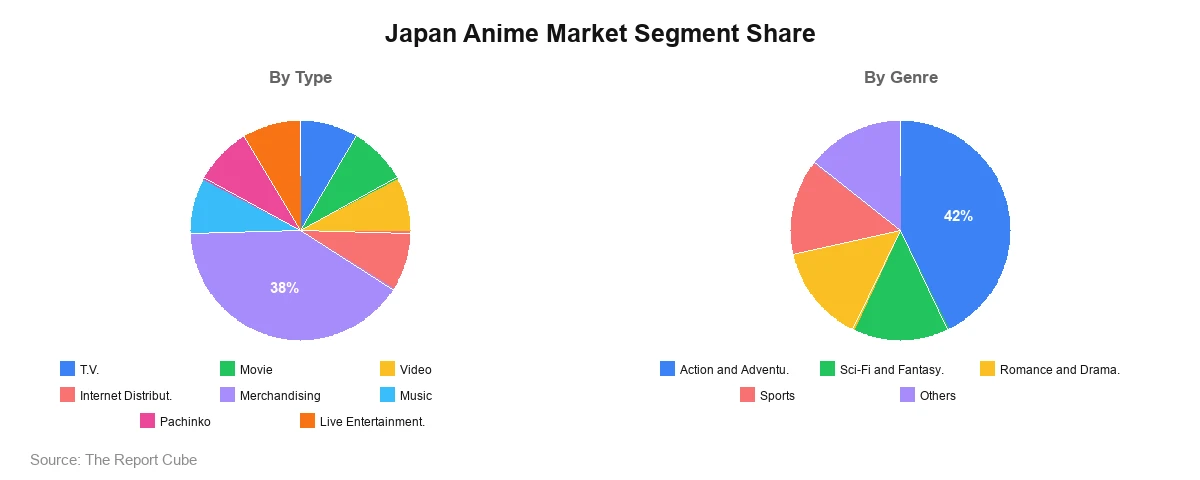
Merchandising dominates the Japan Anime Market by type, accounting for an estimated 38% of total market revenue, driven by character goods, apparel, collectible figures, trading cards, and collaborative retail campaigns tied to high-traffic franchises such as One Piece, Dragon Ball, and Demon Slayer. Retail partnerships with major department stores, specialty figure retailers, and international licensees sustain consistent merchandise turnover throughout the franchise lifecycle. Licensing revenues from character usage across non-media categories including food, cosmetics, and stationery further amplify merchandising's revenue contribution relative to content-only type segments.
Internet distribution is emerging as the fastest-growing type within the segment as platforms including Crunchyroll, Netflix, Amazon Prime Video, and Abema continue expanding their anime libraries and commissioning original productions. T.V. broadcast retains a substantial base audience domestically, while theatrical movie releases generate concentrated box office revenue with franchises such as Demon Slayer: Mugen Train and Jujutsu Kaisen 0 demonstrating the format's commercial ceiling. Music, pachinko, and Japan's live anime entertainment sector collectively represent high-margin complementary revenue streams that strengthen total IP monetization across franchise lifecycles.
By Genre
- Action and Adventure
- Sci-Fi and Fantasy
- Romance and Drama
- Sports
- Others
Action and Adventure is the leading genre in the Japan Anime Market, representing an estimated 42% of total production volume and a proportionally higher share of global licensing revenue, reflecting the genre's broad cross-demographic appeal and merchandising compatibility. Major franchises including Naruto, One Piece, Attack on Titan, and Jujutsu Kaisen have demonstrated multi-decade commercial durability across television, theatrical, and streaming formats. The genre's dominance is further reinforced by its strong performance in international markets, where action-oriented narratives with clear protagonist arcs translate effectively across cultural and linguistic boundaries.
Sci-Fi and Fantasy represents the second-largest genre segment, anchored by franchises including Neon Genesis Evangelion, Sword Art Online, and Re:Zero, which sustain active merchandise and licensing revenues well beyond their original broadcast windows. Romance and Drama genres are gaining momentum as streaming platforms identify female-skewing audiences as an underpenetrated demographic, driving increased production of titles adapted from shoujo manga and romance webtoons. Sports anime, energized by the sustained global popularity of Haikyuu!! and Blue Lock, continues attracting investment as studios recognize the genre's capacity to build dedicated, commercially active fan communities around real-world athletic events and sponsorships.
Regional Projection of Japan Anime Market
The Japan Anime Market exhibits distinct regional variation across the country's eight major geographic blocs, reflecting differences in studio concentration, broadcast infrastructure, consumer spending capacity, and proximity to entertainment production clusters. Kanto retains dominant market share as Japan's primary production and commercial center, while western regions continue expanding their anime tourism and event-driven revenue contributions.
|
Region |
Estimated Market Share |
Key Growth Factors |
Consumer Trends |
|---|---|---|---|
|
Kanto |
41.5% |
Studio concentration, broadcast hub, major retail and event venues |
High spending on merchandise, events, and limited-edition releases |
|
Kansai |
19.2% |
Production studios, anime tourism destinations, strong retail networks |
Rising themed café and experiential venue adoption |
|
Chubu |
12.4% |
Regional broadcast affiliates, growing otaku retail clusters |
Increasing collector merchandise and figure market demand |
|
Kyushu and Okinawa |
10.1% |
Expanding anime tourism, regional live event programming |
Growth in cosplay events and fan community spending |
|
Tohoku |
7.3% |
Anime pilgrimage tourism, regional collaboration initiatives |
Rising participation in franchise-linked travel and events |
|
Hokkaido |
4.8% |
Seasonal event tourism, regional broadcast and retail |
Moderate merchandise spending with event-driven peaks |
|
Chugoku |
3.0% |
Smaller studio affiliates, niche collector communities |
Growing online purchasing of anime merchandise |
|
Shikoku |
1.7% |
Limited but growing anime tourism and local broadcast engagement |
Emerging cosplay and fan event participation |
- Kanto: Kanto dominates the Japan Anime Market with approximately 41.5% regional share, anchored by the concentration of major production studios, broadcast networks, and the world's largest otaku retail district in Akihabara, Tokyo, driving consistent consumer spending across all anime revenue types.
- Kansai: Kansai serves as Japan's second-largest anime production and consumption region, home to Kyoto Animation and a growing network of anime tourism destinations that attract both domestic and international visitors, supporting steady merchandise and live experience revenue growth.
- Chubu: Chubu's regional anime market benefits from proximity to Nagoya's entertainment retail infrastructure and a rising density of collector-focused stores, supporting above-average figure and specialty merchandise sales relative to its population share.
- Kyushu and Okinawa: Kyushu and Okinawa are experiencing above-average growth in anime-linked live event and tourism revenue as regional governments actively co-invest in franchise collaborations that attract fan travelers and support local economies.
- Tohoku: Tohoku leverages its association with several celebrated franchise production locations to generate meaningful anime pilgrimage tourism, with regional municipalities investing in visitor infrastructure and official franchise partnerships to sustain this revenue stream.
- Hokkaido: Hokkaido's anime market contribution is concentrated in seasonal event-driven spending and limited-edition retail drops tied to regional franchises, with growth supported by its expanding profile as a destination for anime-themed tourism packages.
- Chugoku: Chugoku's anime market is characterized by a niche but loyal collector base with strong online purchasing behavior, with regional retail operators increasingly partnering with national anime distributors to capture this demand.
- Shikoku: Shikoku represents the smallest regional share, though municipal investment in cosplay events and franchise collaboration tourism initiatives is gradually raising the region's profile among domestic anime fans seeking immersive travel experiences.
Japan Anime Market: Recent Development (2025)
- MAPPA announced expanded global co-production partnerships, strengthening international original anime content pipeline significantly.
- Toei Animation launched a new digital remastering initiative, revitalizing legacy Dragon Ball and Sailor Moon franchise libraries.
- Kadokawa Corporation expanded its webtoon-to-anime adaptation pipeline, commissioning twelve new titles for streaming distribution.
- Aniplex and Sony Music Entertainment deepened anime music licensing integration, creating dedicated franchise soundtrack monetization strategies.
Japan Anime Market Future Outlook (2034)
The Japan Anime Market is projected to expand at a 4.67% CAGR, reaching approximately USD 20.56 billion by 2034. Growth will be driven by deepening global streaming penetration, continued cross-media IP expansion, and the maturation of immersive fan experience formats that command premium consumer spending. Studios investing in AI-assisted production workflows, digital cel animation tools, and cloud-based collaborative pipelines will compress production timelines and reduce per-episode costs, enabling a higher volume of commercially viable titles across both domestic and international platforms.
Long-term market expansion will be further supported by the emergence of virtual and augmented reality anime experiences, the globalization of Japan's live entertainment formats through overseas touring productions, and the growing influence of social media-driven fan communities in sustaining franchise commercial longevity. Studios and rights holders that strategically manage franchise-linked merchandise and global retail licensing across multiple consumer segments will capture disproportionate revenue share, reinforcing Japan's position as the world's dominant originator of animated entertainment intellectual property through the forecast period and beyond.
Japan Anime Market Report Coverage
|
Report Attribute |
Details |
|---|---|
|
Market Name |
Japan Anime Market |
|
Market Size (2026) |
USD 14.27 Billion |
|
Market Size (2034) |
USD 20.56 Billion |
|
Forecast Period |
2026–2034 |
|
CAGR |
4.67% |
|
Base Year |
2026 |
|
Historical Years |
2021–2025 |
|
Forecast Years |
2026–2034 |
|
Segments Covered |
By Type, By Genre |
|
Regions Covered |
Hokkaido, Tohoku, Kanto, Chubu, Kansai, Chugoku, Shikoku, Kyushu and Okinawa |
|
Key Companies |
Toei Animation Co. Ltd., Studio Ghibli Inc., Sunrise Inc. (Bandai Namco Filmworks), Kyoto Animation Co. Ltd., MADHOUSE Inc., Production I.G Inc., Kadokawa Corporation, Aniplex Inc., MAPPA, Others |
|
Report Format |
PDF, Excel, PPT |
|
Customization |
Available as per client requirements |
Why Choose This Report?
- Comprehensive analysis covering all eight anime revenue types and genre segments.
- Accurate market sizing supported by reliable 2026–2034 forecast methodology.
- Japan-specific regional breakdown across all eight domestic geographic blocs.
- Competitive profiling of leading studios and rights management organizations.
- Insight into global streaming, licensing, and co-production revenue dynamics.
- Analysis of cross-media IP monetization and live entertainment expansion strategies.
- Data-driven research aligned with current industry trends and investor priorities.
- Strategic intelligence supporting content investment and licensing partnership decisions.
Table of Contents
- Introduction
- Objective of the Study
- Product Definition
- Market Segmentation
- Study Variables
- Research Methodology
- Secondary Data Points
- Companies Interviewed
- Primary Data Points
- Breakdown of Primary Interviews
- Secondary Data Points
- Executive Summary
- Market Dynamics
- Drivers
- Challenges
- Opportunity Assessment
- Recent Trends and Developments
- Policy and Regulatory Landscape
- Japan Anime Market Overview and Forecast Analysis (2021-2034)
- Market Size, By Value, By Growth Rate (CAGR/USD Billions)
- Demand – Supply Trends
- Market Share, By Type
- T.V.
- Movie
- Video
- Internet Distribution
- Merchandising
- Music
- Pachinko
- Live Entertainment
- Market Share, By Genre
- Action and Adventure
- Sci-Fi and Fantasy
- Romance and Drama
- Sports
- Others
- Market Share, By Region
- Hokkaido
- Tohoku
- Kanto
- Chubu
- Kansai
- Chugoku
- Shikoku
- Kyushu and Okinawa
- Market Share, By Competitors
- Competition Characteristics
- Revenue Shares
- T.V. Japan Anime Market Overview, 2021-2034F
- By Value (USD Million)
- By Genre – Market Size & Forecast 2021-2034, USD Million
- Action and Adventure
- Sci-Fi and Fantasy
- Romance and Drama
- Sports
- Others
- Movie Japan Anime Market Overview, 2021-2034F
- By Value (USD Million)
- By Genre – Market Size & Forecast 2021-2034, USD Million
- Action and Adventure
- Sci-Fi and Fantasy
- Romance and Drama
- Sports
- Others
- Video Japan Anime Market Overview, 2021-2034F
- By Value (USD Million)
- By Genre – Market Size & Forecast 2021-2034, USD Million
- Action and Adventure
- Sci-Fi and Fantasy
- Romance and Drama
- Sports
- Others
- Internet Distribution Japan Anime Market Overview, 2021-2034F
- By Value (USD Million)
- By Genre – Market Size & Forecast 2021-2034, USD Million
- Action and Adventure
- Sci-Fi and Fantasy
- Romance and Drama
- Sports
- Others
- Merchandising Japan Anime Market Overview, 2021-2034F
- By Value (USD Million)
- By Genre – Market Size & Forecast 2021-2034, USD Million
- Action and Adventure
- Sci-Fi and Fantasy
- Romance and Drama
- Sports
- Others
- Music Japan Anime Market Overview, 2021-2034F
- By Value (USD Million)
- By Genre – Market Size & Forecast 2021-2034, USD Million
- Action and Adventure
- Sci-Fi and Fantasy
- Romance and Drama
- Sports
- Others
- Pachinko Japan Anime Market Overview, 2021-2034F
- By Value (USD Million)
- By Genre – Market Size & Forecast 2021-2034, USD Million
- Action and Adventure
- Sci-Fi and Fantasy
- Romance and Drama
- Sports
- Others
- Live Entertainment Japan Anime Market Overview, 2021-2034F
- By Value (USD Million)
- By Genre – Market Size & Forecast 2021-2034, USD Million
- Action and Adventure
- Sci-Fi and Fantasy
- Romance and Drama
- Sports
- Others
- Competitive Outlook (Company Profile – Partial List)
- Toei Animation Co. Ltd.
- Company Overview
- Business Segments
- Strategic Alliances/Partnerships
- Recent Developments
- Studio Ghibli Inc.
- Company Overview
- Business Segments
- Strategic Alliances/Partnerships
- Recent Developments
- Sunrise Inc. (Bandai Namco Filmworks)
- Company Overview
- Business Segments
- Strategic Alliances/Partnerships
- Recent Developments
- Kyoto Animation Co. Ltd.
- Company Overview
- Business Segments
- Strategic Alliances/Partnerships
- Recent Developments
- MADHOUSE Inc.
- Company Overview
- Business Segments
- Strategic Alliances/Partnerships
- Recent Developments
- Production I.G Inc.
- Company Overview
- Business Segments
- Strategic Alliances/Partnerships
- Recent Developments
- Kadokawa Corporation
- Company Overview
- Business Segments
- Strategic Alliances/Partnerships
- Recent Developments
- Aniplex Inc.
- Company Overview
- Business Segments
- Strategic Alliances/Partnerships
- Recent Developments
- MAPPA
- Company Overview
- Business Segments
- Strategic Alliances/Partnerships
- Recent Developments
- Others
- Toei Animation Co. Ltd.
- Contact Us & Disclaimer
Top Key Players & Market Share Outlook
- Toei Animation Co. Ltd.
- Studio Ghibli Inc.
- Sunrise Inc. (Bandai Namco Filmworks)
- Kyoto Animation Co. Ltd.
- MADHOUSE Inc.
- Production I.G Inc.
- Kadokawa Corporation
- Aniplex Inc.
- MAPPA
- Others
Frequently Asked Questions






