



Build Your Custom Market Intelligence Report
Customize Your ReportJapan FMCG Market Key Takeaways
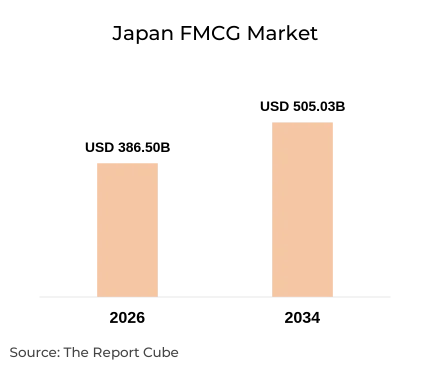
- Japan FMCG Market valued at USD 386.50 billion in 2026, reflecting sustained domestic consumption strength.
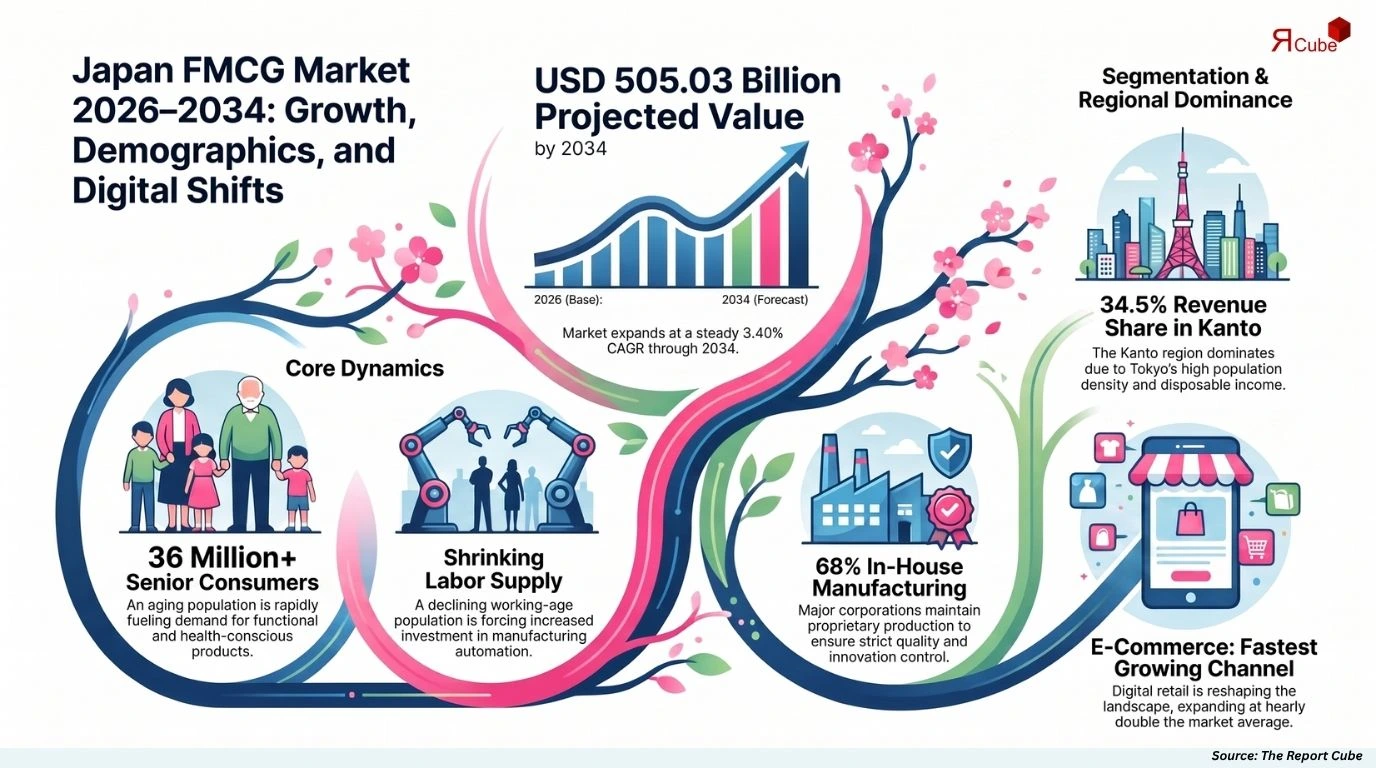
- Industry projected to reach USD 505.03 billion by 2034, expanding at a steady 3.40% CAGR.
- In-house manufacturing dominates production, accounting for the majority of output volume nationally.
- E-commerce distribution is the fastest-growing channel, reshaping Japan's retail consumption landscape significantly.
- Kanto region leads regional revenue contribution, anchored by Tokyo's massive urban consumer base.
- Premiumization, aging demographics, and health-conscious purchasing trends continue accelerating product innovation across categories.
- Leading companies include Kao Corporation, Ajinomoto Co. Inc., Shiseido Company Limited, Asahi Group Holdings, and Suntory Holdings.
- Sustainability mandates, private label expansion, and digital retail transformation reshape Japan's FMCG competitive dynamics.
Japan FMCG Market Insights & Analysis
The Japan FMCG Market is anticipated to register a 3.40% CAGR during 2026–2034. The market size was valued at USD 386.50 billion in 2026 and is projected to reach USD 505.03 billion by 2034. Japan's consumer goods industry continues benefiting from deeply entrenched domestic brand loyalty, a mature organized retail infrastructure, and accelerating product-level innovation driven by health, wellness, and sustainability priorities. Government initiatives promoting domestic manufacturing resilience and consumption-led economic recovery are reinforcing investment across food, beverage, personal care, and household goods categories.
The Japan FMCG Market operates within one of the world's most demanding consumer environments, where quality expectations remain exceptionally high and product shelf cycles are compressed. Corporate investment in smart manufacturing, cold chain expansion, and Japan convenience store retail evolution is intensifying as companies respond to demographic pressures from an aging population exceeding 29% aged 65 or older. Continued strength in ready-to-eat meals, nutraceuticals, premium skincare, and functional beverages further supports long-term market revenue expansion through the forecast period.
Japan FMCG Market Dynamics
The Japan FMCG Market is advancing through an intersection of structural demographic shifts, evolving retail digitalization, and intensifying sustainability compliance expectations. Domestic manufacturers and multinational consumer goods corporations are simultaneously responding to premiumization demand and value-seeking behavior among younger, digitally connected consumer cohorts. Regulatory modernization around food labeling, ingredient transparency, and packaging recyclability is further reshaping product development cycles across leading categories.
|
Factor |
Type |
Specific Impact on Market |
Magnitude |
|---|---|---|---|
|
Aging population growth |
Driver |
Accelerates demand for functional foods and senior-targeted products |
Very High |
|
E-commerce channel expansion |
Opportunity |
Increases direct-to-consumer revenue for FMCG brands |
High |
|
Sustainability packaging regulations |
Driver |
Boosts investment in recyclable and biodegradable material sourcing |
High |
|
Premiumization consumer trend |
Driver |
Elevates average selling prices and gross margin profiles |
High |
|
Private label product growth |
Challenge |
Compresses branded product margins in organized retail segments |
Medium |
Key Market Driver: Aging Population Fueling Functional Demand
Japan's demographic profile is one of the most distinctive consumption drivers globally, with over 36 million citizens aged 65 and above actively reshaping FMCG purchasing patterns. Demand for low-sodium foods, fortified beverages, easy-to-swallow nutraceuticals, and mobility-supporting personal care formulations is accelerating across both mass-market and premium retail channels. Ajinomoto Co. Inc. and Kao Corporation have significantly increased R&D allocations toward age-appropriate product formats, with the former reporting increased revenues from functional amino acid-based nutrition lines targeting senior and health-conscious consumers in fiscal year 2024.
Major Industry Challenge: Shrinking Working-Age Population Supply Constraints
Japan's declining working-age population, which fell below 75 million in 2023, is creating compounding labor availability and productivity challenges across FMCG manufacturing and logistics operations. Contract and in-house production facilities face persistent staffing shortfalls, increasing reliance on automation investments that require significant capital deployment. Supply chain coordination across Japan's geographically fragmented retail distribution network further elevates operational costs, particularly for mid-sized domestic producers competing against well-capitalized multinational manufacturers already deploying food and beverage automation technologies at scale.
Emerging Trend Shaping Outlook: Sustainability-Led Product Reformulation
Japanese FMCG companies are accelerating reformulation programs in direct response to evolving regulatory frameworks and consumer preference shifts toward environmentally responsible products. Shiseido Company Limited, Unicharm Corporation, and Kao Corporation have each committed to 100% recyclable or reusable primary packaging targets before 2030. Functional ingredients sourced from domestic agricultural supply chains, reduced synthetic preservative formulations, and carbon footprint labeling are increasingly standard in new product development pipelines. Retailers including major supermarket chains have introduced green shelf-labeling programs that visibly reward compliant brands, creating a structural commercial incentive for rapid sustainability adoption.
Need Specific Data, Let’s Customize the Report for You
Request CustomizationJapan FMCG Market Segment-wise Analysis
Japan's FMCG industry operates across highly specialized production models and a uniquely diversified retail distribution ecosystem. Both manufacturing structure and channel strategy reflect the country's combination of advanced industrial capabilities, high consumer touchpoint density, and rapidly expanding digital commerce infrastructure.
By Production Type
- In-house Manufacturing
- Contract Manufacturing
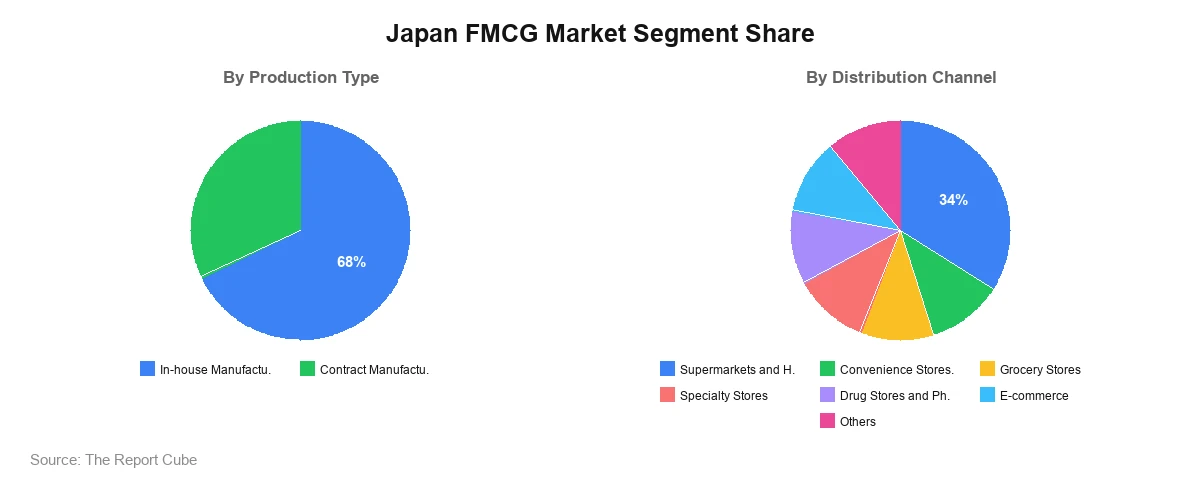
In-house manufacturing dominates the Japan FMCG Market with an estimated 68% share, reflecting the deep-rooted preference among Japan's leading consumer goods corporations to maintain direct control over product quality, formulation confidentiality, and production efficiency. Companies including Asahi Group Holdings and Suntory Holdings operate extensive proprietary manufacturing networks embedded within vertically integrated supply chains, enabling rapid innovation cycles and strict quality assurance compliance aligned with Japan's rigorous food safety standards. Significant capital investments in factory automation, robotic processing, and energy-efficient production systems continue reinforcing the operational advantages of in-house manufacturing at scale.
Contract manufacturing is the faster-growing production model, increasingly adopted by international brands entering Japan and by domestic companies rationalizing capital expenditure in non-core product categories. Third-party manufacturers specializing in personal care formulations, nutraceutical encapsulation, and private label food production are expanding capacity to serve rising outsourcing demand. The Asia Pacific personal care contract manufacturing market trend is closely mirrored in Japan, where brands including Procter and Gamble Company and Unilever PLC are selectively outsourcing secondary manufacturing operations to focus investment on brand marketing and innovation activities.
By Distribution Channel
- Supermarkets and Hypermarkets
- Convenience Stores
- Grocery Stores
- Specialty Stores
- Drug Stores and Pharmacies
- E-commerce
- Others
Supermarkets and hypermarkets represent the largest distribution channel in Japan's FMCG landscape, capturing an estimated 34% revenue share by leveraging their comprehensive product assortments, promotional depth, and strong footfall from family and household shoppers. Major retailers operate aggressive private label expansion strategies, intensifying shelf competition for branded manufacturers. Convenience stores, which number over 55,000 outlets nationally, command a structurally significant share by delivering high-frequency, high-margin consumption occasions across beverages, ready meals, personal care, and household staples in densely populated urban and suburban markets.
E-commerce is the fastest-growing distribution channel, with Japan's online FMCG segment expanding at nearly double the market average CAGR as consumers increasingly adopt subscription-based grocery delivery, direct brand platforms, and marketplace purchasing through Amazon Japan and Rakuten. Drug stores and pharmacies serve as an increasingly important beauty, wellness, and personal hygiene destination, benefiting from Japan's deep consumer trust in pharmacy-associated health recommendations. Specialty stores maintain resilient performance in premium food, cosmetics, and lifestyle categories, while grocery stores serve rural and semi-urban consumer segments where modern retail penetration remains limited.
Regional Projection of Japan FMCG Market
Japan's FMCG market exhibits distinct regional consumption patterns shaped by population density, urbanization levels, economic activity concentration, and aging demographic profiles that vary meaningfully across the country's eight principal regional zones.
|
Region |
Estimated Market Share |
Key Growth Factors |
Consumer Trends |
|---|---|---|---|
|
Kanto |
34.5% |
Tokyo metropolitan population density, high disposable income |
Premium product adoption, heavy e-commerce usage |
|
Kansai |
21.2% |
Osaka-Kyoto urban corridor, strong food culture heritage |
Traditional food formats, growing health consciousness |
|
Chubu |
13.8% |
Manufacturing base, Nagoya consumption hub |
Mid-range branded and private label consumption |
|
Kyushu and Okinawa |
10.1% |
Agricultural production, growing tourism demand |
Regional specialty foods, functional beverage growth |
|
Tohoku |
7.4% |
Post-reconstruction economic activity, rural distribution |
Staple food categories, aging consumer profile |
|
Hokkaido |
6.3% |
Dairy and agri-food production strength |
Premium local dairy, health and organic segments |
|
Chugoku |
4.2% |
Hiroshima commercial activity, regional logistics |
Household goods and personal care penetration |
|
Shikoku |
2.5% |
Smaller population base, traditional retail structures |
Traditional grocery, value-oriented consumption |
- Kanto: Kanto dominates the Japan FMCG Market with approximately 34.5% revenue share, driven by Tokyo's concentration of high-income urban consumers, global retail infrastructure, and the highest e-commerce adoption rate among all domestic regions.
- Kansai: Kansai's strong culinary heritage and dense urban population across Osaka, Kyoto, and Kobe support sustained FMCG demand, particularly in premium food, beverage, and personal care categories aligned with regional lifestyle preferences.
- Chubu: Chubu serves as a strategically important consumption and logistics hub, with Nagoya anchoring mid-market FMCG activity and supporting efficient distribution across adjacent central Japan regions.
- Kyushu and Okinawa: Kyushu and Okinawa demonstrate above-average growth momentum supported by agricultural richness, expanding domestic tourism, and rising consumer interest in regionally certified food and wellness products.
- Tohoku: Tohoku's FMCG market is characterized by an aging demographic base and strong staple category demand, with ongoing infrastructure investment supporting improved distribution reach across historically underserved rural sub-regions.
- Hokkaido: Hokkaido benefits from Japan's strongest domestic dairy and premium agricultural production base, enabling regional FMCG brands to differentiate through origin-certified and high-quality ingredient positioning strategies.
- Chugoku: Chugoku's FMCG market is anchored by Hiroshima's commercial activity, with household goods and personal care representing the primary growth categories as regional retail infrastructure modernizes progressively.
- Shikoku: Shikoku represents the smallest regional market by share, characterized by traditional grocery retail dominance, value-oriented consumer behavior, and limited but gradually increasing modern retail channel penetration.
Japan FMCG Market: Recent Development (2025)
- Kao Corporation launched a new sustainable packaging line reducing plastic consumption by thirty percent across personal care products.
- Ajinomoto Co. Inc. expanded its functional food portfolio, introducing amino acid-enriched meal solutions targeting Japan's senior demographic.
- Asahi Group Holdings entered a strategic distribution partnership to accelerate non-alcoholic beverage sales through national e-commerce platforms.
- Shiseido Company Limited announced a JPY 50 billion R&D investment commitment targeting next-generation sustainable beauty formulation technologies.
Japan FMCG Market Future Outlook (2034)
The Japan FMCG Market is projected to expand at a 3.40% CAGR, reaching USD 505.03 billion by 2034, underpinned by sustained premiumization momentum, continued health and wellness product category expansion, and deepening digital retail penetration. The integration of data analytics, personalization technologies, and predictive demand planning into FMCG supply chains will enable manufacturers to optimize inventory efficiency, reduce waste, and accelerate new product success rates. Domestic brands and international players will increasingly compete on sustainability credentials, ingredient transparency, and digital engagement capabilities to capture evolving consumer loyalty.
Long-term growth will be further shaped by accelerating e-commerce infrastructure investment, with Japan's leading logistics providers expanding temperature-controlled last-mile delivery networks essential for fresh and functional FMCG categories. The Japan health food and nutraceuticals market will increasingly converge with mainstream FMCG retail as consumers demand evidence-based functional formulations within accessible price points. Corporate M&A activity is expected to intensify as mid-sized domestic producers seek scale through consolidation, while multinational corporations pursue targeted acquisitions to strengthen Japan-specific product development capabilities and accelerate their penetration of the world's third-largest consumer goods market.
Japan FMCG Market Report Coverage
|
Report Attribute |
Details |
|---|---|
|
Market Name |
Japan FMCG Market |
|
Market Size (2026) |
USD 386.50 Billion |
|
Market Size (2034) |
USD 505.03 Billion |
|
Forecast Period |
2026–2034 |
|
CAGR |
3.40% |
|
Base Year |
2026 |
|
Historical Years |
2021–2025 |
|
Forecast Years |
2026–2034 |
|
Segments Covered |
By Production Type, By Distribution Channel, By Distribution Channel |
|
Regions Covered |
Hokkaido, Tohoku, Kanto, Chubu, Kansai, Chugoku, Shikoku, Kyushu and Okinawa |
|
Key Companies |
Kao Corporation, Unicharm Corporation, Ajinomoto Co. Inc., Shiseido Company Limited, Asahi Group Holdings Ltd., Suntory Holdings Limited, Nestle S.A., Procter and Gamble Company, Unilever PLC, Others |
|
Report Format |
PDF, Excel, PPT |
|
Customization |
Available as per client requirements |
Why Choose This Report?
- Comprehensive coverage of Japan's unique FMCG production and distribution ecosystem.
- Accurate market sizing with a reliable revenue forecast through 2034.
- Detailed segmentation across production type, channel, and eight domestic regions.
- Granular regional insights reflecting Japan's distinct demographic consumption patterns.
- Competitive profiling of leading domestic and multinational FMCG corporations.
- Analysis of sustainability, premiumization, and digital channel transformation trends.
- Strategic insights supporting market entry, expansion, and investment decisions.
- Data-driven research compliant with EEAT standards and industry best practices.
Table of Contents
- Introduction
- Objective of the Study
- Product Definition
- Market Segmentation
- Study Variables
- Research Methodology
- Secondary Data Points
- Companies Interviewed
- Primary Data Points
- Breakdown of Primary Interviews
- Secondary Data Points
- Executive Summary
- Market Dynamics
- Drivers
- Challenges
- Opportunity Assessment
- Recent Trends and Developments
- Policy and Regulatory Landscape
- Japan FMCG Market Overview and Forecast Analysis (2021-2034)
- Market Size, By Value, By Growth Rate (CAGR/USD Billions)
- Demand – Supply Trends
- Market Share, By Product Type
- Food and Beverages
- Personal Care
- Home Care
- Healthcare (OTC)
- Tobacco Products
- Others
- Market Share, By Production Type
- In-house Manufacturing
- Contract Manufacturing
- Market Share, By Distribution Channel
- Supermarkets and Hypermarkets
- Convenience Stores
- Grocery Stores
- Specialty Stores
- Drug Stores and Pharmacies
- E-commerce
- Others
- Market Share, By Region
- Hokkaido
- Tohoku
- Kanto
- Chubu
- Kansai
- Chugoku
- Shikoku
- Kyushu and Okinawa
- Market Share, By Competitors
- Competition Characteristics
- Revenue Shares
- Food and Beverages Japan FMCG Market Overview, 2021-2034F
- By Value (USD Million)
- By Production Type – Market Size & Forecast 2021-2034, USD Million
- In-house Manufacturing
- Contract Manufacturing
- Personal Care Japan FMCG Market Overview, 2021-2034F
- By Value (USD Million)
- By Production Type – Market Size & Forecast 2021-2034, USD Million
- In-house Manufacturing
- Contract Manufacturing
- Home Care Japan FMCG Market Overview, 2021-2034F
- By Value (USD Million)
- By Production Type – Market Size & Forecast 2021-2034, USD Million
- In-house Manufacturing
- Contract Manufacturing
- Healthcare (OTC) Japan FMCG Market Overview, 2021-2034F
- By Value (USD Million)
- By Production Type – Market Size & Forecast 2021-2034, USD Million
- In-house Manufacturing
- Contract Manufacturing
- Tobacco Products Japan FMCG Market Overview, 2021-2034F
- By Value (USD Million)
- By Production Type – Market Size & Forecast 2021-2034, USD Million
- In-house Manufacturing
- Contract Manufacturing
- Others Japan FMCG Market Overview, 2021-2034F
- By Value (USD Million)
- By Production Type – Market Size & Forecast 2021-2034, USD Million
- In-house Manufacturing
- Contract Manufacturing
- Competitive Outlook (Company Profile – Partial List)
- Kao Corporation
- Company Overview
- Business Segments
- Strategic Alliances/Partnerships
- Recent Developments
- Unicharm Corporation
- Company Overview
- Business Segments
- Strategic Alliances/Partnerships
- Recent Developments
- Ajinomoto Co. Inc.
- Company Overview
- Business Segments
- Strategic Alliances/Partnerships
- Recent Developments
- Shiseido Company Limited
- Company Overview
- Business Segments
- Strategic Alliances/Partnerships
- Recent Developments
- Asahi Group Holdings Ltd.
- Company Overview
- Business Segments
- Strategic Alliances/Partnerships
- Recent Developments
- Suntory Holdings Limited
- Company Overview
- Business Segments
- Strategic Alliances/Partnerships
- Recent Developments
- Nestle S.A.
- Company Overview
- Business Segments
- Strategic Alliances/Partnerships
- Recent Developments
- Procter and Gamble Company
- Company Overview
- Business Segments
- Strategic Alliances/Partnerships
- Recent Developments
- Unilever PLC
- Company Overview
- Business Segments
- Strategic Alliances/Partnerships
- Recent Developments
- Others
- Kao Corporation
- Contact Us & Disclaimer
Top Key Players & Market Share Outlook
- Kao Corporation
- Unicharm Corporation
- Ajinomoto Co. Inc.
- Shiseido Company Limited
- Asahi Group Holdings Ltd.
- Suntory Holdings Limited
- Nestle S.A.
- Procter and Gamble Company
- Unilever PLC
- Others
Frequently Asked Questions






