




Build Your Custom Market Intelligence Report
Customize Your ReportJapan Biodegradable Cutlery Market Key Takeaways
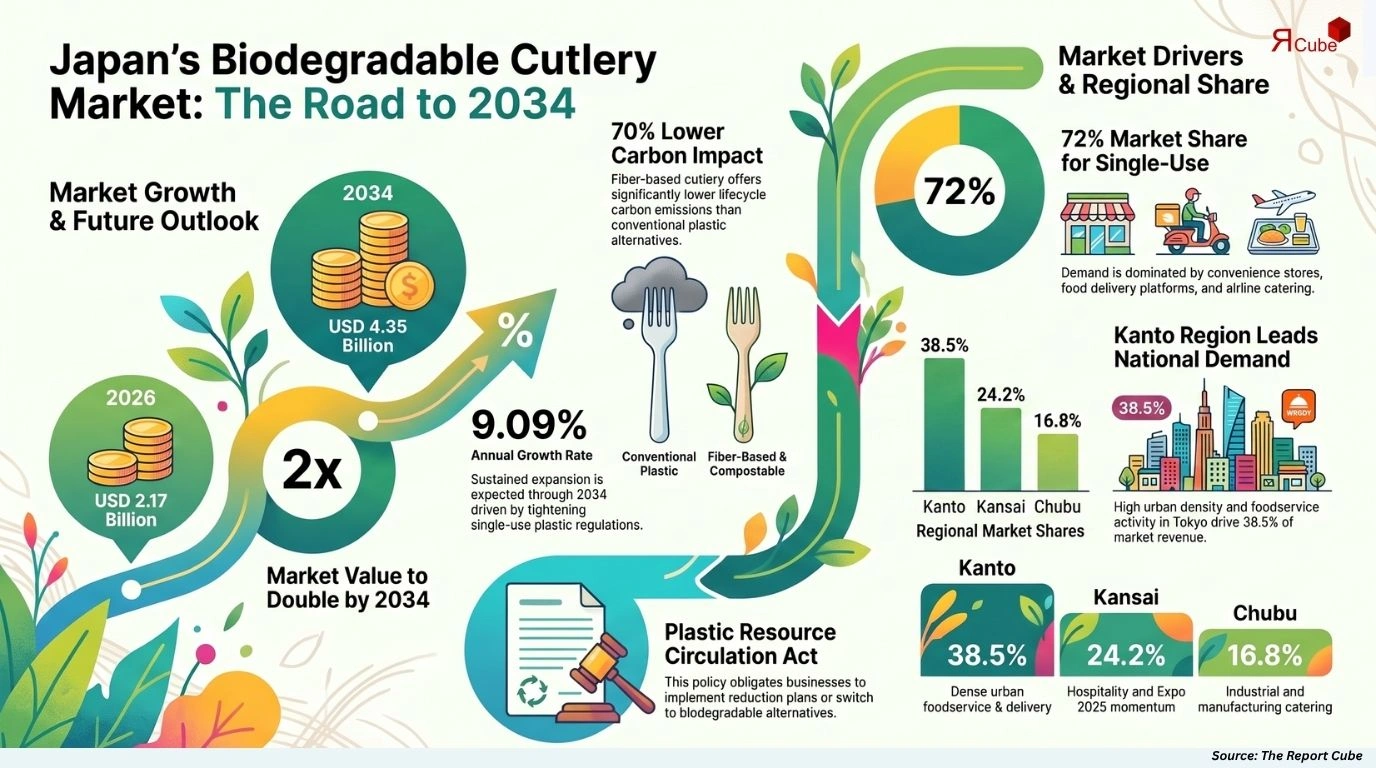
- Japan Biodegradable Cutlery Market was valued at USD 2.17 billion in 2026.
- Market is projected to reach USD 4.35 billion by 2034, nearly doubling over the forecast period.
- Industry is set to expand at a 9.09% CAGR from 2026 through 2034.
- Single-use cutlery dominates operations owing to consistent foodservice and institutional demand.
- Offline distribution channels currently lead in overall market revenue contribution.
- Kanto region holds the largest regional share, driven by dense urban foodservice activity.
- Key players include Japan Pulp and Paper, Daio Paper, Oji Holdings, and Rengo Co.
- Japan's Plastic Resource Circulation Act continues accelerating transition toward compostable alternatives.
Japan Biodegradable Cutlery Market Insights & Analysis
The Japan Biodegradable Cutlery Market is anticipated to register a 9.09% CAGR during 2026–2034. The market size was valued at USD 2.17 billion in 2026 and is projected to reach USD 4.35 billion by 2034. Demand is driven by tightening regulatory mandates under Japan's Plastic Resource Circulation Act, which requires retailers and foodservice operators to reduce reliance on conventional single-use plastics. Government procurement policies actively favor certified biodegradable and compostable alternatives, creating sustained institutional demand across public sector catering, hospitality, and large-scale food delivery platforms. Investments in plant-based and paper-derived cutlery are rising from both domestic producers and international partners entering the Japanese market.
The market also benefits from deepening corporate sustainability commitments across Japan's foodservice sector. Major restaurant chains, convenience store operators, and airline catering companies are increasingly shifting to compostable foodservice cutlery procurement, driven by ESG reporting obligations and consumer pressure. Producers are advancing paper-fiber and wood-pulp-based forming technologies to meet heat resistance and durability requirements comparable to conventional plastic utensils. Fiber-based cutlery has been found to carry approximately 70% lower lifecycle carbon impact than plastic alternatives, a data point gaining traction in procurement evaluations.
Japan Biodegradable Cutlery Market Dynamics
Japan's biodegradable cutlery industry is expanding across foodservice, institutional catering, retail, and event management applications as regulatory pressure and consumer preference reinforce each other. Domestic paper and pulp producers are accelerating product development, while online platforms are enabling bulk procurement by smaller foodservice operators who previously relied on conventional plastic. Government green procurement mandates and waste reduction targets set under Japan's 3R + Renewable policy framework continue shaping supply chain behavior across the segment.
|
Factor |
Type |
Specific Impact on Market |
Magnitude |
|---|---|---|---|
|
Plastic Resource Circulation Act |
Driver |
Compels foodservice operators to switch to compliant biodegradable cutlery |
Very High |
|
E-commerce and food delivery growth |
Opportunity |
Increases bulk demand for single-use eco-friendly utensils online |
High |
|
Reusable cutlery adoption |
Trend |
Encourages premium product development for restaurant and institutional use |
Moderate |
|
Raw material sourcing constraints |
Challenge |
Limits production scalability for wood and husk-based cutlery |
High |
|
Green procurement policy mandates |
Driver |
Creates stable government institutional demand for certified products |
High |
Key Market Driver: Plastic Circulation Act Policy Pressure
Japan's Plastic Resource Circulation Act, enforced progressively since 2022 and strengthened through 2025 regulatory guidance, obligates businesses supplying more than a defined threshold of single-use plastics to submit and implement reduction plans. Foodservice operators, convenience stores, and catering companies are required to either reduce plastic cutlery provision or replace it with approved biodegradable alternatives. This policy framework has directly accelerated procurement of wood and paper-based eco cutlery alternatives, as companies seek to demonstrate compliance and avoid ministerial enforcement orders. Government green procurement further reinforces institutional buying patterns.
Major Industry Challenge: Durability and Heat Resistance Limitations
While paper, husk, and wood-based biodegradable cutlery products have advanced considerably, maintaining structural integrity under heat and moisture exposure remains a technical challenge. Products used in hot meal service, institutional canteens, or humid packaging environments frequently require moisture-resistant coatings or hybrid material formulations that add production cost and complexity. Achieving the performance benchmarks of conventional plastic at a commercially viable price point continues to constrain faster mass adoption, particularly among cost-sensitive small foodservice operators and convenience retail chains operating on thin margins.
Emerging Trend Shaping Outlook: Reusable Biodegradable Cutlery Development
A growing subset of Japanese manufacturers and foodservice operators is investing in reusable biodegradable cutlery - products made from durable biopolymers or compressed plant fibers designed for multiple wash cycles before composting. This segment is gaining traction in corporate cafeterias, airline catering, and premium restaurant settings where single-use cutlery volumes are high and sustainability visibility matters. The trend reflects broader Asia Pacific sustainable tableware product innovation, as producers seek to serve both regulatory compliance and premium ESG positioning requirements simultaneously. Reusable formats command higher unit margins, supporting profitability for domestic producers.
Need Specific Data, Let’s Customize the Report for You
Request CustomizationJapan Biodegradable Cutlery Market Segment-wise Analysis
Japan's biodegradable cutlery market encompasses multiple distribution pathways and operational formats as foodservice operators, retailers, and institutional buyers accelerate their shift away from conventional plastic utensils toward certified compostable alternatives.
By Distribution Channel
- Online
- Offline
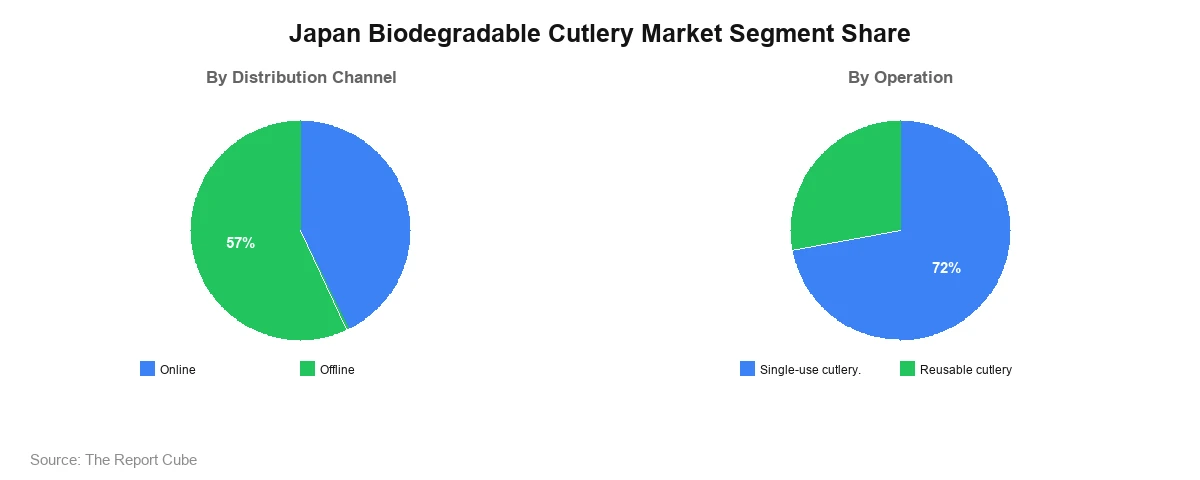
Offline distribution holds the dominant share in the Japan Biodegradable Cutlery Market, accounting for approximately 57% of total market revenue. Wholesale distributors, food packaging suppliers, and direct-to-operator sales networks continue to serve the large-volume requirements of restaurant chains, institutional canteens, hospital catering, and hotel foodservice operations. Traditional trade relationships, product inspection requirements, and bulk pricing arrangements favor offline channels for high-volume commercial procurement in Japan's structured foodservice supply ecosystem.
Online distribution is the fastest-growing channel, driven by the sharp rise in food delivery platforms, e-commerce penetration, and small restaurant operator demand for flexible procurement. Digital marketplaces allow smaller foodservice businesses to source certified biodegradable cutlery in lower minimum order quantities, compare product certifications, and access a wider range of eco-friendly formats than local distributors typically stock. The online share is expanding as online foodservice supply platforms evolve to accommodate bulk recurring orders tied to sustainability compliance documentation requirements.
By Operation
- Single-use cutlery
- Reusable cutlery
Single-use cutlery is the dominant operational segment, representing approximately 72% of market revenue. Demand from convenience stores, fast food operators, food delivery platforms, airline catering, stadium events, and institutional meal services drives sustained high volumes of compostable single-use forks, spoons, knives, and chopsticks. Japan's strict hygiene and sanitation norms, combined with waste management infrastructure for certified compostable waste streams, support continued high adoption of single-use biodegradable formats across commercial foodservice settings.
Reusable cutlery is the fastest-growing operational segment, gaining share among corporate cafeteria operators, premium dining establishments, and sustainability-focused foodservice brands. Products in this segment are typically formed from compressed plant fibers, starch-biopolymer blends, or durable wood composites rated for multiple wash cycles. Adoption is being supported by Japan's Ministry of the Environment guidance encouraging reuse-first approaches under the 3R + Renewable framework, as well as by corporate ESG procurement policies that favor products with measurable lifecycle environmental benefits over standard compostable single-use product alternatives.
Regional Projection of Japan Biodegradable Cutlery Market
Japan's biodegradable cutlery market demonstrates meaningful revenue variation across its major regions, driven by differences in foodservice density, institutional demand concentration, consumer environmental awareness, and proximity to manufacturing and distribution infrastructure.
|
Region |
Estimated Market Share |
Key Growth Factors |
Consumer Trends |
|---|---|---|---|
|
Kanto |
38.5% |
Dense urban foodservice, institutional procurement, food delivery growth |
High demand for online bulk procurement and certified compostable products |
|
Kansai |
24.2% |
Strong hospitality sector, Osaka-Kansai Expo 2025 sustainability momentum |
Growing preference for eco-certified cutlery in tourism and dining |
|
Chubu |
16.8% |
Manufacturing industry catering demand, automotive sector institutional dining |
Steady adoption of compliant biodegradable options in industrial catering |
|
Kyushu |
11.3% |
Expanding food delivery market, regional foodservice growth |
Increasing online procurement for small restaurant operators |
|
Others |
9.2% |
Regional institutional catering and tourism hospitality demand |
Gradual adoption of eco-friendly alternatives in rural and coastal foodservice |
- Kanto: Kanto dominates with approximately 38.5% of national market revenue, driven by the highest concentration of restaurants, convenience stores, corporate canteens, and food delivery activity across Tokyo and surrounding urban prefectures.
- Kansai: Kansai is supported by a robust hospitality and tourism sector, with Osaka's international profile following the 2025 Expo reinforcing corporate and institutional demand for sustainability-certified foodservice products.
- Chubu: Chubu's share reflects steady demand from manufacturing sector institutional catering and a growing number of mid-sized food processing companies transitioning to compliant biodegradable tableware.
- Kyushu: Kyushu is an emerging market, with food delivery expansion in Fukuoka and increasing awareness of plastic reduction mandates among regional foodservice operators accelerating adoption.
- Others: Remaining regions including Tohoku, Hokkaido, Shikoku, and Okinawa contribute through hospitality-driven seasonal demand and government-sector institutional catering transitions toward certified compostable alternatives.
Japan Biodegradable Cutlery Market: Recent Development (2025)
- Oji Holdings launched its Environmental Action Program 2040 in May 2025, reinforcing biodegradable material R&D priorities.
- Oji Holdings partnered with McDonald's Japan and KFC to collect and recycle paper cups across Tokyo in January 2025.
- Daio Paper Corporation expanded its eco-friendly packaging line to include certified biodegradable food contact materials compliant with MHLW positive list standards enforced June 2025.
- Rengo Co. advanced sustainable paper-based foodservice product development, targeting compliant cutlery supply contracts with institutional catering operators.
Japan Biodegradable Cutlery Market Future Outlook (2034)
The Japan Biodegradable Cutlery Market is projected to expand at a 9.09% CAGR, reaching approximately USD 4.35 billion by 2034. Long-term growth will be sustained by continued enforcement and potential tightening of the Plastic Resource Circulation Act, rising corporate ESG reporting requirements, and deepening consumer preference for certified compostable alternatives across Japan's mature foodservice and retail sectors. Domestic paper and pulp producers are well-positioned to scale biodegradable cutlery output using existing fiber processing infrastructure, and material science advances are progressively closing the performance gap between bio-based and conventional plastic cutlery.
Technology investment in plant-based biopolymer forming, heat-resistant paper-fiber composites, and automated compostable cutlery manufacturing will further reduce per-unit costs over the forecast period, supporting wider adoption by cost-sensitive commercial operators. Expansion of Japan's composting infrastructure, alongside government incentives for certified compostable product procurement, will reinforce market fundamentals. The long-term opportunity in reusable biopolymer cutlery products is expected to attract new entrants from the packaging and materials science sectors, diversifying the competitive landscape and accelerating product innovation through 2034.
Japan Biodegradable Cutlery Market Report Coverage
|
Report Attribute |
Details |
|---|---|
|
Market Name |
Japan Biodegradable Cutlery Market |
|
Market Size (2026) |
USD 2.17 Billion |
|
Market Size (2034) |
USD 4.35 Billion |
|
Forecast Period |
2026–2034 |
|
CAGR |
9.09% |
|
Base Year |
2026 |
|
Historical Years |
2021–2025 |
|
Forecast Years |
2026–2034 |
|
Segments Covered |
By Distribution Channel, By Operation, By Raw Material |
|
Regions Covered |
Kanto, Kansai, Chubu, Kyushu, Others |
|
Key Companies |
Japan Pulp and Paper, Daio Paper, Oji Holdings, Rengo Co., Hime-Pla, Haso Ltd., Others |
|
Report Format |
PDF, Excel, PPT |
|
Customization |
Available as per client requirements |
Why Choose This Report?
- Comprehensive analysis of Japan's biodegradable cutlery regulatory environment and market dynamics.
- Accurate market sizing with a reliable 9.09% CAGR forecast through 2034.
- Detailed segmentation covering distribution channels and operational product categories.
- Regional projections across all five major Japanese market zones.
- Competitive profiling of domestic paper, pulp, and eco-packaging manufacturers.
- Analysis of reusable biodegradable cutlery as an emerging high-margin product segment.
- Strategic insights supporting investment, product development, and compliance planning.
- Data-backed research aligned with Japan's evolving plastic reduction regulatory framework.
Table of Contents
- Introduction
- Objective of the Study
- Product Definition
- Market Segmentation
- Study Variables
- Research Methodology
- Secondary Data Points
- Companies Interviewed
- Primary Data Points
- Breakdown of Primary Interviews
- Secondary Data Points
- Executive Summary
- Market Dynamics
- Drivers
- Challenges
- Opportunity Assessment
- Recent Trends and Developments
- Policy and Regulatory Landscape
- Japan Biodegradable Cutlery Market Overview and Forecast Analysis (2021-2034)
- Market Size, By Value, By Growth Rate (CAGR/USD Billions)
- Demand – Supply Trends
- Market Share, By Raw Material
- Wood
- Husk
- Paper
- Plastic
- Others
- Market Share, By Distribution Channel
- Online
- Offline
- Market Share, By Operation
- Single-use cutlery
- Reusable cutler
- Market Share, By Region
- Kanto
- Kansai
- Chubu
- Kyushu
- Others
- Market Share, By Competitors
- Competition Characteristics
- Revenue Shares
- Wood Japan Biodegradable Cutlery Market Overview, 2021-2034F
- By Value (USD Million)
- By Distribution Channel – Market Size & Forecast 2021-2034, USD Million
- Online
- Offline
- Husk Japan Biodegradable Cutlery Market Overview, 2021-2034F
- By Value (USD Million)
- By Distribution Channel – Market Size & Forecast 2021-2034, USD Million
- Online
- Offline
- Paper Japan Biodegradable Cutlery Market Overview, 2021-2034F
- By Value (USD Million)
- By Distribution Channel – Market Size & Forecast 2021-2034, USD Million
- Online
- Offline
- Plastic Japan Biodegradable Cutlery Market Overview, 2021-2034F
- By Value (USD Million)
- By Distribution Channel – Market Size & Forecast 2021-2034, USD Million
- Online
- Offline
- Others Japan Biodegradable Cutlery Market Overview, 2021-2034F
- By Value (USD Million)
- By Distribution Channel – Market Size & Forecast 2021-2034, USD Million
- Online
- Offline
- Competitive Outlook (Company Profile - Partial List)
- Japan Pulp and Paper
- Company Overview
- Business Segments
- Strategic Alliances/Partnerships
- Recent Developments
- Daio Paper
- Company Overview
- Business Segments
- Strategic Alliances/Partnerships
- Recent Developments
- Oji Holdings
- Company Overview
- Business Segments
- Strategic Alliances/Partnerships
- Recent Developments
- Rengo Co.
- Company Overview
- Business Segments
- Strategic Alliances/Partnerships
- Recent Developments
- Hime-Pla
- Company Overview
- Business Segments
- Strategic Alliances/Partnerships
- Recent Developments
- Haso Ltd.
- Company Overview
- Business Segments
- Strategic Alliances/Partnerships
- Recent Developments
- Others
- Japan Pulp and Paper
- Contact Us & Disclaimer
Top Key Players & Market Share Outlook
- Japan Pulp and Paper
- Daio Paper
- Oji Holdings
- Rengo Co.
- Hime-Pla
- Haso Ltd.
- Others
Frequently Asked Questions






