



Build Your Custom Market Intelligence Report
Customize Your ReportJapan Automotive Artificial Intelligence Market Key Takeaways
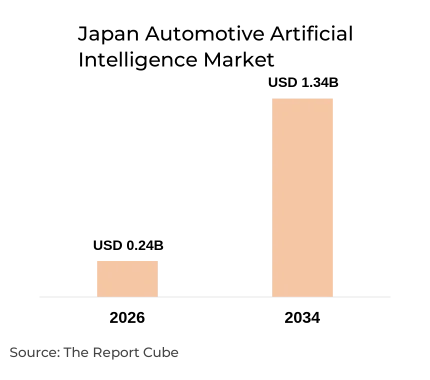
- Japan Automotive Artificial Intelligence Market valued at USD 0.24 billion in 2026, reflecting accelerating industry adoption.
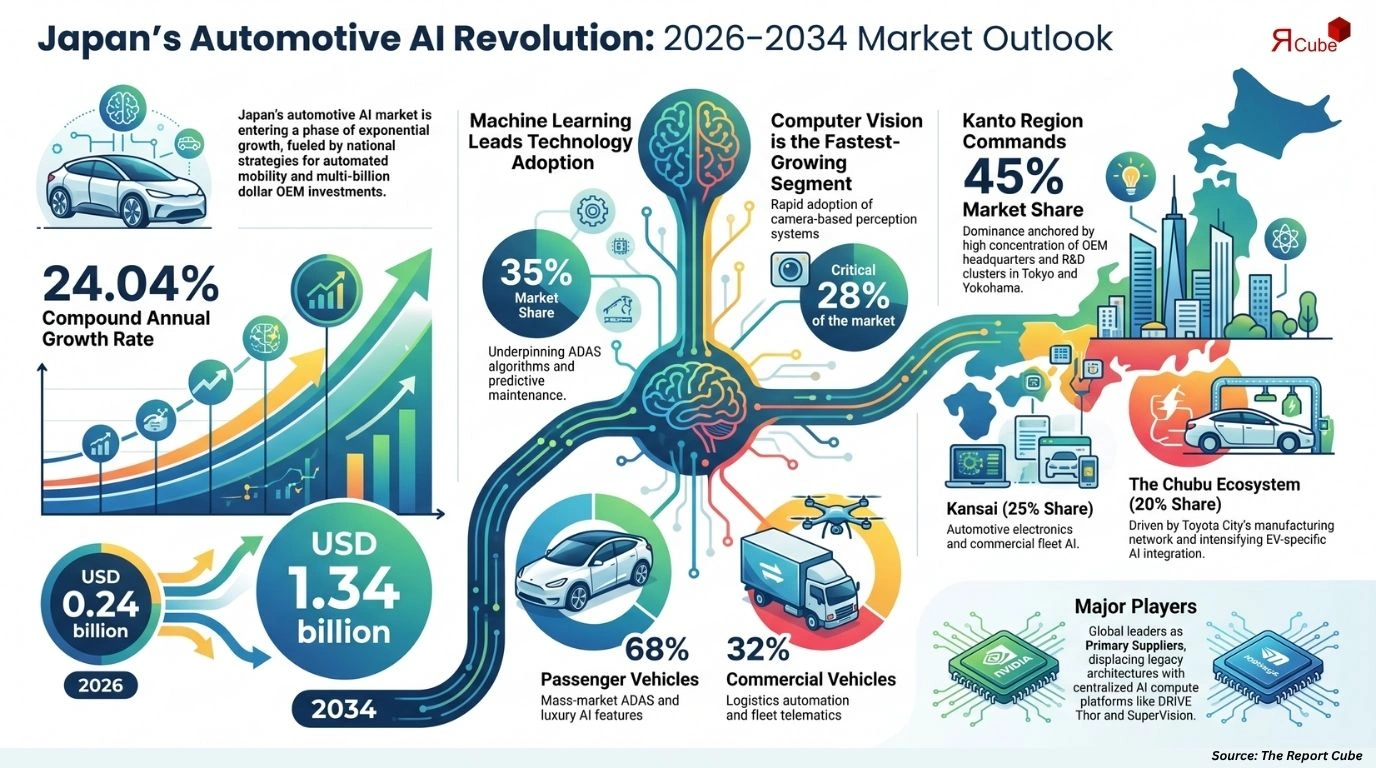
- Market projected to reach USD 1.34 billion by 2034, expanding at a 24.04% CAGR through the forecast period.
- Passenger vehicles lead the vehicle type segment driven by advanced driver assistance system integration.
- Machine learning dominates the technology segment as automakers prioritize predictive analytics deployment.
- Computer vision emerges as the fastest-growing technology segment across Japan's automotive AI landscape.
- NVIDIA Corporation, Mobileye, and Robert Bosch GmbH are leading automotive AI solution providers in Japan.
- Kanto region commands the largest share, anchored by major OEM headquarters and R&D cluster concentration.
- Autonomous driving development and connected vehicle infrastructure are reshaping Japan's automotive AI procurement.
Japan Automotive Artificial Intelligence Market Overview
A comprehensive Japan Automotive Artificial Intelligence Market analysis reveals a sector valued at USD 0.24 billion in 2026, projected to expand at a 24.04% CAGR through 2034. Accelerating deployment of advanced driver assistance systems (ADAS), growing OEM investment in autonomous driving R&D, and Japan's national strategy for connected and automated mobility are collectively sustaining robust demand for automotive AI technologies across passenger and commercial vehicle segments.
Japan's automotive ecosystem - anchored by globally dominant OEMs and Tier-1 suppliers - is rapidly integrating machine learning, computer vision, and natural language processing into vehicle platforms and manufacturing operations. Government-backed initiatives including the Strategic Innovation Promotion Program (SIP) for autonomous driving and Ministry of Land, Infrastructure, Transport and Tourism (MLIT) regulatory frameworks are creating structured pathways for AI-enabled mobility solutions, attracting leading global technology suppliers including NVIDIA Corporation, Mobileye, and Qualcomm Technologies Inc. into the market.
Japan Automotive Artificial Intelligence Market Size & Forecast
|
Metric |
Details |
|---|---|
|
Market Size (2026) |
USD 0.24 billion |
|
Market Size (2034) |
USD 1.34 Billion |
|
CAGR (2026–2034) |
24.04% |
|
Base Year |
2026 |
|
Historical Years |
2021–2025 |
|
Forecast Years |
2026–2034 |
The Japan Automotive Artificial Intelligence Market size was valued at USD 0.24 billion in 2026 and is projected to reach USD 1.34 billion by 2034, advancing at a 24.04% CAGR. This exceptional expansion rate is differentiated by Japan's concurrent pursuit of Level 3 and Level 4 autonomous vehicle commercialization, positioning the country among Asia Pacific's most structurally intensive automotive AI deployment environments.
Japan Automotive Artificial Intelligence Market Dynamics
Japan's automotive AI sector is advancing at an accelerated pace as OEMs, Tier-1 suppliers, and global technology firms converge on shared autonomous and connected vehicle development agendas. Rising regulatory clarity around autonomous driving, expanding vehicle electrification programs, and deepening collaboration between automotive and semiconductor industries are collectively reinforcing Japan Automotive Artificial Intelligence Market growth momentum through 2034.
|
Factor |
Type |
Specific Impact on Market |
Magnitude |
|---|---|---|---|
|
ADAS and autonomous driving investment surge |
Driver |
Accelerates automotive AI hardware and software procurement across OEM supply chains |
High |
|
Government autonomous mobility programs |
Driver |
Provides regulatory frameworks and public R&D funding that de-risk AI technology deployment |
High |
|
Semiconductor supply chain disruptions |
Challenge |
Restricts availability of AI processing chips critical to automotive system integration timelines |
Medium |
|
Expansion into commercial vehicle AI applications |
Opportunity |
Opens new procurement channels for fleet management, logistics automation, and telematics AI |
High |
|
Ethical AI and data privacy requirements |
Trend |
Reshapes software architecture and data handling standards across connected vehicle platforms |
Medium |
- Growth Drivers: Accelerating ADAS and Autonomous Driving Investments: Japanese OEMs including Toyota, Honda, and Nissan have committed multi-billion-dollar investments to ADAS integration and autonomous vehicle R&D, directly increasing procurement of AI processors, computer vision modules, and machine learning platforms from suppliers such as NVIDIA Corporation and Mobileye.
- Market Opportunities: Commercial Vehicle AI Adoption: Logistics automation, last-mile delivery optimization, and fleet telematics present expanding opportunities for automotive AI across Japan's commercial vehicle sector. Companies including Robert Bosch GmbH and Aptiv are actively developing AI-driven fleet management solutions targeting Japan's road freight and urban delivery operators through 2034.
- Industry Challenges: Regulatory and Liability Complexity: Japan's evolving legal framework for autonomous vehicle operation - including liability attribution in AI-assisted accident scenarios - creates uncertainty for OEMs and technology suppliers. Reconciling domestic MLIT guidelines with emerging international standards adds compliance complexity and lengthens product certification cycles across automotive AI deployments.
Japan Automotive Artificial Intelligence Market Trends
- Emerging Trends: Japan Automotive Artificial Intelligence Market trends reflect deepening convergence between vehicle electrification and AI integration, with EV platforms increasingly serving as primary deployment environments for machine learning-based energy management, predictive battery diagnostics, and intelligent charging optimization across passenger and commercial segments.
- Technology Trends: Edge AI computing architectures and in-vehicle AI chips purpose-built for automotive workloads are gaining rapid adoption. NVIDIA's DRIVE platform and Qualcomm's Snapdragon Ride are displacing legacy ECU-based control architectures, enabling real-time sensor fusion, object recognition, and autonomous path planning at the vehicle level.
- Consumer / Buyer Trends: Japanese automotive buyers demonstrate growing acceptance of AI-enhanced safety and convenience features, including lane-keeping assistance, adaptive cruise control, and AI-powered voice interfaces. OEM procurement teams increasingly mandate AI supplier certification, explainability standards, and functional safety compliance under ISO 26262 as baseline sourcing requirements.
Need Specific Data, Let’s Customize the Report for You
Request CustomizationJapan Automotive Artificial Intelligence Market Segment Analysis
Japan's automotive AI market serves distinct vehicle categories and technology application layers, each shaped by unique R&D investment priorities, OEM adoption timelines, and regulatory deployment environments. Understanding Japan Automotive Artificial Intelligence Market share distribution across these segments informs both supplier positioning and investment allocation strategies through the 2034 forecast horizon.
By Vehicle Type
|
Vehicle Type |
Estimated Share (2026) |
Key Characteristics |
|---|---|---|
|
Passenger Vehicles |
68% |
Primary ADAS deployment platform; luxury and mass-market AI feature adoption |
|
Commercial Vehicles |
32% |
Growing fleet AI integration; logistics automation and telematics AI expansion |
Passenger vehicles command an estimated 68% share of Japan's automotive AI market in 2026, driven by widespread ADAS deployment across mass-market and premium vehicle lines. NVIDIA Corporation and Mobileye supply critical AI computing and vision processing platforms to Japanese OEM passenger vehicle programs. Commercial vehicles account for approximately 32% of demand, with Robert Bosch GmbH and Aptiv supplying AI-powered fleet management and safety systems to logistics and transportation operators across Japan's road freight network.
By Technology
|
Technology |
Estimated Share (2026) |
Key Characteristics |
|---|---|---|
|
Machine Learning |
35% |
Core AI layer for ADAS, predictive maintenance, and vehicle behavior modeling |
|
Computer Vision |
28% |
Rapid growth driven by perception systems, object detection, and camera-based ADAS |
|
Natural Language Processing |
16% |
Voice command interfaces and AI assistant integration in connected vehicle platforms |
|
Context-aware Computing |
13% |
Situational intelligence and adaptive driving behavior systems |
|
Others |
8% |
Includes reinforcement learning, edge AI frameworks, and specialized neural networks |
Machine learning leads the technology segment with an estimated 35% share in 2026, underpinning ADAS algorithms, predictive maintenance models, and autonomous path planning systems deployed across Japanese OEM platforms. NVIDIA Corporation and Qualcomm Technologies Inc. provide GPU and SoC infrastructure supporting machine learning workloads at scale. Computer vision, at approximately 28%, is the fastest-growing technology sub-segment as camera-based perception systems become standard across both passenger and commercial vehicle ADAS deployments, with Mobileye and Tesla supplying vision-processing architectures that are reshaping automotive AI system design in Japan.
Japan Automotive Artificial Intelligence Market Regional Analysis
|
Region |
Estimated Market Share |
Key Growth Factors |
Consumer Trends |
|---|---|---|---|
|
Kanto |
45% |
OEM HQ concentration, Tier-1 supplier clusters, R&D infrastructure density |
High ADAS adoption, premium AI feature demand, autonomous pilot programs |
|
Kansai |
25% |
Automotive electronics manufacturing, Osaka-Kobe industrial corridor activity |
Computer vision integration, commercial fleet AI deployment |
|
Chubu |
20% |
Toyota City ecosystem, supplier network density, advanced manufacturing activity |
Machine learning-driven vehicle program development, EV AI integration |
|
Others |
10% |
Regional logistics automation, expanding commercial vehicle AI applications |
Telematics AI adoption, context-aware computing deployment |
- Kanto - Accounting for approximately 45% of total Japan Automotive Artificial Intelligence Market demand, the Kanto region hosts the Japanese headquarters of global technology suppliers including NVIDIA and Qualcomm alongside domestic OEM R&D centers. Tokyo and Yokohama serve as primary commercialization hubs for connected vehicle AI platforms and autonomous driving pilot programs.
- Kansai - The Kansai corridor, representing approximately 25% of market demand, encompasses Japan's automotive electronics manufacturing ecosystem centered on Osaka and Kobe. The region drives computer vision component integration and supports commercial vehicle fleet AI deployment, with Panasonic Automotive and affiliated suppliers contributing to regional technology supply networks.
- Chubu - Anchored by Toyota City's globally significant automotive manufacturing ecosystem, Chubu commands approximately 20% of national automotive AI demand. Toyota's intensifying AI integration across its vehicle lineup - and its extensive local Tier-1 supplier network - creates concentrated procurement demand for machine learning platforms and EV-specific AI architectures.
- Others - Remaining regions including Tohoku, Kyushu, and Hokkaido collectively account for approximately 10% of market demand, driven by regional logistics automation investments, commercial vehicle AI deployments, and expanding government-supported smart mobility demonstration projects across secondary urban centers.
Japan Automotive Artificial Intelligence Market Share & Competitive Landscape
The Japan Automotive Artificial Intelligence Market's competitive landscape is defined by global technology leaders competing on chip architecture capability, software ecosystem depth, OEM partnership breadth, and autonomous driving validation track records. AI silicon providers, perception system specialists, and full-stack autonomous driving platform developers each occupy distinct but overlapping competitive positions across Japan's automotive supply chain.
|
Company |
Competitive Strength |
Primary Segment Served |
|---|---|---|
|
NVIDIA Corporation |
AI compute platforms, DRIVE ecosystem, GPU-accelerated training |
Passenger vehicles, OEM ADAS, autonomous driving |
|
Mobileye |
EyeQ chip series, computer vision, HD mapping |
Passenger vehicles, ADAS perception systems |
|
Qualcomm Technologies Inc. |
Snapdragon Ride SoC, 5G-V2X integration, cockpit AI |
Passenger and commercial vehicles, connected platforms |
|
Robert Bosch GmbH |
Sensor fusion, AI-powered safety systems, fleet telematics |
Commercial vehicles, ADAS, fleet management |
|
Aptiv |
Centralized compute architecture, AI software stack |
Commercial vehicles, full-vehicle intelligence platforms |
|
Tesla |
Autopilot/FSD neural network, end-to-end AI training |
Passenger vehicles, EV AI integration |
|
Ford Motor Company |
BlueCruise ADAS, AI-enhanced powertrain management |
Passenger and commercial vehicles |
|
Cruise LLC |
Autonomous vehicle AI stack, robotaxi operations |
Autonomous passenger vehicle deployment |
Key Companies in the Japan Automotive Artificial Intelligence Market
NVIDIA Corporation
NVIDIA Corporation, headquartered in Santa Clara, California, is the world's leading AI computing company with its DRIVE platform serving as the dominant automotive AI development environment globally. In 2025, NVIDIA deepened partnerships with Japanese OEMs including Toyota and Honda to deploy DRIVE Thor centralized compute platforms across next-generation vehicle architectures, reinforcing its position as the primary AI silicon supplier driving Japan's autonomous vehicle program acceleration.
Mobileye
Mobileye, headquartered in Jerusalem, Israel, and operating as an Intel subsidiary, is a global leader in computer vision and ADAS technology with its EyeQ chip series deployed across hundreds of vehicle models worldwide. In 2025, Mobileye expanded its collaboration with Japanese automakers on SuperVision camera-based autonomous driving systems, advancing perception AI deployment across both premium and volume passenger vehicle programs in the Japan Automotive Artificial Intelligence Market.
Japan Automotive Artificial Intelligence Market Recent Developments
|
Year |
Company |
Development |
|---|---|---|
|
2025 |
NVIDIA Corporation |
Announced expanded Japan OEM partnerships for DRIVE Thor deployment in next-generation Toyota and Honda vehicle platforms |
|
2025 |
Mobileye |
Extended SuperVision autonomous driving system collaboration with Japanese automakers for camera-based Level 2+ ADAS programs |
|
2025 |
Qualcomm Technologies Inc. |
Launched Snapdragon Ride Flex SoC targeting Japanese OEM cockpit-to-ADAS centralized compute platform programs |
Japan Automotive Artificial Intelligence Market Future Outlook
The Japan Automotive Artificial Intelligence Market forecast projects the sector reaching USD 1.34 billion by 2034, expanding at a 24.04% CAGR through the forecast period. Passenger vehicle AI adoption will deepen as Level 3 and Level 4 autonomous systems transition from pilot to commercial deployment. NVIDIA Corporation, Mobileye, and Qualcomm Technologies Inc. are expected to intensify Japan OEM engagement through dedicated platform development programs, local engineering support, and co-development agreements targeting next-generation vehicle architecture integration.
Technological advancement in edge AI processing, sensor fusion efficiency, and real-time V2X communication will progressively lower deployment barriers for both premium and mass-market automotive AI applications through 2034. Japan's regulatory evolution toward geofenced Level 4 autonomous operation will create structured commercial deployment pathways for Cruise LLC and Aptiv. Sustainable AI development practices - including energy-efficient inference hardware and responsible data governance frameworks - will become baseline requirements as Japanese OEMs align automotive AI procurement with broader corporate sustainability commitments.
Japan Automotive Artificial Intelligence Market Report Coverage
The Japan Automotive Artificial Intelligence Market Report provides comprehensive coverage of market sizing, competitive dynamics, technology segmentation, regional distribution, and future outlook across the 2026–2034 forecast period.
|
Report Attribute |
Details |
|---|---|
|
Market Name |
Japan Automotive Artificial Intelligence Market |
|
Market Size (2026) |
USD 0.24 billion |
|
Market Size (2034) |
USD 1.34 Billion |
|
Forecast Period |
2026–2034 |
|
CAGR |
24.04% |
|
Base Year |
2026 |
|
Historical Years |
2021–2025 |
|
Forecast Years |
2026–2034 |
|
Segments Covered |
By Component, By Level of Autonomy, By Vehicle Type, By Technology |
|
Regions Covered |
Kanto, Kansai, Chubu, Others |
|
Key Companies |
Aptiv, Cruise LLC, Mobileye, NVIDIA Corporation, Qualcomm Technologies Inc., Robert Bosch GmbH, Tesla, Ford Motor Company, Others |
|
Report Format |
PDF, Excel, PPT |
|
Customization |
Available as per client requirements |
Why Choose This Japan Automotive Artificial Intelligence Market Report?
- Comprehensive coverage of Japan's rapidly scaling automotive AI ecosystem across vehicle types and technology layers.
- Accurate market sizing from USD 0.24 billion in 2026 through the USD 1.34 billion 2034 forecast.
- Detailed segmentation by vehicle type (Passenger vs. Commercial) and five technology sub-categories.
- Regional insights covering Kanto, Kansai, Chubu, and other prefectures with estimated share data.
- Competitive profiling of 8 leading global automotive AI hardware, software, and platform suppliers.
- Analysis of autonomous driving regulatory developments reshaping Japan's OEM procurement decisions.
- Forecast data aligned with Japan's government autonomous mobility programs and SIP policy frameworks.
- Strategic intelligence supporting supplier partnership planning, market entry, and investment prioritization.
Table of Contents
- Introduction
- Objective of the Study
- Product Definition
- Market Segmentation
- Study Variables
- Research Methodology
- Secondary Data Points
- Companies Interviewed
- Primary Data Points
- Breakdown of Primary Interviews
- Secondary Data Points
- Executive Summary
- Market Dynamics
- Drivers
- Challenges
- Opportunity Assessment
- Recent Trends and Developments
- Policy and Regulatory Landscape
- Japan Automotive Artificial Intelligence Market Overview and Forecast Analysis (2021-2034)
- Market Size, By Value, By Growth Rate (CAGR/USD Billions)
- Demand – Supply Trends
- Market Share, By Component
- Hardware
- Software
- Market Share, By Level of Autonomy
- Level 1
- Level 2
- Level 3
- Level 4
- Market Share, By Vehicle Type
- Passenger Vehicles
- Commercial Vehicles
- Market Share, By Technology
- Machine Learning
- Natural Language Processing
- Computer Vision
- Context-aware Computing
- Others
- Market Share, By Region
- Kanto
- Kansai
- Chubu
- Others
- Market Share, By Competitors
- Competition Characteristics
- Revenue Shares
- Hardware Japan Automotive Artificial Intelligence Market Overview, 2021-2034F
- By Value (USD Million)
- By Level of Autonomy – Market Size & Forecast 2021-2034, USD Million
- Level 1
- Level 2
- Level 3
- Level 4
- Software Japan Automotive Artificial Intelligence Market Overview, 2021-2034F
- By Value (USD Million)
- By Level of Autonomy – Market Size & Forecast 2021-2034, USD Million
- Level 1
- Level 2
- Level 3
- Level 4
- Competitive Outlook (Company Profile - Partial List)
- Aptiv
- Company Overview
- Business Segments
- Strategic Alliances/Partnerships
- Recent Developments
- Cruise LLC
- Company Overview
- Business Segments
- Strategic Alliances/Partnerships
- Recent Developments
- Mobileye
- Company Overview
- Business Segments
- Strategic Alliances/Partnerships
- Recent Developments
- NVIDIA Corporation
- Company Overview
- Business Segments
- Strategic Alliances/Partnerships
- Recent Developments
- Qualcomm Technologies Inc.
- Company Overview
- Business Segments
- Strategic Alliances/Partnerships
- Recent Developments
- Robert Bosch GmbH
- Company Overview
- Business Segments
- Strategic Alliances/Partnerships
- Recent Developments
- Tesla
- Company Overview
- Business Segments
- Strategic Alliances/Partnerships
- Recent Developments
- Ford Motor Company
- Company Overview
- Business Segments
- Strategic Alliances/Partnerships
- Recent Developments
- Others
- Aptiv
- Contact Us & Disclaimer
Top Key Players & Market Share Outlook
- Aptiv
- Cruise LLC
- Mobileye
- NVIDIA Corporation
- Qualcomm Technologies Inc.
- Robert Bosch GmbH
- Tesla
- Ford Motor Company
- Others
Frequently Asked Questions






