



Build Your Custom Market Intelligence Report
Customize Your ReportIndia Automotive Lubricants Market Key Highlights
By Vehicle Type:
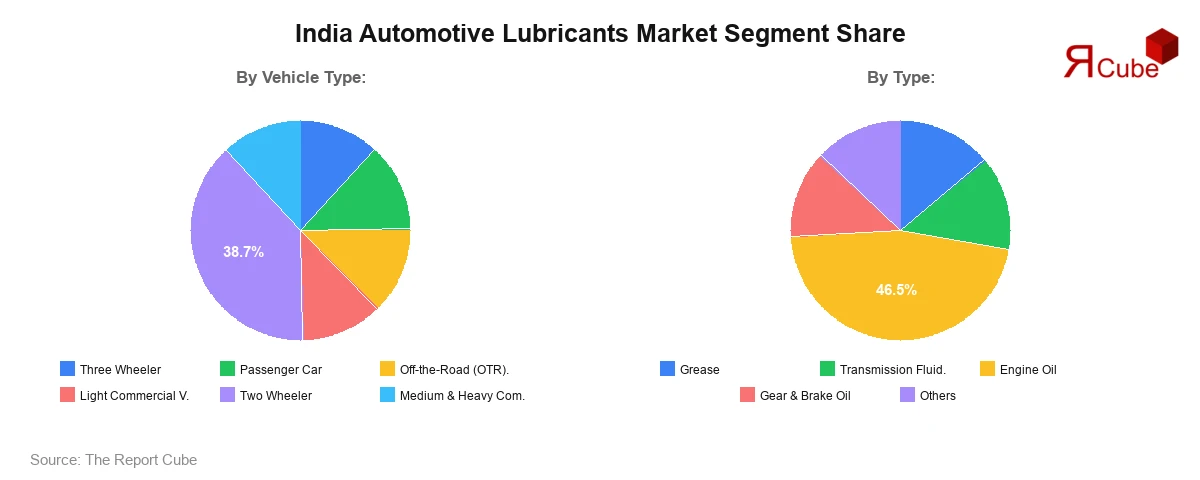
Two Wheeler segment leads the market with nearly 38.7% share.
By Type:
Engine Oil segment dominates the market with around 46.5% of revenue.
Regional Outlook:
South India region dominates the India Automotive Lubricants Market with approximately 31.8% share.
India Automotive Lubricants Market Insights & Analysis
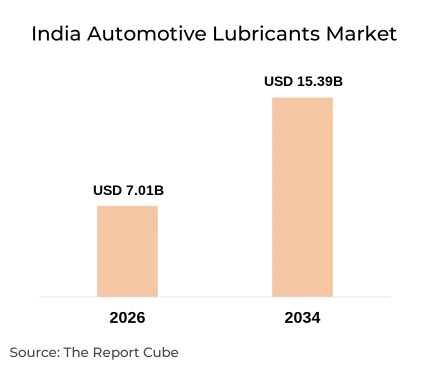
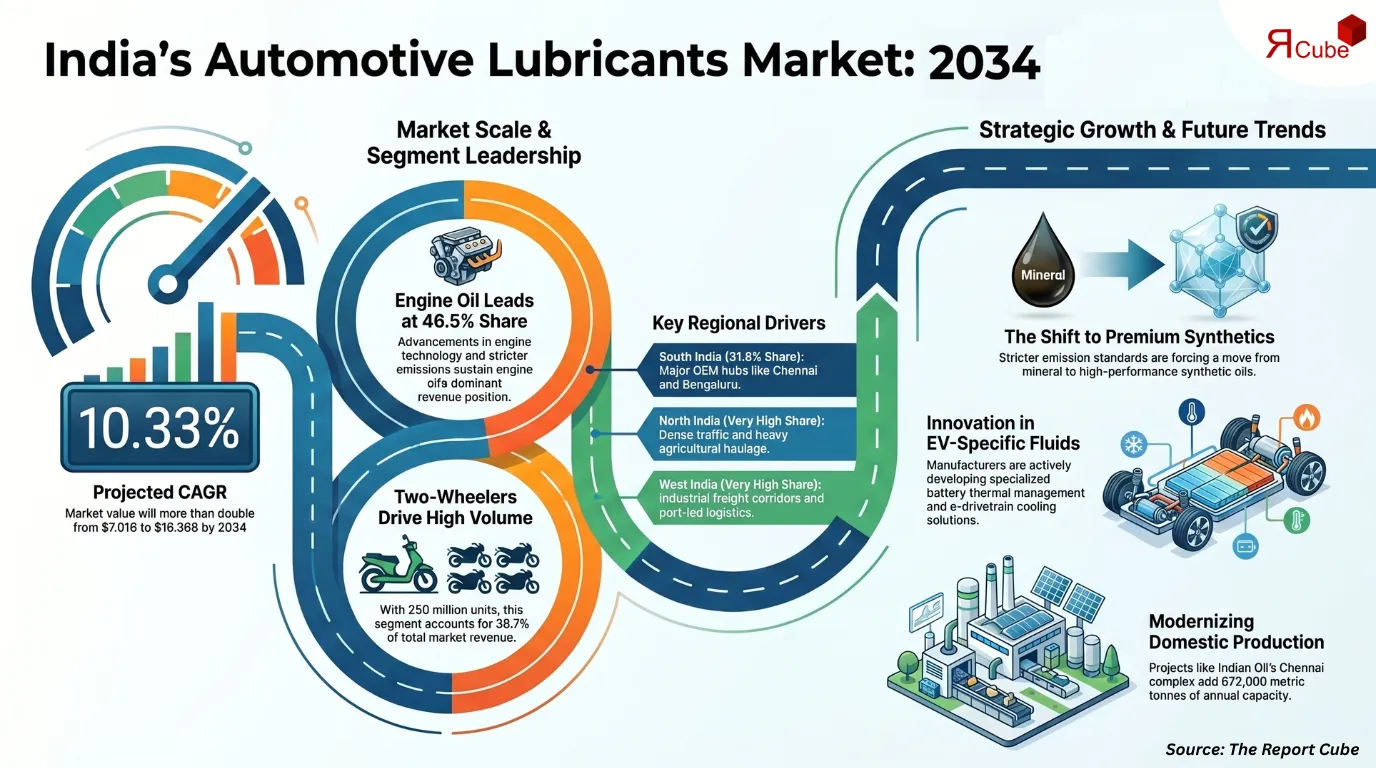
The India Automotive Lubricants Market is anticipated to register a CAGR of around 10.33% during the forecast period 2026-2034. The market size is valued at USD 7.01 Billion in 2026 and is projected to reach USD 15.39 Billion by 2034. Growth is being supported by India's position as one of the world's largest automobile production centers and a rapidly expanding transportation sector. Rising sales of passenger vehicles, commercial fleets, agricultural machinery, and two-wheelers continue to generate substantial lubricant consumption across the country. The automotive sector contributes significantly to lubricant demand, with engine oils accounting for nearly half of total lubricant consumption. Higher vehicle ownership, increasing freight movement, and growing replacement cycles are strengthening market expansion across both urban and rural regions.
Lubricants manufacturing in India is witnessing a period of substantial investment and modernization. Domestic producers and multinational companies are expanding blending facilities, introducing advanced synthetic formulations, and enhancing localized production capabilities to reduce import dependence. The commissioning of large-scale manufacturing projects, including Indian Oil's Chennai lubricant complex, reflects the industry's confidence in long-term demand growth. At the same time, rising adoption of Bharat Stage VI-compliant vehicles and evolving OEM specifications are encouraging the use of high-performance lubricants. Increasing focus on sustainability, energy-efficient formulations, and electric vehicle thermal management fluids is creating new avenues for innovation across the Indian lubricant manufacturing ecosystem.
India Automotive Lubricants Market Impact Analysis
| Factor | Type | Specific Impact on Market | Magnitude | Business Implication |
|---|---|---|---|---|
| Rising Vehicle Parc & Ownership | Market | Expanding two wheeler and car base lifts lubricant consumption | High | Supports long term growth in engine oil and related segments |
| Shift Toward Higher Quality Oils | Technological | Demand gradually moves from mineral to semi and full synthetics | High | Enables premium pricing and upgrade led portfolio positioning |
| OEM Drain Interval Extension | Regulatory | Longer recommended drains reduce service workshop visit counts | Medium | Requires volume protection through wider workshop and retail reach |
| Growth of Organized Service Channels | Competitive | Authorized workshops and quick service chains gain share in sales | Medium | Necessitates alliances and branded programs with key service networks |
| Electric Vehicle Adoption Outlook | Environmental | EV penetration gradually trims demand for engine focused lubricants | Low | Drives diversification into e drivetrain fluids and thermal products |
| Price Sensitivity in Mass Segments | Consumer | Large user base remains highly responsive to lubricant price moves | High | Requires tiered product ladder and tactical discount management |
| Presence of Global and Local Brands | Competitive | Intense brand rivalry shapes promotion intensity and trade margins | High | Demands differentiated branding and strong mechanic influencer focus |
India Automotive Lubricants Market Dynamics
Key Driver: Strong Expansion of India's Automotive Production Base
India's automotive industry continues to serve as the foundation for growth in the India Automotive Lubricants Market. The country remains among the largest global producers of two-wheelers, passenger vehicles, and commercial vehicles, creating a vast installed vehicle base that requires regular maintenance and lubricant replacement. Every stage of vehicle ownership, from factory fill applications to periodic servicing, contributes to lubricant consumption. Growing demand for mobility, rising disposable incomes, and expanding road infrastructure are supporting sustained growth in vehicle registrations across multiple segments.
In addition, government-led manufacturing initiatives and investments in automotive production facilities are increasing lubricant demand within OEM operations. Automotive manufacturing clusters located in Tamil Nadu, Maharashtra, Karnataka, Gujarat, and Haryana generate substantial consumption of industrial and automotive lubricants. The expanding vehicle parc across India ensures recurring aftermarket demand, making lubricant consumption less dependent on new vehicle sales alone. This combination of manufacturing strength and vehicle usage patterns continues to support long-term market growth.
Industry Trends: Shift Toward Premium Lubricants and EV Fluid Technologies
Product innovation is becoming a defining characteristic of the India Automotive Lubricants Market. Vehicle manufacturers are increasingly recommending premium-grade synthetic and semi-synthetic lubricants capable of delivering superior thermal stability, engine cleanliness, and fuel economy benefits. Modern engines operating under stricter emission standards require advanced lubricant formulations that can withstand higher temperatures and extended service intervals. As a result, premium lubricant categories are gaining market share across passenger and commercial vehicle segments.
Another significant industry trend involves the development of specialized fluids for electric mobility applications. Although internal combustion vehicles continue to dominate the Indian vehicle fleet, lubricant manufacturers are actively preparing for future demand by investing in EV-specific cooling fluids, battery thermal management solutions, and transmission lubricants. Shell's EV-Plus Thermal Fluid technology demonstrates how suppliers are adapting product portfolios to support evolving vehicle architectures. These developments are expected to broaden the scope of lubricant applications beyond traditional engine oils over the coming decade.
Book your FREE 30-minute expert consultation today
Contact UsMajor Challenge: Market Transition and Raw Material Volatility
One of the key challenges facing the India Automotive Lubricants Market is the gradual transition toward electrified mobility. Electric vehicles require fewer conventional lubricant products compared to internal combustion engine vehicles, which may influence future demand patterns for engine oils. While EV penetration remains relatively modest within the overall vehicle population, manufacturers are already adapting business strategies to address changing technology requirements.
Another challenge stems from fluctuations in crude oil and base oil prices, which directly impact lubricant manufacturing costs. India continues to depend on imported crude oil for a substantial portion of its energy requirements, making the industry sensitive to global supply disruptions and pricing volatility. Changes in raw material costs can affect profit margins, pricing strategies, and procurement planning. Manufacturers are increasingly focusing on operational efficiency, local sourcing initiatives, and premium product offerings to mitigate these risks.
Opportunity: Expanding Lubricants Manufacturing and Aftermarket Networks
India presents significant opportunities for lubricant manufacturers due to the ongoing expansion of service networks, vehicle ownership, and localized production capabilities. The country's large and aging vehicle fleet creates continuous demand for replacement lubricants, particularly through independent workshops, garages, and retail distribution channels. Rising awareness regarding preventive maintenance is encouraging consumers to use higher-quality lubricant products that improve vehicle performance and longevity.
Simultaneously, lubricants manufacturing in India is receiving substantial investments aimed at strengthening domestic production capacity. New blending plants, specialty lubricant facilities, and advanced formulation centers are enabling manufacturers to serve both domestic and export markets more effectively. The combination of industrial expansion, infrastructure development, and increasing automotive activity positions India as one of the most attractive lubricant markets globally. Companies capable of delivering premium, sustainable, and application-specific lubricant solutions are expected to benefit significantly during the forecast period.
India Automotive Lubricants Market Segment-wise Analysis
By Vehicle Type:
- Three Wheeler
- Passenger Car
- Off-the-Road (OTR) Vehicle
- Light Commercial Vehicle
- Two Wheeler
- Medium & Heavy Commercial Vehicle
The Two Wheeler segment continues to dominate the India Automotive Lubricants Market, accounting for approximately 38.7% of total revenue in 2026. India's two-wheeler population exceeds 250 million units, making it the largest vehicle category in the country. Motorcycles and scooters serve as the primary mode of transportation for a significant portion of the population, particularly in semi-urban and rural regions. Frequent vehicle usage and shorter lubricant replacement intervals contribute to consistent demand for engine oils and related products.
The segment also benefits from growing motorcycle ownership among younger consumers, increasing delivery service operations, and expanding mobility requirements. Leading lubricant manufacturers have developed specialized motorcycle lubricant portfolios designed to improve fuel efficiency, engine protection, and riding performance under Indian operating conditions. With two-wheelers expected to remain the backbone of personal mobility, lubricant consumption from this segment is projected to maintain a leading position throughout the forecast period.
By Type:
- Transmission Fluid
- Grease
- Engine Oil
- Gear & Brake Oil
- Others
Engine Oil remains the largest product category within the India Automotive Lubricants Market, representing approximately 46.5% of total market revenue. Engine oil plays a critical role in reducing friction, minimizing wear, controlling deposits, and maintaining engine efficiency across all vehicle categories. Demand remains particularly strong in passenger cars, commercial vehicles, agricultural machinery, and motorcycles, which collectively account for a substantial share of lubricant consumption nationwide.
Recent advancements in engine technology and stricter emission requirements have accelerated the transition toward high-performance lubricant formulations. Consumers are increasingly selecting synthetic and semi-synthetic engine oils that offer extended drain intervals and improved fuel economy. Manufacturers continue to introduce advanced products aligned with OEM specifications, reinforcing engine oil's dominant position within the overall lubricant industry. Strong replacement demand and recurring maintenance requirements are expected to sustain segment leadership through 2034.
Regional Projection of India Automotive Lubricants Industry
- North India
- South India
- West India
- East India
- Central India
South India holds the largest share of the India Automotive Lubricants Market, accounting for nearly 31.8% of total revenue. The region hosts some of India's most important automotive manufacturing hubs, including Chennai, Bengaluru, and Hosur. Tamil Nadu alone contributes significantly to national vehicle production and has earned recognition as one of the country's leading automotive manufacturing centers. The concentration of OEM facilities, component suppliers, and industrial operations creates substantial demand for both automotive and industrial lubricants.
The region also benefits from strong transportation infrastructure, growing logistics activities, and a well-developed service network. Significant investments in lubricant manufacturing facilities, including Indian Oil's integrated lubricant complex in Chennai, further strengthen South India's strategic importance. Rising vehicle ownership, expanding freight transportation, and increasing industrialization are expected to support continued growth in lubricant consumption across the region throughout the forecast period.
Need insights for a specific region within this market?
Request Regional DataIndia Automotive Lubricants Market Regional Analysis
The India automotive lubricants market differs across regions with varied vehicle mix, road density, and industrial base.
| Region | Demand Level | Key Areas | System Dominance | Core Demand Logic | Growth Nature |
|---|---|---|---|---|---|
| North India | Very High | Delhi NCR, Punjab, Haryana | PV, CV and tractor lubes | Dense traffic and agri haulage | Volume-led, fleet driven |
| South India | High | Chennai, Bengaluru, Hyderabad | 2W, PV and OEM workshop lubes | High 2W park and tech commuters | Premiumization and synthetics |
| West India | Very High | Mumbai, Pune, Gujarat belt | CV, industrial and port led lubes | Freight corridors and industry | Freight and infra linked |
| East India | Medium | Kolkata, Odisha, Assam | CV and 2W value lubes | Long haul routes and price focus | Upgrade from entry grade |
| Central India | Medium | MP, Chhattisgarh belts | Tractor and CV engine oils | Rural mobility and mining flows | Agri and mining cyclical |
Government Initiatives & Policies
- PM E-DRIVE Scheme (2025): The Government of India expanded support for electric mobility through incentive programs promoting EV adoption, charging infrastructure, and advanced mobility technologies. The initiative indirectly encourages development of specialized EV fluids and thermal management lubricants.
- Production Linked Incentive (PLI) Scheme for Automobile and Auto Components (2025-2026): The scheme continues to support domestic automotive manufacturing investments, advanced automotive technologies, and localization efforts, strengthening long-term demand for automotive lubricants across OEM and aftermarket channels.
India Automotive Lubricants Industry Recent Developments
- 2025: Shell India successfully demonstrated its EV-Plus Thermal Fluid technology, an advanced single-fluid thermal management solution capable of cooling batteries, electric motors, and power electronics. The innovation supports enhanced battery efficiency and reflects the industry's growing focus on EV-specific lubricant technologies.
- 2025: Indian Oil Corporation Limited commenced trial operations at its integrated lubricant manufacturing complex in Manali, Chennai. Developed with an investment of approximately INR 1,400 crore, the facility can produce 672,000 metric tonnes annually, strengthening domestic lubricant manufacturing capacity and supply chain resilience.
Why Choose This Report?
- Provides a comprehensive overview of the overall market analysis, encompassing key trends, consumer behavior analysis, and risk assessment to support strategic decision-making.
- Provides accurate, up-to-date insights into market size, segmentation, and emerging opportunities, helping to minimize risk & capitalizing on growth.
- Gives deep understanding of target audience preferences, investment habits, and communication channels for enhanced product development & marketing effectiveness.
- Delivers competitive analysis & benchmarking, uncovering the strengths & weaknesses of market competitors to guide strategies.
- Consolidate comprehensive market intelligence, reducing reasoning & streamlining research efforts.
- Facilitates customized market segmentation & risk mitigation strategies, fine-tuned to the business objectives.
- Aids in identifying both market challenges & untapped opportunities within the industry to drive long-term business growth.
- Provides valuable information based on actual customer data & search trends.
Table of Contents
- Introduction
- Objective of the Study
- Product and Category Definition
- Market Segmentation
- Study Variables
- Research Methodology
- Secondary Data Points
- Breakdown of Secondary Sources
- Primary Data Points
- Breakdown of Primary Interviews
- Secondary Data Points
- Executive Summary
- Market Dynamics
- Emerging Opportunities
- Adoption Trends
- Demand Drivers
- Disruption Analysis (Challenges)
- Industry Analysis & Strategic Insights
- Supply/Value Chain Analysis
- Pricing Analysis
- Go-To-Market (GTM) Strategy
- BCG Matrix
- Recent Trends and Developments
- Import and Export Analysis
- Regulatory and Policy Landscape
- Region-wise Policies
- Government Initiatives
- India Automotive Lubricants Market Overview and Forecast Analysis (2021-2034)
- Market Size, By Value, By Growth Rate (CAGR/USD Billion)
- Market Share, By Vehicle Type
- Three Wheeler
- Passenger Car
- Off-the-Road (OTR) Vehicle
- Light Commercial Vehicle
- Two Wheeler
- Medium & Heavy Commercial Vehicle
- Market Share, By Type
- Transmission Fluid
- Grease
- Engine Oil
- Gear & Brake Oil
- Others
- Market Share, By Base Oil
- Bio-Based
- Mineral
- Semi-Synthetic
- Synthetic
- Market Share, By Demand Category
- Independent Aftermarket (IA)
- OEM
- OES
- Market Share, By Sales Channel
- Retailers
- Online
- Workshops & Garages
- Authorized Dealers
- Market Share, By Region
- North
- South
- West
- East
- Central
- Market Share, By Company
- Revenue Shares & Analysis
- Competitive Landscape
- North India Automotive Lubricants Market Overview and Forecast Analysis (2021-2034)
- Market Size, By Value, By Growth Rate (CAGR/USD Billion/Million)
- Market Share, By Vehicle Type
- Market Share, By Type
- Market Share, By Base Oil
- Market Share, By Demand Category
- Market Share, By Sales Channel
- South India Automotive Lubricants Market Overview and Forecast Analysis (2021-2034)
- Market Size, By Value, By Growth Rate (CAGR/USD Billion/Million)
- Market Share, By Vehicle Type
- Market Share, By Type
- Market Share, By Base Oil
- Market Share, By Demand Category
- Market Share, By Sales Channel
- West India Automotive Lubricants Market Overview and Forecast Analysis (2021-2034)
- Market Size, By Value, By Growth Rate (CAGR/USD Billion/Million)
- Market Share, By Vehicle Type
- Market Share, By Type
- Market Share, By Base Oil
- Market Share, By Demand Category
- Market Share, By Sales Channel
- East India Automotive Lubricants Market Overview and Forecast Analysis (2021-2034)
- Market Size, By Value, By Growth Rate (CAGR/USD Billion/Million)
- Market Share, By Vehicle Type
- Market Share, By Type
- Market Share, By Base Oil
- Market Share, By Demand Category
- Market Share, By Sales Channel
- Central India Automotive Lubricants Market Overview and Forecast Analysis (2021-2034)
- Market Size, By Value, By Growth Rate (CAGR/USD Billion/Million)
- Market Share, By Vehicle Type
- Market Share, By Type
- Market Share, By Base Oil
- Market Share, By Demand Category
- Market Share, By Sales Channel
- Competitive Analysis, 2026
- Market Share of Key Players
- Competitive Mapping for Each Segment and Companies Operating Regionally
- North India Automotive Lubricants Companies Share & Competitive Analysis, 2026
- South India Automotive Lubricants Companies Share & Competitive Analysis, 2026
- West India Automotive Lubricants Companies Share & Competitive Analysis, 2026
- East India Automotive Lubricants Companies Share & Competitive Analysis, 2026
- Central India Automotive Lubricants Companies Share & Competitive Analysis, 2026
- Company Profile (Partial List)
- Shell India
- Company Overview
- Product Portfolio
- Strategic Alliances/Partnerships
- Recent Developments
- Indian Oil
- Company Overview
- Product Portfolio
- Strategic Alliances/Partnerships
- Recent Developments
- ExxonMobil
- Company Overview
- Product Portfolio
- Strategic Alliances/Partnerships
- Recent Developments
- Tide Water Oil
- Company Overview
- Product Portfolio
- Strategic Alliances/Partnerships
- Recent Developments
- Valvoline Cummins
- Company Overview
- Product Portfolio
- Strategic Alliances/Partnerships
- Recent Developments
- Bharat Petroleum
- Company Overview
- Product Portfolio
- Strategic Alliances/Partnerships
- Recent Developments
- Castrol
- Company Overview
- Product Portfolio
- Strategic Alliances/Partnerships
- Recent Developments
- Gulf Oil Lubricants
- Company Overview
- Product Portfolio
- Strategic Alliances/Partnerships
- Recent Developments
- Hindustan Petroleum
- Company Overview
- Product Portfolio
- Strategic Alliances/Partnerships
- Recent Developments
- Others (Partial List)
- Shell India
- Contact Us and Disclaimer
Top Key Players & Market Share Outlook
- Shell India
- Indian Oil
- ExxonMobil
- Tide Water Oil
- Valvoline Cummins
- Bharat Petroleum
- Castrol
- Gulf Oil Lubricants
- Hindustan Petroleum
- Others
Frequently Asked Questions






