



Build Your Custom Market Intelligence Report
Customize Your ReportGlobal Two-Wheeler Market Insights & Analysis
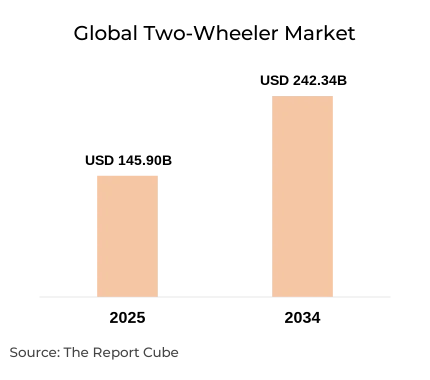
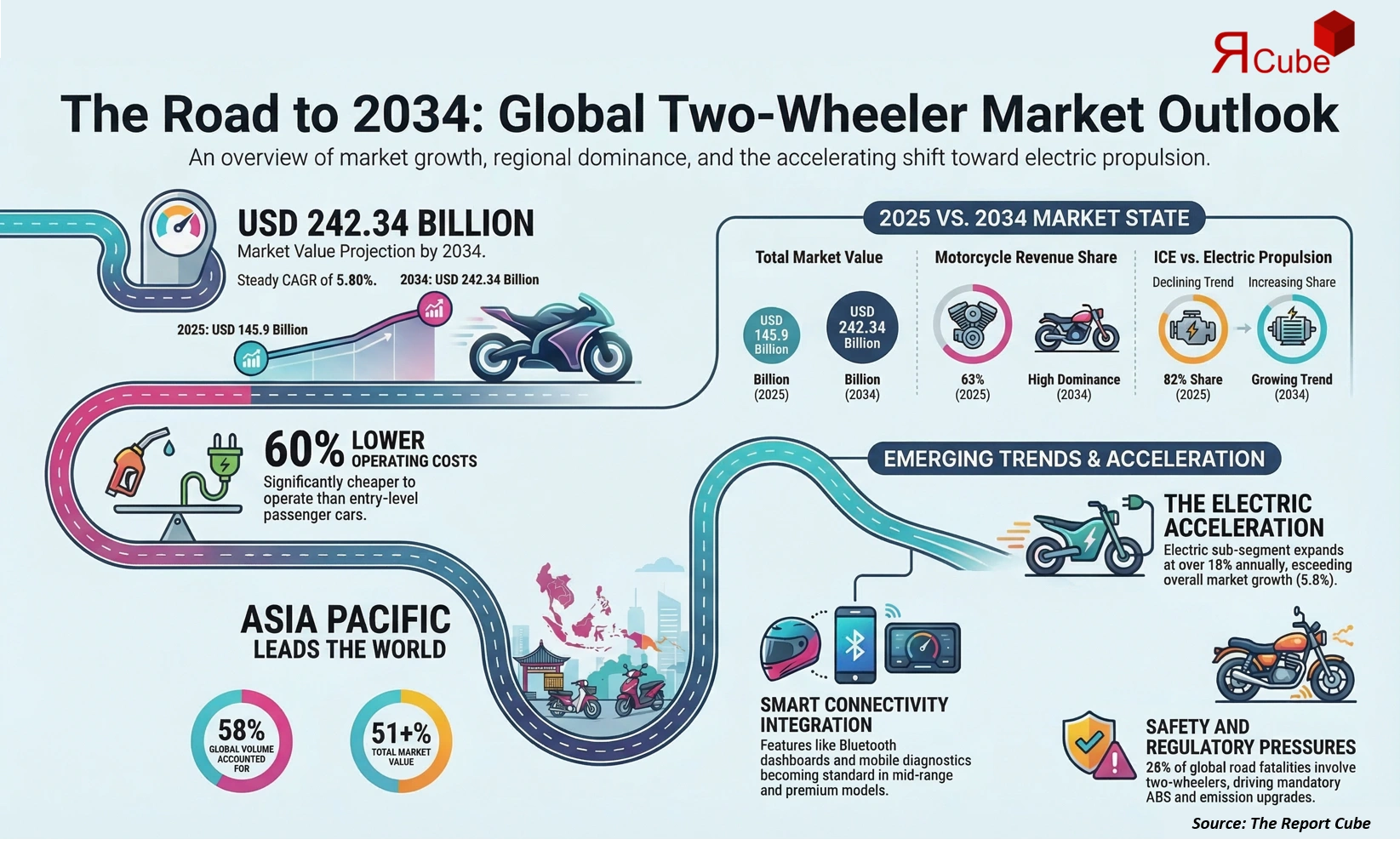
The Global Two-Wheeler Market is anticipated to register a CAGR of 5.80% during the forecast period 2026-2034. The market size was valued at USD 145.9 billion in 2025 and is projected to reach USD 242.34 billion by 2034. This sustained growth reflects the rising dependence on affordable personal mobility, especially in densely populated and emerging economies. Two-wheelers continue to serve as a practical transportation solution due to lower purchase costs, fuel efficiency, and ease of navigation in congested urban environments. Motorcycles and scooters remain integral to daily commuting, logistics, and last-mile connectivity, particularly in Asia Pacific, which accounts for a significant portion of global volume demand.
Beyond basic mobility, evolving consumer preferences are reshaping the market landscape. Demand for sport motorcycles, premium cruisers, and lifestyle-oriented touring bikes has increased steadily in developed regions, supported by rising disposable incomes and recreational riding culture. At the same time, urban commuters increasingly favor lightweight scooters and electric two-wheelers due to convenience, low maintenance, and regulatory support. Technological progress in engine efficiency, safety features, and digital connectivity has further enhanced product appeal. Combined with supportive government policies promoting cleaner mobility and reduced emissions, these factors are creating a diversified and resilient global two-wheeler ecosystem through 2034.
Global Two-Wheeler Market Recent Developments
- 2025: Honda Motor Company introduced new hybrid-compatible motorcycle platforms targeting fuel efficiency and urban commuters.
- 2025: TVS Motor Company expanded its electric scooter production capacity to meet rising domestic and export demand.
Government Initiatives & Policies
- India FAME II Scheme: Incentivizes electric two-wheelers through subsidies and charging infrastructure support.
- EU Fit for 55 Package: Encourages low-emission mobility solutions, including electric two-wheelers.
Global Two-Wheeler Market Dynamics
Key Driver: Rising Urbanization and Cost-Effective Mobility Demand
Rapid urbanization remains a core growth driver for the two-wheeler market, particularly across Asia Pacific, Latin America, and parts of Africa. Over 56% of the global population now lives in urban areas, creating persistent congestion and increasing demand for agile, space-efficient transportation. Two-wheelers offer operating costs nearly 60% lower than entry-level passenger cars, making them highly attractive to middle-income consumers. Growth in ride-hailing, food delivery, and courier services has further boosted fleet demand for motorcycles and scooters. These use cases reinforce steady volume sales and recurring replacement demand across both ICE and electric categories.
Major Challenge: Safety Concerns and Regulatory Pressures
Safety concerns represent a major challenge for the global two-wheeler market. According to international road safety data, two-wheelers account for nearly 28% of global road fatalities, prompting stricter safety regulations. Governments are increasingly mandating features such as anti-lock braking systems, combined braking systems, and enhanced emission standards. While these regulations improve rider safety and environmental outcomes, they also raise manufacturing costs and retail prices. In price-sensitive markets, higher upfront costs can delay purchase decisions, particularly for entry-level commuters, impacting short-term demand elasticity.
Industry Trends: Electrification and Smart Connectivity Integration
Electrification is a defining trend shaping the future of the two-wheeler industry. Electric scooters and electric motorcycles are gaining traction due to lower running costs and favorable policy support. Electric two-wheelers now represent approximately 12% of new registrations in select Asian markets, up from just 4% five years ago. Simultaneously, smart connectivity features such as Bluetooth-enabled dashboards, navigation support, theft alerts, and mobile diagnostics are becoming standard in mid- and premium-range models. These innovations enhance user experience and brand differentiation while aligning with digitally savvy consumers.
Opportunity Ahead: Premiumization and Export Expansion
The growing appetite for premium and lifestyle-oriented motorcycles presents a strong opportunity for manufacturers. Segments such as cruisers, sport bikes, and touring motorcycles are expanding at over 7% annually in North America and Europe. Emerging-market brands are also increasing exports to developed regions by offering competitively priced, feature-rich models. Additionally, improving financing availability and digital retail platforms are expanding access to higher-value two-wheelers. These developments create long-term revenue opportunities beyond traditional commuter segments.
Global Two-Wheeler Market Segment-wise Analysis
By Vehicle Type:
- Motorcycles (Standard or Commuter, Sport, Cruiser, Touring, Off-road or Dual-sport)
- Scooters (Standard Scooters, Maxi Scooters, Mopeds)
- Electric Two-Wheelers (E-Scooters or E-Mopeds, E-Motorcycles)
Motorcycles remain the dominant vehicle type, accounting for approximately 63% of global market revenue in 2025. Standard or commuter motorcycles lead this segment due to their affordability, durability, and suitability for daily commuting and commercial use. Sport and cruiser motorcycles contribute higher margins, especially in developed markets. Electric two-wheelers, while smaller in absolute share, are the fastest-growing sub-segment, expanding at over 18% annually, driven by urban usage, delivery services, and favorable incentive structures.
By Propulsion:
- Internal Combustion Engine (ICE)
- Electric
The ICE segment continues to dominate with nearly 82% market share in 2025, supported by established infrastructure and consumer familiarity. However, electric propulsion is gaining rapid momentum, particularly in urban centers. Electric two-wheelers benefit from lower operating costs, reduced maintenance, and zero tailpipe emissions. Battery price declines of nearly 35% over the past six years have improved affordability, accelerating adoption and gradually reshaping the propulsion mix.
Regional Projection of Global Two-Wheeler Industry
- Asia Pacific
- Europe
- North America
- Latin America
- Middle East and Africa
Asia Pacific leads the global two-wheeler market, accounting for approximately 58% of total volume and over 51% of market value in 2025. High population density, expanding urban centers, and strong commuter demand in countries such as India, China, Indonesia, and Vietnam underpin regional dominance. Europe and North America represent mature but profitable markets, driven by premium motorcycles and electric scooters. Latin America and the Middle East and Africa show steady growth, supported by improving road infrastructure and rising middle-class populations.
Why Choose This Report?
- Provides a comprehensive overview of the overall market analysis, encompassing key trends, consumer behavior analysis, and risk assessment to support strategic decision-making.
- Provides accurate, up-to-date insights into market size, segmentation, and emerging opportunities, helping to minimize risk & capitalizing on growth.
- Gives deep understanding of target audience preferences, investment habits, and communication channels for enhanced product development & marketing effectiveness.
- Delivers competitive analysis & benchmarking, uncovering the strengths & weaknesses of market competitors to guide strategies.
- Consolidate comprehensive market intelligence, reducing reasoning & streamlining research efforts.
- Facilitates customized market segmentation & risk mitigation strategies, fine-tuned to the business objectives.
- Aids in identifying both market challenges & untapped opportunities within the industry to drive long-term business growth.
- Provides valuable information based on actual customer data & search trends.
Table of Contents
- Introduction
- Objective of the Study
- Product and Category Definition
- Market Segmentation
- Study Variables
- Research Methodology
- Secondary Data Points
- Breakdown of Secondary Sources
- Primary Data Points
- Breakdown of Primary Interviews
- Secondary Data Points
- Executive Summary
- Market Dynamics
- Drivers
- Challenges
- Opportunity Assessment
- Recent Trends and Developments
- Regulatory and Policy Landscape
- Global Two-Wheeler Market Overview (2020-2034)
- Market Size, By Value (USD Billion)
- Market Size, By Volume (Units)
- Market Share, By Vehicle Type
- Motorcycles
- Standard or Commuter
- Sport
- Cruiser
- Touring
- Off‑road or Dual‑sport
- Scooters
- Standard Scooters
- Maxi Scooters
- Mopeds
- Electric Two‑Wheelers
- E‑Scooters or E‑Mopeds
- E‑Motorcycles
- Motorcycles
- Market Share, By Propulsion
- Internal Combustion Engine (ICE)
- Electric
- Market Share, By Engine Capacity (ICE)
- Up to 125 cc
- 126-250 cc
- 251-500 cc
- Above 500 cc
- Market Share, By Price Segment
- Economy
- Mid‑range
- Premium
- Market Share, By End User
- Personal or Household Use
- Commercial Use
- Market Share, By Region
- Asia Pacific
- Europe
- North America
- Latin America
- Middle East and Africa
- Market Share, By Company
- Revenue Shares
- Unit Sales Shares
- Competitive Landscape
- Asia Pacific Two-Wheeler Market
- Market Size, By Value (USD Billion)
- Market Size, By Volume
- Market Share, By Vehicle Type
- Market Share, By Propulsion
- Market Share, By Engine Capacity
- Market Share, By Price Segment
- Market Share, By End User
- Market Share, By Region/Country Group
- Market Share, By Country
- China
- India
- Japan
- Indonesia
- Vietnam
- Thailand
- Rest of Asia Pacific
- Europe Two-Wheeler Market
- Market Size, By Value (USD Billion)
- Market Size, By Volume
- Market Share, By Vehicle Type
- Market Share, By Propulsion
- Market Share, By Engine Capacity
- Market Share, By Price Segment
- Market Share, By End User
- Market Share, By Region/Country Group
- Market Share, By Country
- Germany
- France
- United Kingdom
- Italy
- Spain
- Netherlands
- Rest of Europe
- North America Two-Wheeler Market
- Market Size, By Value (USD Billion)
- Market Size, By Volume
- Market Share, By Vehicle Type
- Market Share, By Propulsion
- Market Share, By Engine Capacity
- Market Share, By Price Segment
- Market Share, By End User
- Market Share, By Region/Country Group
- Market Share, By Country
- United States
- Canada
- Mexico
- Latin America Two-Wheeler Market
- Market Size, By Value (USD Billion)
- Market Size, By Volume
- Market Share, By Vehicle Type
- Market Share, By Propulsion
- Market Share, By Engine Capacity
- Market Share, By Price Segment
- Market Share, By End User
- Market Share, By Region/Country Group
- Market Share, By Country
- Brazil
- Argentina
- Colombia
- Rest of Latin America
- Middle East and Africa Two-Wheeler Market
- Market Size, By Value (USD Billion)
- Market Size, By Volume
- Market Share, By Vehicle Type
- Market Share, By Propulsion
- Market Share, By Engine Capacity
- Market Share, By Price Segment
- Market Share, By End User
- Market Share, By Region/Country Group
- Market Share, By Country
- Gulf Cooperation Council Countries
- South Africa
- Rest of Middle East and Africa
- Competitive Outlook and Company Profiles
- Honda Motor Company
- Company Overview
- Product Portfolio
- Strategic Alliances/Partnerships
- Recent Developments
- Hero MotoCorp
- Company Overview
- Product Portfolio
- Strategic Alliances/Partnerships
- Recent Developments
- Yamaha Motor Company
- Company Overview
- Product Portfolio
- Strategic Alliances/Partnerships
- Recent Developments
- Bajaj Auto
- Company Overview
- Product Portfolio
- Strategic Alliances/Partnerships
- Recent Developments
- TVS Motor Company
- Company Overview
- Product Portfolio
- Strategic Alliances/Partnerships
- Recent Developments
- Suzuki Motor Corporation
- Company Overview
- Product Portfolio
- Strategic Alliances/Partnerships
- Recent Developments
- Royal Enfield
- Company Overview
- Product Portfolio
- Strategic Alliances/Partnerships
- Recent Developments
- Harley‑Davidson
- Company Overview
- Product Portfolio
- Strategic Alliances/Partnerships
- Recent Developments
- Kawasaki Heavy Industries (Motorcycle and Engine)
- Company Overview
- Product Portfolio
- Strategic Alliances/Partnerships
- Recent Developments
- Piaggio Group
- Company Overview
- Product Portfolio
- Strategic Alliances/Partnerships
- Recent Developments
- Others
- Honda Motor Company
- Contact Us and Disclaimer
Top Key Players & Market Share Outlook
- Honda Motor Company
- Hero MotoCorp
- Yamaha Motor Company
- Bajaj Auto
- TVS Motor Company
- Suzuki Motor Corporation
- Royal Enfield
- Harley‑Davidson
- Kawasaki Heavy Industries (Motorcycle and Engine)
- Piaggio Group
- Others
Frequently Asked Questions