



Build Your Custom Market Intelligence Report
Customize Your ReportKey Highlights
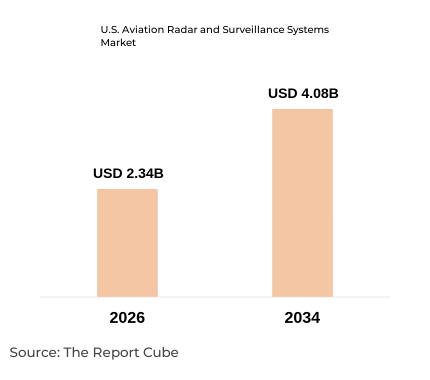
- The U.S. Aviation Radar and Surveillance Systems Market was valued at USD 2.34 billion in 2026.
- The market is projected to reach USD 4.08 billion by 2034.
- The market is expanding at a CAGR of 7.18% during 2026-2034.
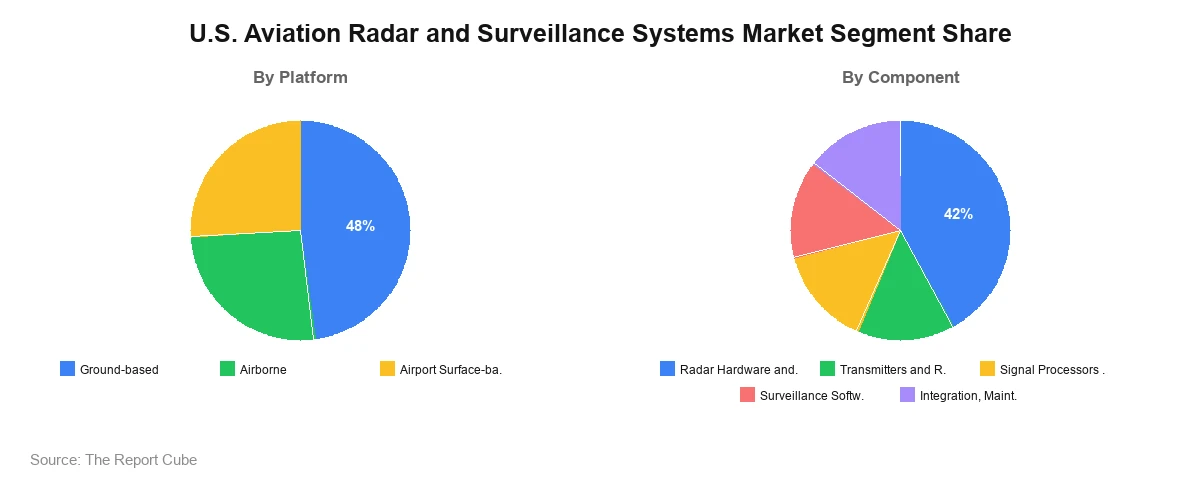
- By platform, ground-based systems lead with approx 48% share in 2026, supported by FAA radar networks and airport surveillance infrastructure.
- The FAA’s programme to replace up to 612 aging radars by June 2028 is the major growth driver.
- RTX and Indra were awarded the FAA’s January 2026 radar replacement contracts, shaping the competitive landscape.
Market Outlook
The U.S. Aviation Radar and Surveillance Systems Market covers the development, integration, deployment and maintenance of radar and surveillance equipment used in civil and military aviation. These systems detect, identify and track aircraft across controlled airspace, terminals and runways, supporting air traffic control, airport operators and defense organizations.
Demand comes from the FAA, commercial airports, airlines, air navigation service providers and military organizations. Applications include air traffic control, airport surface surveillance, airborne surveillance and military aviation monitoring. Primary and secondary radar remain central, while ADS-B, multilateration and Mode S add cooperative surveillance data that improves aircraft identification and situational awareness.
The U.S. Aviation Radar and Surveillance Systems Market is valued at USD 2.34 billion in 2026 and is projected to reach USD 4.08 billion by 2034, growing at a CAGR of 7.18%. Growth is supported by radar replacement programmes, airport surveillance investment, digital radar adoption and demand for integrated, multi-sensor surveillance architectures.
Government Regulations
The Federal Aviation Administration (FAA) is the principal authority overseeing the National Airspace System, including surveillance infrastructure. In January 2026 the agency announced radar contracts to replace up to 612 aging radars by June 2028, many of which date from the 1980s. The FAA also operates ASDE-X and ADS-B Airport Surface Surveillance Capability (ASSC) systems to support runway safety. Suppliers must meet FAA technical, safety, security and interoperability requirements and pass federal procurement qualification before deployment. Defense surveillance programmes follow Department of Defense procurement rules. These requirements create high entry barriers and long qualification cycles, and they favor established aerospace and defense suppliers with proven integration and lifecycle support capabilities. Procurement budgets and appropriations determine the timing of demand, so programme funding should not be read as equivalent to total market revenue.
U.S. Aviation Radar and Surveillance Systems Market Dynamics
Market dynamics are shaped by the modernization of legacy FAA infrastructure, runway safety requirements, digital radar adoption and defense aviation demand. Procurement is concentrated among government buyers, so funding cycles, programme schedules and integration with existing air traffic control systems strongly influence the timing of supplier revenue across the forecast period.
|
Factor |
Type |
Specific Impact on Market |
Magnitude |
|---|---|---|---|
|
FAA radar replacement programme |
Driver |
Creates large-scale equipment, installation and integration demand through 2028 |
High |
|
Runway safety and surface surveillance |
Driver |
Sustains investment in ASDE-X, ASSC and multi-sensor airport systems |
Medium-High |
|
Lifecycle support and upgrades |
Opportunity |
Generates recurring maintenance, calibration and software revenue |
Medium-High |
|
High capital cost and procurement complexity |
Challenge |
Lengthy procurement and funding dependence can delay deployment |
Medium-High |
|
Digital radar and data fusion |
Trend |
Shifts demand towards software, processing and integrated architectures |
Medium-High |
Growth Drivers: Modernization of Aging FAA Radar Infrastructure
The FAA’s January 2026 announcement awarded radar contracts to RTX and Indra to replace up to 612 radars by June 2028. The agency noted that many units date from the 1980s and have exceeded intended service life. Replacement is expected to improve reliability, simplify maintenance and reduce the number of configurations across the National Airspace System. This creates sustained demand for radar hardware, signal processing, installation and integration services, making modernization the central near-term driver of the market.
Market Opportunities: Large-Scale Radar Replacement and Lifecycle Support
The replacement of up to 612 radars creates opportunities for manufacturers, installation contractors, engineering firms and system integrators. Beyond initial procurement, the installed base generates recurring requirements for technical support, spare parts, calibration, software updates and equipment upgrades. Suppliers that pair hardware delivery with long-term maintenance and digital upgrade pathways can build more stable revenue profiles, particularly as the market shifts from initial replacement towards lifecycle services in the later forecast years.
Industry Challenges: High Capital Expenditure and Procurement Complexity
Radar modernization requires substantial investment in hardware, antennas, signal processing, site infrastructure, installation and testing. Government procurement cycles can be lengthy, and project delivery depends on funding availability, supplier capacity and technical acceptance. New systems must also integrate with existing automation, communication and flight data infrastructure, which adds complexity and schedule risk. Announced budgets and appropriations also differ from supplier revenue recognition, which can shift the timing of market revenue.
Need Specific Data, Let’s Customize the Report for You
Request CustomizationMarket Trends: Transition Towards Digital and Multi-Sensor Surveillance
Aviation surveillance is moving from conventional radar towards digital architectures that combine radar, ADS-B, multilateration and other sensor inputs. The FAA’s ASDE-X integrates surface radar, multilateration, ADS-B and airport surveillance radar to help controllers monitor aircraft and vehicles. ASDE-X is operational at 35 U.S. airports and ASSC at nine. This approach improves tracking accuracy and runway safety, and it raises the importance of surveillance software, data fusion and integration services.
U.S. Aviation Radar and Surveillance Systems Market Segment Analysis
The market is segmented by radar type, surveillance technology, application, platform, end user and component. These are alternative classifications of the same market and should not be added together. Segment shares shown below are approximate allocations for 2026.
By Platform
- Ground-based
- Airborne
- Airport Surface-based
Ground-based systems lead with approx 48% share in 2026, supported by FAA radar networks, airport surveillance radar and air traffic control infrastructure. Airborne platforms are the second major segment, driven by defense aviation radar, advanced aircraft surveillance and airborne sensor modernization, and their contribution is expected to rise over the forecast period. Airport surface-based systems form a smaller but strategically important category tied to runway safety and integrated surface monitoring at major airports.
By Component
- Radar Hardware and Antennas
- Transmitters and Receivers
- Signal Processors and Displays
- Surveillance Software
- Integration, Maintenance and Support Services
Radar Hardware and Antennas lead with approx 42% share in 2026 because they form the physical foundation of detection and surveillance infrastructure and are the core of replacement procurement. Transmitters and Receivers are the second major component segment, essential to radar performance and a recurring replacement item. Signal processors and displays, surveillance software and integration and support services are expected to gain importance as digital radar and multi-sensor architectures expand.
U.S. Aviation Radar and Surveillance Systems Market Regional Analysis
The market is influenced by regional differences in aviation activity, airport infrastructure, defense installations and airspace complexity. Major commercial hubs generate demand for terminal and surface surveillance, while extensive airspace and military operations support en-route and airborne radar. Regional share data is not available from approved sources.
|
Region |
Key Growth Factors |
Industry Trends |
|---|---|---|
|
Northeast |
Dense air traffic and complex terminal airspace around New York, Boston, Philadelphia and Washington |
Terminal and surface surveillance demand |
|
Midwest |
Major airline hubs and cargo activity in Chicago, Detroit and Minneapolis |
En-route and integrated aircraft monitoring |
|
South |
Airport expansion and military aviation activity around Atlanta, Dallas, Houston and Miami |
Surface movement monitoring and integrated radar |
|
West |
International airports, aerospace and defense manufacturing, and military installations |
Airport radar and advanced airborne surveillance |
Competitive Landscape
The market includes established aerospace and defense manufacturers, radar suppliers and system integrators. Competition depends on detection performance, signal processing, reliability, interoperability, manufacturing capacity, government procurement qualification and lifecycle support. Entry barriers are significant because of technical, security and certification requirements. The table does not represent a ranking by revenue or market share.
|
Company |
Competitive Strength |
Primary Segment Served |
|---|---|---|
|
RTX Corporation |
Ground and airborne radar, FAA radar replacement contract |
Air traffic control and defense surveillance |
|
Indra Group |
Primary and secondary surveillance radar, FAA radar replacement contract |
Air traffic surveillance |
|
Thales Group |
Aviation radar and air traffic management systems |
Integrated surveillance |
|
Northrop Grumman |
Airborne and defense radar, integrated mission systems |
Military surveillance |
|
L3Harris Technologies |
Airborne sensors and defense electronics |
Defense and airborne surveillance |
|
Leonardo S.p.A. |
Airborne radar and surveillance sensors |
Aerospace and defense |
|
Saab AB |
Radar, surveillance and airborne early warning |
Defense and airborne surveillance |
|
Honeywell International |
Avionics and aircraft electronics |
Aerospace systems |
RTX Corporation: RTX is a U.S. aerospace and defense company with radar, sensor and defense electronics capabilities through its Raytheon business. It was named in the FAA’s January 2026 radar replacement contract announcement, which strengthens its position in ground-based aviation surveillance. Its portfolio spans ground-based and airborne radar for both civil and defense customers, supporting its role in the FAA modernization programme.
Indra Group: Indra is a Spanish technology and defense company with an established air traffic management and surveillance portfolio, including primary and secondary surveillance radar and digital radar. In January 2026 it announced a USD 342 million FAA radar contract, a significant entry point into the U.S. market. Its competitive position rests on radar manufacturing and integration experience in air traffic systems.
Recent Developments and Updates
- January 2026: The FAA announced radar contracts with RTX and Indra to replace up to 612 aging radars by June 2028. The programme is the largest near-term procurement opportunity for ground-based aviation surveillance in the United States.
- January 2026: Indra announced a USD 342 million FAA radar contract, expanding its U.S. air traffic surveillance activity and increasing competition for ground-based radar supply.
- 2026: The FAA’s modernization programme includes 44 airports with replacement surface radars and 200 airports targeted for Surface Awareness Initiative technology, supporting runway safety and airport surveillance demand.
U.S. Aviation Radar and Surveillance Systems Market Future Outlook
The U.S. Aviation Radar and Surveillance Systems Market is expected to grow from USD 2.34 billion in 2026 to USD 4.08 billion by 2034 at a CAGR of 7.18%. Growth is expected to be strongest during the initial replacement phase, as radar procurement and deployment advance. Digital radar, ADS-B, airport surface surveillance and airborne radar modernization should sustain demand through the middle years, with services and software contributing more later.
Competition is expected to centre on integrated, multi-sensor offerings and lifecycle support rather than hardware alone. Risks include government budget changes, manufacturing and installation delays, integration with legacy air traffic systems, cybersecurity requirements and differences between announced budgets and supplier revenue. As the initial replacement cycle matures, growth should moderate and shift towards upgrades, software modernization and maintenance.
U.S. Aviation Radar and Surveillance Systems Market Report Coverage
This report summarizes market size, forecast, segmentation, regional context and the competitive landscape of the U.S. Aviation Radar and Surveillance Systems Market for 2026-2034.
|
Parameter |
Details |
|---|---|
|
Market Name |
U.S. Aviation Radar and Surveillance Systems Market |
|
Market Size (Base Year) |
USD 2.34 billion (2026) |
|
Market Size (Forecast Year) |
USD 4.08 billion (2034) |
|
CAGR |
7.18% |
|
Base Year |
2026 |
|
Historical Period |
2021-2025 |
|
Forecast Period |
2026-2034 |
|
Geographic Scope |
United States |
|
Segmentation |
By Radar Type, By Surveillance Technology, By Application, By Platform, By End User, By Component |
|
Regions Covered |
Northeast, Midwest, South, West |
|
Key Companies |
RTX Corporation, Indra Group, Thales Group, Northrop Grumman, L3Harris Technologies, Leonardo S.p.A., Saab AB, Honeywell International |
|
Customization |
Available as per requirement |
Why Choose This U.S. Aviation Radar and Surveillance Systems Market Report?
- Presents market size from 2026 to 2034 with a 7.18% CAGR.
- Segments the market by radar type, surveillance technology, application, platform, end user and component.
- Analyzes drivers, opportunities, challenges and trends, referencing FAA programme information.
- Provides regional context across the Northeast, Midwest, South and West, and identifies where shares are unavailable.
- Profiles key companies by capability and primary segment served.
- Covers digital radar, ADS-B, multi-sensor surveillance and lifecycle support opportunities.
- Supports procurement, investment and positioning decisions for suppliers and integrators.
Table of Contents
- Introduction
- Objective of the Study
- Product Definition
- Market Segmentation
- Study Variables
- Research Methodology
- Secondary Data Points
- Companies Interviewed
- Primary Data Points
- Breakdown of Primary Interviews
- Secondary Data Points
- Executive Summary
- Market Dynamics
- Drivers
- Challenges
- Opportunity Assessment
- Recent Trends and Developments
- Policy and Regulatory Landscape
- United States Aviation Radar and Surveillance Systems Market Overview and Forecast Analysis (2021-2034)
- Market Size, By Value, By Growth Rate (CAGR/USD Billions)
- Demand – Supply Trends
- Market Share, By Radar Type / System Category
- Primary Surveillance Radar (PSR)
- Secondary Surveillance Radar (SSR)
- Airport Surveillance Radar (ASR)
- Air Route Surveillance Radar (ARSR)
- Airborne Surveillance Radar
- ADS-B / MLAT / Cooperative Surveillance
- Airport Surface Surveillance Systems
- Market Share, By Surveillance Technology
- Primary Radar Technology
- Secondary Radar / Mode S
- Automatic Dependent Surveillance–Broadcast (ADS-B)
- Multilateration (MLAT)
- Integrated Surveillance Systems
- Market Share, By Application
- Air Traffic Control
- Airport Surface Surveillance
- Airborne Surveillance
- Military Aviation Surveillance
- Precision Approach and Landing
- Market Share, By Platform
- Ground-based
- Airborne
- Airport Surface-based
- Market Share, By End User
- FAA and Government Agencies
- Commercial Airports
- Airlines / Commercial Operators
- Military and Defense Organizations
- Air Navigation Service Providers
- Market Share, By Component
- Radar Hardware and Antennas
- Transmitters and Receivers
- Signal Processors and Displays
- Surveillance Software
- Integration, Maintenance and Support Services
- Market Share, By Region
- Northeast
- Midwest
- South
- West
- Market Share, By Competitors
- Competition Characteristics
- Revenue Shares
- Primary Surveillance Radar (PSR) United States Aviation Radar and Surveillance Systems Market Overview, 2021-2034F
- By Value (USD Million)
- By Surveillance Technology – Market Size & Forecast 2021-2034, USD Million
- Primary Radar Technology
- Secondary Radar / Mode S
- Automatic Dependent Surveillance–Broadcast (ADS-B)
- Multilateration (MLAT)
- Integrated Surveillance Systems
- Secondary Surveillance Radar (SSR) United States Aviation Radar and Surveillance Systems Market Overview, 2021-2034F
- By Value (USD Million)
- By Surveillance Technology – Market Size & Forecast 2021-2034, USD Million
- Primary Radar Technology
- Secondary Radar / Mode S
- Automatic Dependent Surveillance–Broadcast (ADS-B)
- Multilateration (MLAT)
- Integrated Surveillance Systems
- Airport Surveillance Radar (ASR) United States Aviation Radar and Surveillance Systems Market Overview, 2021-2034F
- By Value (USD Million)
- By Surveillance Technology – Market Size & Forecast 2021-2034, USD Million
- Primary Radar Technology
- Secondary Radar / Mode S
- Automatic Dependent Surveillance–Broadcast (ADS-B)
- Multilateration (MLAT)
- Integrated Surveillance Systems
- Air Route Surveillance Radar (ARSR) United States Aviation Radar and Surveillance Systems Market Overview, 2021-2034F
- By Value (USD Million)
- By Surveillance Technology – Market Size & Forecast 2021-2034, USD Million
- Primary Radar Technology
- Secondary Radar / Mode S
- Automatic Dependent Surveillance–Broadcast (ADS-B)
- Multilateration (MLAT)
- Integrated Surveillance Systems
- Airborne Surveillance Radar United States Aviation Radar and Surveillance Systems Market Overview, 2021-2034F
- By Value (USD Million)
- By Surveillance Technology – Market Size & Forecast 2021-2034, USD Million
- Primary Radar Technology
- Secondary Radar / Mode S
- Automatic Dependent Surveillance–Broadcast (ADS-B)
- Multilateration (MLAT)
- Integrated Surveillance Systems
- ADS-B / MLAT / Cooperative Surveillance United States Aviation Radar and Surveillance Systems Market Overview, 2021-2034F
- By Value (USD Million)
- By Surveillance Technology – Market Size & Forecast 2021-2034, USD Million
- Primary Radar Technology
- Secondary Radar / Mode S
- Automatic Dependent Surveillance–Broadcast (ADS-B)
- Multilateration (MLAT)
- Integrated Surveillance Systems
- Airport Surface Surveillance Systems United States Aviation Radar and Surveillance Systems Market Overview, 2021-2034F
- By Value (USD Million)
- By Surveillance Technology – Market Size & Forecast 2021-2034, USD Million
- Primary Radar Technology
- Secondary Radar / Mode S
- Automatic Dependent Surveillance–Broadcast (ADS-B)
- Multilateration (MLAT)
- Integrated Surveillance Systems
- Competitive Outlook (Company Profile – Partial List)
- RTX Corporation
- Company Overview
- Business Segments
- Strategic Alliances/Partnerships
- Recent Developments
- Indra Group
- Company Overview
- Business Segments
- Strategic Alliances/Partnerships
- Recent Developments
- Thales Group
- Company Overview
- Business Segments
- Strategic Alliances/Partnerships
- Recent Developments
- Northrop Grumman
- Company Overview
- Business Segments
- Strategic Alliances/Partnerships
- Recent Developments
- L3Harris Technologies
- Company Overview
- Business Segments
- Strategic Alliances/Partnerships
- Recent Developments
- Leonardo S.p.A.
- Company Overview
- Business Segments
- Strategic Alliances/Partnerships
- Recent Developments
- Saab AB
- Company Overview
- Business Segments
- Strategic Alliances/Partnerships
- Recent Developments
- Honeywell International
- Company Overview
- Business Segments
- Strategic Alliances/Partnerships
- Recent Developments
- RTX Corporation
- Contact Us & Disclaimer
Top Key Players & Market Share Outlook
- RTX Corporation
- Indra Group
- Thales Group
- Northrop Grumman
- L3Harris Technologies
- Leonardo S.p.A.
- Saab AB
- Honeywell International
Frequently Asked Questions