



Build Your Custom Market Intelligence Report
Customize Your ReportGlobal Biocomposites Market Insights & Analysis
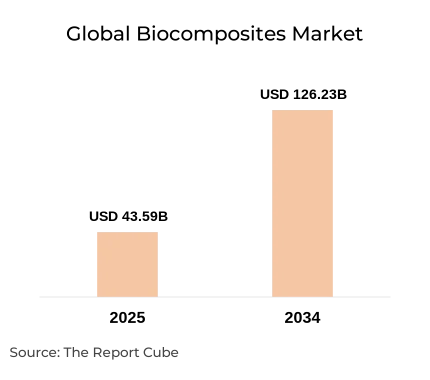
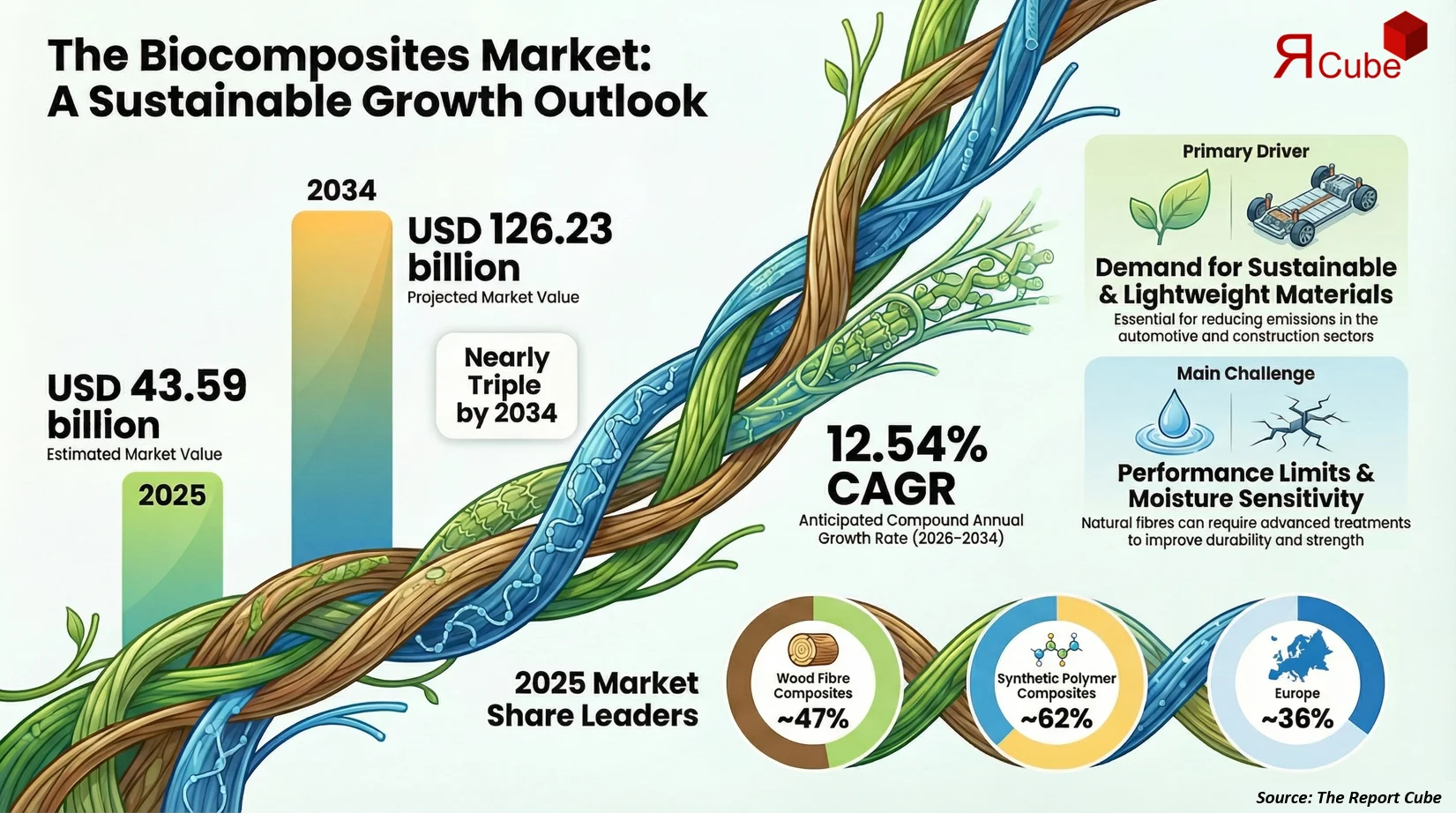
The Global Biocomposites Market is anticipated to register a CAGR of 12.54% during the forecast period 2026–2034. The market size was valued at USD 43.59 Billion in 2025 and is projected to reach USD 126.23 Billion by 2034. This growth is strongly driven by rising demand for sustainable materials across construction, automotive, consumer goods, and packaging industries. Biocomposites, which combine natural fibers with polymer matrices, are increasingly preferred as environmentally responsible alternatives to traditional petroleum-based composites, supporting global decarbonization and circular economy goals.
Biocomposites have transitioned from niche applications to mainstream industrial use as manufacturers respond to regulatory pressure, consumer sustainability awareness, and corporate ESG commitments. These materials offer advantages such as lower carbon footprint, reduced weight, renewability, and improved recyclability. Advancements in material engineering have improved mechanical strength, moisture resistance, and durability, expanding their usability in structural and semi-structural applications. Governments across North America and Europe are promoting bio-based materials through green building standards and procurement policies, while Asia Pacific is witnessing rapid adoption driven by industrial growth and availability of natural fibers.
Global Biocomposites Market Recent Developments
- 2025: UPM expanded production capacity for wood-fiber-based biocomposites to support sustainable construction applications.
- 2025: Bcomp introduced next-generation flax fiber composites targeting lightweight automotive and mobility applications.
Government Initiatives & Policies
- EU Bioeconomy Strategy: Promotes the adoption of bio-based materials to reduce dependence on fossil resources.
- U.S. BioPreferred Program: Encourages federal procurement of bio-based products, supporting biocomposites adoption.
Global Biocomposites Market Dynamics
Key Driver: Rising Demand for Sustainable and Lightweight Materials
The primary driver of the global biocomposites market is the accelerating demand for sustainable, lightweight, and eco-friendly materials across multiple industries. Manufacturers in automotive, construction, furniture, and consumer goods are under increasing pressure to reduce carbon emissions and material waste. Biocomposites offer a compelling solution by combining renewable fibers with polymers to achieve weight reduction of up to 30% compared to conventional materials, while maintaining adequate strength and performance. Automotive OEMs are increasingly integrating biocomposites into interior panels, dashboards, and trims to meet fuel efficiency and emission targets. Similarly, the construction sector is adopting biocomposites for decking, cladding, and structural elements due to their durability and lower environmental impact.
Major Challenge: Performance Limitations and Moisture Sensitivity
Despite strong growth prospects, the biocomposites market faces challenges related to material performance and moisture sensitivity. Natural fibers are inherently hydrophilic, which can affect dimensional stability and long-term durability in high-humidity environments. Compared to traditional composites, biocomposites may exhibit lower thermal resistance and mechanical strength in demanding applications. Addressing these limitations requires advanced surface treatments, coupling agents, and polymer modifications, which can increase production complexity and costs. Additionally, inconsistent quality of natural fibers due to agricultural variability can impact material standardization, posing challenges for large-scale industrial adoption.
Industry Trends: Increasing Use in Automotive and Construction Applications
A significant trend shaping the biocomposites market is the growing adoption in automotive and construction sectors. Automotive manufacturers are using biocomposites to reduce vehicle weight and enhance sustainability credentials without compromising aesthetics. In construction, wood fiber composites are increasingly used in decking, fencing, and façade applications due to their resistance to corrosion, insects, and weathering. The trend is supported by green building certifications such as LEED and BREEAM, which incentivize the use of bio-based materials. Continuous innovation in fiber treatment and composite processing is further expanding application scope.
Opportunity Ahead: Expansion in Circular Economy and Bio-Based Packaging
Biocomposites present significant opportunities within circular economy initiatives and bio-based packaging solutions. As single-use plastics face regulatory bans, companies are exploring bio-based alternatives that offer similar performance with improved environmental profiles. Biocomposites made from agricultural residues and recycled polymers align well with circular economy principles. Emerging economies with abundant natural fiber resources, such as hemp, jute, and flax, offer cost advantages and supply chain resilience. Manufacturers investing in closed-loop recycling and bio-based innovations are expected to capture long-term growth opportunities.
Global Biocomposites Market Segment-wise Analysis
By Fiber Type:
- Wood Fiber Composites
- Non Wood Fiber Composites (Hemp, Flax, Jute, Kenaf, Others)
- Other Natural Fiber Composites
Wood fiber composites dominate the market, accounting for approximately 47% of total revenue in 2025. Their widespread use in construction and outdoor applications is driven by durability, aesthetic appeal, and cost-effectiveness. Non-wood fiber composites are gaining momentum due to superior mechanical properties and lower density, particularly in automotive and consumer goods applications. Hemp and flax fibers are increasingly preferred due to their high strength-to-weight ratios and sustainability benefits.
By Polymer Type:
- Natural Polymer Composites
- Synthetic Polymer Composites
Synthetic polymer composites hold the larger market share, contributing nearly 62% of total revenue in 2025. These composites offer improved processing flexibility, moisture resistance, and mechanical stability. However, natural polymer composites are experiencing faster growth as technological advancements improve their performance and cost competitiveness. Growing emphasis on fully bio-based materials is expected to support long-term adoption of natural polymer composites.
Regional Projection of Global Biocomposites Industry
- North America
- Europe
- Asia Pacific
- Middle East and Africa
- South America
Europe leads the global biocomposites market, accounting for approximately 36% of total revenue in 2025. The region benefits from strong environmental regulations, advanced manufacturing capabilities, and widespread adoption in automotive and construction industries. North America follows closely, supported by green building initiatives and federal bio-based procurement programs. Asia Pacific is the fastest-growing region due to rapid industrialization, availability of natural fibers, and increasing awareness of sustainable materials. South America and the Middle East and Africa show emerging potential driven by agricultural resources and infrastructure development.
Why Choose This Report?
- Provides a comprehensive overview of the overall market analysis, encompassing key trends, consumer behavior analysis, and risk assessment to support strategic decision-making.
- Provides accurate, up-to-date insights into market size, segmentation, and emerging opportunities, helping to minimize risk & capitalizing on growth.
- Gives deep understanding of target audience preferences, investment habits, and communication channels for enhanced product development & marketing effectiveness.
- Delivers competitive analysis & benchmarking, uncovering the strengths & weaknesses of market competitors to guide strategies.
- Consolidate comprehensive market intelligence, reducing reasoning & streamlining research efforts.
- Facilitates customized market segmentation & risk mitigation strategies, fine-tuned to the business objectives.
- Aids in identifying both market challenges & untapped opportunities within the industry to drive long-term business growth.
- Provides valuable information based on actual customer data & search trends.
Table of Contents
- Introduction
- Objective of the Study
- Product and Category Definition
- Market Segmentation
- Study Variables
- Research Methodology
- Secondary Data Points
- Breakdown of Secondary Sources
- Primary Data Points
- Breakdown of Primary Interviews
- Secondary Data Points
- Executive Summary
- Market Dynamics
- Drivers
- Challenges
- Opportunity Assessment
- Recent Trends and Developments
- Regulatory and Policy Landscape
- Global Biocomposites Market Overview (2020-2034)
- Market Size, By Value (USD Billion)
- Market Share, By Fiber Type
- Wood Fiber Composites
- Non Wood Fiber Composites (Hemp, Flax, Jute, Kenaf, Others)
- Other Natural Fiber Composites
- Market Share, By Polymer Type
- Natural Polymer Composites
- Synthetic Polymer Composites
- Market Share, By Product Type
- Green Biocomposites
- Hybrid Biocomposites
- Market Share, By Processing Method
- Extrusion
- Injection Molding
- Compression Molding
- Filament Winding
- Machine Press and Others
- Market Share, By End Use Industry
- Building and Construction
- Transportation (Automotive, Rail, Aerospace)
- Consumer Goods and Electronics
- Packaging
- Furniture and Interior
- Others
- Market Share, By Region
- North America
- Europe
- Asia Pacific
- Middle East and Africa
- South America
- Market Share, By Company
- Revenue Shares
- Competitive Landscape
- North America Biocomposites Market
- Market Size, By Value (USD Billion)
- Market Share, By Fiber Type
- Market Share, By Polymer Type
- Market Share, By Product Type
- Market Share, By Processing Method
- Market Share, By End Use Industry
- Market Share, By Country
- United States
- Canada
- Mexico
- Europe Biocomposites Market
- Market Size, By Value (USD Billion)
- Market Share, By Fiber Type
- Market Share, By Polymer Type
- Market Share, By Product Type
- Market Share, By Processing Method
- Market Share, By End Use Industry
- Market Share, By Country
- Germany
- United Kingdom
- France
- Italy
- Spain
- Northern and Nordic Countries
- Rest of Europe
- Asia Pacific Biocomposites Market
- Market Size, By Value (USD Billion)
- Market Share, By Fiber Type
- Market Share, By Polymer Type
- Market Share, By Product Type
- Market Share, By Processing Method
- Market Share, By End Use Industry
- Market Share, By Country
- China
- India
- Japan
- South Korea
- Indonesia
- Rest of Asia Pacific
- Middle East and Africa Biocomposites Market
- Market Size, By Value (USD Billion)
- Market Share, By Fiber Type
- Market Share, By Polymer Type
- Market Share, By Product Type
- Market Share, By Processing Method
- Market Share, By End Use Industry
- Market Share, By Country
- Saudi Arabia
- United Arab Emirates
- South Africa
- Rest of Middle East and Africa
- South America Biocomposites Market
- Market Size, By Value (USD Billion)
- Market Share, By Fiber Type
- Market Share, By Polymer Type
- Market Share, By Product Type
- Market Share, By Processing Method
- Market Share, By End Use Industry
- Market Share, By Country
- Brazil
- Argentina
- Rest of South America
- Competitive Outlook and Company Profiles
- UPM
- Company Overview
- Product Portfolio
- Strategic Alliances and Partnerships
- Recent Developments
- Trex Company
- Company Overview
- Product Portfolio
- Strategic Alliances and Partnerships
- Recent Developments
- Fiberon LLC
- Company Overview
- Product Portfolio
- Strategic Alliances and Partnerships
- Recent Developments
- FlexForm Technologies
- Company Overview
- Product Portfolio
- Strategic Alliances and Partnerships
- Recent Developments
- UFP Industries / Universal Forest Products
- Company Overview
- Product Portfolio
- Strategic Alliances and Partnerships
- Recent Developments
- Meshlin Composites ZRT
- Company Overview
- Product Portfolio
- Strategic Alliances and Partnerships
- Recent Developments
- Nanjing Jufeng Advanced Materials
- Company Overview
- Product Portfolio
- Strategic Alliances and Partnerships
- Recent Developments
- Tecnaro GmbH
- Company Overview
- Product Portfolio
- Strategic Alliances and Partnerships
- Recent Developments
- Procotex Corporation
- Company Overview
- Product Portfolio
- Strategic Alliances and Partnerships
- Recent Developments
- Bcomp
- Company Overview
- Product Portfolio
- Strategic Alliances and Partnerships
- Recent Developments
- Others
- UPM
- Contact Us and Disclaimer
Top Key Players & Market Share Outlook
- UPM
- Trex Company
- Fiberon LLC
- FlexForm Technologies
- UFP Industries / Universal Forest Products
- Meshlin Composites ZRT
- Nanjing Jufeng Advanced Materials
- Tecnaro GmbH
- Procotex Corporation
- Bcomp
- Others
Frequently Asked Questions






