



Build Your Custom Market Intelligence Report
Customize Your ReportGlobal Biodegradable Engine Oil Market Key Highlights
By Base Oil Type:
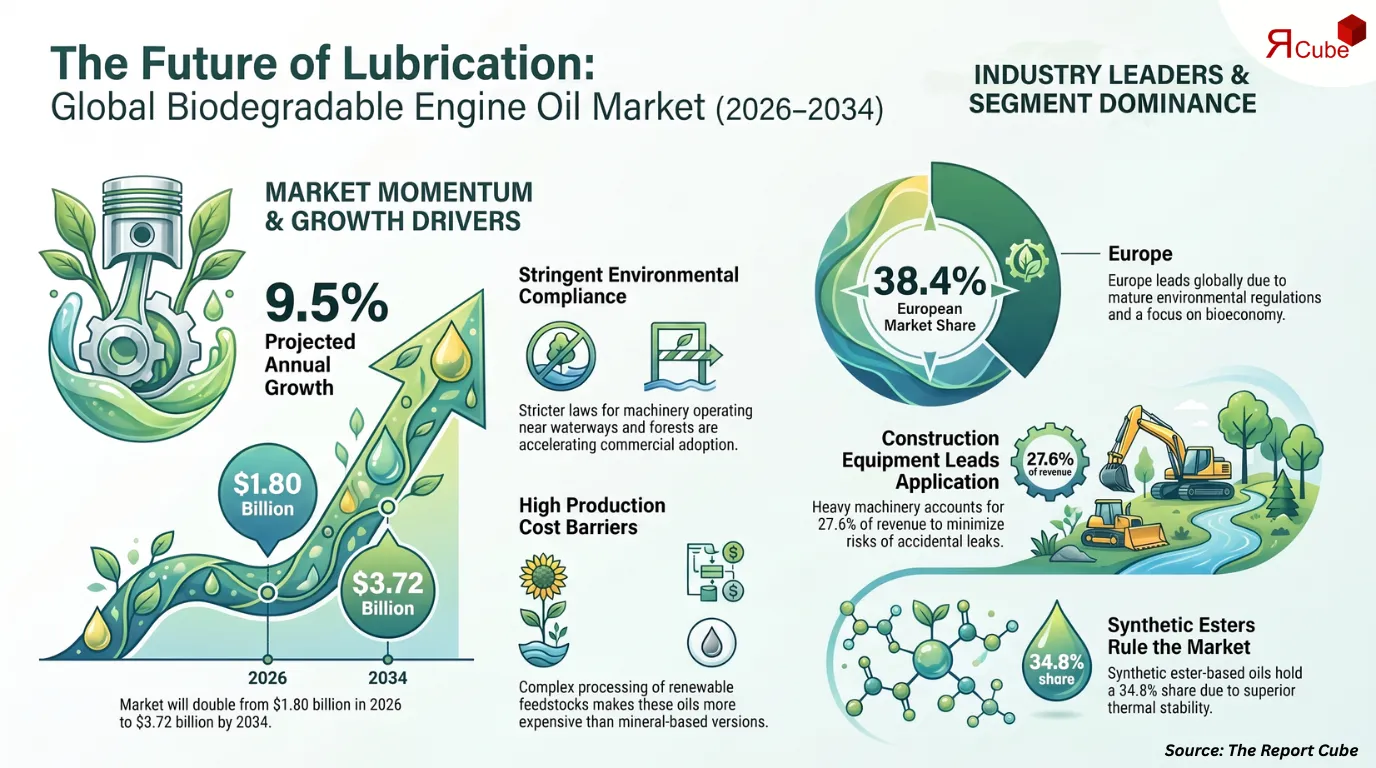
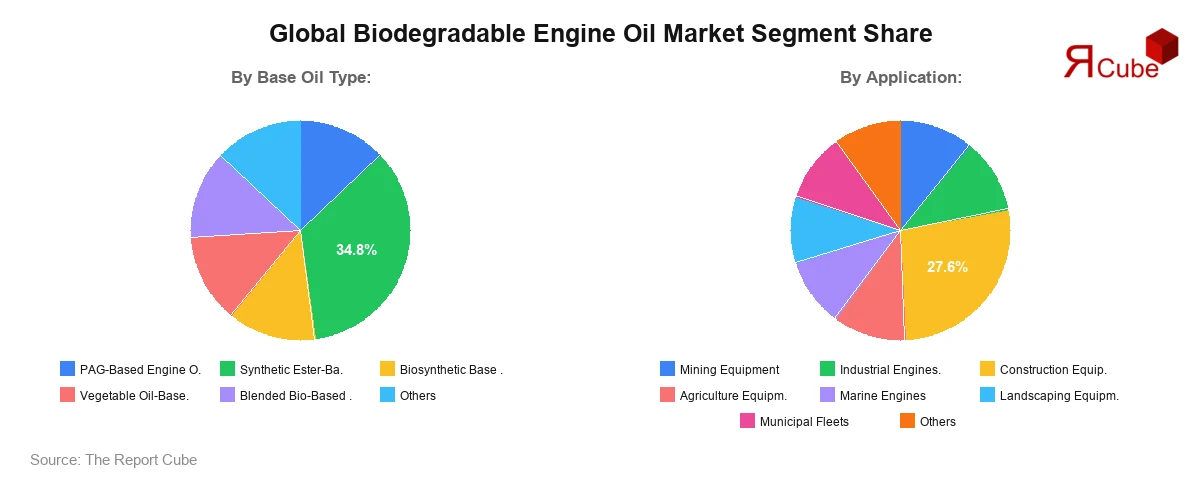
Synthetic Ester-Based Engine Oil segment leads the market with approximately 34.8% share.
By Application:
Construction Equipment dominates the market with nearly 27.6% of total revenue.
Regional Outlook:
Europe dominates the Global Biodegradable Engine Oil Market with around 38.4% market share.
Global Biodegradable Engine Oil Market Insights & Analysis
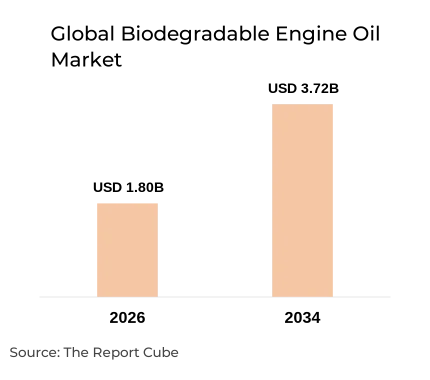
The Global Biodegradable Engine Oil Market is anticipated to register a CAGR of around 9.5% during the forecast period of 2026-2034. The market size is valued at USD 1.80 billion in 2026 and is projected to reach USD 3.72 billion by 2034. Industry momentum is being supported by stricter environmental compliance requirements, growing investment in sustainable industrial operations, and continuous improvements in bio-based lubricant technology. Companies operating in construction, forestry, agriculture, mining, marine transportation, and municipal services are replacing conventional mineral-based lubricants with eco friendly engine oil to minimize the environmental impact of accidental leaks and routine maintenance activities. Modern biodegradable formulations developed from synthetic esters and renewable base oils now deliver enhanced oxidation stability, corrosion protection, wear resistance, and thermal performance, making them suitable for heavy-duty operating conditions while meeting increasingly demanding equipment performance requirements.
Commercial adoption continues to accelerate as equipment manufacturers broaden approvals for biodegradable lubricants and industrial fleet operators integrate sustainability into long-term maintenance strategies. Investment in renewable feedstocks, advanced additive chemistry, and high-performance biosynthetic base oils is improving product durability and extending lubricant service intervals, helping reduce lifecycle operating costs. Europe maintains its leadership position through mature environmental regulations and widespread use of environmentally acceptable lubricants, while North America benefits from expanding green infrastructure projects and stricter industrial environmental practices. Asia Pacific is emerging as the fastest-growing regional market, supported by rapid infrastructure development, increasing mechanization in agriculture, and greater awareness of environmentally responsible maintenance solutions. These structural market developments continue strengthening the long-term outlook for the biodegradable engine oil market.
Global Biodegradable Engine Oil Market Impact Analysis
| Factor | Type | Specific Impact on Market | Magnitude | Business Implication |
|---|---|---|---|---|
| Stringent Environmental Regulations | Regulatory | Policies restrict mineral oils and favor low toxicity lubricants | High | Drives faster adoption of certified biodegradable engine oils globally |
| Demand for Sustainable Lubricants | Market | End users shift preference to eco friendly high performance oils | High | Supports premium pricing and portfolio expansion in bio lubricants |
| Growth in Automotive and Off Highway Fleet | Market | Rising vehicle and machinery stock increases lubricant consumption | Medium | Creates steady volume demand across transport and construction uses |
| Advances in Ester Based Formulations | Technological | Improved synthetic esters enhance stability and biodegradability | Medium | Enables performance parity with conventional oils in key segments |
| High Production and Treatment Costs | Market | Complex processing raises unit cost versus mineral based oils | Medium | Limits penetration in highly price sensitive bulk lubricant markets |
| Expansion of Bio Based Feedstock Supply | Environmental | Greater vegetable oil output supports scalable bio oil production | Medium | Improves security of raw materials and long term cost competitiveness |
| Awareness of Oil Spill Impacts | Consumer | Industries seek lubricants that reduce ecological damage risk | High | Encourages switch to biodegradable oils in marine and forestry uses |
Global Biodegradable Engine Oil Market Dynamics
Key Driver: Environmental Compliance Standards Continue to Accelerate Commercial Adoption
Environmental legislation governing industrial operations has become a primary factor supporting demand for biodegradable engine oils across developed and emerging economies. Regulatory authorities are introducing stricter requirements for machinery operating near forests, waterways, agricultural land, coastal zones, and environmentally protected areas where lubricant leakage may create long-term ecological damage. As a result, industries including construction, marine transportation, mining, forestry, and municipal services are increasingly transitioning toward eco friendly engine oil that offers reliable engine protection while significantly reducing environmental risks. These regulations are encouraging both public and private organizations to incorporate environmentally acceptable lubricants into procurement specifications and long-term sustainability programs.
Industry participants are responding through continuous product innovation focused on improving lubricant efficiency without compromising environmental performance. High-performance synthetic ester technologies, renewable base oils, and advanced additive systems now provide excellent oxidation stability, engine cleanliness, corrosion resistance, and extended drain intervals comparable to premium petroleum-based lubricants. Growing collaboration between lubricant manufacturers and original equipment manufacturers has also increased product certifications and equipment compatibility, enabling fleet operators to adopt biodegradable engine oils with greater confidence. These developments continue expanding market demand across both industrial and commercial applications worldwide.
Industry Trends: Technological Innovation and Sustainable Fleet Management Reshape Product Demand
Product development within the Biodegradable Engine Oil Market is increasingly focused on achieving higher operational efficiency while supporting global sustainability objectives. Manufacturers continue investing in renewable raw materials, next-generation ester chemistry, and multifunctional additive technologies capable of improving viscosity stability, thermal endurance, oxidation resistance, and engine durability under demanding operating environments. These innovations allow biodegradable lubricants to perform effectively across construction equipment, marine engines, agricultural machinery, industrial generators, and heavy-duty diesel applications where operational reliability remains essential. Continuous improvements in formulation technology have significantly expanded customer confidence in bio-based lubrication solutions.
Fleet operators are simultaneously adopting predictive maintenance programs and digital equipment monitoring systems that optimize lubricant replacement schedules and improve asset utilization. This trend is increasing demand for premium biodegradable engine oils capable of maintaining consistent performance throughout extended service intervals. Equipment manufacturers are also strengthening technical partnerships with lubricant producers to certify environmentally acceptable formulations for new engine platforms. These collaborative initiatives are improving market acceptance while supporting broader commercialization across industries that prioritize operational efficiency, environmental stewardship, and long-term equipment reliability.
Book your FREE 30-minute expert consultation today
Contact UsMajor Challenge: Cost Competitiveness and Uneven Market Awareness Continue to Influence Purchasing Decisions
Although biodegradable lubricants deliver measurable environmental and operational benefits, their higher manufacturing costs remain a significant challenge for broader market penetration. Renewable feedstocks, synthetic ester production, specialized additive technologies, and strict quality certification processes generally increase product costs compared with conventional mineral-based engine oils. Budget-sensitive industries, particularly in developing economies, often prioritize short-term operating expenses over lifecycle sustainability benefits, slowing the pace of adoption. Price sensitivity remains particularly evident among smaller fleet operators and independent equipment owners with limited maintenance budgets.
Market development is also affected by varying levels of technical awareness regarding biodegradable lubricant performance and compatibility. Some end users continue to associate bio-based lubricants with reduced durability despite significant technological advancements achieved during the past decade. Limited distribution infrastructure in several emerging economies further restricts product accessibility. Expanding technical education, improving distributor networks, increasing OEM approvals, and demonstrating long-term cost savings through extended equipment life will remain important priorities for manufacturers seeking to accelerate global adoption of eco friendly engine oil solutions.
Opportunity: Green Infrastructure Investment and Environmentally Sensitive Industries Create Long-Term Growth Potential
Large-scale investment in sustainable infrastructure projects is creating attractive opportunities for manufacturers operating in the Biodegradable Engine Oil Market. Governments and private developers increasingly require environmentally acceptable lubricants for construction equipment used in projects located near rivers, reservoirs, forests, wetlands, and protected ecological zones. Similar demand is emerging from offshore wind farms, hydropower facilities, precision agriculture, municipal fleet modernization, and sustainable forestry operations where environmental compliance has become an important procurement criterion. These application areas provide significant long-term growth opportunities for suppliers offering high-performance biodegradable engine oils.
Innovation across renewable lubricant technologies is expected to further strengthen future market expansion. Manufacturers continue investing in advanced biosynthetic base oils, renewable feedstocks, and circular production methods that improve product performance while reducing manufacturing costs. Regional production expansion, stronger distribution partnerships, and increasing OEM collaboration are improving product availability across emerging economies. As industries continue balancing operational efficiency with sustainability objectives, demand for eco friendly engine oil is expected to accelerate steadily, supporting sustained revenue growth and broader commercial adoption throughout the forecast period.
Global Biodegradable Engine Oil Market Segment-wise Analysis
By Base Oil Type:
- PAG-Based Engine Oil
- Synthetic Ester-Based Engine Oil
- Biosynthetic Base Oil-Based Engine Oil
- Vegetable Oil-Based Engine Oil
- Blended Bio-Based Engine Oil
- Others
Synthetic Ester-Based Engine Oil held the largest share of approximately 34.8% of the Biodegradable Engine Oil Market in 2026. The segment continues to lead because synthetic esters provide an optimal combination of biodegradability, thermal stability, oxidation resistance, and excellent lubrication under severe operating conditions. Heavy-duty machinery used in construction, forestry, marine transportation, mining, and agriculture requires lubricants capable of maintaining viscosity and protecting engine components during prolonged operating cycles. Compared with conventional bio-based oils, synthetic ester formulations deliver longer service life, superior low-temperature fluidity, and improved resistance to deposit formation, making them the preferred choice for demanding industrial applications.
Manufacturers continue investing in renewable ester chemistry and advanced additive technologies to improve engine cleanliness, corrosion protection, and wear resistance while maintaining compliance with increasingly stringent environmental regulations. Equipment manufacturers are also expanding approvals for synthetic ester-based lubricants across modern diesel and gasoline engines, strengthening customer confidence in biodegradable alternatives. Growing replacement of petroleum-derived lubricants with eco friendly engine oil in environmentally sensitive industries is expected to sustain robust demand for this segment throughout the forecast period, particularly across Europe and North America where environmental compliance remains a key purchasing criterion.
By Application:
- Mining Equipment
- Industrial Engines
- Construction Equipment
- Agriculture Equipment
- Marine Engines
- Landscaping Equipment
- Municipal Fleets
- Forestry Equipment
- Others
Construction Equipment accounted for nearly 27.6% of global market revenue in 2026, making it the leading application segment. Large-scale infrastructure development, urban expansion, renewable energy projects, and transportation construction continue increasing the deployment of excavators, bulldozers, cranes, loaders, and other heavy equipment that frequently operate in environmentally sensitive locations. Since accidental lubricant leaks can contaminate surrounding soil and water resources, contractors and fleet operators are increasingly adopting biodegradable engine oils to comply with environmental standards while maintaining equipment reliability and operational efficiency.
Commercial construction companies are also integrating sustainability goals into fleet maintenance programs as governments introduce stricter environmental requirements for public infrastructure projects. Continuous investment in highways, rail networks, bridges, tunnels, ports, and utility infrastructure across Asia Pacific, Europe, and North America is creating long-term demand for eco friendly engine oil. Improved lubricant durability, extended drain intervals, and compatibility with high-performance construction equipment further support the segment's growth, allowing operators to reduce maintenance costs while achieving environmental compliance without compromising machine productivity.
Regional Projection of Global Biodegradable Engine Oil Industry
- North America
- Europe
- Asia Pacific
- Middle East and Africa
- South America
Europe captured the largest share of the Global Biodegradable Engine Oil Market, accounting for approximately 38.4% of global revenue in 2026. Regional leadership is supported by comprehensive environmental legislation, mature industrial sustainability practices, and widespread adoption of environmentally acceptable lubricants across construction, forestry, agriculture, inland waterways, marine transportation, and municipal operations. Countries including Germany, France, Sweden, Finland, and the Netherlands have established strong regulatory frameworks encouraging the replacement of conventional petroleum-based lubricants with biodegradable alternatives in environmentally sensitive applications. These policies continue driving consistent demand for high-performance eco friendly engine oil throughout the region.
The presence of leading lubricant manufacturers, established research capabilities, and advanced industrial infrastructure further strengthens Europe's competitive position. Companies continue investing in renewable base oils, next-generation ester technologies, and certified biodegradable lubricant portfolios to address evolving environmental requirements while improving engine performance. Strong collaboration between lubricant suppliers, equipment manufacturers, and industrial fleet operators has accelerated commercial adoption across multiple end-use industries. Ongoing investment in renewable energy projects, sustainable forestry, green construction, and low-emission transportation is expected to preserve Europe's market leadership and support steady regional growth over the forecast period.
Need insights for a specific region within this market?
Request Regional DataRegional Analysis of Global Biodegradable Engine Oil Market
The biodegradable engine oil market shows varied regional growth, driven by regulation, industrial activity and sustainability focus.
| Cluster | Demand Level | Key Areas | System Dominance | Core Demand Logic | Growth Nature |
|---|---|---|---|---|---|
| North America | High | U.S., Canada, Mexico | Bio-based engine oils | Emission rules and fleet upgrades | Regulation-led steady growth |
| Europe | Very High | Germany, France, Nordics | Biodegradable lubricant blends | Strong environmental regulation push | Policy-driven dominant growth |
| Asia Pacific | Very High | China, Japan, India, ASEAN | Bio-engine oils for transport | Industrialization and green mandates | Fastest volume expansion |
| Middle East & Africa | Medium | GCC, South Africa, Nigeria | Eco-grade oils in heavy equipment | Infrastructure and mining projects | Gradual adoption from low base |
| South America | Medium | Brazil, Argentina, Chile | Bio-lubricants in agri and fleet | Agro exports and sustainability focus | Emerging but accelerating growth |
Government Initiatives & Policies
- European Union Bioeconomy Strategy (Updated Implementation 2025): The European Union continues supporting sustainable bio-based industries through research funding and circular economy initiatives that encourage the development and commercialization of renewable lubricants and environmentally acceptable industrial products.
- U.S. EPA Safer Choice Program (2025 Expansion): The U.S. Environmental Protection Agency continues expanding recognition of environmentally preferable products, encouraging manufacturers to develop safer lubricant formulations with reduced environmental impact for commercial and industrial applications.
Global Biodegradable Engine Oil Industry Recent Developments
- 2026: FUCHS SE expanded customer-facing communication for its PLANTO biodegradable lubricant portfolio, highlighting environmentally acceptable lubrication solutions for forestry, agriculture, waterways, construction, and municipal equipment operating in environmentally sensitive locations where spill prevention and regulatory compliance remain key purchasing priorities.
- 2026: PANOLIN AG reinforced its market position by strengthening the promotion of biodegradable and environmentally acceptable lubricant solutions designed for construction, forestry, marine, hydropower, and off-highway equipment. The initiative supports customers seeking high-performance lubricants that align with increasingly stringent environmental regulations.
- 2025: RSC Bio Solutions, LLC expanded commercial support for its biodegradable lubricant portfolio across marine, offshore, and industrial applications, responding to growing demand for environmentally acceptable lubricants used in operations located near water bodies and environmentally protected areas.
- 2025: Nandan Petrochem (Velvex) strengthened its lubricant and AdBlue market visibility during Excon 2025 by showcasing products designed for construction equipment fleets and off-highway vehicles, supporting the industry's gradual transition toward more sustainable lubrication solutions.
Why Choose This Report?
- Provides a comprehensive overview of the overall market analysis, encompassing key trends, consumer behavior analysis, and risk assessment to support strategic decision-making.
- Provides accurate, up-to-date insights into market size, segmentation, and emerging opportunities, helping to minimize risk while capitalizing on growth opportunities.
- Gives deep understanding of target audience preferences, investment habits, and communication channels for enhanced product development and marketing effectiveness.
- Delivers competitive analysis and benchmarking, uncovering the strengths and weaknesses of market competitors to guide business strategies.
- Consolidates comprehensive market intelligence, reducing research efforts and streamlining strategic planning.
- Facilitates customized market segmentation and risk mitigation strategies, fine-tuned to specific business objectives.
- Aids in identifying both market challenges and untapped opportunities within the industry to drive long-term business growth.
- Provides valuable information based on actual customer demand patterns, industry developments, and search trends.
Table of Contents
- Introduction
- Objective of the Study
- Product and Category Definition
- Market Segmentation
- Study Variables
- Research Methodology
- Secondary Data Points
- Breakdown of Secondary Sources
- Primary Data Points
- Breakdown of Primary Interviews
- Secondary Data Points
- Executive Summary
- Market Dynamics
- Emerging Opportunities
- Adoption Trends
- Demand Drivers
- Disruption Analysis (Challenges)
- Industry Analysis & Strategic Insights
- Supply/Value Chain Analysis
- Pricing Analysis
- Go-To-Market (GTM) Strategy
- BCG Matrix
- Recent Trends and Developments
- Import and Export Analysis
- Regulatory and Policy Landscape
- Region-wise policies
- Government Initiatives
- Global Biodegradable Engine Oil Market Overview and Forecast Analysis (2021-2034)
- Market Size, By Value, By Growth Rate (CAGR/USD Million)
- Market Share, By Base Oil Type
- PAG-Based Engine Oil
- Synthetic Ester-Based Engine Oil
- Biosynthetic Base Oil-Based Engine Oil
- Vegetable Oil-Based Engine Oil
- Blended Bio-Based Engine Oil
- Others
- Market Share, By Engine Type
- Four-Stroke Engines
- Gasoline Engines
- Hybrid Equipment Engines
- Diesel Engines
- Two-Stroke Engines
- Market Share, By Viscosity Grade
- SAE 5W-30
- SAE 10W-30
- SAE 10W-40
- SAE 15W-40
- SAE 20W-50
- Others
- Market Share, By Application
- Mining Equipment
- Industrial Engines
- Construction Equipment
- Agriculture Equipment
- Marine Engines
- Landscaping Equipment
- Municipal Fleets
- Forestry Equipment
- Others
- Market Share, By Distribution Channel
- Distributor Sales
- Aftermarket
- Online Sales
- Fleet Contracts
- OEM Fill
- Market Share, By Region
- North America
- Europe
- Asia Pacific
- Middle East and Africa
- South America
- Market Share, By Company
- Revenue Shares and Analysis
- Competitive Landscape
- North America Biodegradable Engine Oil Market Overview and Forecast Analysis (2021-2034)
- Market Size, By Value, By Growth Rate (CAGR/USD Million)
- Market Share, By Base Oil Type
- Market Share, By Engine Type
- Market Share, By Viscosity Grade
- Market Share, By Application
- Market Share, By Distribution Channel
- Market Share, By Country
- The United States
- Canada
- Mexico
- Rest of North America
- Europe Biodegradable Engine Oil Market Overview and Forecast Analysis (2021-2034)
- Market Size, By Value, By Growth Rate (CAGR/USD Million)
- Market Share, By Base Oil Type
- Market Share, By Engine Type
- Market Share, By Viscosity Grade
- Market Share, By Application
- Market Share, By Distribution Channel
- Market Share, By Country
- Germany
- The United Kingdom
- France
- Italy
- Spain
- Netherlands
- Russia
- Poland
- Belgium
- Sweden
- Rest of Europe
- Asia Pacific Biodegradable Engine Oil Market Overview and Forecast Analysis (2021-2034)
- Market Size, By Value, By Growth Rate (CAGR/USD Million)
- Market Share, By Base Oil Type
- Market Share, By Engine Type
- Market Share, By Viscosity Grade
- Market Share, By Application
- Market Share, By Distribution Channel
- Market Share, By Country
- China
- India
- Japan
- South Korea
- Australia
- Indonesia
- Thailand
- Malaysia
- Vietnam
- Philippines
- Singapore
- New Zealand
- Rest of Asia Pacific
- Middle East and Africa Biodegradable Engine Oil Market Overview and Forecast Analysis (2021-2034)
- Market Size, By Value, By Growth Rate (CAGR/USD Million)
- Market Share, By Base Oil Type
- Market Share, By Engine Type
- Market Share, By Viscosity Grade
- Market Share, By Application
- Market Share, By Distribution Channel
- Market Share, By Country
- Saudi Arabia
- The United Arab Emirates
- South Africa
- Egypt
- Nigeria
- Morocco
- Turkey
- Rest of Middle East and Africa
- South America Biodegradable Engine Oil Market Overview and Forecast Analysis (2021-2034)
- Market Size, By Value, By Growth Rate (CAGR/USD Million)
- Market Share, By Base Oil Type
- Market Share, By Engine Type
- Market Share, By Viscosity Grade
- Market Share, By Application
- Market Share, By Distribution Channel
- Market Share, By Country
- Brazil
- Argentina
- Chile
- Colombia
- Peru
- Rest of South America
- Competitive Analysis, 2026
- Market Share of Key Players
- Competitive Mapping for Each Segment and Companies Operating Regionally
- North America Biodegradable Engine Oil Companies Share and Competitive Analysis, 2026
- Europe Biodegradable Engine Oil Companies Share and Competitive Analysis, 2026
- Asia Pacific Biodegradable Engine Oil Companies Share and Competitive Analysis, 2026
- Middle East and Africa Biodegradable Engine Oil Companies Share and Competitive Analysis, 2026
- South America Biodegradable Engine Oil Companies Share and Competitive Analysis, 2026
- Company Profile (Partial List)
- Idemitsu Kosan Co., Ltd.
- Company Overview
- Product Portfolio
- Strategic Alliances/Partnerships
- Recent Developments
- Renewable Lubricants, Inc.
- Company Overview
- Product Portfolio
- Strategic Alliances/Partnerships
- Recent Developments
- Exxon Mobil Corporation
- Company Overview
- Product Portfolio
- Strategic Alliances/Partnerships
- Recent Developments
- FUCHS SE
- Company Overview
- Product Portfolio
- Strategic Alliances/Partnerships
- Recent Developments
- Petroliam Nasional Berhad
- Company Overview
- Product Portfolio
- Strategic Alliances/Partnerships
- Recent Developments
- Motul S.A.
- Company Overview
- Product Portfolio
- Strategic Alliances/Partnerships
- Recent Developments
- PANOLIN AG
- Company Overview
- Product Portfolio
- Strategic Alliances/Partnerships
- Recent Developments
- Quaker Houghton
- Company Overview
- Product Portfolio
- Strategic Alliances/Partnerships
- Recent Developments
- LIQUI MOLY GmbH
- Company Overview
- Product Portfolio
- Strategic Alliances/Partnerships
- Recent Developments
- Shell plc
- Company Overview
- Product Portfolio
- Strategic Alliances/Partnerships
- Recent Developments
- ENEOS Corporation
- Company Overview
- Product Portfolio
- Strategic Alliances/Partnerships
- Recent Developments
- Repsol S.A.
- Company Overview
- Product Portfolio
- Strategic Alliances/Partnerships
- Recent Developments
- Chevron Corporation
- Company Overview
- Product Portfolio
- Strategic Alliances/Partnerships
- Recent Developments
- Valvoline Inc.
- Company Overview
- Product Portfolio
- Strategic Alliances/Partnerships
- Recent Developments
- BP p.l.c.
- Company Overview
- Product Portfolio
- Strategic Alliances/Partnerships
- Recent Developments
- Phillips 66 Company
- Company Overview
- Product Portfolio
- Strategic Alliances/Partnerships
- Recent Developments
- TotalEnergies SE
- Company Overview
- Product Portfolio
- Strategic Alliances/Partnerships
- Recent Developments
- Klüber Lubrication München SE & Co. KG
- Company Overview
- Product Portfolio
- Strategic Alliances/Partnerships
- Recent Developments
- RSC Bio Solutions, LLC
- Company Overview
- Product Portfolio
- Strategic Alliances/Partnerships
- Recent Developments
- Morris Lubricants
- Company Overview
- Product Portfolio
- Strategic Alliances/Partnerships
- Recent Developments
- Others (Partial List)
- Idemitsu Kosan Co., Ltd.
- Contact Us and Disclaimer
Top Key Players & Market Share Outlook
- Idemitsu Kosan Co., Ltd.
- Renewable Lubricants, Inc.
- Exxon Mobil Corporation
- FUCHS SE
- Petroliam Nasional Berhad
- Motul S.A.
- PANOLIN AG
- Quaker Houghton
- LIQUI MOLY GmbH
- Shell plc
- ENEOS Corporation
- Repsol S.A.
- Chevron Corporation
- Valvoline Inc.
- BP p.l.c.
- Phillips 66 Company
- TotalEnergies SE
- Klüber Lubrication München SE & Co. KG
- RSC Bio Solutions, LLC
- Morris Lubricants
Frequently Asked Questions






